


Arizona Infant Hip Dysplasia Diagnosis Failure Lawyer
Written by: Hastings Law Firm | Reviewed by: Tommy Hastings | Updated: July 27, 2026
A delayed diagnosis of developmental dysplasia of the hip can turn an early, noninvasive treatment opportunity into a longer course of care with more pain, more procedures, and lasting limits on mobility. When screening exams are missed, risk factors are not acted on, or concerning findings are dismissed, families can be left coping with outcomes that feel preventable. Understanding how diagnostic errors happen and how untreated hip dysplasia affects a child over time can help families make informed decisions. If you or a loved one were harmed or worse due to a delayed or missed infant hip dysplasia diagnosis in Phoenix, Arizona, contact Hastings Law Firm for a free, confidential case review.

Protecting Arizona Children from Preventable Hip Injuries
What You Should Know About Pediatric Hip Exam Negligence Claims in Arizona:
- Long term mobility and quality of life can be permanently affected when hip dysplasia is not identified early.
- More invasive treatment and prolonged recovery can become more likely when early bracing is no longer an option.
- A malpractice claim can turn on whether standard newborn hip screenings were performed and documented.
- Options for recovery can depend on whether risk factors were present but not followed with appropriate evaluation.
- Misinterpreting a concerning hip finding as a harmless sound can delay needed follow up.
- Compensation in Arizona pediatric hip dysplasia cases can include medical expenses, pain and suffering, and loss of future earning capacity.
- Parental losses can be part of damages in severe cases involving long term caregiving burdens.
- The ability to move forward with a claim can be limited without a qualified expert opinion supporting a deviation from accepted care.
- Missing or incomplete pediatric records can become a major dispute point when evaluating what happened during well child visits.

A Healthcare Focused Law Firm
When your child receives a late diagnosis of hip dysplasia, it can feel like the ground shifts beneath you. You may be facing surgeries and treatments that could have been avoided if the condition had been caught during the first three to four months of life. During this window, a simple brace called a Pavlik harness can gently guide the hip into proper alignment without surgery.
Learning that your child’s pain and medical procedures were preventable is overwhelming. You deserve to know what happened and whether your child’s doctor met the standard expected of them.
As an Arizona missed hip dysplasia lawyer, Hastings Law Firm focuses exclusively on medical malpractice. Our team of attorneys, in-house nurses, and medical consultants can review your child’s records, identify where the care fell short, and explain your legal options. The consultation is free, and you pay no fees unless we recover compensation for your family.
Understanding Developmental Dysplasia of the Hip and Diagnostic Errors
Developmental dysplasia of the hip (DDH) is a condition where the ball and socket of the hip joint do not form correctly, and it is highly treatable if caught early but can be devastating if missed. In a healthy hip, the femoral head fits snugly into the acetabulum, which is the cup-shaped socket of the pelvis. In a child with congenital hip dysplasia (DDH), that connection is loose or shallow, allowing the femoral head to slip out of the socket during movement.
According to the National Center for Biotechnology Information’s overview of Developmental Dysplasia of the Hip, DDH affects roughly 1 to 3 percent of newborns. The difference between a simple fix and a lifetime of complications depends on early detection.
Here is what the treatment timeline typically looks like:
- Birth to 4 months: A Pavlik harness can usually correct the alignment without any surgical intervention. This is the critical window for treatment because the infant’s joints are still soft and malleable.
- 4 to 6 months: Bracing becomes less effective. Closed reduction under anesthesia may be needed to reposition the hip if earlier methods fail.
- 6 months and older: Open surgery, casting, and prolonged recovery become increasingly likely. Research published in PubMed on prognostic factors for failed Pavlik harness treatment confirms that delayed intervention significantly reduces the success of non-invasive options.
- Childhood through adulthood: Missed cases can lead to repeated surgeries, chronic pain, and early joint deterioration.
A missed hip dysplasia lawyer can help families determine whether their child’s doctor failed to identify the condition during this important period.

When Does a Delayed Diagnosis Qualify as Medical Malpractice
A delayed diagnosis becomes malpractice when a doctor deviates from the standard of care by failing to perform mandatory screenings like the Barlow or Ortolani maneuvers or by dismissing parental concerns about hip clicks. The standard of care is the level of treatment a reasonably competent physician would provide under similar circumstances.
Risk factors that should trigger closer evaluation include breech birth, a family history of hip dysplasia, and female sex. When these factors are present, the standard of care typically calls for a hip ultrasound at around six weeks of age to visualize the joint. If an Arizona hip dysplasia attorney finds that an ultrasound was never ordered despite clear risk factors, that gap can form the basis of a negligence claim.
The standard newborn hip exam involves two specific physical tests. The Barlow maneuver is a test where the doctor gently pushes the hip backward to see if it can be dislocated. The Ortolani maneuver is the reverse, where the doctor lifts and rotates the hip forward to see if a dislocated hip can be guided back into the socket. Both should be performed at birth and during early well-child visits.
A missed diagnosis lawyer can examine whether these screenings were documented or skipped entirely. When a pediatrician fails to refer to a specialist after detecting instability, it may constitute medical negligence. Research from PubMed Central on instability testing for congenital hip dislocation reinforces how essential these exams are in the first weeks of life to prevent disability.
Distinguishing Between Harmless Clicks and Dangerous Clunks
Properly distinguishing between these sounds is essential for a timely diagnosis of hip dysplasia. One of the most common diagnostic misinterpretations involves confusing a benign hip “click” with a pathological “clunk.” These two findings have very different clinical meanings.
| Finding | What It Sounds/Feels Like | Clinical Significance |
|---|---|---|
| Click | A soft, high-pitched snapping sound | Usually caused by ligaments or tendons; generally harmless and common in newborns |
| Clunk | A deep, palpable shifting or “thud” felt during the Barlow or Ortolani maneuver | Indicates the femoral head is moving in or out of the hip socket; a warning sign of DDH requiring further evaluation |
A malpractice lawyer for DDH may investigate whether a provider documented a “click” without performing the follow-up evaluation that a clunk would have warranted.

The Hastings Law Firm Difference
Results matter, but what truly sets us apart is how we achieve them. Every verdict, every settlement, and every Arizona courtroom victory comes from one guiding promise: To treat each client’s fight for justice as if it were our own.
This balance of skill, experience, and empathy reflects our core philosophy that justice should not only compensate the injured, but also make healthcare safer nationwide.

The Long-Term Impact of Untreated Hip Dysplasia on Mobility
Children with untreated DDH often face repeated surgeries, leg length discrepancies, early-onset arthritis, and the likely need for total hip replacement in young adulthood. DDH is a condition where the hip joint does not develop correctly, leading to significant physical challenges later in life. The consequences of a missed diagnosis extend far beyond infancy.
Immediate impact in early childhood:
- Invasive surgical procedures such as open or closed reduction to reposition the hip
- Pelvic osteotomy, a procedure where the bone is surgically cut and realigned to improve socket coverage
- Months in a Spica cast, a rigid body cast that immobilizes the hips and legs during healing
Impact during adolescence: Children may be unable to participate in sports that their peers enjoy. Chronic pain and restricted mobility can severely affect social development and self-confidence during these formative years.
Impact into adulthood: A study published in PubMed on hip dysplasia diagnosed after skeletal maturity found that untreated DDH is strongly associated with progression to osteoarthritis. This often requires total hip replacement in a patient’s twenties or thirties. These are life-altering outcomes that were, in many cases, entirely preventable.
An Arizona birth injury lawyer evaluates the full scope of these consequences when building a case for your child.
Proving Negligence with Our Arizona Medical Malpractice Team
Proving negligence requires clear evidence that the doctor missed standard warning signs, supported by expert testimony from orthopedists who can attest that a competent physician would have diagnosed the condition. Medical malpractice occurs when a healthcare provider fails to follow the accepted medical standards for patient care. Our firm, led by board-certified trial attorney Tommy Hastings, applies over two decades of experience to investigate these failures.
Gathering and analyzing records. We review your child’s pediatric records line by line, looking for documentation of hip exams and referral decisions. Missing or incomplete notes can be just as telling as what is written down.
Expert review. Arizona law requires a preliminary expert opinion to support a medical malpractice case. Under Arizona Revised Statutes § 12-2603, a qualified medical professional must provide an affidavit of merit confirming that the care fell below the accepted standard. This affidavit is typically served at the time initial disclosures are exchanged, which occurs thirty days after the defendant files a responsive pleading. Our national network of pediatric orthopedists helps us meet this requirement with experienced specialists.
Establishing causation. Establishing liability for a missed diagnosis is only part of the case. As a missed hip dysplasia lawyer in Phoenix, we must demonstrate that earlier treatment would have prevented the need for surgery or changed the long-term prognosis. Our team connects the timeline of missed opportunities directly to the harm your child experienced to prove pediatrician negligence.
Compensation and Damages Recoverable in Pediatric Injury Claims
Compensation in Arizona DDH cases includes current and future medical expenses, pain and suffering for the child, and loss of future earning capacity if the disability is permanent. A legal claim for medical negligence allows families to seek recovery for the financial and emotional costs of a preventable injury. Because these injuries affect a child for decades, the full value of a claim reflects a lifetime of care and financial burden.
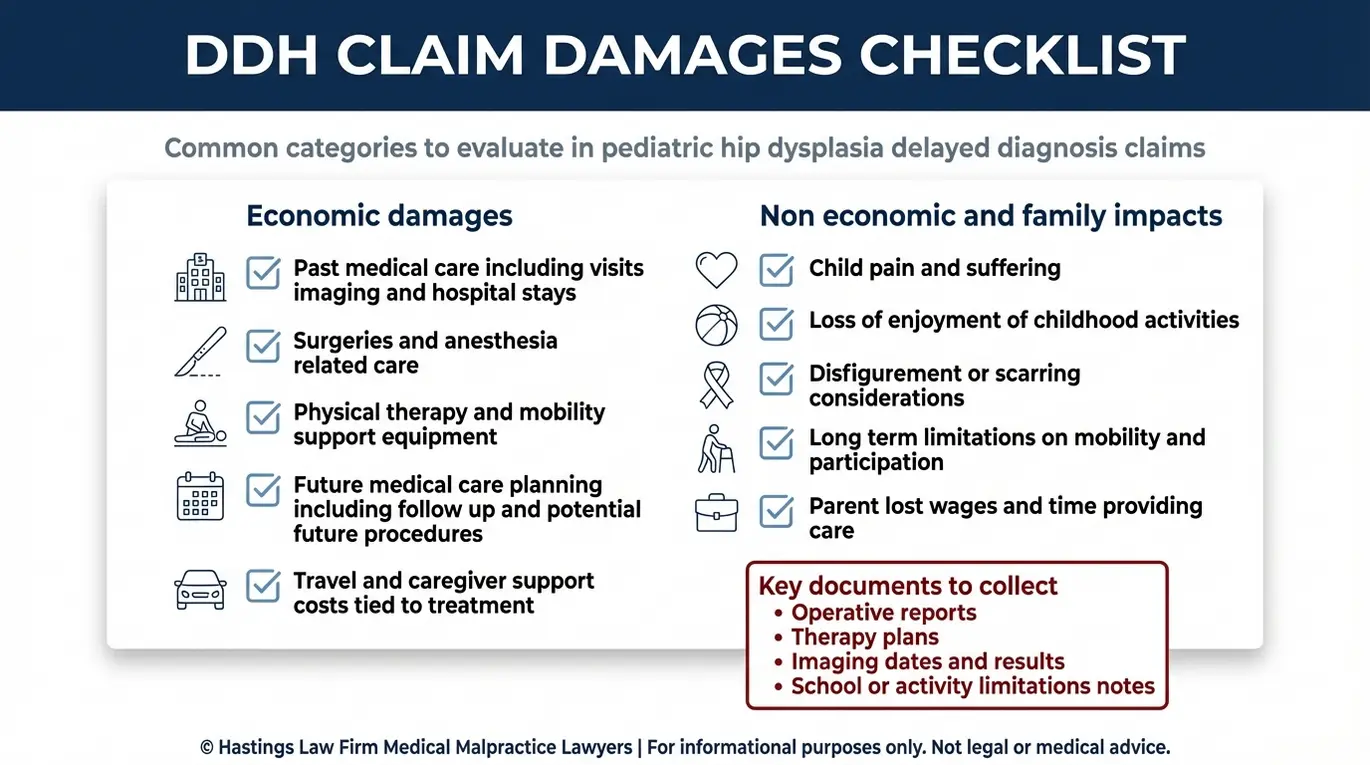
Here is what an Arizona missed hip dysplasia lawyer typically evaluates when seeking compensation for hip dysplasia:
Economic Damages:
- Past surgical costs, hospital stays, and physical therapy
- Future hip replacements, future medical care, and ongoing rehabilitation
- Adaptive equipment or mobility aids
- Lost wages for parents who took time off work to care for their child
Non-Economic Damages:
- Physical pain and suffering endured by the child
- Loss of enjoyment of childhood activities and sports
- Emotional distress and the psychological toll of repeated medical procedures
- Disfigurement or visible scarring from surgeries and casting
Parental Claims:
- Compensation for hip dysplasia-related caregiving responsibilities
- Loss of consortium or companionship claims in severe cases
Each category requires detailed documentation. We work with life care planners and medical economists to project costs across your child’s lifetime so that no future need is overlooked.
Contact the Arizona Birth Injury Attorneys at Hastings Law Firm Today for Help
If your child was diagnosed with hip dysplasia after months or years of missed warning signs, you are not alone, and you are not wrong for asking questions. Seeking a legal review helps families determine if their child’s injury was the result of preventable medical negligence.
Hastings Law Firm is not a general practice firm processing high volumes of unrelated claims. We are a dedicated medical malpractice team with in-house nurses, former defense attorneys, and a national network of medical experts. Every case we accept is prepared from day one as if it will go to trial because that level of preparation is what it takes to hold healthcare providers accountable.
Our legal team includes former defense attorneys and experienced hospital nurses who understand the internal protocols healthcare systems use. As an Arizona missed hip dysplasia lawyer, we can review your child’s medical records and consult with pediatric orthopedic specialists to give you honest answers. Time limits apply to these cases, so reaching out early helps preserve important evidence.
The consultation is free and confidential. You pay no attorney fees unless we win. Contact Hastings Law Firm today to take the first step toward protecting your child’s future.
Frequently Asked Questions About Infant Hip Dysplasia Diagnosis Failure in Arizona


This content was researched and written by the Hastings Law Firm editorial team, which includes attorneys, medical professionals, and experienced researchers. Our writing is informed by internal knowledge and practical experience, and we cross-check critical details against authoritative sources cited throughout. Every piece undergoes human-led fact-checking and legal review. Because legal and medical information can change, if you spot an error, please contact us. Learn more about our content standards and review process on our editorial policy page.

Tommy Hastings, founder of Hastings Law Firm, is a board-certified personal injury trial lawyer dedicated exclusively to healthcare injury cases. Since 2001, he has represented injured patients and families in litigation against major hospital systems, pharmaceutical companies, and negligent healthcare providers nationwide. He has handled numerous high-profile cases that have drawn national media attention and resulted in multi-million dollar recoveries. He draws on that experience in his writing, helping readers understand how these cases work and what options may be available to them.
