


Texas Misread Lab Results Lawyer
Written by: Hastings Law Firm | Reviewed by: Gabe Sassin | Updated: July 27, 2026
Misread lab results and other laboratory errors can derail care, delay a time sensitive diagnosis, or trigger unnecessary procedures with lasting physical and emotional harm. Problems can stem from mislabeled samples, contamination, interpretation mistakes, lost specimens, or failures to communicate critical values. Responsibility may rest with a hospital lab, an independent lab company, or a physician who did not act on abnormal findings. These situations often turn on what the records show and whether the error caused a worsened outcome. If you or a loved one were harmed or worse due to misread lab results in Texas, contact Hastings Law Firm for a free, confidential case review.
Trusted Texas Medical Attorneys for Laboratory Error Malpractice Claims
What You Should Know About Laboratory Error Malpractice Claims in Texas:
- Harm can escalate quickly when incorrect lab data drives the wrong treatment path or delays a time sensitive diagnosis.
- Unnecessary procedures and severe emotional distress can follow when a healthy patient receives a false serious diagnosis.
- A worsened outcome can occur even when the test result is correct if critical values are not communicated to the treating physician in time.
- Liability can shift depending on whether the error came from a technician processing failure or a pathologist interpretation judgment.
- Responsibility may rest with a hospital, an independent commercial lab, or an ordering physician who failed to act on abnormal results.
- Options can narrow if legal time limits are missed, since Texas medical malpractice claims are subject to a statute of limitations with limited exceptions.
- Recovery for pain and suffering can be limited in Texas medical malpractice cases due to non economic damage caps.
- Proof can depend on whether original specimens and slides are preserved, since re examination may be impossible after routine disposal.
- Key facts can be lost if electronic audit trails are not obtained, since standard record requests may not include metadata showing access and changes.

A Healthcare Focused Law Firm
When a lab report comes back wrong, the consequences reach far beyond a piece of paper. A misread result can send your treatment down the wrong path, delay a time-sensitive diagnosis, or put you through procedures you never needed. If you suspect a laboratory error caused you or a loved one harm, you are not imagining things, and you are not powerless.
At Hastings Law Firm, our medical-legal team includes in-house nurse consultants and board-certified patient advocates who know how to read clinical data, trace where a breakdown occurred, and determine whether negligence played a role. The firm is led by Tommy Hastings, who is board-certified in Personal Injury Trial Law by the Texas Board of Legal Specialization. As a Texas misread lab results lawyer, we focus exclusively on medical malpractice, and lab error cases are among the most technically demanding claims we handle.
If something about your diagnosis or treatment doesn’t add up, we can review what happened and explain your options at no cost and no obligation.
Common Types of Laboratory Negligence Cases We Handle
Laboratory negligence occurs when a deviation from the standard of care produces incorrect data, leading to misdiagnosis or delayed treatment. These errors take many forms, including mistakes in genetic testing, and each one carries distinct medical and legal consequences depending on where the breakdown happened.
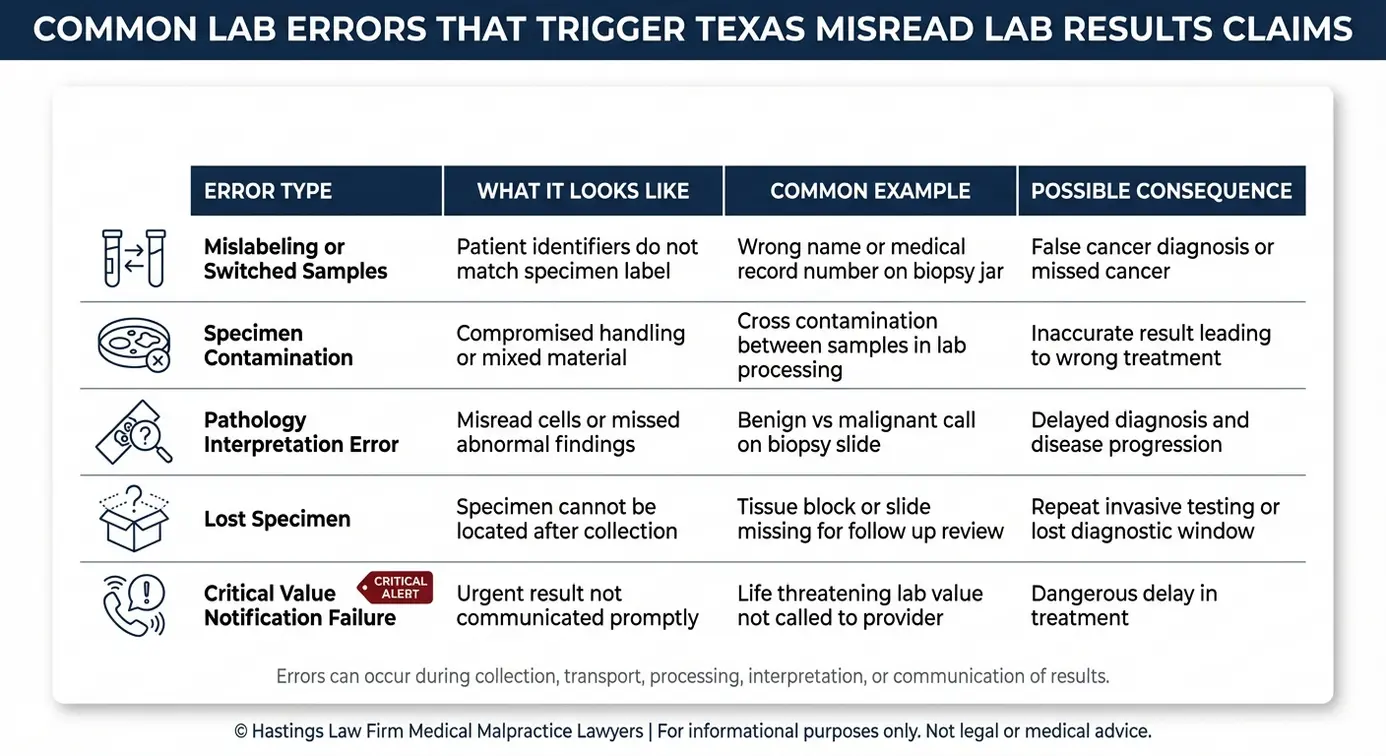
Mislabeling and Switched Samples
Mislabeled samples occur when a specimen is incorrectly identified or swapped with another patient’s data. Mislabeled samples, meaning specimens that are tagged with the wrong patient’s information or accidentally switched during processing, can lead to devastating outcomes. This error occurs when specimens are incorrectly identified at the point of collection or during intake. A healthy patient may be told they have cancer and undergo unnecessary surgery. Meanwhile, the patient who actually needed treatment receives a clean report and loses critical time.
Specimen Contamination
Contamination happens when outside substances mix with a sample, making the data inaccurate. When lab staff handle a sample improperly, contamination can render the results unreliable. This refers to samples compromised by environmental factors or poor handling during sterile protocols. Cross-contamination between specimens, exposure to incorrect temperatures, or failure to follow these protocols can produce data that looks legitimate but leads clinicians in the wrong direction.
Pathology Interpretation Errors
In oncology and biopsy cases, a pathologist examines tissue under a microscope and makes a medical judgment about what the cells show. Pathology is the medical specialty focused on the study of disease through laboratory analysis. A pathology interpretation error, defined as a failure to correctly identify disease markers that a competent specialist would have seen, involves a breach of medical judgment.
Proving that a pathologist was negligent requires showing they missed something a reasonably competent pathologist would have identified under the same circumstances. In biopsy and oncology cases, this often means a qualified expert must re-examine the original slides. Research published in a study on second-opinion surgical pathology review (PubMed) has shown that secondary reviews can reveal clinically significant discrepancies in initial pathology interpretations.
Lost Specimens
A diagnostic window refers to the time frame needed to make an accurate diagnosis. When a critical tissue sample or blood draw is lost before it can be analyzed, the patient may face painful re-testing or, worse, lose the only diagnostic window available. In time-sensitive conditions, a lost specimen can mean the difference between early intervention and advanced disease.
| Error Type | Example Scenario | Potential Consequence |
|---|---|---|
| Mislabeled / Switched Samples | Two patients’ blood draws are swapped during processing | Healthy patient undergoes unnecessary treatment; sick patient’s diagnosis is missed |
| Specimen Contamination | A biopsy sample is improperly stored or cross-contaminated | Inaccurate results lead to a wrong diagnosis or missed condition |
| Pathology Interpretation Error | A pathologist misreads cells on a biopsy slide | False negative delays cancer treatment; false positive triggers unneeded procedures |
| Lost Specimen | A tissue sample is discarded or misplaced before analysis | Patient loses the only opportunity for a timely diagnosis |
Critical Value Notification Failures
Sometimes the lab gets the result right, but the information never reaches the treating physician in time. A critical value, a lab finding that signals a life-threatening condition, requires immediate communication under established lab protocols. A critical value notification protocol ensures that life-threatening data is handled with appropriate urgency and is the standardized procedure a lab must follow to alert a physician of these urgent results.
When miscommunication causes that chain to break down, a correct diagnosis can sit in a system for hours or days while the patient’s condition worsens. A lawyer for misread pathology or lab communication failures can investigate whether established notification procedures were followed.
Understanding the Distinction Between Technician and Pathologist Errors
Liability often depends on who made the error. Technician errors typically involve processing mistakes, while pathologist errors involve medical judgment and interpretation. Understanding the difference matters because it changes how the case is built and how liability is assigned.
Technician errors tend to involve the mechanical and procedural side of lab work. These include machine calibration failures, data entry mistakes, mislabeling, and mishandling of specimens. Because labs are required to follow strict clinical guidelines and regulatory requirements, these breakdowns are often clear-cut examples of negligence. The standard of care for processing is well-documented, and deviations are usually traceable through lab records.
Pathologist errors are different. A pathologist is a physician who specializes in examining tissue, blood, and other biological samples to diagnose disease. A pathology interpretation error, defined as a failure to correctly identify disease markers that a competent specialist would have seen, involves a breach of medical judgment.
Proving that a pathologist was negligent requires showing they missed something a reasonably competent pathologist would have identified under the same circumstances. In biopsy and oncology cases, this often means a qualified expert must re-examine the original slides. Research published in a study on second-opinion surgical pathology review (PubMed) has shown that secondary reviews can reveal clinically significant discrepancies in initial pathology interpretations.
Who bears liability? The answer depends on the structure of the lab and its relationship to the treating facility:
- If the error occurred in a hospital’s internal lab, the hospital itself may be liable.
- If an independent commercial lab (such as Quest or LabCorp) processed the specimen, that company may bear direct responsibility.
- If a physician failed to act on abnormal results or ordered the wrong test, the ordering doctor may also be accountable.
A medical malpractice lawyer for lab mistakes will trace the error back through each step to determine where responsibility lies and which parties should be named in a claim.
The Hastings Law Firm Difference
Results matter, but what truly sets us apart is how we achieve them. Every verdict, every settlement, and every Texas courtroom victory comes from one guiding promise: To treat each client’s fight for justice as if it were our own.
This balance of skill, experience, and empathy reflects our core philosophy that justice should not only compensate the injured, but also make healthcare safer nationwide.

Proving Liability and the Standard of Care in Lab Malpractice
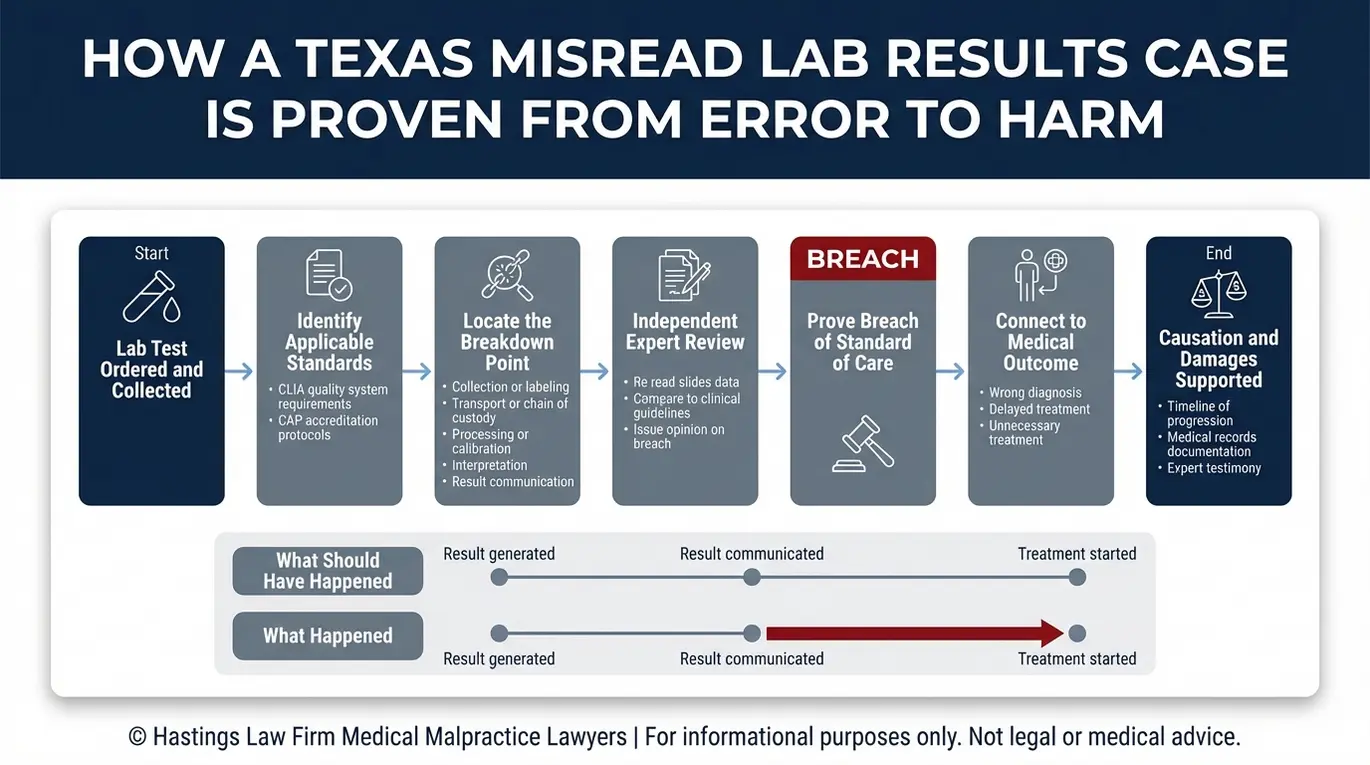
To prove liability, we must demonstrate that the lab violated established safety protocols or accreditation standards, and that the violation directly caused the patient’s injury. This is the foundation of every lab malpractice case, and it requires a structured, evidence-driven approach.
Establishing the Standard
The standard of care for clinical laboratories is defined largely by two sources. The standard of care represents the level of caution and quality a reasonable professional must provide to a patient. CLIA, the Clinical Laboratory Improvement Amendments, is a set of federal regulations under 42 CFR Part 493 Subpart K (eCFR) that governs quality systems for laboratory testing.
CAP, the College of American Pathologists, maintains voluntary accreditation standards that many labs adopt as their benchmark for quality. These regulations mandate rigorous proficiency testing and regular inspections to ensure laboratories maintain high accuracy levels. Together, these frameworks set the baseline expectations for specimen handling, testing accuracy, result reporting, and personnel qualifications. When a lab deviates from these requirements, that deviation can establish a breach of the standard.
The Role of Expert Testimony
Lab malpractice cases require qualified, independent experts. As a Texas misread lab results lawyer, we retain third-party pathologists and independent experts to re-examine original slides, raw data, and testing procedures. Their role is to offer an objective opinion about whether the lab’s work met the applicable standard.
In many cases, we use a “blinded” review process where the expert reviews the slide without knowing the initial diagnosis, ensuring their conclusion is unbiased. This rigorous methodology strengthens the validity of the testimony. According to the National Academies’ report on Improving Diagnosis in Health Care (NCBI Bookshelf), diagnostic errors remain one of the most under-recognized sources of patient harm, reinforcing why expert review is essential.
Proving Causation
Showing that a mistake happened is not enough. We must also prove causation, meaning the error directly led to a worsened outcome. For example, if a lab misread a biopsy and the patient’s cancer advanced from Stage I to Stage IV during the delay, we need expert testimony connecting that progression to the missed diagnosis.
Proving causation in lab error cases is often difficult and requires distinguishing between the underlying condition and the harm caused specifically by the delay. A lab malpractice attorney builds this link through medical records, treatment timelines, and clinical analysis so that the full scope of harm is clearly established.
Preserving Evidence and The Importance of Audit Trails
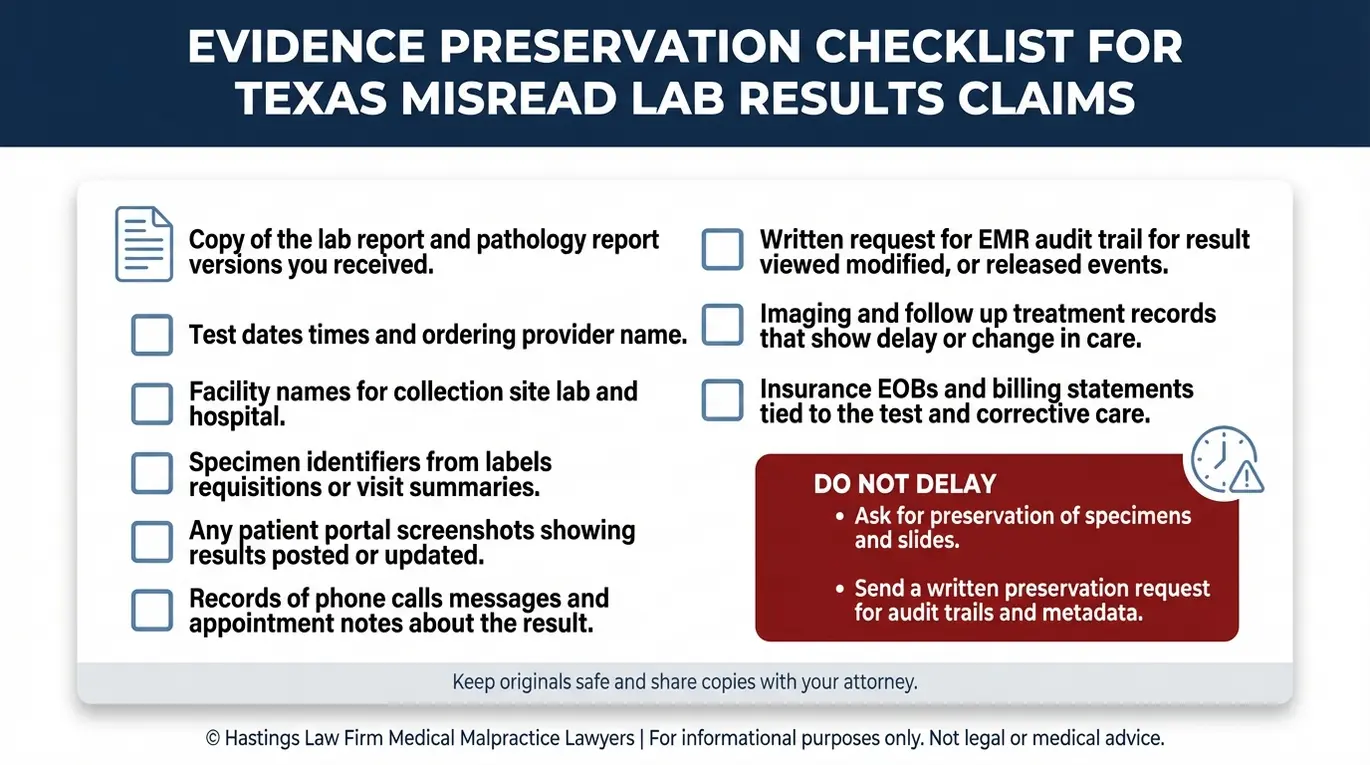
Securing the physical evidence and digital footprint as early as possible is critical to preventing spoliation of evidence, which is the legal term for the destruction or alteration of proof. Lab evidence is uniquely fragile. Tissue samples degrade, digital records can be overwritten, and retention policies may allow disposal of key materials if no one intervenes.
Physical Evidence
The original tissue blocks, glass slides, and stored specimens are often the most important pieces of evidence in a lab negligence case. These materials allow an independent expert to re-examine the same sample and determine whether the original interpretation was accurate. Without them, re-analysis may be impossible. An attorney for laboratory negligence can take immediate legal steps to ensure that labs and hospitals preserve these materials before routine disposal occurs.
Digital Evidence
Modern laboratories operate through electronic systems that track every interaction with a result. These systems maintain a history of who created, viewed, or changed a report. An EMR audit trail, the electronic medical record’s log of who accessed, viewed, modified, or transmitted a result and exactly when, can reveal critical gaps in communication.
Standard medical record requests often fail to yield these specific metadata logs, which is why legal intervention is frequently necessary to uncover the complete history of a result. We request these audit trails to reconstruct the chain of custody, the documented tracking of a specimen from the moment it is collected through processing, analysis, and reporting. Under the Individuals’ Right under HIPAA to Access their Health Information, 45 CFR § 164.524 (HHS.gov), patients have the legal right to obtain copies of their health records.
What You Can Do Now
If you suspect a lab error affected your care, gathering your medical records and other information can help your legal team move quickly. We recommend patients take the following steps to build a preliminary file:
- Dates of the lab tests in question
- Names of the facilities where samples were collected and processed
- Copies of any lab reports or result notifications you have received
- Names of the physicians who ordered the tests or communicated the results
- Any written communications (portal messages, letters) referencing your results
Compensation for Victims of Misread Lab Results
Patients harmed by laboratory errors may be entitled to economic damages for medical costs and lost income, as well as non-economic damages for pain, suffering, and physical impairment. The specific value of a claim depends on the severity of the harm and how significantly the error altered the course of treatment.
Economic Damages
These cover the measurable financial losses caused by the lab’s mistake. They can include the cost of corrective treatment that became necessary because of the error, the expense of the original failed procedure or test, and future medical expenses for ongoing care.
In cases where a delayed diagnosis led to more aggressive treatment, such as extensive chemotherapy that could have been avoided, the economic impact is substantial. Patients may also recover lost wages and lost earning capacity if the injury prevents them from returning to work.
Non-Economic Damages
A misread lab result doesn’t just affect your body. A false cancer diagnosis can cause months of severe anxiety before the truth is uncovered. A missed diagnosis can mean living with a worsening condition that could have been treated sooner. Compensation for pain and suffering accounts for the emotional distress, physical pain, and diminished quality of life that follow these errors.
Punitive Damages
In rare instances where the laboratory’s conduct involved gross negligence or malice, such as intentionally falsifying results to cut costs or cover up mistakes, punitive damages may be available. These are designed not to compensate the patient, but to punish the wrongdoer and deter similar conduct in the future.
Wrongful Death
When a laboratory error leads to a missed or delayed diagnosis and the patient does not survive, families may pursue a wrongful death claim. As a Texas misread lab results lawyer, we help surviving family members seek accountability and the financial security they need to move forward. These cases require careful documentation connecting the lab failure to the outcome, and our medical-legal team works with qualified experts to build that connection.
Contact the Texas Healthcare Malpractice Attorneys at Hastings Law Firm Today for Help
We cannot undo a laboratory error, but we can work to hold the responsible parties accountable and pursue the financial security you and your family need going forward. At Hastings Law Firm, our team of attorneys, nurse consultants, and patient advocates is built for exactly this type of case. Our legal team includes former hospital nurses and defense counsel who provide insider insight into the systems we challenge.
There are no fees unless we recover compensation for you. Every consultation is free, confidential, and led by professionals who understand both the medicine and the law.
If you believe a lab mistake affected your diagnosis or treatment, reach out to speak with a Texas misread lab results lawyer today. Contact Hastings Law Firm for a risk-free case evaluation, and let us help you find the answers you deserve.
Frequently Asked Questions About Misread Lab Results in Texas


This content was researched and written by the Hastings Law Firm editorial team, which includes attorneys, medical professionals, and experienced researchers. Our writing is informed by internal knowledge and practical experience, and we cross-check critical details against authoritative sources cited throughout. Every piece undergoes human-led fact-checking and legal review. Because legal and medical information can change, if you spot an error, please contact us. Learn more about our content standards and review process on our editorial policy page.

Gabe Sassin has focused exclusively on medical malpractice law since 2007. After spending more than a decade as a malpractice defense attorney, he knows exactly how the other side works. He has seen firsthand how healthcare providers, insurers, corporate defendants, and their legal teams think, prepare, and build their defense against claims. That knowledge works for the people who need it most today, injured patients and their families. His unique experience shapes everything he writes, giving readers a look at how these cases actually work from someone who has handled them from both sides.
