


Texas Medical Spa Malpractice Lawyer
Written by: Hastings Law Firm | Reviewed by: Gabe Sassin | Updated: July 27, 2026
Medical spa treatments can look routine, but mistakes during laser procedures, injections, or other skin penetrating services can cause serious harm such as burns, scarring, infection, nerve injury, and disfigurement. In Texas, the line between a day spa service and the practice of medicine affects who can perform procedures, what supervision is required, and how an injury claim is classified. Problems often arise when a medical director provides inadequate oversight or when staff operate outside their training. If you or a loved one were harmed or worse due to medical spa malpractice in Texas, contact Hastings Law Firm for a free, confidential case review.
Trusted Legal Representation for MedSpa Negligence in Texas
What You Should Know About MedSpa Negligence Claims in Texas:
- Lasting injuries can follow medical spa procedures when devices are miscalibrated or injections are performed incorrectly.
- Options can change based on whether the harm is classified as medical negligence rather than ordinary negligence.
- Accountability can extend to a medical director even when the physician was not physically present during the procedure.
- Patient safety can be undermined when a facility uses sham supervision with little training, oversight, or written protocols.
- Recovery can be limited by damage caps when a claim falls under the Texas Medical Liability Act.
- A claim can be lost entirely when an expert report requirement is missed or an expert report is found insufficient.
- Liability can shift toward a manufacturer when harm is tied to a defective device or contaminated drug rather than provider error.
- Clarity about what was done and by whom can be central, since invasive treatments are treated as the practice of medicine in Texas.
- Product sourcing and supply chain records can be central when counterfeit or diluted injectables are suspected.
- Medical records and supervision documentation can be central when delegation and oversight are disputed.

A Healthcare Focused Law Firm
Medical spas offer treatments that sound routine, like laser hair removal or injectable cosmetic treatments. But when something goes wrong, the injuries can be severe. Laser burns, which are thermal injuries caused by improperly calibrated devices, can leave lasting scars. Infections from unsterile needles, nerve damage from misplaced injections, and disfigurement from undertrained staff are all outcomes we have seen in cases across the state.
If you or a loved one was harmed during a procedure at a medical spa, you may have a medical malpractice claim. These cases involve specific legal requirements that many attorneys are not equipped to handle. Founded by board-certified trial lawyer Tommy Hastings, Hastings Law Firm focuses exclusively on medical negligence and has the medical and legal resources to evaluate what happened, identify who is responsible, and hold them accountable. Contact us for a free, confidential case evaluation to learn more about your options.
Legal Distinctions Between Day Spas and Medical Spas in Texas
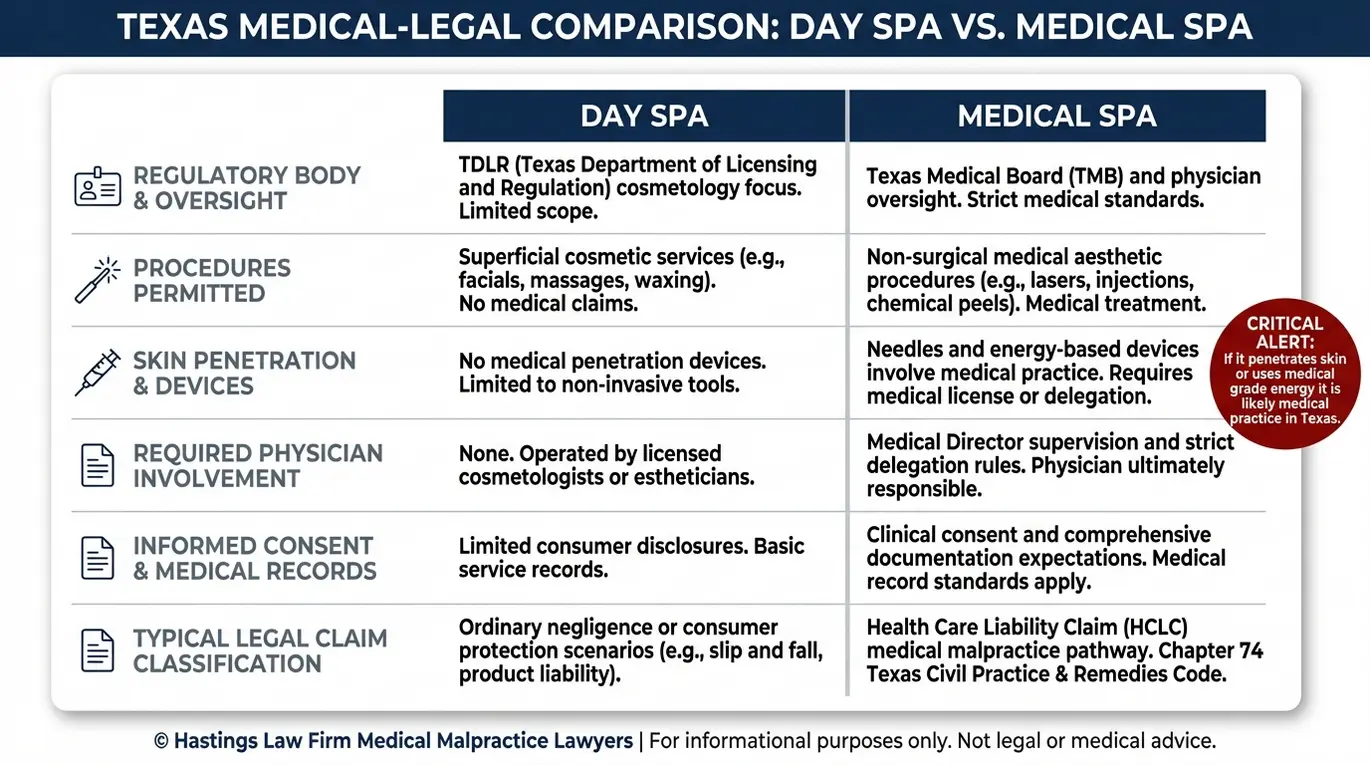
A medical spa, often called a MedSpa, is a facility that performs non-surgical medical procedures under the supervision of a licensed physician. A day spa, by contrast, is limited to superficial cosmetic services and is regulated by the Texas Department of Licensing and Regulation (TDLR) under cosmetology rules, without any requirement for medical oversight. While day spas focus on relaxation and non-invasive aesthetics, medical spas bridge the gap between a beauty salon and a doctor’s office, offering treatments that carry significantly higher risks and require strict adherence to medical standards.
This distinction matters because many patients do not realize they are undergoing a medical procedure until something goes wrong. The environment looks like a spa. The staff may not wear scrubs. The marketing emphasizes relaxation and beauty.
But if the treatment involves a device or technique that penetrates the skin, such as lasers, needles, or chemical agents that reach deeper tissue layers, it is considered the practice of medicine under the Texas Medical Practice Act. That means it falls under the authority of the Texas Medical Board, not TDLR. The Texas Medical Board sets strict standards for who can perform these invasive acts, unlike the more relaxed oversight found in cosmetology settings. When a facility crosses the line from surface-level beauty treatments to medical intervention, the legal landscape shifts entirely, exposing the facility to medical malpractice liability rather than simple business negligence.
An aesthetician, a professional licensed to perform surface-level skin treatments like facials and basic peels, can legally provide those services under TDLR rules. However, they cannot step outside this scope without risk. Performing laser treatments or administering injectables requires medical training, medical supervision, and proper delegation from a licensed physician who is the facility’s medical director. The medical director is the physician legally responsible for overseeing all medical procedures at the MedSpa. Without this oversight, an aesthetician practicing medicine is committing a crime, and the facility is operating illegally.
This is the line that separates a beauty service from a medical act, and it determines how an injury claim is classified. Med Spa malpractice attorneys must understand this regulatory framework to build a viable case and ensure the right parties are held accountable.
| Facility Type | Regulatory Body | Permitted Procedures |
|---|---|---|
| Day Spa | Texas Department of Licensing & Regulation (TDLR) | Facials, basic skin care, superficial peels, cosmetic application |
| Medical Spa (MedSpa) | Texas Medical Board (TMB) | Laser treatments, Botox, dermal fillers, chemical peels, micro-needling, CoolSculpting |
Liability for Inadequate Medical Director Supervision
Under Texas law, a medical director can be held liable for injuries caused by the people they delegate medical tasks to, especially if they failed to provide adequate supervision, training, or written protocols. This legal responsibility does not disappear simply because the physician was not physically present at the time of the injury. Proper physician supervision is a strict requirement, not a suggestion.
Texas allows physicians to delegate certain medical procedures to midlevel practitioners like nurse practitioners and physician assistants, as well as to aestheticians in limited circumstances. Texas law, including the Texas Occupations Code Chapter 157 and Texas Medical Board rules, outlines how delegation is supposed to work: the physician must establish clear standing orders and must maintain ongoing oversight of the people carrying out those orders. Standing orders are written protocols that specify how a procedure should be performed, including dosages, device settings, and emergency response steps.
The problem is that some MedSpas operate with what the industry calls a “rent-a-license” arrangement. A physician lends their medical license and name to a spa but rarely, if ever, sets foot in the facility. They may not review patient records, train staff, or update protocols. In these situations, the concept of physician delegation, which is the legal transfer of authority from a physician to a qualified subordinate, exists only on paper.
Texas also enforces rules around the corporate practice of medicine. A non-physician business owner cannot direct medical decisions. The medical component of a MedSpa must be owned and controlled by a licensed physician. When a corporate entity is effectively making medical decisions while a medical director is a figurehead, both the physician and the business may share liability.
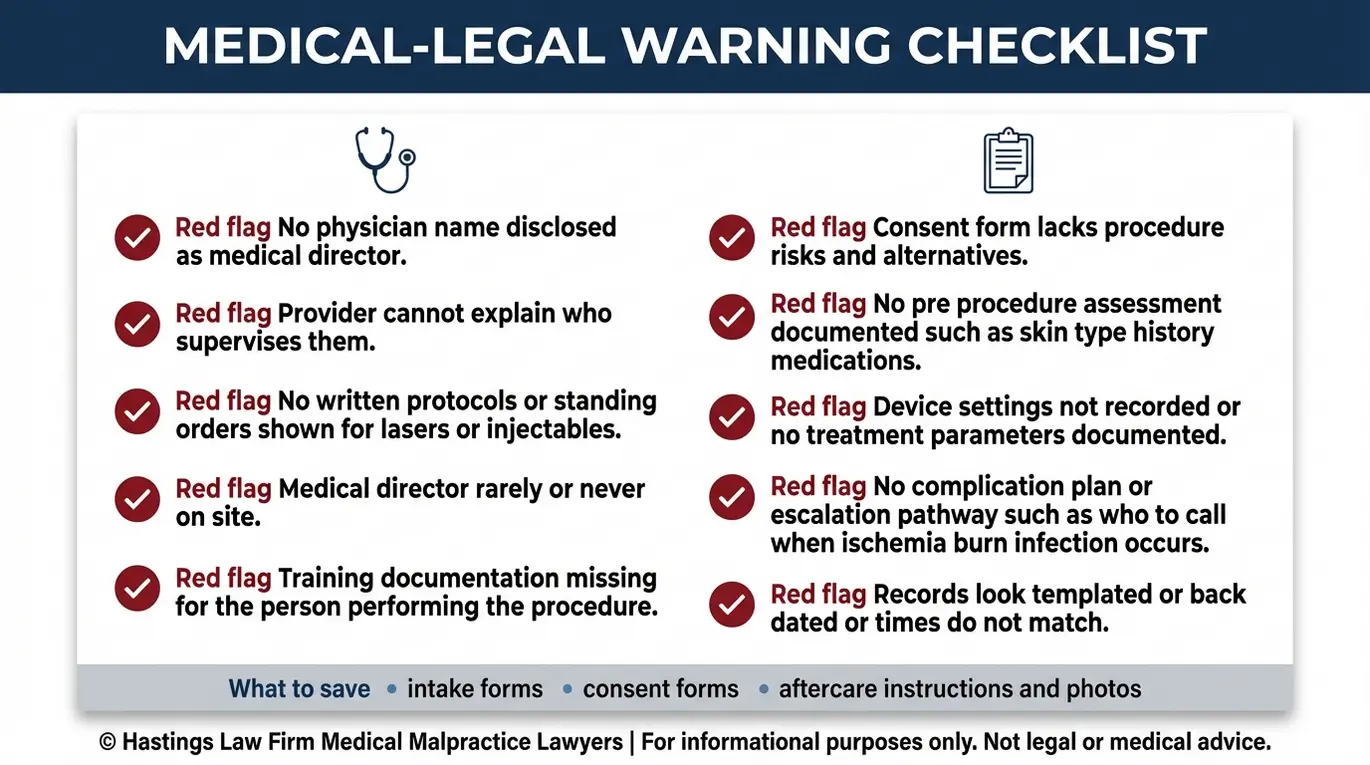
This doctrine ensures that profit motives do not override patient safety, yet many spas violate this by allowing business owners to dictate treatment parameters. A medical spa injury lawyer in Texas will look for specific red flags that suggest supervision was inadequate:
Signs of ‘Sham’ Supervision
- The medical director has never physically visited the facility
- No written standing orders or treatment protocols exist for the procedures performed
- Staff members were not trained or credentialed for the specific treatments they administered
- Patient records were not reviewed or co-signed by the supervising physician
- The medical director oversees multiple locations simultaneously without a realistic plan for oversight
- Emergency response procedures were never established or practiced
The Hastings Law Firm Difference
Results matter, but what truly sets us apart is how we achieve them. Every verdict, every settlement, and every Texas courtroom victory comes from one guiding promise: To treat each client’s fight for justice as if it were our own.
This balance of skill, experience, and empathy reflects our core philosophy that justice should not only compensate the injured, but also make healthcare safer nationwide.

Common Aesthetic Errors That Constitute Medical Negligence
Medical negligence in a MedSpa setting occurs when a provider deviates from the accepted standard of care, the level of treatment a reasonably competent professional would provide under similar circumstances, during procedures like laser treatments or cosmetic injections, resulting in preventable harm such as burns, scarring, tissue death, or infection.
These injuries are not simply “bad results.” They often stem from identifiable errors that a qualified provider should have avoided. A Texas MedSpa negligence attorney will examine exactly what went wrong, who performed the procedure, and what protocols were or were not in place.
Laser injuries are among the most common claims. Devices used for hair removal, skin resurfacing, or pigment correction must be carefully calibrated to the patient’s skin type. Using incorrect settings, particularly on darker skin tones where the Fitzpatrick scale rating requires specific adjustments, can cause deep thermal burns and permanent scarring. The University of Utah Health Burn Center documents how CO2 laser treatments are sometimes used to treat the very burn scars that negligent laser procedures create.
Injectable errors carry their own serious risks. Injectables, a category that includes Botox (a neurotoxin that temporarily paralyzes muscles) and dermal fillers (gel-like substances injected to restore volume or smooth wrinkles), require precise anatomical knowledge. Vascular occlusion, a condition where filler material is accidentally injected into or compresses a blood vessel, can cut off blood supply to tissue, potentially causing skin necrosis or even blindness. Misplaced Botox can lead to facial drooping, asymmetry, or difficulty swallowing.
CoolSculpting complications include paradoxical adipose hyperplasia (PAH), a rare condition where the treated fat cells grow larger instead of shrinking, as well as burns or nerve damage from improper applicator placement.
Chemical peels and micro-needling can cause severe chemical burns or infection when performed at incorrect concentrations or depths, or without proper sterile technique.
A lack of informed consent is also an important failure. Informed consent means your provider explained the risks and you agreed to the treatment.
There is also the issue of counterfeit or cut-rate products. Some facilities reduce costs by purchasing unapproved, diluted, or counterfeit versions of products like Botox or dermal fillers from unauthorized distributors. Patients may never know what was actually injected. Medical malpractice lawyers for spa injuries investigate supply chain records and product sourcing as part of building the case.
Navigating the Texas Medical Liability Act in MedSpa Cases
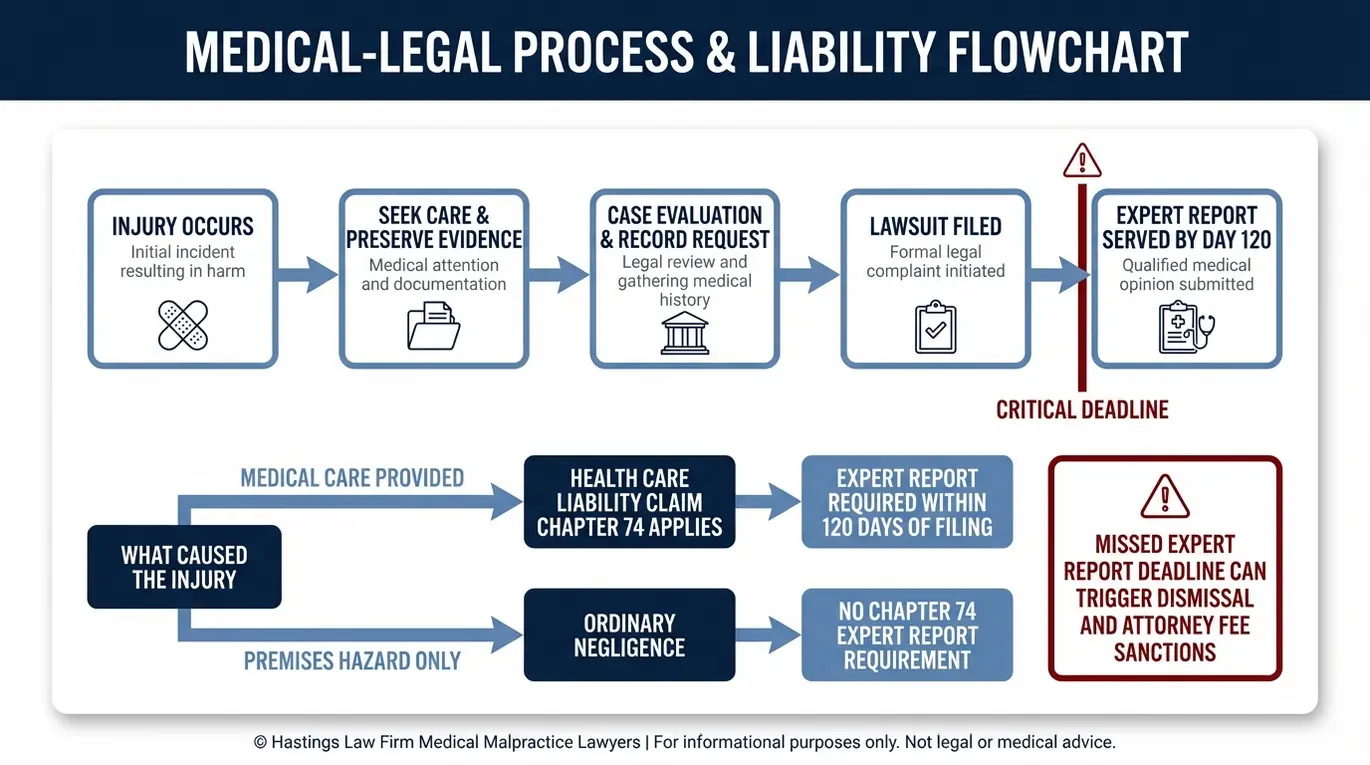
Most MedSpa injury cases are classified as “health care liability claims” under Chapter 74 of the Texas Civil Practice & Remedies Code. This classification triggers an important procedural requirement: the plaintiff must serve a qualified expert report on each defendant within 120 days after the defendant files an original answer, or the case faces dismissal.
Many claims fall apart before they ever reach a courtroom because of these requirements. A general personal injury attorney who treats a laser burn case like a premises liability or product defect claim may not recognize that Chapter 74 applies. If they miss the expert report deadline, the court is required to dismiss the case. The consequences go beyond losing the claim. Under the statute, the court must also award the defendant reasonable attorney’s fees and costs of court.
The classification of MedSpa injuries depends on the nature of the act that caused the harm. A laser burn during a hair removal session is a health care liability claim because it arose from the provision of medical treatment. But if you slipped on a wet floor in the MedSpa lobby, that would likely be ordinary negligence, which does not require a Chapter 74 expert report. The distinction is not always obvious, and getting it wrong in either direction can be devastating to the case.
The expert report itself must be authored by a qualified physician and must identify the applicable standard of care, explain how the defendant deviated from it, and establish how that deviation caused the injury. For example, a claim involving cryolipolysis, the freezing technology used in CoolSculpting, requires a report detailing how the provider failed to prevent paradoxical adipose hyperplasia (PAH), a condition where treated fat tissue expands rather than breaks down. This is not a formality.
Texas courts have dismissed cases where expert reports were deemed insufficient in their analysis, even when filed on time. You can review the full statutory requirements under Texas Civil Practice & Remedies Code Section 74.351.
This is one of the reasons hiring a lawyer with specific experience in health care liability claims matters. At Hastings Law Firm, our in-house medical staff, including nurse practitioners and Board Certified Patient Advocates, begins reviewing records and identifying potential experts from the day a case is accepted. We prepare every case as if it will go to trial, which means the expert report is built on a thorough medical reconstruction, not a rushed, last-minute filing to meet a deadline.
Filing a lawsuit for med spa negligence under Chapter 74 requires precision, medical knowledge, and strict attention to procedural deadlines. A missed step does not just slow the case down. It ends it.
Contact the Texas Healthcare Malpractice Attorneys at Hastings Law Firm Today for Help
A disfiguring injury from what was supposed to be a routine beauty treatment is not something you should have to accept. When a MedSpa provider fails to meet the standard of care, whether through inadequate training, absent supervision, or improper technique, that is medical negligence, and you have the right to pursue accountability.
Hastings Law Firm represents clients across Texas on a contingency fee basis, meaning you pay no attorney fees or costs unless we secure a recovery for you. Our team of attorneys, nurse consultants, and former defense lawyers has the medical insight and trial preparation to handle these cases from evaluation through verdict.
If you or a loved one has been injured at a medical spa, schedule a free, confidential evaluation with one of our Board Certified Patient Advocates. As an experienced Texas Medical Spa Malpractice Lawyer, we can review your records, explain your legal options, and help you understand what happened and what comes next.
Frequently Asked Questions About Medical Spa Malpractice in Texas


This content was researched and written by the Hastings Law Firm editorial team, which includes attorneys, medical professionals, and experienced researchers. Our writing is informed by internal knowledge and practical experience, and we cross-check critical details against authoritative sources cited throughout. Every piece undergoes human-led fact-checking and legal review. Because legal and medical information can change, if you spot an error, please contact us. Learn more about our content standards and review process on our editorial policy page.

Gabe Sassin has focused exclusively on medical malpractice law since 2007. After spending more than a decade as a malpractice defense attorney, he knows exactly how the other side works. He has seen firsthand how healthcare providers, insurers, corporate defendants, and their legal teams think, prepare, and build their defense against claims. That knowledge works for the people who need it most today, injured patients and their families. His unique experience shapes everything he writes, giving readers a look at how these cases actually work from someone who has handled them from both sides.
