


Texas Medication Overdose in Hospital Lawyer
Written by: Hastings Law Firm | Reviewed by: Brady D. Williams | Updated: July 27, 2026
Hospital medication overdoses can leave patients and families facing sudden medical crises, lasting harm, and deep uncertainty about how a preventable error happened. These events often stem from breakdowns in prescribing, dispensing, or administration, including communication failures, staffing strain, and missed safety checks. The consequences can be severe, ranging from organ damage to life threatening outcomes, and responsibility may involve clinicians, pharmacy systems, or the hospital itself. If you or a loved one were harmed or worse due to a medication overdose in a Texas hospital in Texas, contact Hastings Law Firm for a free, confidential case review.
Trusted Texas Medical Attorneys for Hospital Medication Error Claims
What You Should Know About Hospital Medication Error Claims in Texas:
- Life threatening harm can result from hospital medication overdoses, including organ failure, cardiac arrest, and fatal outcomes.
- Responsibility can extend beyond one clinician because prescribing, dispensing, and administration failures can occur across the chain of care.
- Recovery options can be limited if Texas medical malpractice time limits are missed.
- Compensation can include economic damages such as medical bills and lost wages and non economic damages such as pain, suffering, and physical impairment.
- Non economic recovery can be capped in Texas for medication error cases, while economic damages are not capped.
- Compensation can be reduced when a patient is found partially responsible under Texas proportionate responsibility rules.
- Proving what happened can depend on whether hospital records show discrepancies between physician orders, MAR entries, and pharmacy logs.
- Key evidence can be lost or become less reliable over time because records can be altered, witnesses can move on, and electronic data can be overwritten.
- Digital logs can be central when barcode scanning or infusion pump data conflicts with manual nursing notes.
- Liability disputes can arise when a hospital claims a physician was an independent contractor rather than an employee.

A Healthcare Focused Law Firm
When someone you love is harmed by a medication overdose in a hospital, the shock can be overwhelming. You trusted the medical team to provide safe care, and that trust was broken. It is natural to feel confused, angry, and unsure of what to do next.
At Hastings Law Firm, we focus exclusively on medical malpractice. Our team of attorneys, nurse consultants, and Board Certified Patient Advocates understands both the medicine and the law behind hospital medication errors. We know what to look for in the records, and we know how to hold the responsible parties accountable.
If you believe a hospital overdose caused serious harm to you or a family member, a Texas medication overdose in hospital lawyer at our firm can review what happened and explain your options. Consultations are free, and you pay no fees unless we recover compensation on your behalf.
Legal Representation for Hospital Overdose Victims
A Texas hospital overdose attorney represents patients harmed by incorrect dosages in clinical settings, investigating the breach of the standard of care to pursue compensation for medical expenses, suffering, and long-term harm. This is not general personal injury work. Hospital medication error cases require a legal team that understands clinical protocols, pharmacy systems, and the medical science behind how drugs interact with the human body. Without this specialized knowledge, critical evidence regarding the standard of care can be easily overlooked.
At Hastings Law Firm, medical malpractice is all we do. Unlike firms that spread their resources across car accidents, slip-and-fall cases, and other unrelated claims, every member of our team is dedicated to medical negligence litigation. That singular focus means we understand the duty of care hospitals owe their patients and how to identify where that duty was violated.
We prepare every case from day one as though it will go before a jury. This trial-ready approach is not about posturing; it is about building the strongest possible evidence early so that defense attorneys and insurance carriers understand we will not accept less than fair value. That level of preparation gives us a firm negotiation posture and consistently produces better outcomes for our clients.
Our team includes former defense attorneys who once represented hospitals, along with experienced nurses who previously worked inside the systems we now challenge. This insider perspective allows us to anticipate defense strategies, identify charting inconsistencies, and understand how hospital protocols are supposed to function. When we review your case, we already know where to look because we have seen these failures from the other side.
Defining Clinical Medication Overdoses and Negligence
A clinical medication overdose occurs when a patient receives a volume of medication exceeding the therapeutic range due to prescribing, dispensing, or administration errors, resulting in toxicity or physiological harm. These cases involve proving that a medical professional’s actions fell below the accepted standard of care. This is different from an adverse drug reaction, which is an unexpected side effect that can happen even when the correct medication and dose are given. A negligent overdose means someone in the chain of care made a preventable mistake.
These mistakes take many forms. According to the Medication Dispensing Errors and Prevention resource on the NCBI Bookshelf, dispensing and administration errors are among the most common types of preventable harm in hospitals. A hospital medication error lawyer investigates exactly where the breakdown occurred.
Common overdose scenarios include:
- Double dosing: A nurse administers a dose without realizing another provider already gave the same medication during a shift change.
- Unit confusion: A dosage error where milligrams (mg) are confused with micrograms (mcg), resulting in a dose that is 1,000 times too high.
- Failure to adjust for the patient: The prescribing physician does not account for the patient’s weight, age, kidney function, or liver function when calculating the prescription dosage, leading to an incorrect dose that the body cannot safely process.
- Omission error: A necessary adjustment or hold order is missed, and the patient continues receiving a medication that should have been stopped or reduced.
The physical consequences of an overdose can be severe and immediate. Depending on the drug involved, a patient may experience respiratory depression, dangerously low blood pressure, seizures, organ failure, or cardiac arrest. In the worst cases, these errors are fatal.
The Hastings Law Firm Difference
Results matter, but what truly sets us apart is how we achieve them. Every verdict, every settlement, and every Texas courtroom victory comes from one guiding promise: To treat each client’s fight for justice as if it were our own.
This balance of skill, experience, and empathy reflects our core philosophy that justice should not only compensate the injured, but also make healthcare safer nationwide.

Common Causes of Hospital Medication Overdoses
Hospital overdoses are frequently caused by communication failures, fatigue, system glitches in electronic health records, or bypassing safety protocols like barcode scanning. Research from the Agency for Healthcare Research and Quality (AHRQ) on Medication Safety Event Reporting confirms that organizational stress, including understaffing and high patient volumes, directly contributes to the conditions where these errors occur.
Communication breakdowns are a leading cause. Verbal orders in chaotic clinical environments are easily misheard, leading to recording errors by nurses or pharmacists. Yet even with electronic ordering systems, critical allergy information or drug interaction warnings can be missed during handoffs between shifts.
Nurse distraction and overload is another common factor. High patient loads increase dispensing error risks, such as pulling medications from the wrong bin or skipping safety checks. A lawyer for medication errors will investigate these staffing failures.
Pharmacy-level failures also occur. If an automated dispensing cabinet (the computerized medication storage unit on a hospital floor) is stocked with the wrong concentration, every patient accessing that drawer is at risk.
| Cause | Where It Occurs | Typical Failure |
|---|---|---|
| Verbal order miscommunication | Bedside / phone orders | Wrong dose or wrong drug recorded |
| Nurse overload and distraction | Patient floor | Safety checks skipped or double dosing |
| Pharmacy stocking error | Automated dispensing cabinet | Wrong vial concentration loaded |
| Drug interaction oversight | Prescribing stage | Failure to review current medication list |
| Drug allergy ignored | Prescribing or administration | Known allergy not flagged or overridden |
EHR and CPOE System Liability
Electronic Health Records (EHR) and Computerized Physician Order Entry (CPOE) systems are used to track patient data and prescriptions but can sometimes contribute to errors. Drop-down menus in CPOE systems can place different medications adjacent to one another, leading to selection mistakes. Frequent warnings also cause alert fatigue, the tendency to reflexively override safety alerts. A lawyer for medication errors investigates whether electronic systems contributed to the overdose.

High-Risk Medications and Administration Errors
Certain “high-risk medications,” such as opioids, insulin, and anticoagulants, carry a higher risk of fatal overdose if mismanaged because even small dosing errors can cause life-threatening harm. A Texas medical malpractice attorney handling overdose cases checks compliance for these drugs:
| Drug Category | Examples | Primary Risk |
|---|---|---|
| Opioids / Sedatives | Fentanyl, Morphine, Midazolam | Respiratory arrest and death |
| Insulin | Regular insulin, Insulin glargine | Severe hypoglycemia, coma, or death |
| Anticoagulants | Heparin, Warfarin, Enoxaparin | Uncontrolled hemorrhage |
Opioids and sedatives are dangerous. A systematic review from PSNet (AHRQ) on opioid-related medication errors identifies opioid administration errors as a leading source of preventable harm. Even small fentanyl dosage errors can suppress breathing within minutes.
Insulin errors often involve unit calculation mistakes or selecting the wrong type, potentially causing severe hypoglycemia or brain damage.
Anticoagulants like heparin require precise dosing; excessive amounts cause uncontrolled bleeding.
Look-Alike/Sound-Alike Drugs
Look-alike/sound-alike drugs (LASA) pose significant risks when names or packaging appear similar, leading to a packaging error or administration mistake. These errors occur when two drugs have similar names or packaging, making them easy to confuse in a busy clinical environment. For example, confusing hydroxyzine with hydralazine can be fatal. These are preventable instances of pharmacy negligence requiring safeguards like tall-man lettering.
Identifying Liable Parties in Hospital Overdose Cases
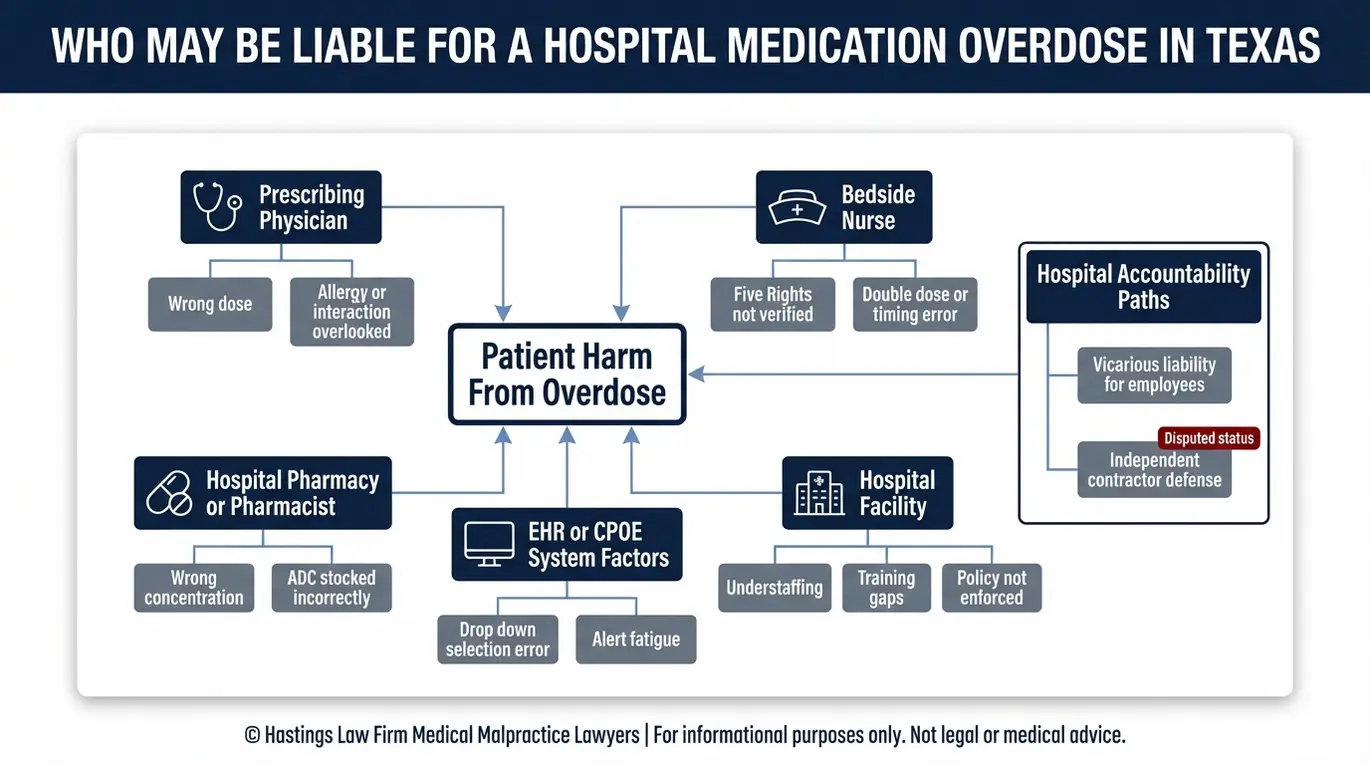
Liability in a hospital overdose case may extend to multiple parties: the prescribing physician, the nurse who administered the drug, the hospital pharmacy that dispensed it, or the hospital itself for inadequate staffing and training. In clinical settings, liability often follows the chain of command from the doctor’s order to the pharmacy’s preparation and the nurse’s administration.
The physician may be liable if they prescribed the wrong dose, ignored documented drug allergies, or failed to account for drug interactions with the patient’s current medications.
The nurse may be responsible if they failed to follow the Five Rights of medication administration, the bedside safety protocol requiring verification of the right patient, right drug, right dose, right route, and right time. Skipping these steps is a clear instance of nurse malpractice.
The hospital can be held liable for institutional failures. If understaffing forced nurses to skip safety checks, or if the facility failed to maintain its automated dispensing systems, the institution itself may bear responsibility. Under Texas law, hospitals may also be liable for the negligence of their employees through vicarious liability. As outlined in the Texas Pattern Jury Charges on General Negligence, the legal framework for establishing institutional responsibility is well defined in jury instructions.
When suing a hospital for overdose, a Texas medication overdose in hospital lawyer will investigate every link in the chain to determine which parties bear responsibility.
Proving Medical Malpractice Through Hospital Records
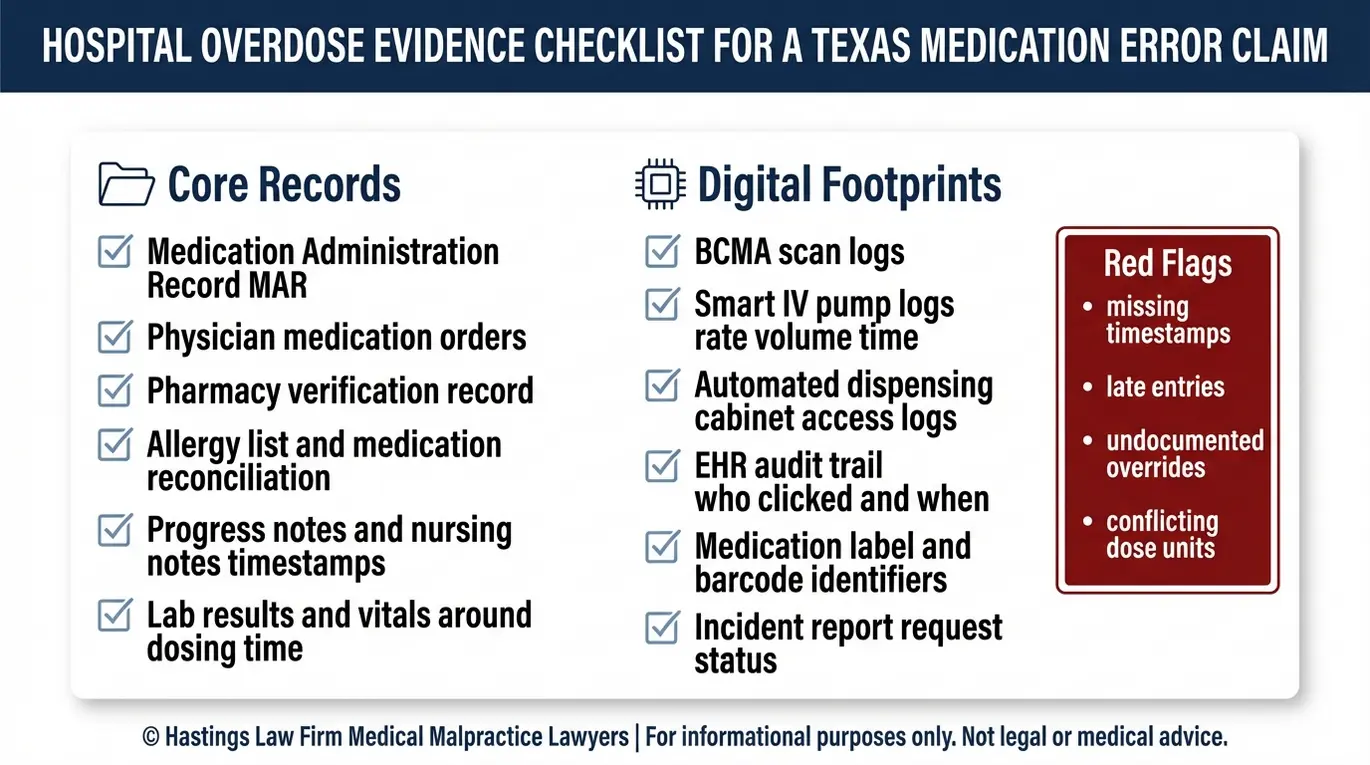
Proving negligence requires a forensic review of the Medication Administration Record (MAR), physician orders, and pharmacy logs to identify discrepancies between what was ordered and what was delivered. The medical records provide a factual timeline of the patient’s care. We compare the MAR against physician orders and pharmacy logs to uncover these errors.
Expert testimony is essential to establish the standard of care, explain the breach, and connect it to the injury (causation). A qualified medical expert reviews the records and provides an opinion on whether the care met accepted medical standards.
Our in-house medical team spots charting inconsistencies like late entries or altered timestamps that suggest incomplete records. Late entries and missing documentation often indicate that the record does not tell the full story.
The U.S. Department of Health and Human Services’ guidance on individuals’ right to access health information under HIPAA confirms your right to access complete medical records. Key evidence we review in a medication error investigation includes:
- Medication Administration Record (MAR) entries and timestamps
- Physician order sheets and CPOE system logs
- Pharmacy dispensing records and automated cabinet access logs
- Nursing notes and shift-change handoff documentation
- Patient vital signs and lab results before and after the overdose
BCMA and IV Pump Logs as Evidence
Barcode Medication Administration (BCMA) systems create a digital record of administration. These technologies create a digital log of exactly when and how much medication was administered. Skipped BCMA scans are critical evidence. Smart infusion pump logs provide another layer of evidence through digital forensics, capturing rates and alarms. Often, this data contradicts manual nursing notes. A Texas medication overdose in hospital lawyer will obtain and analyze these digital records as part of building the case.
Compensation for Victims of Medical Overdoses
Patients harmed by hospital overdoses can recover economic damages for medical bills and lost wages, as well as non-economic damages for pain, suffering, and physical impairment. Economic damages cover direct financial losses, while non-economic damages cover the human cost of an injury. Securing full compensation for medical overdose claims often involves complex calculations regarding long-term needs.
Current medical expenses often include emergency treatment for the overdose itself, such as ICU stays, intubation, dialysis for kidney failure, or administration of reversal agents. These costs can accumulate rapidly.
Future care needs are a significant component in many cases. A medication overdose that causes brain injury from oxygen deprivation (hypoxia) or permanent organ damage may require years of rehabilitation, specialized equipment, and home modifications. We work with medical and financial experts to calculate the full scope of future costs.
Lost earning capacity applies when the injury prevents the patient from returning to their previous occupation or working at all. We analyze not just current lost wages, but the loss of future career advancement and retirement benefits. In wrongful death cases, the family may recover for the lost financial support the deceased would have provided.
Texas Statute of Limitations for Medication Error Claims
In Texas, medical malpractice claims must generally be filed within two years from the date of the negligent act. Texas malpractice time limits determine how long a patient has to pursue a legal claim after an error occurs. This deadline is established by Texas Civil Practice and Remedies Code, Section 74.251 and applies to nearly all medication error claims. Navigating Texas malpractice time limits is critical to preserving your claim.
Texas also imposes a statute of repose, a hard 10-year outer boundary after which no medical malpractice claim can be filed regardless of when the injury was discovered. Limited exceptions exist for minors, but for most adults, the two-year clock and the 10-year outer limit are strict.
Why does this matter right now? Hospital records can be altered or lost. Witnesses change jobs and their memories fade. Electronic system data may be overwritten. The sooner a Texas medication overdose in hospital lawyer begins the investigation, the better the chance of preserving the evidence needed to prove your case.
If you suspect a hospital medication error caused harm to you or someone in your family, do not wait to learn about your rights. The timeline under Chapter 74 of the Texas Civil Practice and Remedies Code leaves limited room for delay.
Contact the Texas Healthcare Malpractice Attorneys at Hastings Law Firm Today for Help
You should not have to face a hospital’s legal team on your own while still dealing with the physical and emotional consequences of a medication error. Our team focuses on uncovering the truth behind medical errors to help families find resolution. At Hastings Law Firm, founder Tommy Hastings, who is Board Certified in Personal Injury Trial Law, and our entire team are prepared to investigate what happened, identify who is responsible, and pursue the compensation your family needs to move forward.
Every case we accept is prepared for trial from the beginning. That commitment, combined with our team of former defense attorneys and in-house medical professionals, is what allows us to stand on equal footing with even the largest hospital systems.
There is no cost to speak with us, and you owe no fees unless we win your case. If you or a loved one was harmed by a medication overdose in a Texas hospital, contact Hastings Law Firm for a free, confidential case evaluation. Let us help you find the answers you deserve.
Frequently Asked Questions About Medication Overdose in Hospital in Texas


This content was researched and written by the Hastings Law Firm editorial team, which includes attorneys, medical professionals, and experienced researchers. Our writing is informed by internal knowledge and practical experience, and we cross-check critical details against authoritative sources cited throughout. Every piece undergoes human-led fact-checking and legal review. Because legal and medical information can change, if you spot an error, please contact us. Learn more about our content standards and review process on our editorial policy page.

Brady D. Williams is a nationally recognized medical malpractice attorney who has spent his career handling high-stakes litigation for injured patients and families across the country. Licensed in both Texas and California, Brady draws on experience from hundreds of resolved medical cases to break down complex legal and medical topics for the people who need that information most. His writing reflects the same attention to detail and commitment to clarity that he brings to every case he handles.
