


Fort Worth Medication Error Lawyer
Written by: Hastings Law Firm | Reviewed by: Brady D. Williams | Updated: July 27, 2026
Medication and prescription mistakes can cause sudden harm and leave patients facing new symptoms, added medical costs, and uncertainty about what went wrong. In Texas, not every adverse drug outcome is malpractice, but preventable errors that fall below the standard of care can lead to serious and lasting consequences. These cases often turn on whether the injury came from a negligent decision rather than an expected medication risk, and responsibility may involve multiple providers or a facility. If you or a loved one were harmed or worse due to a medication error in Fort Worth, Texas, contact Hastings Law Firm for a free, confidential case review.
Trusted Fort Worth Medical Attorneys for Prescription Mistakes
What You Should Know About Wrong Drug or Dosage Error Claims in Fort Worth:
- Life altering harm can result from preventable medication mistakes, including organ failure or death.
- Accountability can depend on whether the harm came from a negligent error rather than a known medication risk.
- Liability can extend beyond one person because prescribing, dispensing, and administration may involve doctors, nurses, pharmacists, and hospitals.
- Recovery can depend on proving the medication mistake caused the injury rather than the underlying illness.
- Options can be lost if a claim is not filed within the applicable Texas time limits.
- Non economic recovery can be limited in Texas because statutory caps apply to pain and suffering type damages in prescription error cases.
- Compensation can include both financial losses and personal harms, such as medical bills, lost wages, pain and suffering, and physical impairment.
- Settlement value can be reduced if a patient is found partially at fault, such as not taking medication as directed or not disclosing other drugs.
- Case outcomes can turn on what the clinical records show, including prescribing records, pharmacy logs, and medication administration logs.
- System level problems can be central when safety alerts are routinely overridden or verification protocols are bypassed.

A Healthcare Focused Law Firm
When a medication error causes unexpected harm, it can shake your confidence in the people and systems you trusted with your health. You may be dealing with new symptoms, mounting medical bills, or lingering questions about what went wrong and why. These concerns are valid, and you deserve clear answers.
Hastings Law Firm focuses exclusively on medical malpractice litigation and has represented patients since 2005. As a Fort Worth medication error lawyer team backed by in-house medical professionals, former defense attorneys, and a national network of experts, we understand both the medical and legal sides of these claims. If you believe a preventable drug error caused you or a loved one harm, we can review what happened and explain your options in a free, confidential consultation.
Defining Medication Errors and Medical Negligence in Texas
A medication error is a preventable event that may cause or lead to inappropriate medication use or patient harm while the medication is in the control of a healthcare professional, patient, or consumer. Not every bad outcome from a prescription drug is malpractice, but when a preventable mistake leads to injury, the law provides a path to accountability. Our founder, Tommy Hastings, is board-certified in Personal Injury Trial Law by the Texas Board of Legal Specialization and has dedicated over 20 years to practicing medical negligence law.
Under Texas law, medical malpractice claims are governed by Texas Civil Practice and Remedies Code Chapter 74, which sets out specific requirements for bringing a claim against a healthcare provider. At the center of every medication error case is the standard of care, which is the level of treatment a reasonably competent medical professional would have provided under similar circumstances. When a doctor, nurse, or pharmacist falls below that standard and a patient is harmed as a result, that failure constitutes negligence.
Distinguishing between a known side effect and a negligent error is essential. Every medication carries some risk. Your doctor or pharmacist should explain potential adverse effects before you begin treatment. A known side effect that occurs despite proper prescribing and monitoring is not, by itself, grounds for a claim. But when a provider prescribes a drug without reviewing your medical history, ignores a documented allergy, or administers the wrong dose, that crosses the line from accepted risk into preventable harm.
An adverse drug event (ADE), which is any injury resulting from the use of a medication, can range from a mild allergic reaction to organ failure or death. When an ADE stems from a provider’s negligent decision rather than an inherent risk of the drug, the consequences can be life-altering. Patients may face corrective surgeries, extended hospital stays, chronic health conditions, or the loss of their ability to work and care for their families.
Fort Worth medication error lawyers at Hastings Law Firm work alongside in-house nurses and board-certified patient advocates to examine the clinical details of every case. Our medication error attorneys look at what was prescribed, what was administered, and whether the provider met the standard of care at each step. That medical-legal approach is how we determine whether a preventable error caused real, compensable harm.
Common Types of Medication and Prescription Errors
Common errors include administering the wrong dosage, prescribing contraindicated drugs, pharmacy dispensing mistakes, and failure to account for patient allergies. A medication error is a preventable failure in the treatment process that can occur at any point. These mistakes can happen from the moment a doctor writes a prescription to the moment a nurse administers it at a patient’s bedside. Our firm uses a thorough medication process review to find where these systems failed.
Dosage Errors
A dosing error, a mistake in the amount of medication prescribed or given, is one of the most frequent types of prescription mistakes. These often result from simple math errors or misplaced decimal points. For example, a patient prescribed 1.0 mg of a potent blood thinner could receive 10 mg if the decimal is misread.
The difference between a therapeutic dose and an incorrect dosage can be remarkably small, and the consequences of getting it wrong can include internal bleeding, seizures, or cardiac arrest. Underdosing carries its own risks, potentially allowing a serious condition like an infection or blood clot to progress unchecked.
Administration Errors
Even when the right drug is prescribed at the right dose, errors can occur during administration in a hospital or clinical setting. A nurse may give medication to the wrong patient, use the wrong route (injecting a drug meant to be taken orally), or administer it at the wrong time. These administration errors often reflect larger systemic issues, such as high patient-to-nurse ratios or inadequate verification protocols.
Pharmacy Dispensing Errors
Pharmacists are trained to serve as a final safety check before medication reaches a patient in a retail or hospital pharmacy. When that check fails, the results can be serious. One well-documented cause involves look-alike, sound-alike medications (LASA drugs), which are drug pairs with similar names or packaging that are easily confused.
A study published by the Agency for Healthcare Research and Quality (AHRQ) Network of Patient Safety Databases examined ordering errors and found that drug name confusion and improper labeling remain persistent sources of preventable harm. A prescription error lawyer can investigate whether the pharmacy followed proper dispensing and verification procedures.
Contraindication and Drug Interaction Errors
Prescribing a medication that reacts negatively with another drug the patient is already taking is a preventable and sometimes dangerous mistake. A drug-drug interaction, which is a harmful reaction between two or more drugs, can amplify side effects, reduce the effectiveness of treatment, or cause a toxic reaction. Providers are expected to review a patient’s full medication list and medical history before prescribing. When they fail to do so, a lawyer for medication mistakes can help determine whether that omission breached the standard of care.
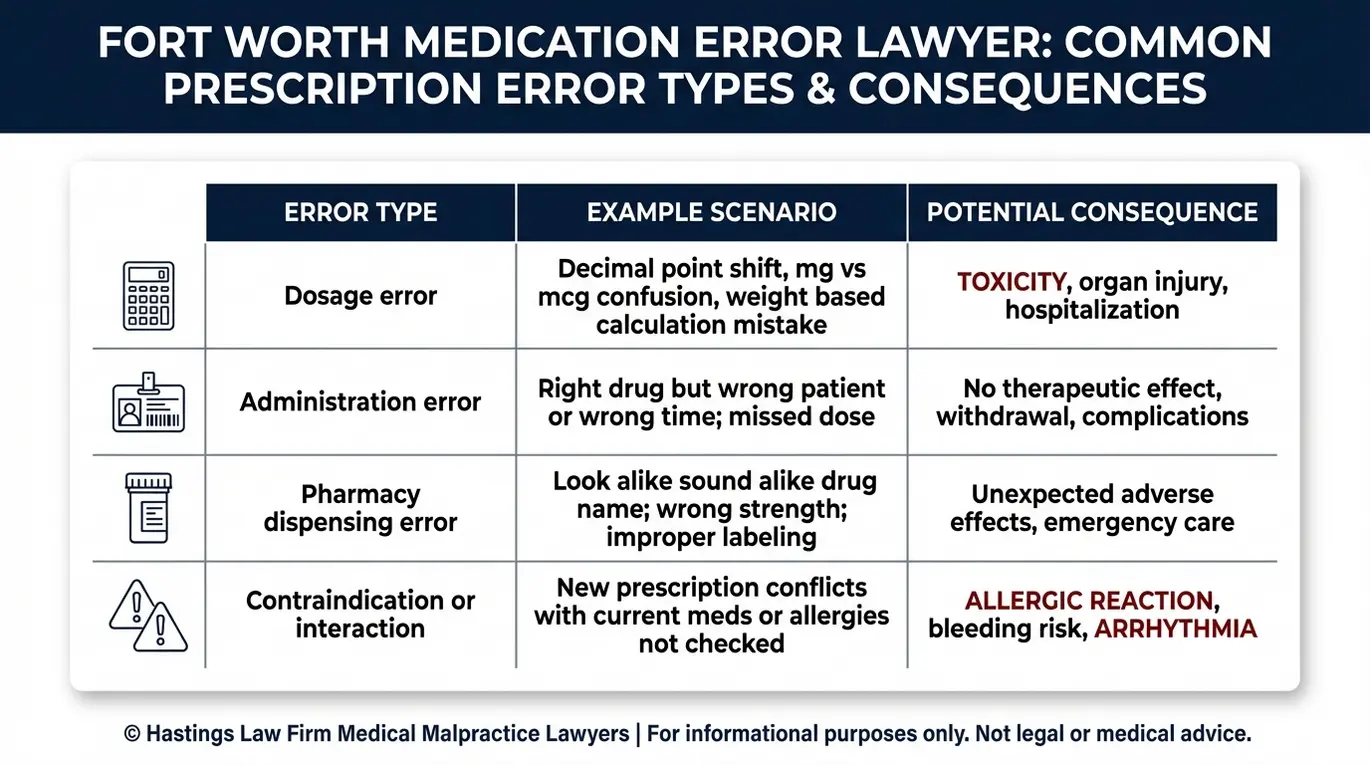
The table below outlines common categories of medication errors, what they look like in practice, and the harm they can cause.
| Error Type | Example Scenario | Potential Consequence |
|---|---|---|
| Wrong Dosage | Decimal point error turns 1.0 mg into 10 mg | Overdose, organ damage, internal bleeding |
| Wrong Patient | Nurse administers medication to incorrect patient | Allergic reaction, adverse drug event |
| Pharmacy Dispensing (LASA) | Pharmacist fills hydroxyzine instead of hydralazine | Dangerous blood pressure changes, sedation |
| Drug Interaction | Doctor prescribes blood thinner alongside NSAID | Uncontrolled bleeding, hemorrhage |
| Improper Labeling | Incorrect instructions on prescription bottle | Patient takes wrong dose or frequency |
| Failure to Check Allergies | Known allergy not reviewed before prescribing | Anaphylaxis, respiratory distress |
A Fort Worth medication error attorney at Hastings Law Firm has the medical knowledge and legal experience to trace exactly where the breakdown occurred and identify who is responsible.
The Hastings Law Firm Difference
Results matter, but what truly sets us apart is how we achieve them. Every verdict, every settlement, and every Fort Worth courtroom victory comes from one guiding promise: To treat each client’s fight for justice as if it were our own.
This balance of skill, experience, and empathy reflects our core philosophy that justice should not only compensate the injured, but also make healthcare safer nationwide.

Liability for Medication Errors: Suing Doctors, Pharmacists, and Hospitals
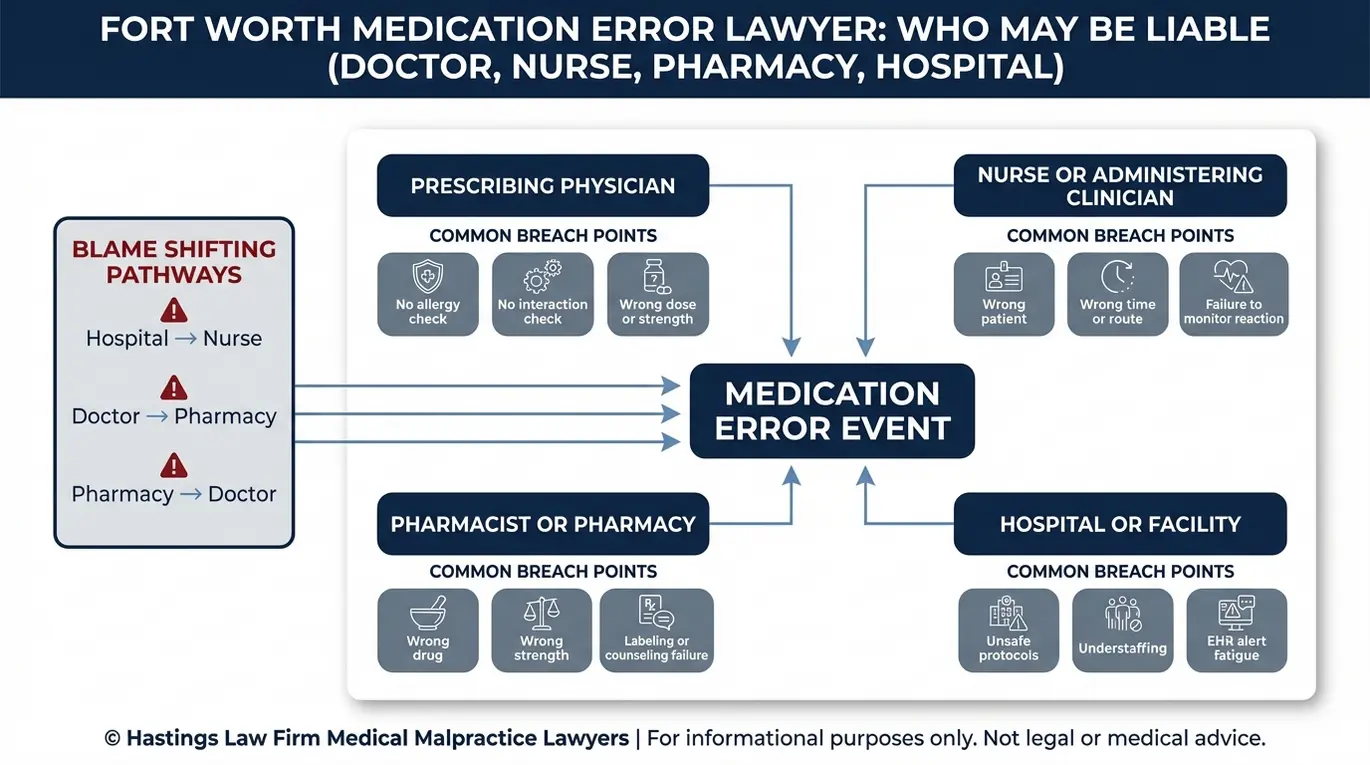
Liability can extend to prescribing physicians, nurses who administer the drug, pharmacists who dispense it, or the hospital facility itself for inadequate protocols. Liability refers to the legal responsibility a professional or facility has for harm caused by an error. Our team includes former defense attorneys and hospital nurses who understand how a healthcare provider or facility defends these claims.
Determining who is legally responsible starts with looking at how many hands a medication passes through before it reaches a patient. The parties who may bear liability include:
- Prescribing Physicians: A doctor who prescribes medication without checking a patient’s history, current drug regimen, or known allergies may be liable for the resulting injury. If you need to sue a doctor for a medication error, the question is whether a competent physician in the same specialty would have made the same prescribing decision.
- Pharmacists: Pharmacists have an independent duty to verify prescriptions, flag potential drug-drug interactions, and confirm proper dosing. A pharmacist negligence lawyer examines whether the pharmacist caught, or should have caught, a problem before filling the prescription.
- Nurses and Administering Staff: Nurses are responsible for verifying the “five rights” of medication administration: right patient, right drug, right dose, right route, and right time. Errors here can occur when bar-code medication administration (BCMA), an electronic scanning system designed to match a patient’s wristband to their prescribed medication, is bypassed or malfunctioning.
- Hospitals and Healthcare Facilities: A hospital medication error attorney may pursue the facility directly when systemic failures contribute to medication mistakes. Understaffing, poor training, broken equipment, or inadequate safety protocols can create an environment where individual errors become inevitable.
The U.S. Food and Drug Administration’s MedWatch program (Form FDA 3500) provides a formal channel for reporting adverse events related to medications and medical products. These reports can become valuable evidence in litigation, documenting that a problem was known or should have been known.
Physician Burnout and Systemic Failures
Individual mistakes do not always happen in isolation, as overworked providers facing long shifts are more likely to make errors. One contributing factor is alert fatigue, a condition in which clinicians become desensitized to the constant stream of clinical decision support (CDS) alerts. These are automated warnings built into electronic health records designed to flag potential prescribing errors.
When a hospital’s electronic system generates hundreds of alerts per shift, providers may begin overriding them by default, including the ones that flag genuine dangers. This is evidence of a systemic failure rather than a justifiable excuse. Our team, which includes former defense attorneys who once represented hospitals, understands how facilities document and defend these breakdowns. That insight helps us identify the right targets and build a case that accounts for both individual and institutional responsibility.
Proving Negligence in a Fort Worth Medication Error Claim
Proving a claim requires demonstrating a direct link between the provider’s breach of duty and the patient’s specific injury, supported by expert medical testimony. A medication malpractice lawsuit is not simply about showing that a mistake was made. You must also show that the mistake, and not the underlying illness, caused the harm.
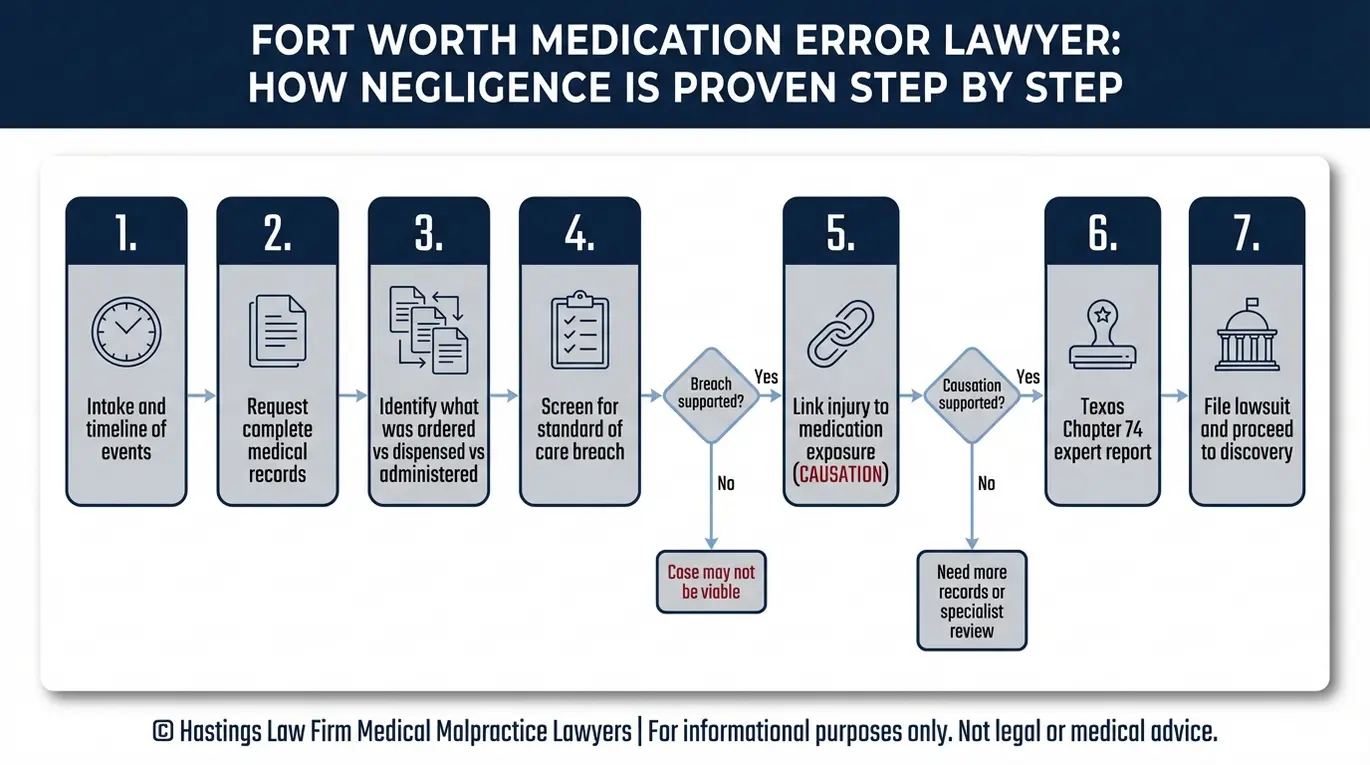
Proving a medication error in Texas follows a structured legal and medical process. Here is how we approach it:
- Record Collection and Preservation: The first step is gathering every relevant medical document, including prescribing records, pharmacy logs, and the Medication Administration Record (MAR/eMAR). This is the detailed hospital log showing every drug given to a patient, the dose, the time, and the name of the administering provider.
- In-House Medical Review: Our team of nurse consultants and board-certified patient advocates reviews the clinical data to identify where the standard of care may have been breached. Because they have experience working inside hospitals, they know how to read charting and spot inconsistencies.
- Expert Report: Texas law requires a qualified expert report early in the litigation process. This report, prepared by a credentialed medical professional, must identify the specific standard of care, how it was violated, and how that violation caused the patient’s injury.
- Establishing Causation: This is often the most contested element. The defense will argue that the patient’s condition, not the medication error, caused the injury. Establishing causation involves building a clear, evidence-based timeline showing that the patient’s harm was a direct result of the wrong drug, dose, or interaction.
Breakdowns in Communication and Patient Education
Not all medication errors happen inside a pharmacy or hospital room, as some occur because a provider failed to warn a patient about side effects. The sig, the set of directions written on a prescription label, may be unclear, incomplete, or missing entirely. When patient education is lacking and individuals suffer adverse effects as a result, that communication failure can form the basis of a negligence claim.
Recoverable Damages for Prescription Drug Injuries
Patients can recover economic damages for medical bills and lost wages, as well as non-economic damages for pain, suffering, and physical impairment. Damages represent the financial compensation awarded to cover the losses caused by medical negligence. The full scope of medication error compensation depends on how the error affected the patient’s health, finances, and daily life.
Economic Damages cover the measurable financial losses tied to the injury:
- Current and future medical costs, including corrective surgeries and ongoing treatment
- Prescription costs for medications needed to address the harm caused by the original error
- Lost wages from missed work during recovery
- Lost earning capacity if the injury prevents a return to the same career
Non-Economic Damages address the personal toll of the injury:
- Physical pain and suffering caused by the error and any corrective procedures
- Mental anguish, including anxiety and loss of trust in medical care
- Physical impairment or disfigurement
- Loss of enjoyment of life
Under the Texas Civil Practice and Remedies Code § 74.301, non-economic damages for prescription errors are subject to statutory caps. Texas places a $250,000 cap on non-economic damages against individual physicians and a separate cap for healthcare institutions. Economic damages, including medical bills and lost income, have no cap.
Impact of Comparative Fault in Texas
Texas follows a proportionate responsibility system, often referred to as comparative fault, meaning a patient’s damages for prescription errors may be reduced if they are found partially at fault. For example, if a patient did not take the medication as directed or failed to disclose other drugs they were using, the defense may argue the patient shares some blame.
Under Texas law, a patient can still recover damages as long as their share of proportionate responsibility does not exceed 50%. This can lead to a settlement reduction. Our legal team accounts for these arguments from the start, building cases that address potential defenses before they gain traction.
Texas Statute of Limitations for Medication Error Lawsuits
In Texas, the general statute of limitations for medical malpractice is two years from the date of the error or the date the injury was discovered. Missing this deadline almost always means losing the right to file a claim, regardless of how strong the evidence may be.
The two-year clock typically begins on the date the medication error occurred. But medication errors are not always immediately obvious. A patient prescribed the wrong drug or the wrong dose may not experience symptoms for weeks or months. In those situations, the discovery rule may apply. This legal principle delays the start of the medication error statute of limitations until the date the patient knew, or reasonably should have known, that the injury was connected to the error.
Even with the discovery rule, Texas imposes an absolute deadline. The statute of repose sets a hard 10-year cap from the date of the negligent act. After 10 years, no claim can be filed, even if the injury was only recently discovered. Because these deadlines are strict and case-specific, consulting with an attorney early protects your ability to pursue a claim.
Contact the Fort Worth Healthcare Malpractice Attorneys at Hastings Law Firm Today for Help
If a medication error has caused you or someone in your family unexpected harm, you do not have to face the aftermath alone. Hastings Law Firm was built on a single mission: to restore trust for patients who have been let down by the healthcare system and to enforce the accountability that prevents the same mistake from happening again.
Our team of attorneys, in-house nurses, and patient advocates is ready to review your medical records, identify what went wrong, and explain whether you have a path forward. There are no fees unless we secure a recovery on your behalf, and every risk-free case evaluation is free and confidential.
You can reach Hastings Law Firm by phone or through our website to schedule your consultation. Let us help you find the answers you deserve.
Frequently Asked Questions About Medication Error in Fort Worth


This content was researched and written by the Hastings Law Firm editorial team, which includes attorneys, medical professionals, and experienced researchers. Our writing is informed by internal knowledge and practical experience, and we cross-check critical details against authoritative sources cited throughout. Every piece undergoes human-led fact-checking and legal review. Because legal and medical information can change, if you spot an error, please contact us. Learn more about our content standards and review process on our editorial policy page.

Brady D. Williams is a nationally recognized medical malpractice attorney who has spent his career handling high-stakes litigation for injured patients and families across the country. Licensed in both Texas and California, Brady draws on experience from hundreds of resolved medical cases to break down complex legal and medical topics for the people who need that information most. His writing reflects the same attention to detail and commitment to clarity that he brings to every case he handles.
