


Austin Medication Error Lawyer
Prescription mistakes can cause sudden and lasting harm when the wrong drug, dose, or instructions reach a patient. These errors often stem from breakdowns in communication and safety checks across prescribing, dispensing, labeling, and administration. The resulting adverse drug events can lead to serious reactions, extended hospitalization, permanent injury, or fatal outcomes, and responsibility may involve multiple providers or facilities. Clear documentation and timely attention to what happened can matter for understanding accountability and potential recovery. If you or a loved one were harmed or worse due to a medication error in Austin, Texas, contact Hastings Law Firm for a free, confidential case review.

Last Updated: July 27, 2026
Trusted Austin Medical Attorneys for Prescription Mistakes
When a medication error, any preventable event where the wrong drug, wrong dose, or wrong instructions reach a patient, causes real harm, the consequences can reshape your life overnight. An adverse drug event (ADE), meaning the actual physical injury caused by a medication mistake, can range from a dangerous allergic reaction to permanent organ damage or worse. If you or a loved one has been hurt by a prescription mistake, you deserve answers about what went wrong and who is responsible.
As a dedicated Austin medication error lawyer team, Hastings Law Firm focuses exclusively on medical malpractice. Our legal and medical professionals work together to determine whether a preventable error caused your injury and to hold the responsible parties accountable. Contact us for a free, confidential case evaluation so we can review what happened and explain your options.

Common Causes of Medication Errors in Austin Hospitals and Pharmacies
Medication errors typically occur due to communication breakdowns, staffing shortages that lead to fatigue, illegible handwriting, or similarly named drugs, resulting in patients receiving the wrong medication or an incorrect dosage. Understanding how and why these pharmaceutical errors occur is the first step in seeking accountability after a patient is harmed.
The sources of these errors generally fall into a few categories:
- Pharmacy dispensing errors: A dispensing error, a mistake where a pharmacy provides the wrong pill, the wrong strength, or medication meant for a different patient, often stems from systemic issues. High patient volumes and staffing shortages at retail chains can make staff susceptible to these mistakes.
- Hospital administration errors: A medication administration error, a failure occurring when a nurse or technician gives a patient the wrong drug, the wrong dose, or delivers it through the wrong route (such as IV instead of oral), is a serious risk. High patient volumes in Austin facilities can create rushed conditions where critical safety checks get skipped.
- Prescribing errors: A physician may prescribe a drug that interacts dangerously with the patient’s existing medications, overlook a documented allergy, or select an incorrect dosage for the patient’s weight or kidney function.
- Labeling errors: Instructions may be printed for the wrong patient, or dosing directions may be mislabeled on a bottle, leading to accidental overdose or underdosing.
Each of these errors reflects a breakdown in safety protocols designed to protect patients. When healthcare providers fail to follow those protocols, the adverse effects can be severe, including organ failure, stroke, prolonged hospitalization, or death.
If you suspect a prescription error caused harm to you or someone in your family, an Austin medication error lawyer can help identify where the breakdown occurred. A medication error attorney at Hastings Law Firm, supported by in-house medical staff, reviews pharmacy records, hospital medication administration logs, and prescribing histories to trace the error back to its source.
How Brand Name Confusion Leads to Serious Injury
One of the most dangerous and underappreciated causes of pharmacy malpractice involves Look-Alike, Sound-Alike drugs (LASA), which are medications with names so similar that they are easily confused during prescribing or dispensing. For example, hydroxyzine (an antihistamine) and hydralazine (a blood pressure medication) look nearly identical on a handwritten prescription. Swapping one for the other can cause a serious, even life-threatening, reaction.
The healthcare industry has adopted Tall Man lettering, a system that capitalizes distinct portions of drug names (such as hydrOXYzine versus hydrALAZine), to reduce confusion. But this safeguard only works when pharmacists and prescribers actually use it. When negligence leads to a LASA mix-up, patients can suffer dangerous drug interactions and adverse effects that were entirely preventable. A medication error attorney can investigate whether proper LASA protocols were in place and whether staff followed them.
Recovering Damages for Prescription Errors in Texas
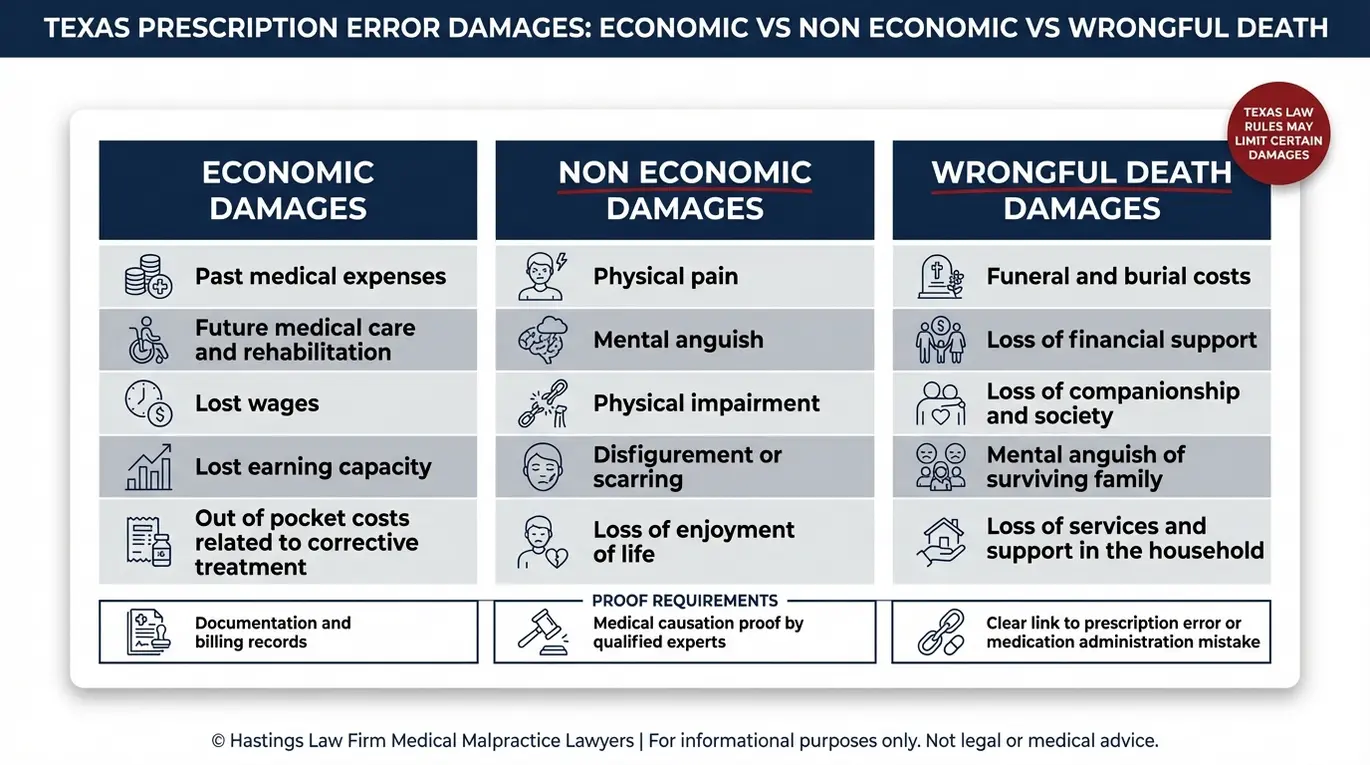
Victims of medication errors in Texas can recover economic damages for medical bills and lost wages, as well as non-economic damages for pain, suffering, and physical impairment. Texas law divides recoverable damages into two main categories. Understanding the difference is important because different rules apply to each.
| Damage Type | What It Covers | Cap in Texas |
|---|---|---|
| Economic Damages | Past and future medical bills, corrective treatment, lost wages, lost earning capacity, out-of-pocket costs | No cap |
| Non-Economic Damages | Physical pain, mental anguish, disfigurement, loss of companionship, physical impairment | Capped under Civil Practice and Remedies Code Chapter 74 (generally $250,000 per claimant against individual providers, plus up to $250,000 per healthcare institution, with a combined maximum of $500,000 to $750,000 depending on parties involved) |
| Wrongful Death Damages | Funeral expenses, loss of financial support, loss of care and companionship, mental anguish of surviving family | Economic damages uncapped; non-economic damages subject to statutory caps |
Economic damages cover the tangible financial losses. If a wrong medication caused an extended hospital stay, the need for corrective surgery, or an inability to return to work, those costs are fully recoverable with no statutory limit. Documenting these medical expenses is critical, as they form the baseline of your claim and demonstrate the financial reality of the negligence.
Non-economic damages address the personal toll: chronic pain, emotional distress, scarring, and the loss of enjoyment of daily life. Texas tort reform places caps on these amounts, but they still represent a significant part of most settlements. Managing the challenges of a personal injury lawsuit requires experienced legal counsel to ensure that subjective harms are effectively communicated to a jury or insurance adjuster.
When a fatal overdose or dangerous drug interaction causes death, surviving family members may pursue a wrongful death claim for both their financial losses and the anguish of losing a loved one.
As Austin medication error lawyers, we work with medical and financial experts to document the full scope of harm so that nothing is overlooked. An attorney for medication mistakes can ensure all potential avenues for compensation are explored. Our goal is to present a complete picture of how the error affected your life, both now and in the years ahead.
The Hastings Law Firm Difference
Results matter, but what truly sets us apart is how we achieve them. Every verdict, every settlement, and every Austin courtroom victory comes from one guiding promise: To treat each client’s fight for justice as if it were our own.
This balance of skill, experience, and empathy reflects our core philosophy that justice should not only compensate the injured, but also make health care safer nationwide.

Proving Negligence and Our Evidence Collection Approach
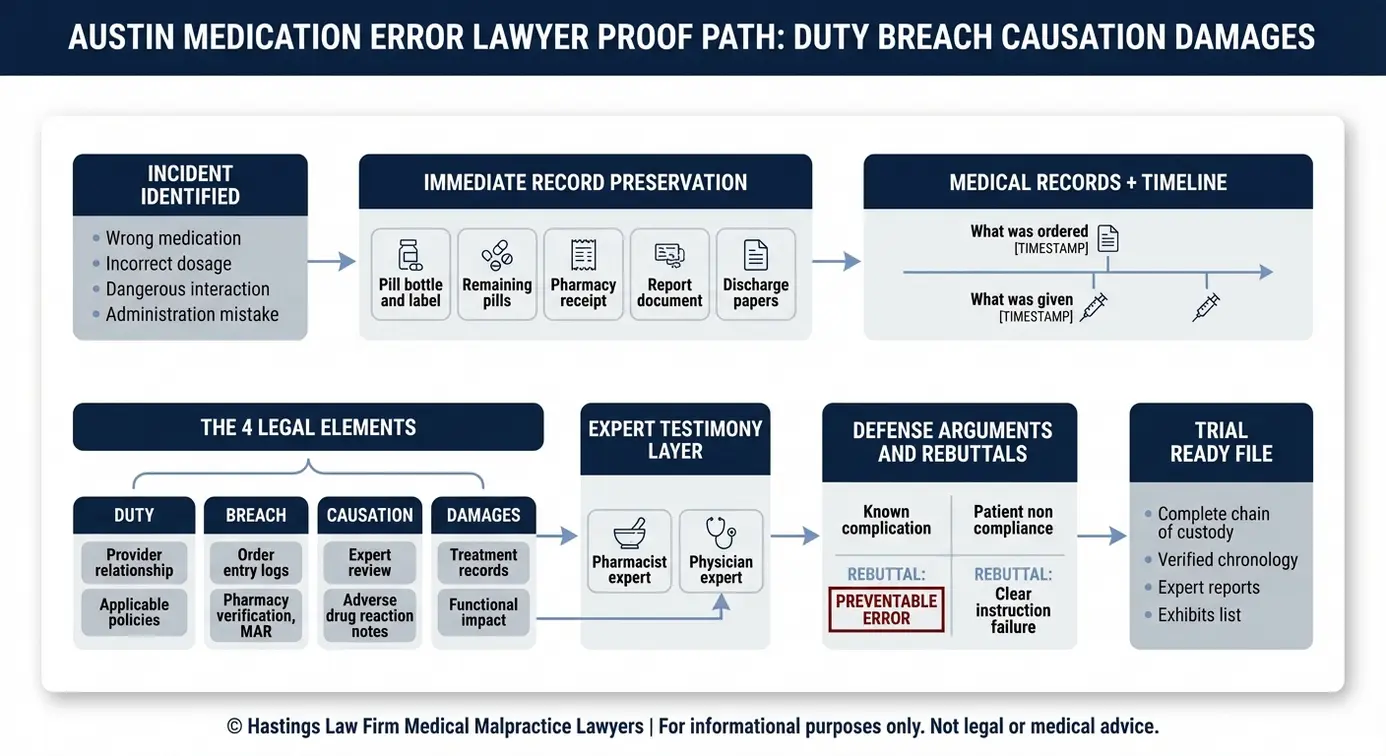
Proving a medication error requires demonstrating that the healthcare provider violated the accepted standard of care and that this violation directly caused your injury. Establishing this involves a thorough review of medical records, pharmacy chain-of-custody evidence, and qualified expert testimony.
Every medical malpractice claim built around a medication error rests on four legal elements:
- Duty: The physician, nurse, or pharmacist owed you a professional duty of care.
- Breach: They failed to meet the standard of care, meaning the level of treatment a reasonably competent professional would have provided under similar circumstances.
- Causation: The breach directly caused your injury, not a pre-existing condition or a known risk of the medication.
- Damages: You suffered measurable harm, whether physical, financial, or both.
Our investigation begins with a detailed review of your medical records, pharmacy dispensing logs, and electronic prescribing data. We look for evidence of a drug-drug interaction, a harmful reaction between two medications, or a contraindication, a specific medical reason a drug should not have been given to a particular patient based on their medical history.
Expert testimony is essential in these cases. Under Section 74.351 of the Texas Civil Practice and Remedies Code, Texas law requires qualified expert reports in medical malpractice litigation. We retain pharmacists, physicians, and toxicologists from our national expert network who can explain exactly how the error occurred and why it caused your specific injury. Their analysis often serves as the cornerstone of the case, scientifically proving that the adverse event was preventable.
Hospitals and pharmacies typically defend these cases by arguing the harm was a known side effect, that the patient did not follow instructions, or that a pre-existing condition caused the symptoms. As an Austin medication error lawyer team with former defense attorneys on staff, we know how defense counsel frames these cases and we prepare our evidence to address those tactics from day one.
Steps to Take If You Suspect a Medication Mistake
Immediate steps include seeking emergency medical attention, preserving the pill bottle and all pharmacy receipts, requesting medical records, and contacting a specialist attorney before speaking to hospital risk managers. Following these steps after a suspected medication error helps protect your health and your legal rights.
- Get medical attention immediately. If you are experiencing an adverse reaction, go to an emergency room or urgent care facility. Ask a different provider to evaluate the suspected error and document everything in your chart. This creates an independent medical record that can be critical later. Medication reconciliation, the process where a healthcare provider compiles and compares your complete medication list, can help identify what went wrong.
- Preserve the physical evidence. Keep the pill bottle, packaging, receipts, or any remaining medication. Photograph the label, the pills, and any accompanying paperwork. Be aware of pharmacy repossession, an attempt by a pharmacy to take back the medication after learning of an error. Once that evidence leaves your hands, it may be difficult to recover, making it harder to prove negligence.
- Request your medical and pharmacy records. You have the right to obtain copies of your prescriptions, hospital medication administration records, and doctor’s notes. Do this promptly, before anything can be altered or lost. Having a complete set of records early allows your legal team to assess the validity of your claim faster.
- Do not sign anything. If the hospital or pharmacy contacts you with forms, waivers, or incident reports, do not sign anything until you have spoken with a medication error lawyer in Austin who can review the documents. Risk managers often try to settle quickly for low amounts before you understand the full extent of the harm.
- Contact a specialist attorney. Before speaking with hospital risk managers or pharmacy corporate representatives, talk to an attorney who handles pharmacy malpractice and medication error cases. The CDC’s PROTECT Initiative highlights how common preventable medication overdoses are in children; having legal guidance early helps ensure you do not inadvertently waive important rights.
Acting quickly protects both your health and the evidence needed to build a strong claim.

Texas Statute of Limitations for Medication Error Claims
In Texas, you generally have two years from the date of the medication error to file a claim, though specific exceptions exist for minors or undiscovered injuries. Knowing the legal deadlines for filing a medical negligence claim in Texas is essential for protecting your rights.
There are limited exceptions. The discovery rule may extend the deadline if you did not know, and could not reasonably have known, that a medication error caused your injury. Texas courts apply this exception strictly, so it is not something to rely on without legal guidance.
Texas also imposes an absolute 10-year statute of repose. Even if the injury was truly undiscoverable, no medical malpractice claim can be filed more than 10 years after the date the error occurred. Different rules may apply for minors, but the window is still limited. Managing the litigation timeline can be challenging, and waiting too long to investigate can result in a valid claim being time-barred.
Because these deadlines are unforgiving, Austin medication error attorneys at Hastings Law Firm encourage anyone who suspects a prescription error to reach out as early as possible. An early evaluation gives us the best opportunity to secure records and preserve evidence while it still exists.
Contact the Austin Healthcare Malpractice Attorneys at Hastings Law Firm Today for Help
A medication error can cause lasting harm, but it does not have to go unanswered. Since 2005, Hastings Law Firm has focused solely on representing those harmed by medical negligence, ensuring patients have the expertise needed to challenge large healthcare systems.
If you or a loved one was harmed by a prescription mistake, our team of attorneys, nurse consultants, and patient advocates is ready to listen. We will review your records, identify what went wrong, and explain your legal options in plain terms.
We handle every case on a contingency fee basis, meaning you pay no attorney fees or costs unless we secure a recovery for you. Your consultation is free and completely confidential.
Contact our medication error law firm today to schedule your risk-free case evaluation. Let us help you find the answers you deserve.
Frequently Asked Questions About Medication Error in Austin


This content was researched and written by the Hastings Law Firm editorial team, which includes attorneys, medical professionals, and experienced researchers. Our writing is informed by internal knowledge and practical experience, and we cross-check critical details against authoritative sources cited throughout. Every piece undergoes human-led fact-checking and legal review. Because legal and medical information can change, if you spot an error, please contact us. Learn more about our content standards and review process on our editorial policy page.

Gabe Sassin has focused exclusively on medical malpractice law since 2007. After spending more than a decade as a malpractice defense attorney, he knows exactly how the other side works. He has seen firsthand how healthcare providers, insurers, corporate defendants, and their legal teams think, prepare, and build their defense against claims. That knowledge works for the people who need it most today, injured patients and their families. His unique experience shapes everything he writes, giving readers a look at how these cases actually work from someone who has handled them from both sides.
