


Texas Medical Nerve Damage Lawyer
Written by: Hastings Law Firm | Reviewed by: Brady D. Williams | Updated: July 27, 2026
Surgical nerve injuries can leave a person with lasting pain, weakness, and loss of function that disrupts work, sleep, and daily independence. Some nerve damage is a known risk of surgery, but preventable errors such as cutting a nerve, improper positioning under anesthesia, equipment compression, or injection mistakes can lead to permanent harm. Clear documentation and objective testing can help show what happened and how severe the injury is. If you or a loved one were harmed or worse due to surgical nerve damage in Texas, contact Hastings Law Firm for a free, confidential case review.

Trusted Texas Medical Attorneys for Surgical Nerve Injury Claims
What You Should Know About Nerve Injury From Surgery Claims in Texas:
- Long term disability and chronic pain can follow surgical nerve damage when an injury is permanent rather than temporary.
- Liability can turn on whether the injury was a preventable error rather than a known complication disclosed in informed consent.
- Recovery options can be lost if Texas filing deadlines are missed, even when the underlying negligence is strong.
- A claim can be dismissed early without required expert support, which Texas law ties to strict report requirements.
- Compensation can cover medical bills and lost earning capacity without a statutory cap, which can matter in high cost long term care.
- Non economic recovery can be limited in Texas medical malpractice cases, which can affect compensation for pain and impairment.
- Disputes often focus on operative notes and anesthesia records, since they can show positioning, monitoring, and intraoperative events.
- Proof of severity can depend on objective testing such as EMG and nerve conduction studies, which can document location and permanence of damage.
- Responsibility can extend beyond the surgeon to other providers and hospitals, including anesthesiologists and nursing staff.
- Serious injuries can arise from positioning, equipment compression, or injections, not only from direct cutting of a nerve.

A Healthcare Focused Law Firm
If you or someone you love suffered nerve damage during a medical procedure, you may be dealing with pain, lost mobility, and real uncertainty about your future. These injuries can affect every part of daily life, and getting clear answers about what went wrong often feels impossible without the right help. A Texas medical nerve damage lawyer can review your medical records and coordinate electrodiagnostic testing. These tests, like electromyography (EMG) and nerve conduction studies (NCS), measure electrical signals to determine if your injury resulted from a preventable error. At Hastings Law Firm, founded by board-certified trial attorney Tommy Hastings, our team focuses exclusively on medical malpractice. We are here to help you understand what happened and explain your legal options at no cost unless we recover for you.
Common Causes of Iatrogenic Nerve Injuries in Texas Hospitals
Surgical nerve damage, also called iatrogenic injury (meaning an injury caused by a medical procedure or treatment), typically occurs due to direct severance with a scalpel, compression from retractors, improper patient positioning during anesthesia, or chemical injury from injections. While some degree of risk exists in any operation, many of these injuries happen because of surgical errors, surgical negligence, and other preventable mistakes by the surgical team.
Understanding how these injuries occur is the first step toward building a case. A Texas nerve damage attorney will examine the operative report, anesthesia records, and nursing notes to identify exactly where the breakdown happened. Here are the most common causes we see.
Direct Trauma During Surgery
A nerve can be cut, nicked, or stretched when a surgeon operates in close proximity to nerve pathways. Procedures like hernia repairs, hip replacements, carpal tunnel releases, and spinal surgeries carry a heightened risk because major nerves run directly through or near the surgical field. Procedures near nerve pathways require high precision to avoid injury.
A severed nerve or nicked nerve during one of these operations may indicate instances of surgical negligence where the surgeon failed to properly identify and protect the surrounding anatomy. Research published by PubMed Central on peripheral nerve injury following arthroplasty confirms that nerve damage during joint replacement surgery is a well-documented risk with identifiable contributing factors. A Texas medical nerve damage lawyer can investigate these specific claims.
Positioning Errors Under Anesthesia
When a patient is under general anesthesia, they cannot feel pain or shift their body. Proper body alignment is required to prevent nerve stretching while a patient is immobile. The surgical team is responsible for positioning and monitoring the patient throughout the procedure.
If a limb is hyperextended, compressed against a hard surface, or left in an improperly positioned state for an extended period, nerves can sustain serious damage. Brachial plexus injuries affecting the shoulder and arm, as well as sciatic nerve compression, are among the most common positioning-related injuries. These errors often point to a breakdown in communication between the anesthesiologist and the nursing team.
Equipment-Related Compression
Surgical instruments can also cause nerve injury when used improperly. These tools are used to stabilize the surgical site or limit blood loss. Retractor pressure, the force applied by metal retractors used to hold open an incision, can compress nearby nerves if the instrument is placed incorrectly or left in position too long.
Similarly, a pneumatic tourniquet applied to control blood flow during limb surgery can cause nerve damage when inflation pressures are too high or the tourniquet remains inflated beyond safe time limits. Safety guidelines published by the AORN Journal on pneumatic tourniquet use outline specific protocols that surgical teams are expected to follow. Consulting an attorney for nerve damage in Texas ensures these protocols are checked.
Injection Injuries
Not all nerve damage occurs in the operating room. Injections for nerve blocks, vaccinations, or blood draws can cause direct needle trauma or expose the nerve to toxic substances. Damage can occur if a needle directly strikes a nerve or if medication is injected into the wrong tissue.
In some cases, this leads to complex regional pain syndrome (CRPS), a chronic condition involving severe burning pain and swelling. These injuries may seem minor at first but can become permanent.
High-risk procedures where iatrogenic nerve injury is most frequently reported include:
- Hip and knee replacement surgery
- Hernia repair (inguinal and femoral)
- Carpal tunnel release
- Spinal fusion and laminectomy
- Cesarean delivery
- Thyroid and neck surgeries
- Dental and oral surgery involving the inferior alveolar nerve
These procedures often involve operating near complex nerve networks, which increases the risk of surgical error. If you experienced nerve damage after any of these procedures, a nerve injury lawyer in Texas can help determine whether the standard of care was met or whether negligence played a role.
Distinguishing Acceptable Risks from Actionable Medical Negligence
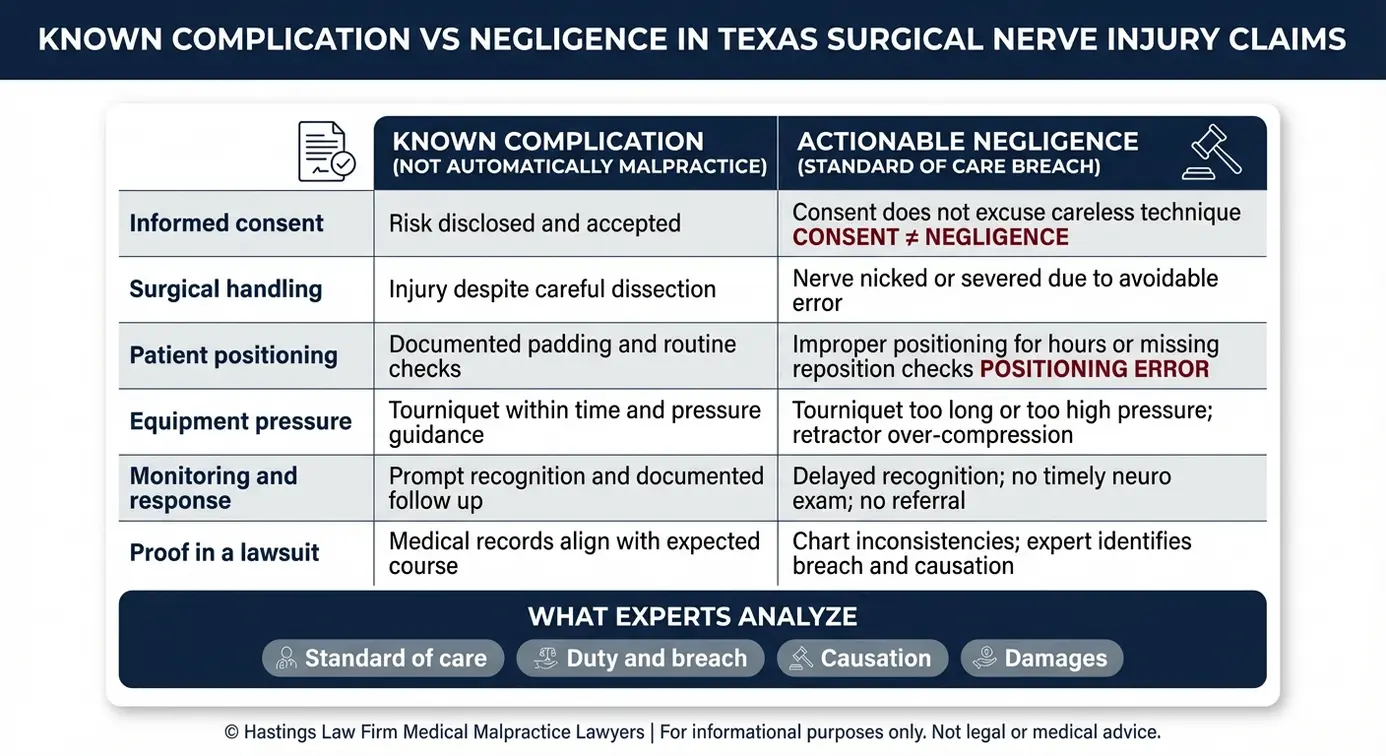
Not every nerve injury is malpractice. Medical negligence is proven when the healthcare provider deviates from the accepted standard of care, meaning a competent doctor would not have made the same error under similar circumstances. This distinction is central to every medical malpractice case involving nerve damage, and it is the question our team investigates from day one. A Texas nerve damage attorney helps patients understand this distinction.
The “Known Complication” Defense
Hospitals and their defense attorneys will almost always argue that nerve damage is a “known complication” of surgery. They point to the informed consent form you signed before the procedure and claim the risk was disclosed. This defense attempts to absolve them of their legal duty to provide safe care. A consent form acknowledges that complications can occur even with proper care. It does not excuse negligent technique, failure to monitor nerve function, or errors in patient positioning, which is how the patient’s body is arranged and supported during surgery to protect vulnerable structures.
The question is not whether nerve damage can happen. The question is whether the specific injury was caused by a failure to meet the standard of care.
Proving the Breach
To move past the “known complication” argument, we must demonstrate that the provider’s actions fell below what a reasonably skilled professional would have done. This means showing that the injury resulted from a lack of skill, attention, or adherence to established protocols rather than an unavoidable outcome. A medical malpractice lawyer for nerve injuries knows how to find this evidence.
We examine the operative notes, anesthesia logs, and post-surgical documentation to reconstruct what happened minute by minute. Our in-house medical staff, including nurse consultants who have worked within the hospital systems we now challenge, assist in identifying these standard of care breaches. We establish causation by connecting the specific breach to the injury. If, for example, a pneumatic tourniquet was inflated beyond recommended time limits, or if positioning records show no documented repositioning checks, those gaps become evidence of a breach.
The Agency for Healthcare Research and Quality (AHRQ) Patient Safety Indicators provide standardized benchmarks that help identify when a postoperative complication may signal a quality-of-care failure rather than an inherent surgical risk.
The Role of Expert Witnesses
Texas law requires expert witness testimony to establish both the standard of care and the breach. Our Texas medical nerve damage attorneys work with a national network of board-certified surgeons, anesthesiologists, and neurologists who review case evidence and provide objective opinions on whether the provider’s conduct met accepted medical standards. These medical experts are essential to distinguishing a genuine complication from actionable negligence. Without this specific testimony, a judge may dismiss a claim before it ever reaches a jury, underscoring the need for a legal team with deep medical resources.
| Known Complication | Potential Negligence |
|---|---|
| Nerve irritation or minor numbness that resolves within weeks | Permanent nerve damage from a severed or crushed nerve during a routine procedure |
| Temporary swelling near a surgical site that briefly affects sensation | Failure to identify and protect a major nerve clearly visible in the operative field |
| Mild positioning-related discomfort that resolves with physical therapy | No documented repositioning checks during a procedure lasting several hours |
| Expected inflammation following a nerve block injection | Injection administered directly into a nerve, causing immediate and lasting damage |
Reviewing these differences with a nerve injury lawyer in Texas can clarify your legal standing.
Identifying the Difference Between Temporary and Permanent Injury
The medical severity of a nerve injury directly affects both the prognosis and the legal value of a claim. Nerve injuries are generally classified along a spectrum, and two terms define the extremes.
Neuropraxia, the mildest form of nerve injury, involves temporary disruption of nerve signaling, usually from compression or stretching, without structural damage to the nerve itself. Patients with neuropraxia typically recover full function within weeks to a few months as the nerve heals on its own.
Neurotmesis, the most severe classification where the nerve has been completely severed or destroyed, often results in permanent loss of sensation, chronic pain, or paralysis in the affected area. Regeneration is unlikely without surgical intervention such as nerve grafting, and even then, full recovery is rare.
The distinction matters because permanent injuries carry significantly greater prognosis implications and damages, both in terms of lifetime medical costs and the ongoing impact on a person’s ability to work and live independently. It affects both the physiology of the nerve and the potential recovery.
The Hastings Law Firm Difference
Results matter, but what truly sets us apart is how we achieve them. Every verdict, every settlement, and every Texas courtroom victory comes from one guiding promise: To treat each client’s fight for justice as if it were our own.
This balance of skill, experience, and empathy reflects our core philosophy that justice should not only compensate the injured, but also make healthcare safer nationwide.

Signs of Permanent Nerve Damage After Surgery
Symptoms of permanent nerve damage include chronic numbness, muscle atrophy, “drop foot,” loss of motor function, and burning neuropathic pain that persists long after the expected recovery period. If you are experiencing these symptoms months after a procedure, your body may be telling you that something went wrong during your care.
Sensory Deficits
Early warning signs often start with changes in sensation. Persistent numbness, tingling, or a “pins and needles” feeling that does not resolve can signal underlying nerve damage. A Texas nerve injury attorney often sees these sensory changes progress into neuropathic pain. This is a type of chronic nerve pain characterized by burning, shooting, or electric-shock sensations that occur without any external trigger. Neuropathic pain can be constant or intermittent, and it often worsens at night, making sleep difficult.
Motor Deficits
When nerve damage affects motor function, you may notice weakness or even paralysis, a complete inability to move part of your body. Foot drop, a condition where you cannot lift the front of your foot due to damage to the peroneal nerve, is one of the more recognizable signs.
Other motor deficits include difficulty gripping objects, loss of fine motor skills in the hands, or visible muscle atrophy where the affected muscles shrink from lack of nerve stimulation. These changes can make it difficult or impossible to work, drive, or perform basic daily tasks. If you face these limitations, consulting a medical malpractice lawyer for nerve damage is important.
Diagnostic Confirmation
Objective diagnostic tests are critical to proving the extent of nerve damage in a legal claim. Electromyography (EMG) and nerve conduction studies measure the electrical activity in your muscles and the speed at which signals travel along your nerves. These nerve conduction tests can pinpoint where the damage occurred, how severe it is, and whether the nerve is recovering or permanently impaired. As a Texas medical nerve damage lawyer, we coordinate with your treating physicians and independent specialists to ensure this diagnostic evidence is properly documented and preserved.
Symptoms that may indicate permanent nerve damage after surgery:
- Numbness or loss of sensation that has not improved after several months
- Burning, shooting, or electric-shock pain in the affected area
- Muscle weakness or inability to move a limb normally
- Visible muscle wasting or atrophy
- Foot drop or difficulty walking
- Loss of grip strength or fine motor control
- Hypersensitivity to touch or temperature changes in the affected region
- Chronic sleep disruption caused by nerve pain
If you recognize several of these symptoms, consulting with a nerve damage lawyer in Texas can help you understand whether your injury may have been preventable.

Compensation for Victims of Surgical Nerve Damage in Texas
Patients who suffer nerve damage due to medical negligence can recover economic damages for medical bills and lost earning capacity, as well as non-economic damages for physical pain, mental anguish, and physical impairment. Compensation is designed to address the physical and financial changes caused by medical errors. An experienced Texas medical nerve damage lawyer helps patients pursue the full scope of recoverable compensation, which depends on the severity of the injury and how it has changed your life.
Economic Damages
Economic damages cover the measurable financial losses caused by the injury. These are not subject to a cap under Texas law, meaning there is no statutory limit on the amount you can recover for out-of-pocket costs and lost income. Your nerve injury lawyer in Texas will calculate:
- Past and future medical bills and expenses, including nerve repair surgery, nerve grafts, pain management, physical therapy, and prescription medications
- Lost wages from time missed at work during treatment and recovery
- Loss of future earning capacity if the nerve damage prevents you from returning to your previous occupation or limits the type of work you can perform
- Costs of assistive devices, home modifications, or ongoing rehabilitative care to ensure future financial security for the patient
Calculating these losses requires detailed economic modeling, especially when a patient is young or was in a high-earning profession. We account for inflation, promotions, and benefits lost over a career span.
Non-Economic Damages
Non-economic damages address the personal toll that no receipt or invoice can capture. Under Texas Civil Practice and Remedies Code § 74.301, non-economic damages in medical malpractice cases are subject to non-economic caps. Even with these limits, these damages represent a significant part of most nerve injury claims. A Texas surgical nerve damage attorney fights to maximize these amounts.
Non-economic damages may include:
- Physical pain and suffering, including chronic neuropathic pain
- Mental anguish and emotional distress
- Physical impairment and loss of bodily function
- Loss of enjoyment of life and inability to participate in activities you once valued
- Physical disfigurement, such as visible muscle atrophy or abnormal gait
While caps exist, these damages acknowledge that the injury stole more than just money; it took away peace of mind, physical independence, and freedom from pain.
The Life-Altering Impact
Nerve damage affects far more than the injury site. Chronic pain can disrupt sleep, and muscle weakness can make it unsafe to drive. Loss of hand function can end a career. The daily reality of living with permanent nerve damage is something our team understands, and it is something we communicate clearly to juries and insurance carriers to help secure a fair settlement.
A Texas nerve damage attorney at Hastings Law Firm works to make sure every dimension of your loss is accounted for, not just the bills that have already arrived. For many, the psychological weight of an avoidable injury is as heavy as the physical pain. Depression and anxiety are common among patients of surgical nerve damage, creating additional layers of harm that must be addressed in the claim.
Texas Laws Impacting Your Nerve Injury Claim
Texas medical malpractice claims are governed by Chapter 74 of the Civil Practice and Remedies Code, which imposes strict expert report deadlines and caps on non-economic damages. These laws, born from tort reform efforts, create procedural hurdles for patients who wait too long or work with attorneys unfamiliar with medical malpractice litigation in Texas.
Statute of Limitations
The general deadline to file a nerve damage malpractice claim in Texas is two years from the date of the injury. Consulting a Texas nerve damage attorney immediately is important. If you miss this window, the court will almost certainly dismiss your case regardless of its merits.
Texas also enforces a 10-year statute of repose, which is an absolute outer deadline. Even if the nerve damage was not discovered until years later, no claim can be filed more than 10 years after the date of the act or omission that caused the injury. While the discovery rule may extend the deadline if the injury was hidden, relying on it is risky. This absolute bar applies even if the patient had no way of knowing about the negligence, making it a rigid boundary for seeking justice.
The 120-Day Expert Report Requirement
After a lawsuit is filed, the patient must serve a qualified expert report on all defendants within 120 days of each defendant’s original answer. This report, sometimes called a certificate of merit, must identify the applicable standard of care, explain how the provider breached that standard, and establish how the breach caused the nerve injury. Failure to serve a compliant report within the deadline can result in dismissal of your case and an order to pay the defendant’s attorney fees.
This report is not merely a formality; it must be written by a peer of the defendant who practices in the same field. If the report is deemed insufficient by the court, the case dies there. This strict standard aims to filter out frivolous suits but often trips up valid claims handled by inexperienced counsel. This is why we handle every case with a trial-ready approach, using established expert relationships from the start.
Non-Economic Damage Caps
Texas law caps non-economic damages in medical malpractice cases. For claims against physicians or non-institutional healthcare providers, the statutory cap is $250,000 per claimant, regardless of the number of physician defendants. For claims involving one or more health care institutions, the cap is $250,000 per institution, up to a combined maximum of $500,000 for all institutions.
A skilled medical malpractice lawyer for nerve injuries understands how to handle these caps. Economic damages, including medical bills, lost wages, and future earning capacity, remain uncapped.

Contact the Texas Healthcare Malpractice Attorneys at Hastings Law Firm Today for Help
Nerve damage from a medical procedure can change the course of your life. If you believe your injury was caused by a preventable error, you deserve answers and a team that knows how to find them.
Hastings Law Firm focuses exclusively on medical malpractice. Our attorneys, nurse consultants, and medical experts work together to investigate what happened, identify who is responsible, and pursue the full compensation you are owed. We handle cases on a contingency fee basis, which means you pay no attorney fees or costs unless we recover for you.
Contact a Texas medical nerve damage lawyer at our firm today for a free, confidential case evaluation. Let us review your records and help you understand your options.
Frequently Asked Questions About Medical Nerve Damage in Texas


This content was researched and written by the Hastings Law Firm editorial team, which includes attorneys, medical professionals, and experienced researchers. Our writing is informed by internal knowledge and practical experience, and we cross-check critical details against authoritative sources cited throughout. Every piece undergoes human-led fact-checking and legal review. Because legal and medical information can change, if you spot an error, please contact us. Learn more about our content standards and review process on our editorial policy page.

Brady D. Williams is a nationally recognized medical malpractice attorney who has spent his career handling high-stakes litigation for injured patients and families across the country. Licensed in both Texas and California, Brady draws on experience from hundreds of resolved medical cases to break down complex legal and medical topics for the people who need that information most. His writing reflects the same attention to detail and commitment to clarity that he brings to every case he handles.
