


Arizona Medical Nerve Damage Lawyer
Written by: Hastings Law Firm | Reviewed by: Tommy Hastings | Updated: July 27, 2026
Surgical and anesthesia related nerve injuries can leave a person with lasting pain, numbness, and loss of function that affects daily life. Some nerve symptoms resolve, but severe damage can be permanent or irreversible when nerves are compressed, stretched, burned, or cut during a procedure. These injuries often raise concerns about whether the standard of care was followed, whether a known risk is being used to excuse a preventable mistake, and who may share responsibility for the harm. If you or a loved one were harmed or worse due to surgical nerve injuries in Arizona, contact Hastings Law Firm for a free, confidential case review.
Trusted Arizona Medical Attorneys for Surgical Nerve Injury Claims in Arizona
What You Should Know About Nerve Injury From Surgery Claims in Arizona:
- Long term disability and chronic pain can follow a surgical nerve injury when nerve fibers are severely compressed, stretched, burned, or cut.
- Accountability can depend on whether the injury reflects a preventable error rather than a known surgical risk.
- Liability can extend beyond the surgeon when positioning errors, equipment failures, or inadequate monitoring contribute to the injury.
- Legal options can be lost if Arizona filing time limits are missed, including stricter requirements for claims involving public entities.
- Recovery can turn on whether the nerve injury severity is documented as mild, partial, or complete disruption with different prognoses.
- Disputes often focus on consent forms, since signing consent does not excuse careless conduct tied to an avoidable mistake.
- Proof can depend on objective operating room documentation such as operative notes, anesthesia logs, and neuromonitoring readouts.
- Key evidence can exist outside the written chart when device generated electronic logs show timing and usage during the procedure.
- Compensation can include financial losses and personal harms such as medical costs, lost income, chronic pain, loss of sensation, and emotional distress.
- Punitive damages may be possible in rare situations involving gross negligence or reckless disregard for patient safety.

A Healthcare Focused Law Firm
Nerve damage caused by a surgical error or anesthesia mistake can change your life in ways that are difficult to put into words. If you or a loved one is living with chronic pain, numbness, or loss of function after a medical procedure, you deserve clear answers about what happened and whether it should have been prevented.
At Hastings Law Firm, our team focuses exclusively on medical malpractice. Led by founder Tommy Hastings, a board-certified trial lawyer with over 20 years of experience, we provide a team of board-certified trial attorneys and in-house medical professionals to handle your case. As an experienced Arizona medical nerve damage lawyer team, we understand both the medicine and the law behind these cases. We are here to help you find out what went wrong, who is responsible, and what your options are.
If you believe your nerve injury was preventable, contact us for a free, confidential case evaluation. You pay nothing unless we recover for you.
Understanding Medical Nerve Damage Injuries in Arizona Patients
Medical nerve damage refers to preventable trauma to the nervous system caused by surgical error, improper positioning, or anesthesia mistakes, often resulting in permanent neuropathy or paralysis. Not every case of nerve damage after surgery is the result of negligence, but when these injuries stem from avoidable errors, such as a slip of the scalpel or improper positioning, patients have a right to seek accountability. Understanding the nature of the injury is the first step toward determining if a claim exists.
Peripheral nerve injuries affect the nerves outside the brain and spinal cord, which act as the communication lines between the brain and the rest of the body. Common nerves affected include the sciatic nerve in the leg, the brachial plexus in the shoulder and arm, and nerves in the hands, feet, and face. Symptoms range from tingling and numbness to severe neuropathic pain and complete loss of muscle function.
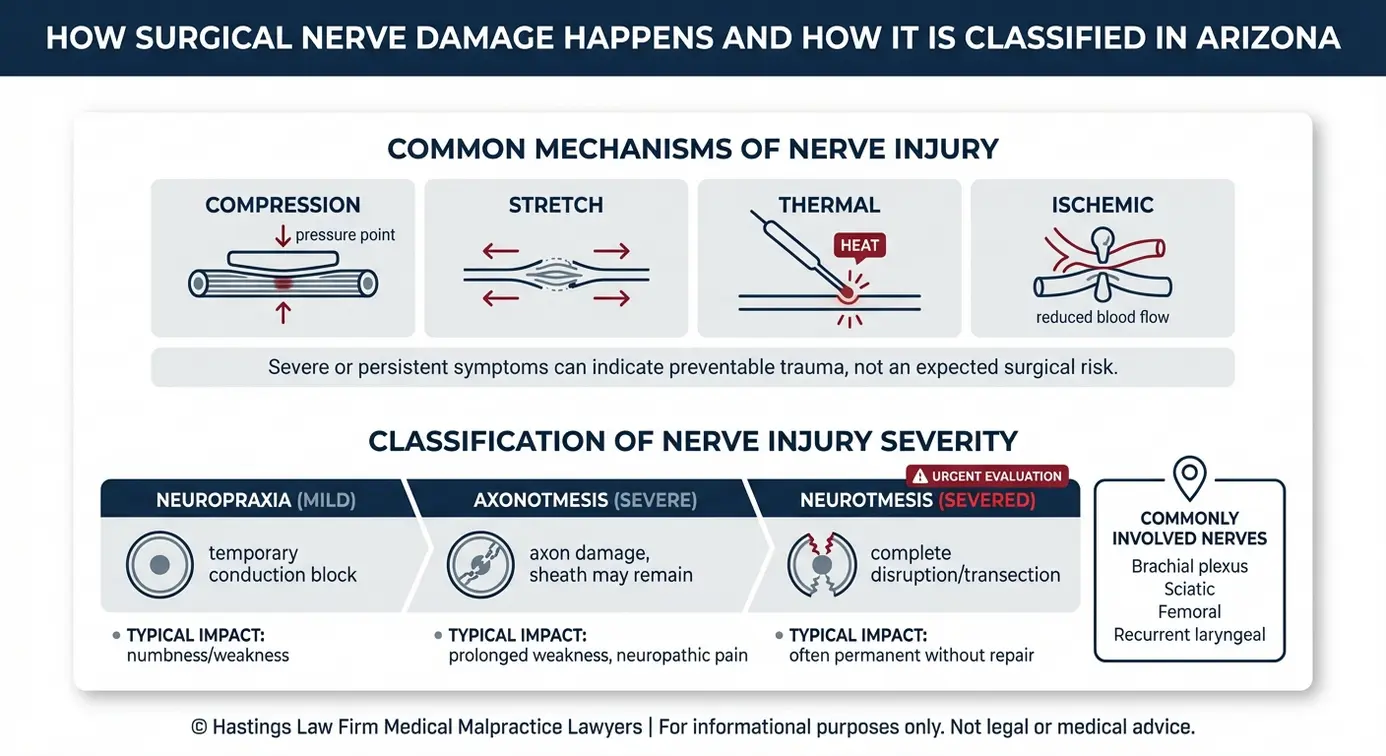
Patients should recognize the difference between temporary sensation loss and permanent damage. Some post-surgical numbness resolves on its own within weeks. When nerve fibers are severely compressed, stretched, burned, or cut during a procedure, the resulting damage can be lasting or irreversible.
The mechanisms behind these injuries generally fall into distinct categories:
- Ischemic nerve injury: Blood flow to the nerve is cut off, often due to prolonged pressure or improper tourniquet use, starving the nerve of oxygen.
- Stretch injuries: A nerve is pulled beyond its tolerance, commonly from aggressive retraction or improper patient positioning.
- Thermal injuries: Heat from electrocautery instruments burns nerve tissue during surgery.
While some degree of risk exists with any surgery, severe nerve damage is often a sign that the standard of care was not followed. Arizona law, under A.R.S. § 12-542, gives patients a limited window to pursue a claim. Consulting an Arizona medical nerve damage lawyer early can help preserve your legal options and the evidence needed to support your case.
Classification of Nerve Injuries
Medical professionals classify nerve injuries by severity, and that classification directly affects both your prognosis and the strength of a potential legal claim. The severity of the injury often determines the legal path forward and the necessary medical treatment.
Neuropraxia is the mildest form. The nerve is bruised but intact, and function typically returns within weeks or months. Axonotmesis is more severe, involving damage to the nerve fibers themselves while the outer sheath remains intact. Recovery is possible but often incomplete and slow.
The most serious classification is neurotmesis, a complete severance or destruction of the nerve. According to the National Center for Biotechnology Information (NCBI Bookshelf), neurotmesis typically requires surgical repair and rarely results in full recovery of function. This type of injury, sometimes called a transection, can affect critical structures like the recurrent laryngeal nerve or the femoral nerve.
When a nerve is completely severed during a procedure, it raises serious questions about what the surgeon was doing and whether proper precautions were taken.
Can I Sue for Nerve Damage After Surgery in Arizona?
You can file a lawsuit if you can prove the nerve damage resulted from a medical provider’s deviation from the accepted standard of care, rather than a known surgical risk. A bad outcome alone is not malpractice, but a preventable error that causes lasting harm can be. A deviation from the standard of care means a healthcare provider did not act as a reasonably competent professional would have under similar circumstances.
One of the most common defenses in these cases is the known risk defense. Surgeons often include nerve injury on pre-operative consent forms, and defense attorneys will argue that the patient accepted this possibility. Defense attorneys frequently rely on the signed consent form to dismiss valid claims, arguing that you agreed to the injury. But signing a consent form does not give a doctor permission to be careless. If the injury was caused by a specific, avoidable mistake, the consent form does not shield the provider from liability.
Under A.R.S. § 12-563, Arizona law requires that a medical malpractice claim establish specific legal elements. To determine whether your case is viable, a nerve damage malpractice lawyer will evaluate whether these core requirements can be met:
- Duty of care: The provider had a professional obligation to treat you according to accepted medical standards. This legal obligation ensures that every patient receives a baseline level of competent medical treatment.
- Breach of duty: The provider failed to meet that standard, whether through an act or an omission. For example, if a surgeon cuts a nerve that should have been identified and protected, this may constitute a breach.
- Causation: The breach directly caused your nerve damage, not the underlying condition or a known risk of the procedure. Your attorney must demonstrate that the specific breach was the primary factor leading to your current condition.
- Damages: You suffered measurable harm, including physical, financial, or emotional losses. Without proof of significant damages, a malpractice case cannot proceed, regardless of the error.
Each of these elements must be supported by evidence. That is why suing for nerve injury requires medical records, expert analysis, and a legal team that understands the medicine behind the claim.
At Hastings Law Firm, our in-house medical staff and former defense attorneys know how to identify the gap between a known complication and a preventable error. We investigate from day one, building the kind of evidence that holds up at trial.
The Hastings Law Firm Difference
Results matter, but what truly sets us apart is how we achieve them. Every verdict, every settlement, and every Arizona courtroom victory comes from one guiding promise: To treat each client’s fight for justice as if it were our own.
This balance of skill, experience, and empathy reflects our core philosophy that justice should not only compensate the injured, but also make healthcare safer nationwide.

Common Causes of Preventable Nerve Injuries During Medical Procedures
Common causes include surgical mistakes such as transection (the accidental cutting of a nerve), improper patient positioning during anesthesia leading to compression, and failure to monitor nerve signals during high-risk procedures. Standard of care refers to the level of caution and skill that a medical professional must provide to avoid these mistakes.
Surgical Errors
During any operation, nerves in the surgical field are at risk. A transection occurs when a surgeon accidentally cuts through a nerve, sometimes while dissecting tissue or controlling bleeding. Thermal nerve injuries can happen when electrocautery instruments are used too close to nerve tissue, causing burns that destroy nerve fibers. These errors are most common in surgeries involving the neck, spine, abdomen, and extremities.
Anesthesia and Positioning Errors
When a patient is under anesthesia, they cannot feel pain or shift their body. That makes proper positioning the responsibility of the surgical team. A compression injury occurs when sustained pressure on a nerve cuts off blood supply, and it is one of the most preventable forms of nerve damage.
Failing to pad bony pressure points, hyperextending a limb, or leaving a patient in the same position for too long are critical patient positioning errors that can all lead to serious injury. Research published in the AORN Journal on Preventing Perioperative Peripheral Nerve Injuries confirms that proper positioning protocols significantly reduce the risk of these injuries.
| Cause of Injury | Mechanism | Common Nerves Affected |
|---|---|---|
| Surgical transection | Nerve accidentally cut during dissection | Recurrent laryngeal, facial, femoral |
| Electrocautery burn | Thermal damage from surgical instruments | Nerves adjacent to surgical site |
| Compression from positioning | Sustained pressure during anesthesia | Brachial plexus, sciatic, ulnar |
| Excessive retraction or stretch | Nerve pulled beyond tolerance | Brachial plexus, femoral |
An Arizona nerve injury attorney can work with medical experts to determine which of these mechanisms applies to your case.
Intraoperative Nerve Monitoring Failures
Intraoperative nerve monitoring (IONM) is a technology designed to track nerve function in real time during surgery, giving the surgical team an early warning if a nerve is being stressed or damaged. Failure to use intraoperative nerve monitoring to track nerve signals during high-risk procedures is a significant oversight. It is standard practice during many spinal, thyroid, and head and neck procedures.
The recurrent laryngeal nerve, which controls the vocal cords, is one of the most commonly monitored nerves during thyroid surgery. When IONM is available and either not used or its alerts are ignored, a resulting injury raises serious questions about whether the surgical team met the standard of care.
IONM devices generate their own electronic data logs, which can become critical evidence. These device records exist independently of the surgeon’s written notes and can reveal exactly when nerve signals changed during the operation.
Proving Medical Negligence in Surgical Nerve Damage Cases
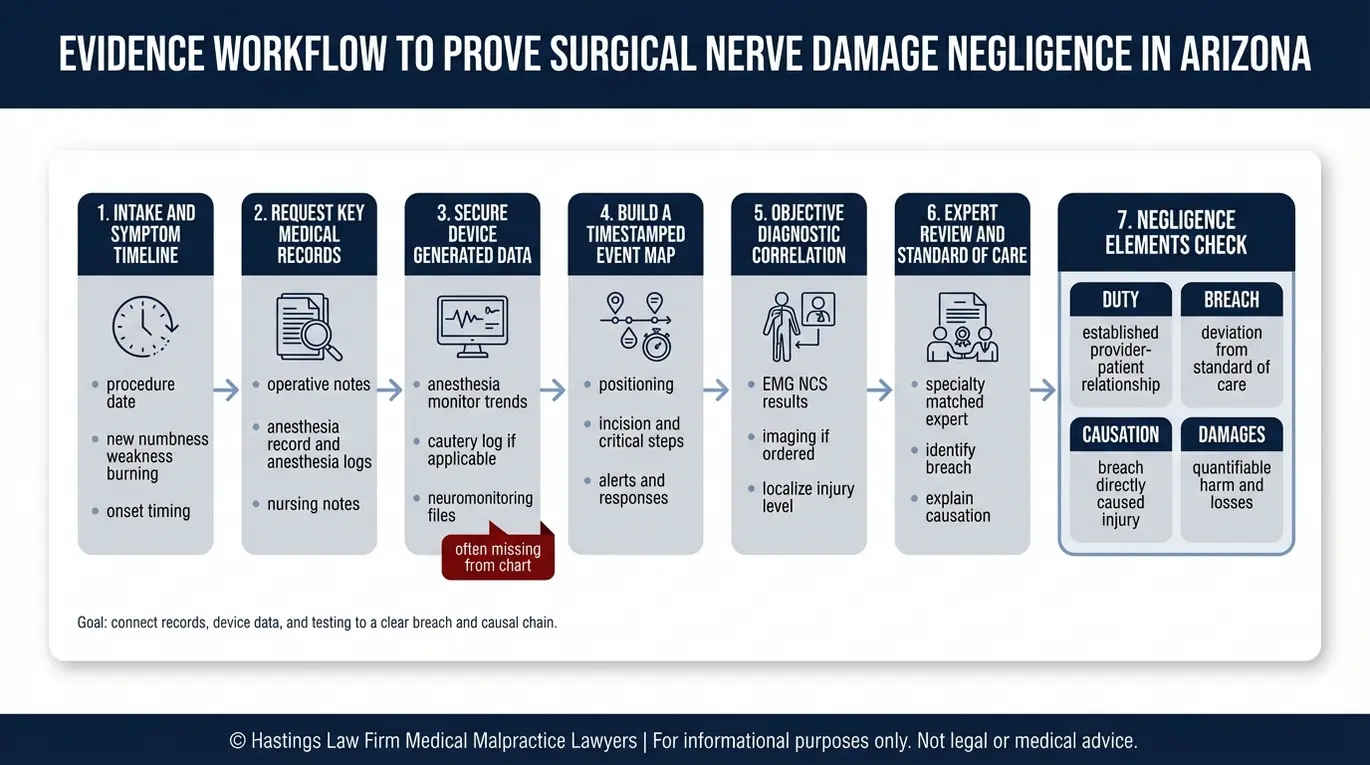
Proving negligence requires obtaining objective evidence such as operative notes, anesthesia logs, and neuromonitoring readouts, verified by expert witness testimony to establish a breach of duty. We build our legal case by reconstructing what happened minute by minute inside the operating room.
Here is how the investigation typically unfolds:
- Step 1: Obtain all medical records. This includes operative notes, anesthesia logs, nursing documentation, and any device-generated data. Patients have a legal right to their records, as outlined by the Assistant Secretary for Technology Policy (ASTP) guide to accessing health records.
- Step 2: Conduct objective diagnostic testing. Electromyography and nerve conduction studies (EMG/NCS), also known as nerve conduction tests, help pinpoint exactly where and when the damage occurred. These tests measure the electrical activity in muscles and the speed of nerve signals. Research in PubMed on needle electromyography suggests timing is important for an accurate diagnosis of the severity and location of the injury.
- Step 3: Retain qualified medical experts. Arizona law requires expert witness testimony. Our national network of specialists reviews the records and testing to determine whether the standard of care was breached and whether that breach caused the nerve injury.
- Step 4: Build the causation timeline. We align the medical records, test results, and expert opinions to establish a clear connection between the provider’s actions and your injury.
At Hastings Law Firm, our in-house nurse consultants and former defense attorneys use their insider knowledge to identify inconsistencies or omissions in medical records that might otherwise go unnoticed.
Utilizing Device-Generated Evidence
Beyond the written surgical notes, modern operating rooms contain equipment that records its own data. Electrocautery machines, anesthesia monitors, and IONM devices all generate electronic logs with precise timestamps.
A thermal nerve injury, meaning a burn caused by an electrocautery instrument, may not be documented in the surgeon’s operative report. But the device’s own usage log can show exactly when and how long the instrument was activated near the affected nerve. Anesthesia logs can reveal positioning changes, blood pressure fluctuations, and the duration of the procedure.
This data is often the most objective evidence available. Our legal team works to preserve and extract this information before it can be overwritten or lost.
Liability: Holding Surgeons and Hospitals Accountable
Liability may extend beyond the lead surgeon to include anesthesiologists for positioning errors, the hospital for equipment failures, or nursing staff for inadequate post-operative monitoring. Liability refers to the legal responsibility for harm caused to a patient. In nerve damage cases, multiple parties can share responsibility depending on what the evidence shows.
The Surgeon may bear direct liability if the nerve was cut, burned, or otherwise damaged through a technical error during the procedure. Operative notes, device logs, and expert analysis help establish whether the injury was caused by a departure from accepted surgical technique, amounting to surgical negligence.
The Anesthesiologist is typically responsible for patient positioning and maintaining the patient’s safety while they are unconscious. If a compression or stretch injury resulted from improper positioning or inadequate padding, the anesthesiologist may be liable. In some cases, the certified registered nurse anesthetist (CRNA) or other members of the anesthesia team may also bear responsibility.
The Hospital or Surgical Facility can be held accountable for systemic failures. This includes failing to maintain or provide functioning IONM equipment, inadequate staffing, hiring unqualified personnel, or failing to enforce safety protocols. In some instances, a facility may be held responsible for its own hospital negligence or through vicarious liability for the actions of its employees.
Hospitals are corporate entities with a duty to ensure their facilities are safe and their staff is competent. When they cut corners on safety equipment or staffing levels, they can be held directly liable for the resulting harm. Identifying every responsible party ensures that the full scope of accountability is addressed.
Compensation for Permanent Nerve Damage and Neuropathy
Compensation includes economic damages for medical bills and lost wages, as well as non-economic damages for chronic pain, loss of sensation, and the emotional toll of physical disability. Damages represent the legal term for the money sought as compensation for your injuries. The value of a nerve injury claim depends on the severity of the damage and how it affects your daily life.
Economic damages cover the financial losses you can measure and document:
- Past and future medical expenses, including surgeries, physical therapy, pain management, and assistive devices. This also includes the projected costs of long-term care if the injury results in permanent disability.
- Lost wages from time missed at work during treatment and recovery. We calculate these figures based on your employment history and pay records.
- Lost earning capacity if the injury prevents you from returning to your previous occupation or working at all. Vocational experts may be retained to estimate the lifetime value of your lost career opportunities.
Non-economic damages address the personal toll of the injury:
- Chronic neuropathic pain, which research published in PubMed Central on neuropathic pain describes as a maladaptive response of the nervous system to damage, often causing persistent sensations. This pain can be debilitating, requiring lifelong medication and management.
- Loss of sensation or motor function that limits daily activities.
- Loss of enjoyment of life and the ability to participate in hobbies, exercise, or family activities. If you can no longer pick up your children or play an instrument you loved, these losses are compensable.
- Emotional distress, anxiety, and depression related to the injury.
Punitive damages are rare but may apply in cases involving gross negligence or reckless disregard for patient safety. These are designed to punish particularly egregious conduct and deter similar behavior.
A nerve injury compensation lawyer can help you identify and document the full extent of your losses so that nothing is left out of your claim.
Arizona Statute of Limitations for Nerve Injury Malpractice Claims
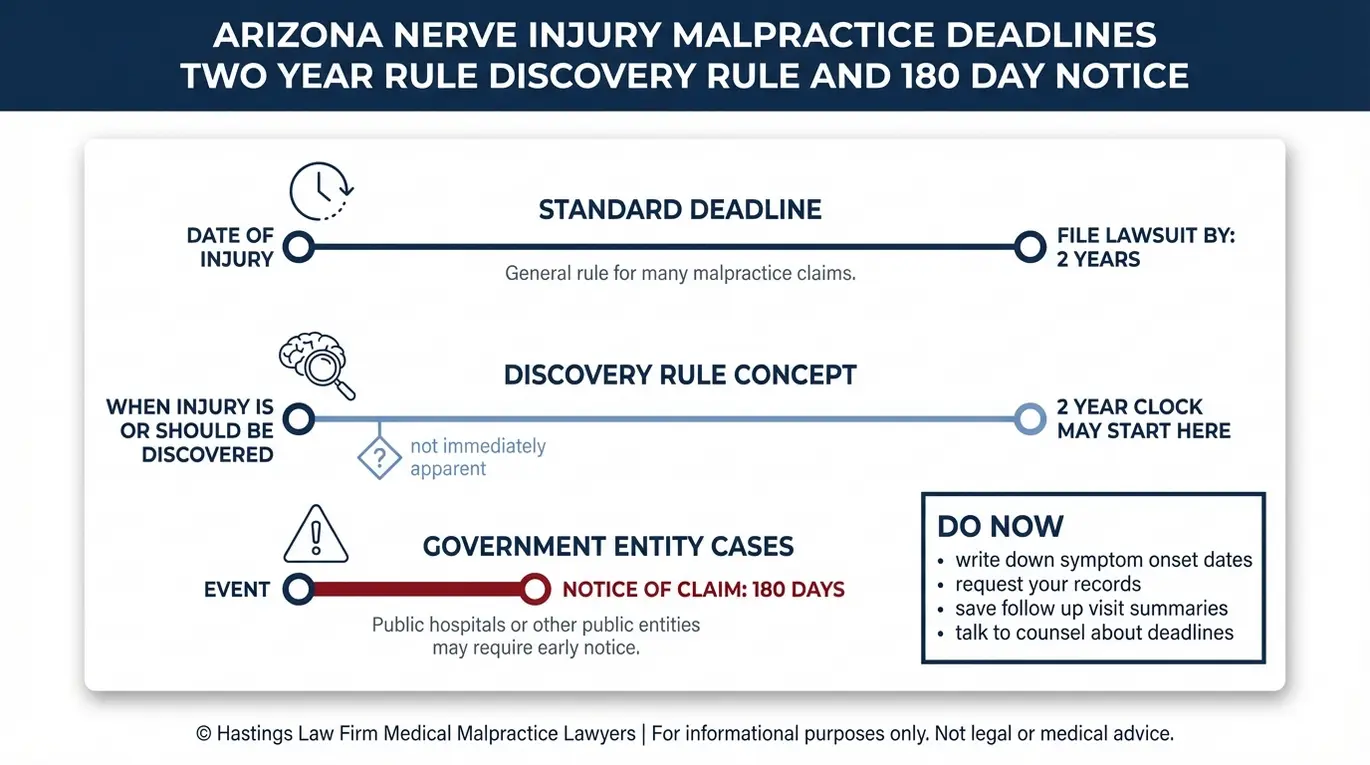
In Arizona, medical malpractice claims must generally be filed within two years of the injury, though the “discovery rule” may extend this deadline if the nerve damage was not immediately apparent. The statute of limitations is the legal deadline for filing a lawsuit. Working through Arizona medical malpractice laws regarding time limits is detailed and important to your case.
The Two-Year Rule: Under A.R.S. § 12-542, you have two years from the date of the injury to file a medical malpractice lawsuit. This deadline applies to most nerve damage claims that arise from surgical or procedural errors.
The Discovery Rule: Nerve damage symptoms do not always appear right away. Numbness, weakness, or pain may develop days or weeks after the procedure. Arizona courts recognize a discovery rule, which can extend the filing deadline to two years from the date you knew, or reasonably should have known, that the injury may have been caused by negligence.
⚠️ Important Deadline Warning: Claims against government-operated hospitals or public healthcare entities in Arizona require a formal Notice of Claim within 180 days of the injury. Missing this deadline can permanently bar your case, regardless of the standard two-year statute of limitations.
Because these deadlines are strict and the exceptions are narrow, consulting an Arizona medical nerve damage lawyer as early as possible is the best way to protect your rights.
Contact the Arizona Healthcare Malpractice Attorneys at Hastings Law Firm Today for Help
A preventable surgical error should not define your future. If you or a loved one is living with nerve damage caused by medical negligence, Hastings Law Firm is here to help you understand what happened and what comes next.
Our board-certified trial attorneys and on-staff medical team will review your medical records, consult with qualified experts, and investigate your case at no upfront cost. We work on a contingency fee basis, which means you pay nothing unless we recover compensation on your behalf.
You do not have to face this alone. Contact Hastings Law Firm today for a free, confidential case evaluation. Let us help you get the answers and accountability you deserve.
Frequently Asked Questions About Medical Nerve Damage in Arizona


This content was researched and written by the Hastings Law Firm editorial team, which includes attorneys, medical professionals, and experienced researchers. Our writing is informed by internal knowledge and practical experience, and we cross-check critical details against authoritative sources cited throughout. Every piece undergoes human-led fact-checking and legal review. Because legal and medical information can change, if you spot an error, please contact us. Learn more about our content standards and review process on our editorial policy page.

Tommy Hastings, founder of Hastings Law Firm, is a board-certified personal injury trial lawyer dedicated exclusively to healthcare injury cases. Since 2001, he has represented injured patients and families in litigation against major hospital systems, pharmaceutical companies, and negligent healthcare providers nationwide. He has handled numerous high-profile cases that have drawn national media attention and resulted in multi-million dollar recoveries. He draws on that experience in his writing, helping readers understand how these cases work and what options may be available to them.
