


Texas Medical Lab Testing Malpractice Lawyer
Written by: Hastings Law Firm | Reviewed by: Brady D. Williams | Updated: July 27, 2026
Medical lab errors can trigger misdiagnosis, delayed care, and unnecessary treatment that leaves lasting physical and emotional harm. These cases often turn on where the breakdown occurred in specimen handling, testing accuracy, or result reporting, and on whether the error can be traced to a specific failure in the testing chain. Accountability may involve a physician, a laboratory, or a hospital depending on each role in ordering, processing, and follow up. If you or a loved one were harmed or worse due to medical lab testing malpractice in Texas, contact Hastings Law Firm for a free, confidential case review.

Trusted Legal Representation for Lab Error Negligence in Texas
What You Should Know About Medical Test Result Negligence Claims in Texas:
- Life changing harm can follow a lab mistake because incorrect results can drive misdiagnosis, delayed care, or unnecessary treatment.
- The most severe outcomes can include wrongful death when a testing failure prevents timely intervention for a treatable condition.
- Responsibility can be disputed because doctors, laboratories, and hospitals have different duties in ordering tests, processing specimens, reporting results, and following up.
- Options can narrow if key requirements are missed because Texas medical malpractice claims face strict timing and expert report consequences.
- Recovery can be limited because Texas caps non economic damages in medical malpractice cases while economic damages are not capped.
- Proving fault can be difficult because liability depends on showing a deviation from accepted laboratory standards and linking it to the injury.
- A case can hinge on specimen integrity because breaks in chain of custody can make it hard to verify whether a result was reliable.
- Hidden systemic problems can drive widespread errors because software failures, miscommunication, or missed calibration can affect many results before detection.
- Critical evidence can be lost because biological specimens and complete lab records may be altered, discarded, or overwritten without preservation.
- Disputes often focus on documentation because medical records may show whether results were transmitted, received, and acted on in time.

A Healthcare Focused Law Firm
When a medical lab makes an error, the consequences often reach far beyond a single test result. A wrong diagnosis, a missed condition, or an unnecessary treatment can change the course of a person’s life. If you or a loved one has been harmed by a laboratory mistake, you may be struggling to understand what went wrong and who should be held accountable.
These cases are technically demanding. They require an understanding of laboratory protocols, clinical regulations, and the medical chain of events that connects a flawed test result to a real injury. Hastings Law Firm focuses exclusively on medical malpractice, and our team includes in-house medical professionals who know how to trace an error back to its source.
If you believe a lab error contributed to a misdiagnosis, delayed treatment, or unnecessary procedure, a Texas medical lab testing malpractice lawyer at our firm can review your situation and explain your options in a free, confidential consultation.
Common Types of Medical Lab Errors in Texas Hospitals
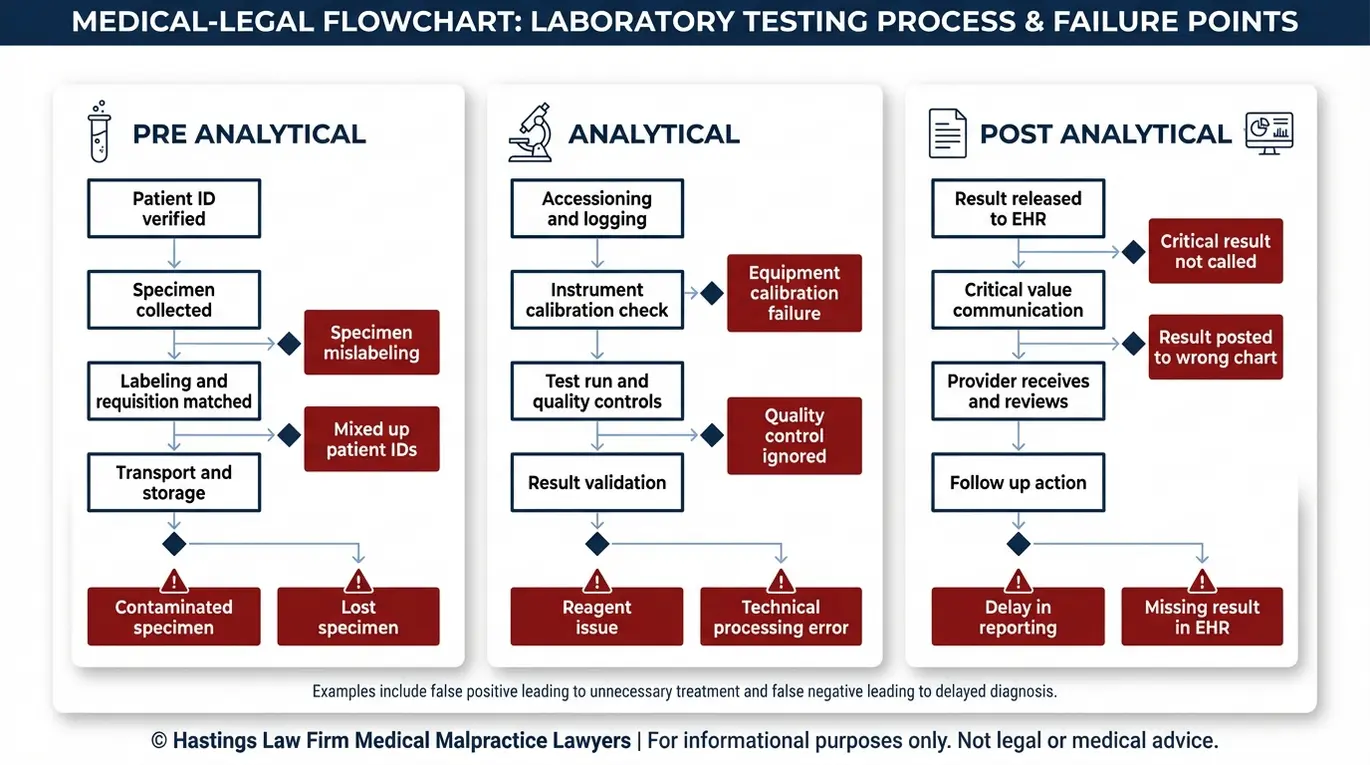
Medical lab errors typically involve pre-analytical mistakes like specimen mislabeling, analytical errors such as equipment calibration failure, or post-analytical errors like failing to communicate critical results to the ordering physician. Each category represents a different point in the testing process where a breakdown can lead to serious patient harm and flawed analytical errors.
Understanding where the error occurred is often the first step in building a case. According to a review published by the National Center for Biotechnology Information (NCBI), diagnostic errors remain one of the most common and consequential forms of medical mistakes. In lab-based cases, those errors tend to fall into three phases.
Pre-Analytical Errors (Before the Test Is Run)
Pre-analytical errors involve the collection and handling of samples before testing begins:
- Specimen mislabeling, which occurs when a sample is tagged with the wrong patient’s information, leading to results being attributed to the wrong person
- Contaminated specimens, meaning samples that are compromised by improper collection technique, storage failure, or exposure to outside substances
- Lost specimens, where samples disappear during transport or intake and are never tested at all
- Incorrect test orders, where the wrong test is requested or a critical test is omitted entirely
Analytical Errors (During the Test)
Analytical errors occur during the actual testing phase when the lab processes the specimen:
- Equipment malfunction or calibration drift producing inaccurate readings
- False positives, where the test incorrectly indicates a disease or condition is present, potentially triggering unnecessary and harmful treatments
- False negatives, where the test fails to detect an existing condition, leading to a delayed diagnosis or no diagnosis at all
- Errors in genetic testing interpretation that can distort risk assessments for hereditary conditions
Post-Analytical Errors (After the Test Is Complete)
Post-analytical errors involve the reporting and communication of results after testing is complete:
- Failure to transmit critical results to the ordering physician
- Results “lost” in the electronic health record (EHR) system, where they sit unread or undelivered
- Transcription errors that alter numerical values or diagnostic codes
- Delayed reporting that causes gaps in time-sensitive treatment decisions
A Texas medical lab malpractice attorney investigates where in this chain the failure occurred. Our team traces the sample from collection through reporting, identifying the specific communication and reporting failures that led to injury. If you are searching for a lawyer for lab test errors, that level of detailed medical reconstruction is exactly what these cases require.
The Consequences of Test Result Negligence: Misdiagnosis & Delayed Care
The primary consequence of lab negligence is misdiagnosis, which often leads to the progression of untreated diseases (like cancer) or the administration of harmful, unnecessary treatments based on incorrect data. In either scenario, the patient bears the physical and emotional burden of someone else’s mistake.
Cancer and Pathology Errors
Some of the most devastating cases involve pathology errors in biopsies. When a malignant tumor is misread as benign, a patient may lose months or even years of treatment time. In oncology, that delayed diagnosis can mean the difference between an early-stage diagnosis with a high survival rate and a late-stage diagnosis with far fewer options.
Conversely, a false positive, where a benign sample is incorrectly classified as cancerous, can lead to aggressive chemotherapy, radiation, or surgery that the patient never needed.
Medication and Dosing Errors
Incorrect lab values can also lead to dangerous medication decisions. Laboratory results guide many medical treatments, including medication prescriptions. If bloodwork reports the wrong level of a drug or enzyme, a physician may prescribe a dosage that is too high, too low, or entirely contraindicated, potentially leading to organ damage or adverse drug reactions.
Genetic Testing Consequences
Errors in genetic screening carry long-term consequences that extend beyond the individual patient. Genetic tests look for specific mutations that can indicate risk for inherited diseases. A false negative, a result incorrectly indicating a condition is absent, on a hereditary cancer panel may cause a family to forgo recommended surveillance or preventive procedures.
A false positive may lead to irreversible decisions about family planning or prophylactic surgery. These outcomes reshape lives based on information that was simply wrong.
In the most severe cases, lab negligence contributes to wrongful death. When a failure to diagnose a treatable condition occurs because of a testing failure, the window for effective intervention can close permanently. A lab negligence lawyer examines whether the error, rather than the underlying disease, is what caused the patient’s outcome to deteriorate.
The Hastings Law Firm Difference
Results matter, but what truly sets us apart is how we achieve them. Every verdict, every settlement, and every Texas courtroom victory comes from one guiding promise: To treat each client’s fight for justice as if it were our own.
This balance of skill, experience, and empathy reflects our core philosophy that justice should not only compensate the injured, but also make healthcare safer nationwide.

Proving Liability: Standard of Care for Clinical Labs
Proving liability requires demonstrating that the lab deviated from the accepted standard of care, such as Clinical Laboratory Improvement Amendments (CLIA) regulations or internal protocols, and that this specific breach directly caused the patient’s injury.
Under Texas Civil Practice and Remedies Code Chapter 74.001, medical malpractice claims, including those against laboratories, must establish the same core elements as any healthcare liability claim: duty, breach, causation, and damages.
Defining the Standard
The standard of care for a clinical lab is what a reasonably competent laboratory would have done under similar circumstances. This includes compliance with Clinical Laboratory Improvement Amendments (CLIA), the federal regulatory requirements governing laboratory testing, and adherence to clinical guidelines and protocols set by accrediting bodies like the College of American Pathologists (as reflected in resources such as the CAP Point of Care Testing Checklist).
Chain of Custody
Chain of custody, the documented trail of a specimen from the moment it is collected from the patient through processing, analysis, and reporting, must remain unbroken. If that chain is broken, whether through mislabeling, mishandling, or a gap in documentation, it becomes difficult for the lab to verify the integrity of the result.
Expert Testimony
Suing a lab for malpractice in Texas requires qualified expert testimony. Under Texas Civil Practice and Remedies Code Chapter 74, plaintiffs must provide an expert report within 120 days of the date each defendant files an original answer. In lab error cases, that expert is often a pathologist, laboratory director, or clinical scientist who can speak to what the standard required and how the lab fell short.
Evidence Preservation Checklist
If you suspect a lab error, the following steps can help protect the evidence needed to support your claim:
- Request that the lab preserve all remaining biological specimens, including slides, tissue blocks, and stored blood or fluid samples
- Obtain complete copies of all lab reports, including any amended or corrected results
- Secure your full medical record from every provider involved in ordering, receiving, or acting on the test results
- Document the timeline of your diagnosis, symptoms, and any treatments that were started or delayed based on the lab result
- Contact a Texas lab error attorney who can issue a formal spoliation letter to prevent the destruction of physical evidence
Systemic Failures: Communication & Equipment Liability
Systemic failures refer to errors caused by technology or process breakdowns rather than a single individual’s mistake. Not every lab error is caused by an individual technician. In some cases, the failure is systemic, rooted in technology or miscommunication between departments.
A laboratory information system (LIS), the software platform that manages test orders, results, and reporting within a lab, can malfunction or fail to interface properly with a hospital’s electronic health record. When that happens, a completed result may never reach the ordering physician, creating a diagnostic delay that the patient has no way of knowing about.
Instrument calibration, the process of verifying that testing equipment produces accurate measurements, is another area where systemic failure occurs. If calibration schedules are missed or quality control checks are skipped, the equipment itself may produce unreliable data across hundreds of patient tests before the problem is identified. These cases may involve product liability claims against equipment manufacturers in addition to negligence claims against the lab.

Who Is Liable? Doctors vs. Third-Party Laboratories
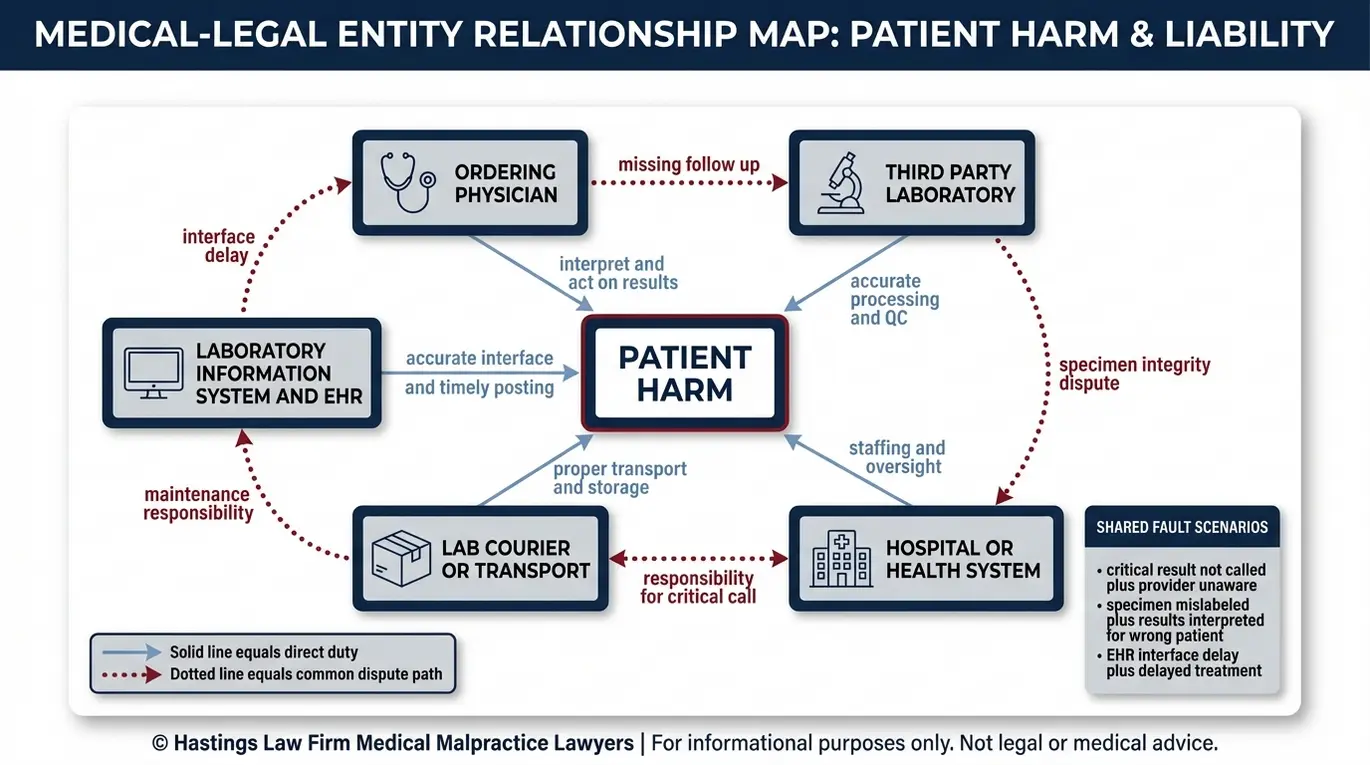
Liability often depends on where the error occurred; the ordering physician is liable for interpreting results, while the third-party lab is liable for processing errors, though both may share fault in cases of communication breakdown.
Determining liability involves identifying which party—the doctor, the lab, or the hospital—failed to meet their specific obligations. This is one of the most contested issues in lab malpractice cases, because each party often points to the other. Understanding who was responsible for what helps with identifying responsible parties and cutting through that dynamic.
| Responsibility Area | Ordering Physician | Clinical Lab | Hospital/Facility |
|---|---|---|---|
| Ordering the correct test | ✔ | ||
| Proper specimen collection and labeling | ✔ (or delegated staff) | ✔ | |
| Accurate processing and analysis | ✔ | ||
| Timely reporting of results | ✔ | ||
| Following up on pending or missing results | ✔ | ||
| Equipment maintenance and calibration | ✔ | ✔ (if in-house lab) | |
| Staffing and training of lab personnel | ✔ | ✔ (if in-house lab) | |
| Acting on critical or abnormal values | ✔ | ✔ (notification duty) |
The Doctor’s Role
A physician who orders a test has a responsibility to follow up on the result. If a report never arrives, the physician cannot simply assume the test was normal. Failure to track pending results in the medical records is a recognized form of diagnostic negligence.
The Lab’s Role
The clinical lab is responsible for the technical integrity of the testing process. This includes histopathology, the microscopic examination of tissue samples used in surgical pathology, as well as genetic testing, which analyzes DNA to assess disease risk or guide treatment. Errors in either discipline can have far-reaching effects on patient care.
The Hospital’s Role
When the lab operates within a hospital system, the facility itself may bear institutional liability, potentially impacting the hospital safety grade, for staffing shortages, deferred equipment maintenance, or failures in its information systems. Our team investigates all of these relationships to identify every responsible party.
Contact the Texas Healthcare Malpractice Attorneys at Hastings Law Firm Today for Help
Lab errors are technical in nature, but the harm they cause is deeply personal. A missed cancer diagnosis, an unnecessary surgery, a treatment that should have started months earlier: these are the real consequences that patients and families live with every day.
Founded by board-certified trial attorney Tommy Hastings, our firm works with nurse consultants and medical professionals to investigate exactly what went wrong. We use our national expert network to maintain relationships with laboratory experts and pathologists who can provide necessary testimony.
We handle every case on a contingency fee basis, which means you pay no attorney fees or costs unless we recover compensation for you. If you need a Texas medical lab testing malpractice lawyer, contact us today for a free, confidential case evaluation. Let us help you find the answers you deserve.
Frequently Asked Questions About Medical Lab Testing Malpractice in Texas


This content was researched and written by the Hastings Law Firm editorial team, which includes attorneys, medical professionals, and experienced researchers. Our writing is informed by internal knowledge and practical experience, and we cross-check critical details against authoritative sources cited throughout. Every piece undergoes human-led fact-checking and legal review. Because legal and medical information can change, if you spot an error, please contact us. Learn more about our content standards and review process on our editorial policy page.

Brady D. Williams is a nationally recognized medical malpractice attorney who has spent his career handling high-stakes litigation for injured patients and families across the country. Licensed in both Texas and California, Brady draws on experience from hundreds of resolved medical cases to break down complex legal and medical topics for the people who need that information most. His writing reflects the same attention to detail and commitment to clarity that he brings to every case he handles.
