


Texas Mammography Malpractice Lawyer
Written by: Hastings Law Firm | Reviewed by: Brady D. Williams | Updated: July 27, 2026
A misread mammogram can delay a breast cancer diagnosis and change treatment options and long term outcomes. Some delays reflect known limits of imaging, but others involve preventable mistakes such as missed findings, incorrect classification, or breakdowns in follow up communication. Texas also has dense breast tissue notification requirements that can affect whether additional imaging is recommended. Understanding how these errors happen and how harm is measured can help families make informed decisions after a serious diagnostic failure. If you or a loved one were harmed or worse due to a misread mammogram in Texas, contact Hastings Law Firm for a free, confidential case review.

Trusted Legal Representation for Mammogram Negligence in Texas
What You Should Know About Mammogram Misdiagnosis Claims in Texas:
- A delayed breast cancer diagnosis can lead to disease progression and more aggressive treatment when a mammogram is misread.
- A negligence dispute often turns on whether the outcome reflects known imaging limits or a preventable professional error.
- A BI RADS assessment that does not match the images can lead to lost time and delayed follow up care.
- A failure to recommend additional imaging when dense breast tissue is known can leave important findings undetected.
- A failure to compare current mammograms with prior studies can allow gradual changes to be missed.
- A breakdown in communicating suspicious results can delay biopsy and treatment even when an abnormality is identified.
- Options can narrow quickly in claims involving Texas public hospitals because special notice rules can bar recovery if missed.
- Recovery can be limited in Texas because non economic damages are capped even when medical bills and lost income are substantial.
- Proving a delayed diagnosis claim can depend on imaging studies, pathology reports, and qualified expert review of the original films.

A Healthcare Focused Law Firm
When a mammogram is misread and breast cancer goes undetected, the consequences can be life-altering. A delayed diagnosis may mean the difference between early-stage treatment and a far more aggressive fight against advanced disease. If you or a loved one experienced a missed or delayed breast cancer diagnosis because of a mammography error, you have the right to ask what went wrong and to hold the responsible parties accountable.
At Hastings Law Firm, our team of attorneys, in-house nurse consultants, and former defense lawyers focuses exclusively on medical malpractice litigation. As Texas mammography malpractice lawyers, we understand both the medical science behind imaging failures and the legal strategy needed to prove them. Contact us for a free, confidential case evaluation so we can review what happened and explain your options.
Understanding Mammography Malpractice and Diagnostic Errors
Mammography malpractice occurs when a radiologist fails to meet the standard of care while reading diagnostic imaging, leading to a false negative or delayed diagnosis of breast cancer that allows the disease to advance to a more dangerous stage. Mammography uses low-dose X-rays to create images of breast tissue and search for signs of disease. Knowing the distinction between a known limitation of the technology and an actual error in professional judgment is essential.
A screening mammogram is a routine exam used to detect breast cancer in patients who have no symptoms. A diagnostic mammogram, by contrast, is ordered when a patient already has symptoms or an abnormal finding that needs closer evaluation. Both types of mammograms are interpreted using a standardized classification system called BI-RADS, the Breast Imaging Reporting and Data System, which assigns a score from 0 to 6 to guide follow-up recommendations. When a radiologist assigns a score that does not match what the images actually show, critical time can be lost.
The American Cancer Society screening guidelines help establish a baseline for when and how often women should be screened. These guidelines, combined with Texas-specific mandates like those found in Insurance Code Chapter 1356, set the framework that a Texas mammogram lawyer uses to measure whether a radiologist’s actions fell below what the profession requires.
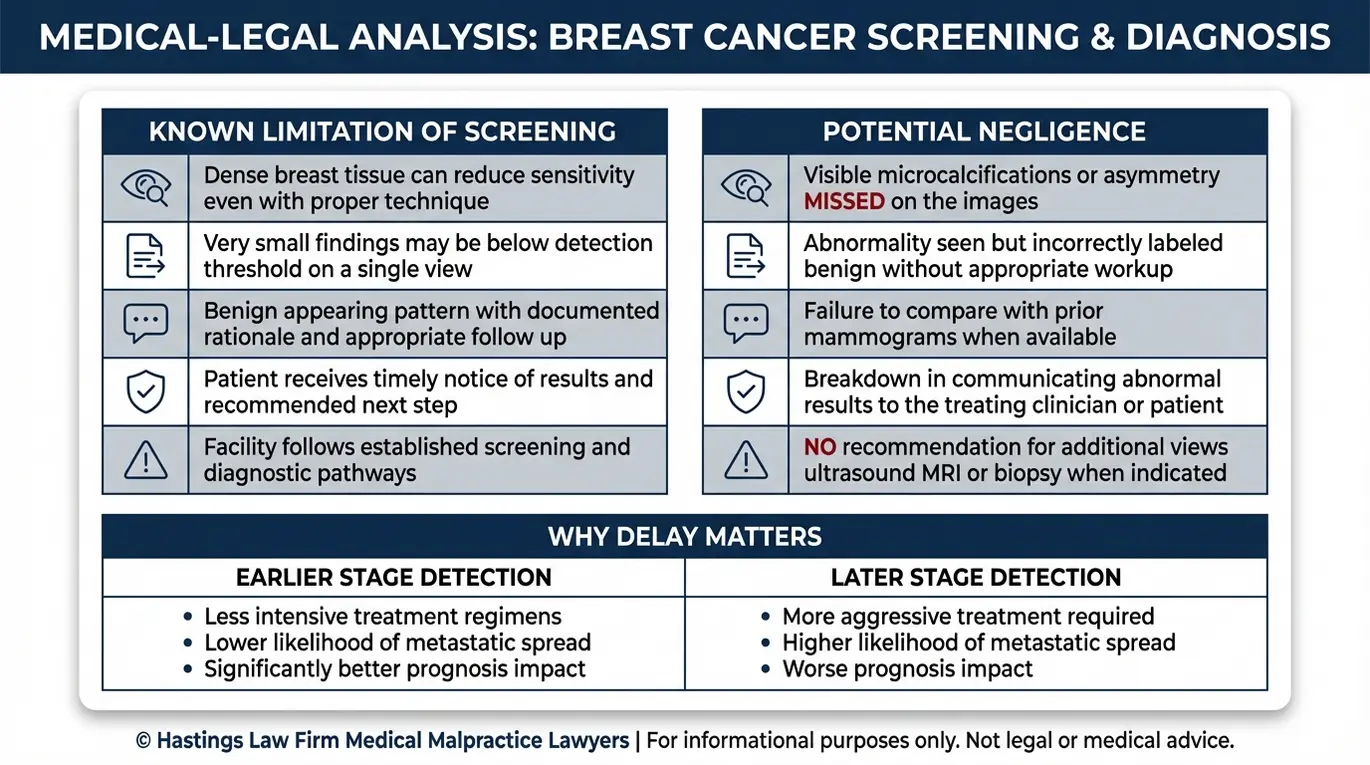
The difference between a known complication and actionable negligence comes down to the breach of duty. Mammograms are not perfect; dense tissue, overlapping structures, and subtle findings can make interpretation challenging. These are known limitations. But when a radiologist overlooks clearly visible abnormalities, fails to recommend additional imaging, or does not compare current scans to prior studies, the error moves beyond an inherent limitation and into potential negligence.
The stakes of a missed diagnosis are severe. According to data from the National Cancer Institute’s SEER program, the five-year survival rate for localized breast cancer is approximately 99% or higher. When cancer is not caught until it has spread to distant organs, that rate drops to around 31–33%.
A delay caused by a misread mammogram can directly affect the stage of a patient’s diagnosis. The survival difference between those stages is the foundation of a cancer misdiagnosis claim. Mammography malpractice attorneys build their cases around proving that the delay changed the patient’s prognosis and the course of treatment they were forced to endure.
Common Errors Committed by Radiologists in Texas
Common radiological errors include failing to identify microcalcifications (tiny calcium deposits that can signal early-stage cancer), dismissing abnormalities in dense breast tissue without ordering follow-up imaging, and overlooking asymmetrical density patterns that call for additional views or biopsy. Recognizing these specific mistakes is the first step in determining if negligence occurred.
Perceptual errors happen when the abnormality is present and visible on the scan, but the radiologist simply does not see it. Research published in PMC on “satisfaction of search” phenomena shows that identifying one finding may cause a radiologist to stop looking for others. This cognitive pattern can cause a second, potentially more dangerous lesion to go unnoticed.
Interpretation errors occur when the radiologist sees an abnormality but incorrectly classifies it as benign. For instance, a cluster of microcalcifications might be incorrectly dismissed as routine. This leads to patients being sent home without necessary biopsy or ultrasound.
Comparison failures involve a radiologist’s failure to perform a longitudinal comparison. This means they do not review the current mammogram alongside prior imaging from previous years. Subtle changes over time, such as a slowly growing mass or gradually increasing calcifications, can be invisible on a single image but obvious when compared side by side.
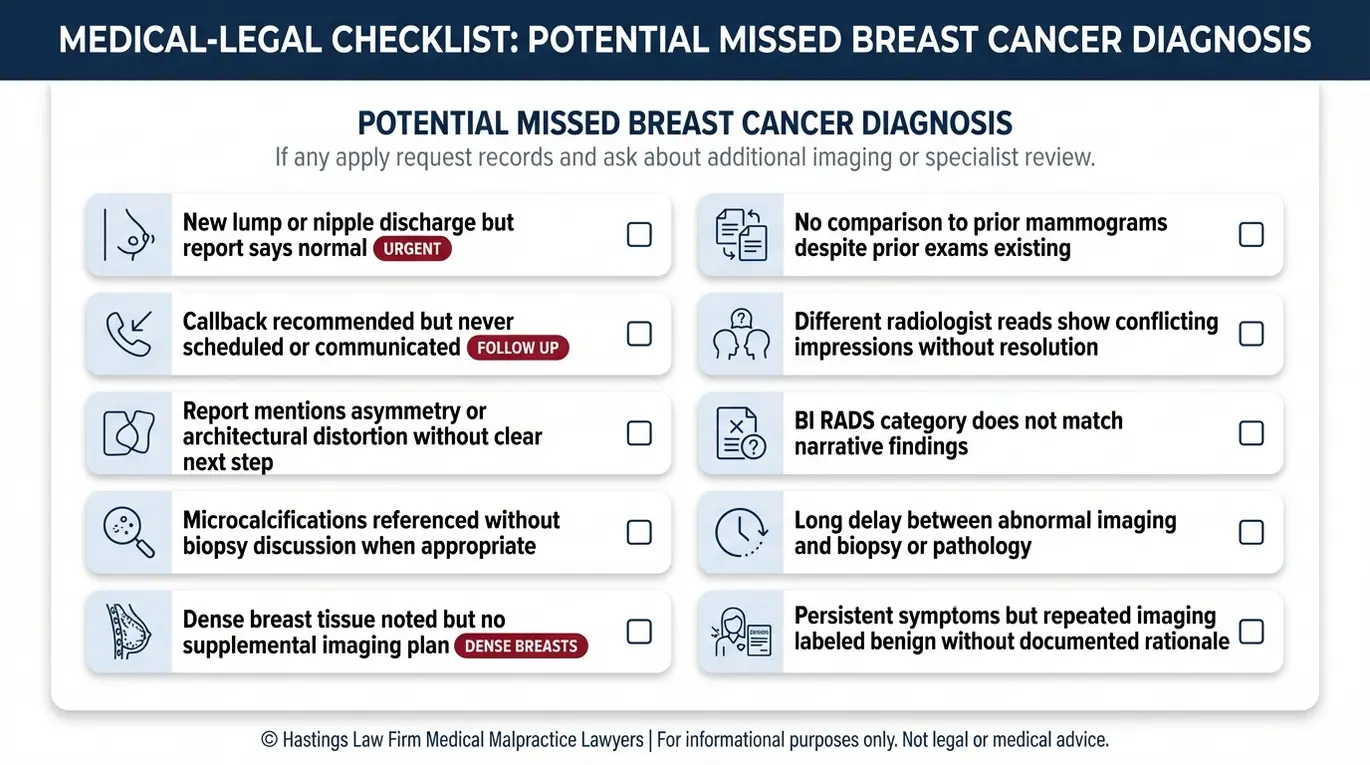
A mammogram malpractice lawyer in Texas examines the diagnostic chain to find the breakdown. Key red flags include:
- A BI-RADS score that does not match the visible findings on the image
- No recommendation for supplemental imaging (ultrasound or MRI) despite dense breast tissue
- Failure to compare current mammograms with available prior studies
- No follow-up recommendation after an inconclusive or suspicious finding
- Delayed communication of results to the referring physician or the patient
Each of these breakdowns can support a negligence claim when it leads to a delayed breast cancer diagnosis. As noted in research from the Texas A&M University School of Law, the liability framework in Texas requires careful documentation of both the error itself and the harm it caused.
Henda’s Law and Dense Breast Tissue Notifications
Texas House Bill 2102, known as Henda’s Law, requires mammography facilities to notify patients in writing if their breast tissue is classified as dense. Henda’s Law is a specific Texas statute that improves transparency regarding breast density. Dense breast tissue matters because it can mask tumors on a standard mammogram, significantly reducing the sensitivity of the exam. When tissue is dense, supplemental breast imaging, such as a screening ultrasound or breast MRI, may be necessary to detect cancers that a mammogram alone would miss.
If a facility fails to provide the required dense breast tissue notification, or if a radiologist does not recommend appropriate supplemental imaging for a patient with known dense tissue, that failure can form the basis of a negligence claim. The notification requirement exists precisely because patients deserve the information needed to advocate for their own care, and providers have a duty to supply it.
The Hastings Law Firm Difference
Results matter, but what truly sets us apart is how we achieve them. Every verdict, every settlement, and every Texas courtroom victory comes from one guiding promise: To treat each client’s fight for justice as if it were our own.
This balance of skill, experience, and empathy reflects our core philosophy that justice should not only compensate the injured, but also make healthcare safer nationwide.

Establishing Liability Against Texas Radiologists
To prove liability in a mammography negligence case, a Texas mammography malpractice lawyer must show that a competent radiologist acting under similar circumstances would have identified the malignancy and that the delay in diagnosis directly caused a worsening of the patient’s prognosis. The legal process for holding a medical professional accountable involves proving several specific elements.
Breach of duty requires demonstrating that the radiologist’s reading of the imaging studies fell below the accepted standard of care. This is where expert testimony becomes central. Under Texas law, a qualified medical expert, usually a board-certified radiologist, must review the original images and explain what a competent peer would have identified. As outlined in the University of Houston Law Center’s medical malpractice analysis, the breach must be supported by specific clinical evidence, not just a bad outcome.
Duty is typically the most straightforward element. The moment a radiologist accepts and interprets a patient’s mammogram, a doctor-patient relationship exists and a professional duty of care attaches.
Causation connects the radiologist’s error to the patient’s harm. In delayed diagnosis cases, this means proving that the cancer advanced during the period of delay and that earlier detection would have led to a better outcome. An interval cancer, one that develops or becomes detectable between scheduled screenings, must be distinguished from a cancer that was already visible but missed. Cancer staging is the primary metric used to measure how much the delay affected the patient’s condition.
Communication failures represent a separate theory of negligence. Even when a radiologist correctly identifies a suspicious finding, the result must be communicated promptly to the ordering physician and the patient. Breakdowns in the reporting chain between the radiology lab and the treating doctor can delay biopsy, pathology analysis, and treatment by weeks or months.
A mammography negligence attorney must prove each element through medical records, imaging studies, pathology reports, and qualified expert testimony. At Hastings Law Firm, our in-house nursing staff and national network of medical experts help reconstruct the clinical timeline and identify exactly where the standard of care was violated.
The essential elements of a mammography malpractice claim include:
- A doctor-patient relationship existed at the time of the imaging study
- The radiologist failed to identify or properly classify a visible abnormality
- The misread directly caused a delay in diagnosis and treatment
- The patient suffered measurable harm, including disease progression, more aggressive treatment, or reduced survival odds
- A qualified expert has confirmed the breach and its connection to the harm

Legal Barriers Involved in Public Hospital Litigation
Suing a public hospital in Texas is governed by the Texas Tort Claims Act, which imposes strict notice deadlines and requires proof that the injury resulted from the use of “tangible personal property,” a legal hurdle that complicates many misdiagnosis cases. Lawsuits against government entities follow different procedural rules than those against private hospitals. Sovereign immunity can shield government-run hospitals from certain legal claims. In a mammography case, the defense may argue that misinterpreting an image is a failure of professional judgment rather than the “use” of physical equipment.
This distinction matters because the law generally protects government-run hospitals from lawsuits unless the claim fits within specific, narrow exceptions. A medical malpractice lawyer for mammogram errors will evaluate whether the diagnostic testing workflow can be tied to the alleged negligence in a way that satisfies the tangible property requirement.
There is an important distinction between the public hospital itself and the radiologists who work there. Radiology services at public hospitals are frequently provided by independent contractors or private physician groups. These third-party contractors typically do not share the hospital’s sovereign immunity and can be sued under standard medical negligence laws. Identifying the correct defendant early in the case is important to preserving a viable claim.
Time is a serious concern in public hospital cases. Notice deadlines for claims against public entities can be as short as 90 days or six months, depending on the governmental body. Missing this window can eliminate the right to file a lawsuit entirely, whether for personal injury or wrongful death. These notice deadlines are distinct from the standard statute of limitations.
Recovering Compensation for the Harms of Delayed Diagnosis
Patients harmed by mammography errors may be entitled to both economic and non-economic damages based on the full scope of harm caused by the delayed diagnosis. Damages are the financial compensation sought for injuries and losses in a legal case. When breast cancer progresses because of a missed finding, the financial and personal toll can be significant.
| Economic Damages | Non-Economic Damages |
|---|---|
| Cost of additional chemotherapy, radiation, or surgery that early detection may have avoided | Physical pain and suffering from more aggressive treatment |
| Lost wages and reduced earning capacity during extended treatment | Mental anguish, anxiety, and emotional distress |
| Ongoing medical monitoring and follow-up care | Loss of enjoyment of life and daily activities |
| In-home care, rehabilitation, and related expenses | Disfigurement or permanent physical changes from advanced-stage treatment |
In wrongful death cases, surviving family members may pursue compensation for funeral expenses, lost financial support, loss of companionship, and mental anguish. Economic damages such as medical bills and lost wages are not subject to statutory caps in Texas, though non-economic damages are limited under Chapter 74 of the Texas Civil Practice and Remedies Code.
Contact the Texas Healthcare Malpractice Attorneys at Hastings Law Firm Today for Help
If a delayed or missed mammogram diagnosis affected your cancer treatment or the health of someone you love, our team is here to help you find answers. Founded by Tommy Hastings, a board-certified trial lawyer with over 20 years of experience, our firm focuses exclusively on medical malpractice litigation. We prepare every case from day one as if it will go to trial, ensuring we are ready to present evidence to a jury.
Our team uses former defense attorneys’ insights to anticipate hospital tactics and a national network of medical experts to evaluate imaging failures. We work to reconstruct the clinical timeline and determine who should be held accountable for the harm you have suffered.
We work on a contingency fee basis, which means you pay no attorney fees or costs unless we recover compensation for you. Contact us today to schedule a free, confidential case evaluation with one of our patient advocates.
Frequently Asked Questions About Mammography Center Malpractice in Texas


This content was researched and written by the Hastings Law Firm editorial team, which includes attorneys, medical professionals, and experienced researchers. Our writing is informed by internal knowledge and practical experience, and we cross-check critical details against authoritative sources cited throughout. Every piece undergoes human-led fact-checking and legal review. Because legal and medical information can change, if you spot an error, please contact us. Learn more about our content standards and review process on our editorial policy page.

Brady D. Williams is a nationally recognized medical malpractice attorney who has spent his career handling high-stakes litigation for injured patients and families across the country. Licensed in both Texas and California, Brady draws on experience from hundreds of resolved medical cases to break down complex legal and medical topics for the people who need that information most. His writing reflects the same attention to detail and commitment to clarity that he brings to every case he handles.
