


Texas IV Fluid Contamination Lawyer
Written by: Hastings Law Firm | Reviewed by: Gabe Sassin | Updated: July 27, 2026
Contaminated IV fluids can introduce bacteria or toxins directly into the bloodstream, turning routine hospital care into a serious infection with lasting harm or fatal outcomes. These events can be linked to problems in manufacturing, pharmacy compounding, or hospital storage and administration, and the source is often disputed. Proving what happened can become harder if key materials are discarded and records are incomplete. If you or a loved one were harmed or worse due to contaminated IV fluids in Texas, contact Hastings Law Firm for a free, confidential case review.
Trusted Texas Medical Attorneys for Contaminated IV Malpractice Claims
What You Should Know About Contaminated IV Malpractice Claims in Texas:
- Outcomes can be severe when contaminated IV fluids enter the bloodstream, including sepsis, organ failure, septic shock, and fatal outcomes.
- Responsibility can fall on more than one party when contamination occurs, including a manufacturer, a compounding pharmacy, or a hospital.
- Recovery can turn on whether the infection source is traced to the IV product rather than another hospital related source.
- Options can narrow if physical evidence is discarded, since used IV bags and tubing are often disposed of under routine protocols.
- Recovery can be limited for non economic harms in Texas, since statutory caps apply to non economic damages in health care liability claims.
- Case viability can be affected if required expert support is not provided on time, since Texas imposes an expert report requirement that can lead to dismissal.
- Causation can be strengthened when lab findings link the bloodstream bacteria to the product, including through genetic sequencing.
- Proof can depend on documentation that ties a patient to a specific product, including lot numbers and recall information.

A Healthcare Focused Law Firm
When a hospital gives intravenous (IV) fluids, liquid solutions delivered directly into a vein to provide hydration or medication, those solutions enter the bloodstream directly, bypassing every natural barrier your body has against infection. Patients trust that these fluids are sterile and safe. When that trust is broken by contaminated IV products, the consequences can be severe and life-altering.
If you or a loved one developed a serious infection after receiving IV therapy, you may be dealing with mounting medical bills, unanswered questions, and a deep sense of betrayal. You deserve to know what happened, and you deserve a legal team with the medical knowledge to find out.
As a Texas IV fluid contamination lawyer, Hastings Law Firm brings together former defense attorneys, in-house nurse consultants, and a national network of medical experts to investigate exactly how and where contamination occurred. We can review what happened in your case and explain your legal options during a free, confidential evaluation.
Health Risks and Sepsis Caused by Contaminated IV Fluids
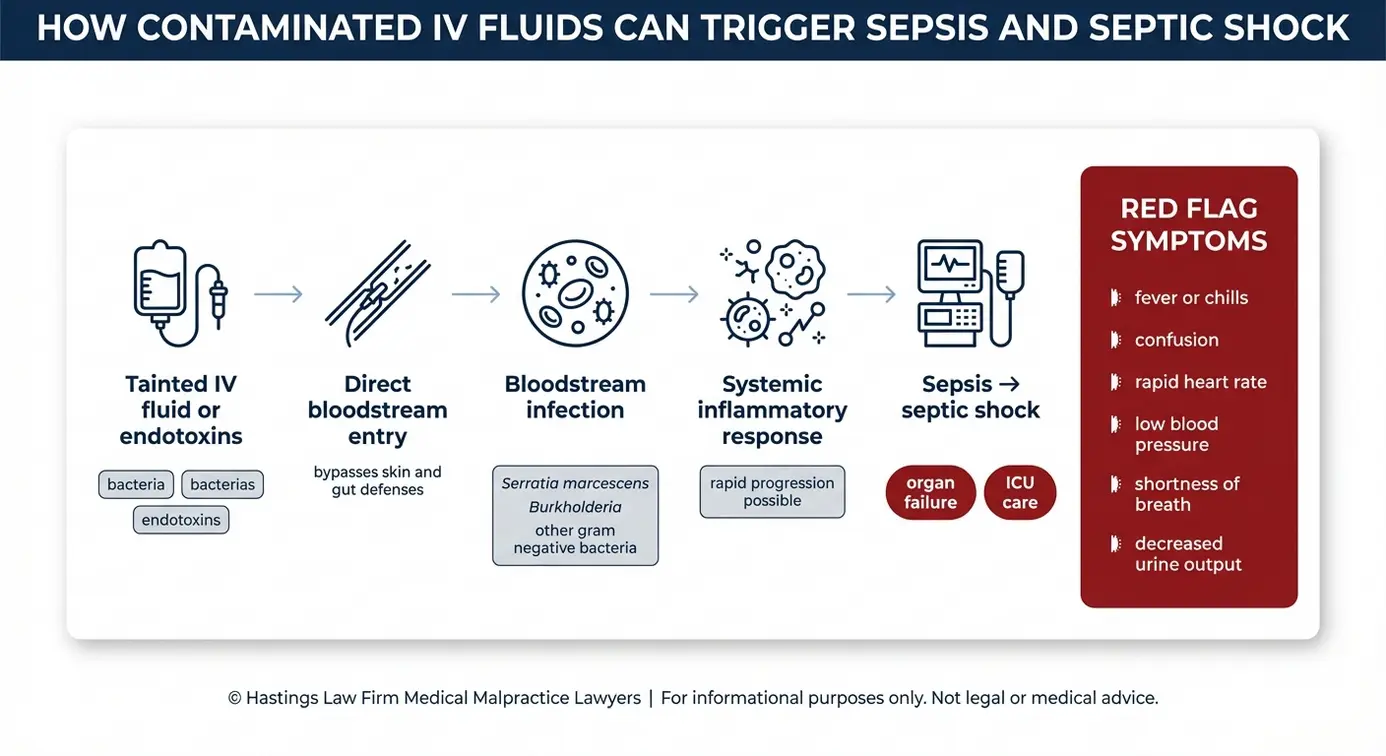
Contaminated IV fluids can introduce dangerous bacteria directly into the bloodstream, leading to sepsis, organ failure, and septic shock, conditions that often require intensive care and can be fatal.
To understand why these cases are so serious, consider what IV therapy is designed to do. IV fluids deliver medication, nutrition, or hydration straight into a vein. This direct access to the circulatory system is precisely what makes contaminated fluids so dangerous. Unlike ingesting something harmful, where the digestive system provides some defense, bacteria or toxins entering through an IV line meet no resistance. They spread through the body rapidly, overwhelming the immune system before doctors can identify the source.
When tainted IV bags reach a patient, the pathogens inside can trigger a cascade of immune responses. The Centers for Disease Control and Prevention (CDC) defines sepsis as the body’s extreme response to an infection and calls it a life-threatening medical emergency. What may begin as a fever or chills can escalate within hours to septic shock, a condition marked by dangerously low blood pressure, organ failure, and tissue death.
Several specific organisms have been linked to contaminated IV products and compounding failures:
- Serratia marcescens, a bacterium commonly associated with contaminated medical solutions and hospital-acquired bloodstream infections, is particularly dangerous because it thrives on moist surfaces and can survive in nutrient-poor environments.
- Burkholderia species, a group of pathogens which the CDC linked to contaminated nonsterile products in a documented outbreak investigation.
- Endotoxins, toxic substances released by certain bacteria that can trigger widespread inflammation even after the bacteria themselves are destroyed.
The how the illness develops from initial exposure to critical illness can happen quickly. Early symptoms may include:
- Sudden fever and chills during or shortly after IV infusion
- Rapid heart rate and low blood pressure
- Confusion or altered mental state
- Skin discoloration or mottling
- Decreased urine output, signaling kidney distress
For patients already hospitalized with other conditions, these symptoms can be mistaken for complications of the underlying illness, delaying the recognition that the IV fluid itself is the source. A contaminated IV fluid attorney can work with infectious disease specialists to trace the infection back to the contaminated product, showing the critical link between what was administered and what went wrong.
Establishing Liability: Hospital Negligence vs. Manufacturing Defects
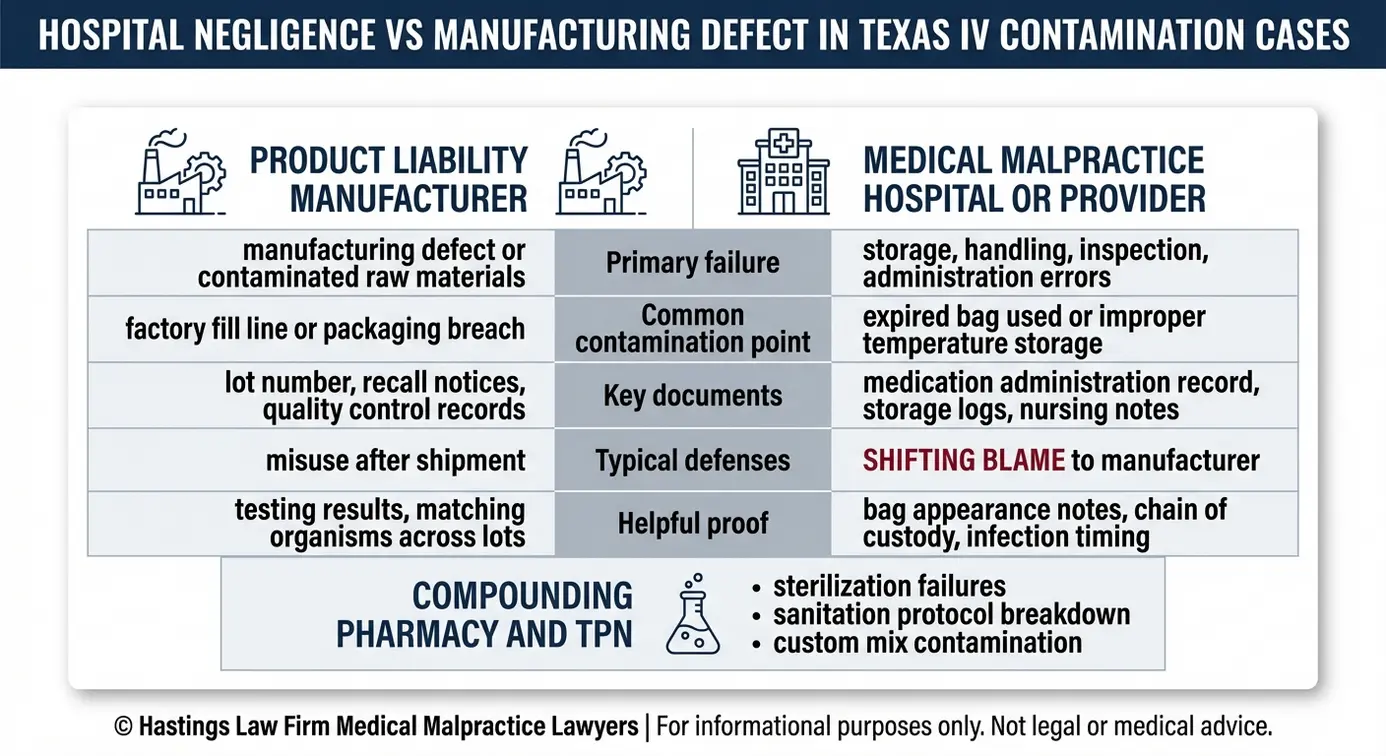
Liability in IV contamination cases may lie with the pharmaceutical manufacturer for producing defective bags, the compounding pharmacy for sanitation failures, or the hospital for improper storage and administration. In many cases, more than one party is responsible.
Manufacturer and product liability claims focus on defects at the factory level. If bacteria or endotoxins were present in the sealed product before it ever reached a hospital, the manufacturer may be strictly liable for a manufacturing defect. This means a patient need only prove the product was defective and caused harm, not that the manufacturer was careless.
Hospital and provider negligence claims address failures in how IV fluids are stored, handled, and administered. Hospitals have a duty of care to inspect bags for cloudiness or particulate matter, verify expiration dates, and maintain proper storage temperatures. A Texas IV contamination malpractice lawyer evaluates whether the facility followed these protocols or if shortcuts contributed to the patient’s infection.
| Factor | Manufacturer / Product Liability | Hospital / Provider Negligence |
|---|---|---|
| Legal Theory | Strict liability or manufacturing defect | Medical malpractice (breach of duty) |
| Focus of Investigation | Factory conditions, raw materials, sealed product testing | Storage protocols, visual inspection, administration technique |
| Key Evidence | Lot numbers, FDA recall data, batch testing results | Temperature logs, nursing documentation, chain-of-custody records |
| Standard Applied | Product was defective when it left the manufacturer | Provider failed to meet the accepted standard of care |
Pharmacy Compounding and TPN Contamination Mechanisms
Some of the highest-risk IV contamination cases involve pharmacy compounding, the process of mixing customized medications or nutrient solutions for individual patients. Total parenteral nutrition (TPN), a specialized IV formula that delivers essential nutrients directly to patients who cannot eat, is one of the most common compounded products linked to contamination events. Compounding involves creating custom medical solutions for patients in a sterile environment.
Unlike mass-produced IV bags, compounded solutions are often prepared in hospital pharmacies or by third-party compounding pharmacies. Sterile compounding, also called aseptic technique, requires rigorous environmental controls like laminar airflow hoods and gowning procedures. It also involves strict time limits known as beyond-use dates (BUDs). This is the window during which a product can be safely administered before the risk of bacterial growth becomes unacceptable.
When sanitation protocols break down through improper cleaning, inadequate training, or exceeding a product’s beyond-use date, bacteria can colonize the solution before it ever reaches the patient. Because TPN is nutrient-rich, it provides an ideal growth medium for organisms like Serratia marcescens, allowing bacterial counts to multiply rapidly in a short period.
The Hastings Law Firm Difference
Results matter, but what truly sets us apart is how we achieve them. Every verdict, every settlement, and every Texas courtroom victory comes from one guiding promise: To treat each client’s fight for justice as if it were our own.
This balance of skill, experience, and empathy reflects our core philosophy that justice should not only compensate the injured, but also make healthcare safer nationwide.

Investigating IV Infection Cases and Texas Chapter 74 Requirements
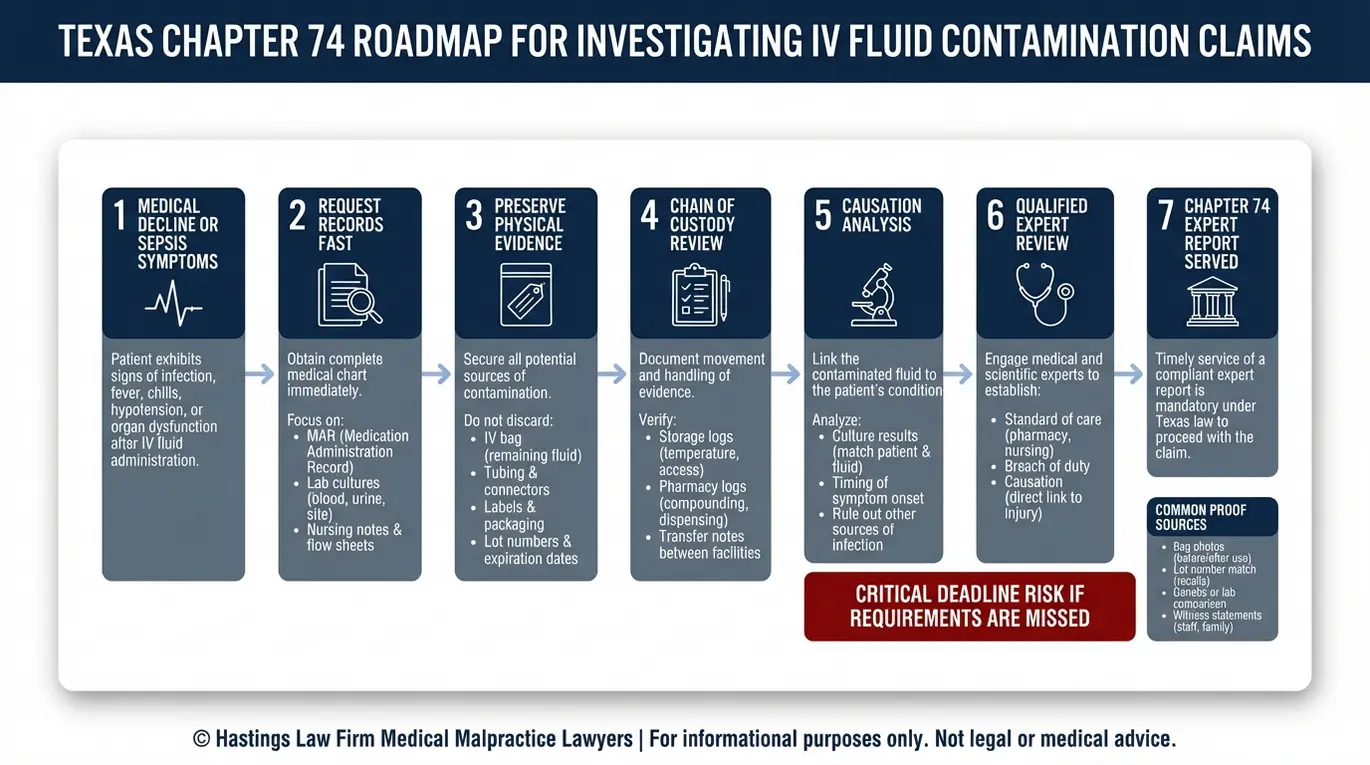
Investigating these cases requires securing the actual IV bag for testing, reviewing chain-of-custody logs, and obtaining expert reports as mandated by Texas Chapter 74 to prove the source of the bacteria.
Time is the single most important factor once contamination is suspected. Hospitals routinely dispose of used IV bags and tubing as part of standard waste protocols. If that physical evidence is destroyed, proving the source of a bloodstream infection (BSI), an infection confirmed by blood cultures showing bacteria that entered through the vascular system, becomes significantly harder.
A Texas IV fluid injury attorney typically takes immediate steps to help evidence collection:
- Sending a formal spoliation letter to the hospital demanding preservation of the IV bag, tubing, and associated lot documentation
- Requesting pharmacy compounding records, including environmental monitoring logs and staff assignments
- Securing the patient’s complete medical records, blood culture results, and antibiotic administration timelines
- Using genetic sequencing to match bacteria found in the patient’s blood to bacteria found in the product, such as Serratia marcescens
The Chapter 74 requirement adds another layer of urgency. Under Texas Civil Practice and Remedies Code Chapter 74, any health care liability claim requires the plaintiff to serve a qualified expert report within 120 days after the date each defendant’s original answer is filed. This report must identify the standard of care, explain how it was breached, and connect that breach to the patient’s injury. If the report is not served on time, the court must dismiss the case.
Causation is often the most contested element. Defense teams will argue the infection originated from another source, such as a surgical site, a urinary catheter, or the patient’s own compromised immune system. Genetic testing and expert testimony help show whether the specific strain of bacteria in the patient’s bloodstream matches what was found in the contaminated fluid or compounding environment.
At Hastings Law Firm, our in-house nurse consultants and former defense attorneys know exactly what records to request and what the defense will challenge. We begin this investigative work from day one.
Compensation for Sepsis Injuries and Wrongful Death
Victims of IV contamination may recover damages for medical bills (past and future), lost wages, physical pain, mental anguish, and in fatal cases, wrongful death damages for the surviving family.
Economic damages cover the measurable financial losses tied to the injury. For sepsis and bloodstream infection cases, these costs can be substantial. Extended ICU stays, emergency dialysis, long-term intravenous antibiotic therapy, and follow-up care for organ damage all generate significant expenses. Lost wages and diminished earning capacity also fall into this category, particularly for patients whose recovery takes months or results in permanent limitations.
Non-economic damages address the harm that does not come with a receipt, including pain and suffering. The physical pain of septic shock, the psychological toll of a hospital-acquired infection, and the lasting erosion of trust in the medical system are all compensable under Texas law. For many of our clients, the emotional weight of learning that a routine IV infusion caused a life-threatening illness is as devastating as the physical injury itself. Under Texas Civil Practice and Remedies Code § 74.301, non-economic damages in medical malpractice and health care liability claims are subject to statutory caps, which we can explain in detail during your case evaluation.
Wrongful death claims become available when sepsis or septic shock, a dangerous drop in blood pressure and organ perfusion caused by overwhelming infection, results in a patient’s death. Surviving spouses, children, and parents may seek compensation for loss of companionship, mental anguish, lost financial support, and funeral expenses. We can help families understand both the timeline and the full scope of what the law allows.
Contact the Texas Healthcare Malpractice Attorneys at Hastings Law Firm Today for Help
If you suspect a contaminated IV fluid caused a serious infection or contributed to the loss of someone you love, the answers you need are inside the medical records, the pharmacy logs, and the chain-of-custody documentation. Getting to those answers quickly matters, because evidence can disappear and Texas imposes strict filing deadlines on these claims.
Hastings Law Firm was built for cases like these. Our team includes former hospital defense attorneys who understand exactly how the other side prepares its case, and in-house medical professionals who can interpret the clinical evidence from the very first consultation. Every case we accept is prepared as though it will go to trial.
As a Texas IV fluid contamination lawyer, Tommy Hastings and his team are ready to review your situation at no cost and with no obligation. We focus exclusively on medical malpractice litigation and are Texas healthcare malpractice attorneys dedicated to patient safety. You pay nothing unless we recover compensation on your behalf.
Contact Hastings Law Firm today for a free, confidential case evaluation.
Frequently Asked Questions About IV Fluid Contamination in Texas


This content was researched and written by the Hastings Law Firm editorial team, which includes attorneys, medical professionals, and experienced researchers. Our writing is informed by internal knowledge and practical experience, and we cross-check critical details against authoritative sources cited throughout. Every piece undergoes human-led fact-checking and legal review. Because legal and medical information can change, if you spot an error, please contact us. Learn more about our content standards and review process on our editorial policy page.

Gabe Sassin has focused exclusively on medical malpractice law since 2007. After spending more than a decade as a malpractice defense attorney, he knows exactly how the other side works. He has seen firsthand how healthcare providers, insurers, corporate defendants, and their legal teams think, prepare, and build their defense against claims. That knowledge works for the people who need it most today, injured patients and their families. His unique experience shapes everything he writes, giving readers a look at how these cases actually work from someone who has handled them from both sides.
