


Texas Informed Consent Interpreter Failure Lawyer
Written by: Hastings Law Firm | Reviewed by: Brady D. Williams | Updated: July 27, 2026
Non English speaking patients can be harmed when medical care is provided without meaningful language access. Informed consent depends on a real conversation about risks, benefits, alternatives, and the option to refuse, and a signed English form alone may not show true understanding. Interpreter failures can lead to miscommunication about procedures, medications, and discharge instructions, with serious and preventable consequences. Federal protections and Texas standards emphasize the need for qualified interpreters and accurate documentation. If you or a loved one were harmed or worse due to informed consent interpreter failure in Texas, contact Hastings Law Firm for a free, confidential case review.

Top-Rated Legal Representation for Non-English Speaking Patients in Texas
What You Should Know About Non-English Speaking Patient Negligence Claims in Texas:
- Serious harm can follow when a patient agrees to treatment without understanding key risks, benefits, or alternatives due to language barriers.
- Consent can be challenged as invalid when an English only signature is used without an interpreter or translated documents.
- Options to refuse or choose a different treatment can be effectively lost when risks are not communicated in a language the patient understands.
- Liability risk increases when hospitals rely on unqualified translators such as family members or bilingual staff instead of qualified medical interpreters.
- Preventable complications can occur when discharge and medication instructions are not provided in the patient primary language.
- Wrong procedure outcomes can become more likely when patients cannot meaningfully participate in surgical verification due to language barriers.
- Disputes often focus on whether the translation failure caused agreement to a procedure that would otherwise have been refused.
- Legal options in Texas can be permanently limited when timing requirements are missed.
- Recovery can be limited because Texas caps non economic damages in medical malpractice cases.
- Medical records can be central when they show whether interpreter services were used and whether understanding was confirmed.

A Healthcare Focused Law Firm
Every patient has the right to understand what a doctor is proposing before agreeing to it. When a healthcare provider fails to communicate in a language the patient speaks, that right is taken away. For patients with limited English proficiency (LEP), meaning they do not speak, read, or write English well enough to understand medical information, this failure can lead to serious, preventable harm.
Federal protections like Title VI of the Civil Rights Act, which prohibits discrimination based on national origin in any program receiving federal funding, exist specifically to prevent this. Yet hospitals and clinics across Texas continue to cut corners on language access every day.
If you or a loved one was injured after a provider failed to use a qualified interpreter, a Texas informed consent interpreter failure lawyer at Hastings Law Firm can review what happened and explain your legal options in a free, confidential consultation.
Informed Consent Rights for Patients with Limited English Proficiency
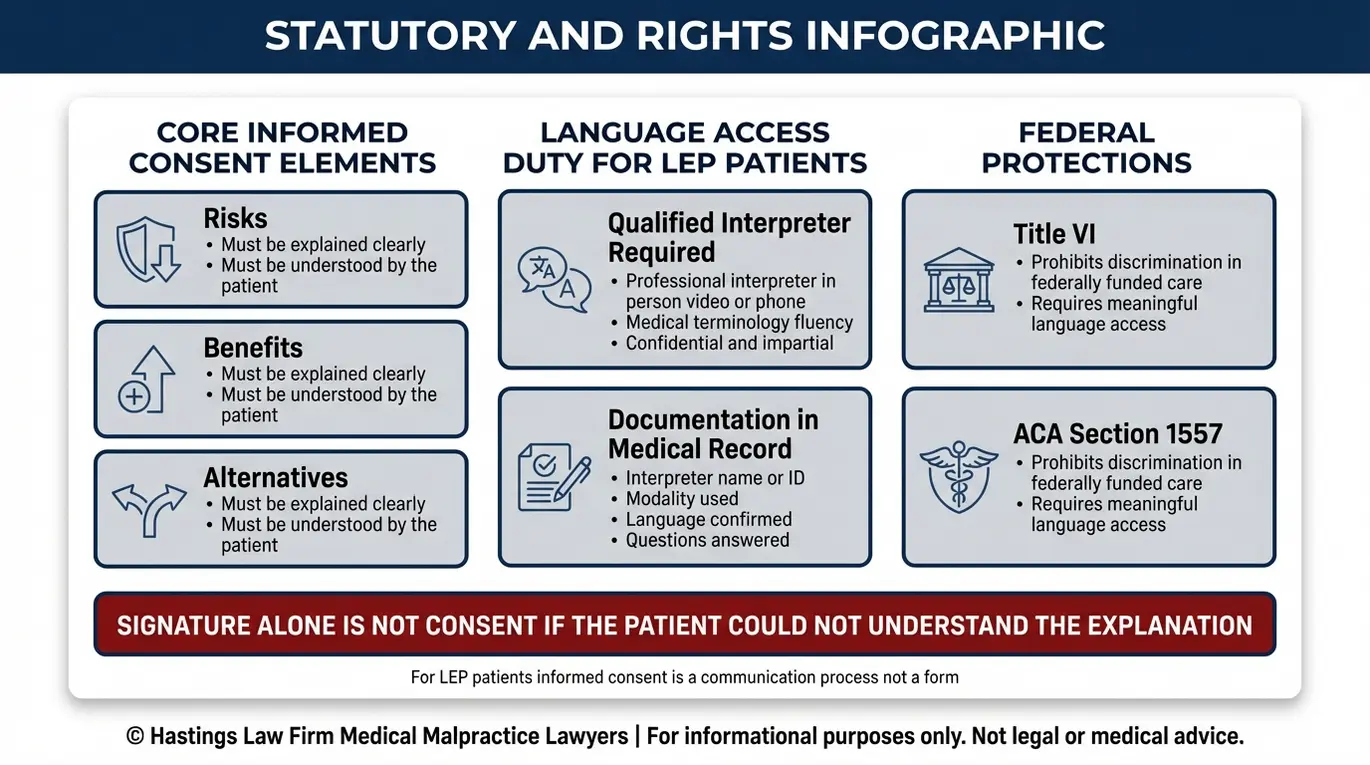
Informed consent requires that a patient fully understands the risks, benefits, and alternatives of a medical procedure before agreeing to it, which mandates the use of qualified interpreters for non-English speakers under federal law. This process mandates clear communication for LEP patients, those who have limited English proficiency, to ensure they can make an educated choice about their care.
Informed consent is not a form. It is a conversation. The doctor has a legal duty to warn the patient about what could go wrong, what other treatment options exist, and what happens if the patient declines. If that conversation never happens in a language the patient actually understands, the consent is not valid, regardless of what was signed.
Federal law reinforces this obligation. Section 1557 of the Affordable Care Act, the primary nondiscrimination provision in the ACA, requires healthcare facilities that receive federal funding to provide meaningful language access to LEP patients. Title VI of the Civil Rights Act similarly prohibits national origin discrimination, which includes denying services to someone because of the language they speak. Together, these laws set a clear standard of care for patient rights and language access in healthcare settings.
For a lawyer for informed consent cases, the core question is clear: did the patient genuinely understand what they were agreeing to?
A valid informed consent process for LEP patients should include:
- A qualified medical interpreter present during the consent discussion to ensure medical terms are translated accurately.
- Translation of all relevant consent documents into the patient’s primary language so you can review risks at your own pace.
- A clear explanation of the diagnosis, proposed treatment, risks, benefits, and alternatives to provide a complete picture of the care.
- An opportunity for the patient to ask questions and receive answers they can understand before making a decision.
- Documentation in the medical record confirming that interpreter services were used to create a legal record of the communication.
If any of these steps were skipped or handled inadequately, a Texas informed consent attorney can evaluate whether the provider breached their legal duty.
The Distinction Between Signing a Form and Valid Consent
A signed consent form written entirely in English does not prove that a non-English-speaking patient understood it. If no interpreter was present and no translated document was provided, that signature may be legally voidable. This means it can be challenged as invalid because true consent was never obtained.
One way providers confirm real understanding is through the teach-back method, a technique where the patient is asked to repeat back, in their own words, what they were told about the procedure. This helps verify that the information was actually absorbed, not just delivered. When a language barrier exists and no teach-back or equivalent confirmation occurs, the medical records may reflect a breach of duty.
Patients also have the right of informed refusal, the ability to decline a procedure after being told the risks. If a patient could not understand the risks well enough to make that choice, their right to refuse was effectively eliminated to ensure valid informed consent.
How Hospital Interpreter Failures Cause Medical Malpractice
Medical malpractice occurs when a provider breaches the standard of care by relying on unqualified translators, such as family members or bilingual staff, leading to miscommunication regarding surgical risks or medication instructions. These shortcuts create serious liability and risks for miscommunication about surgical risks, medication instructions, and diagnoses.
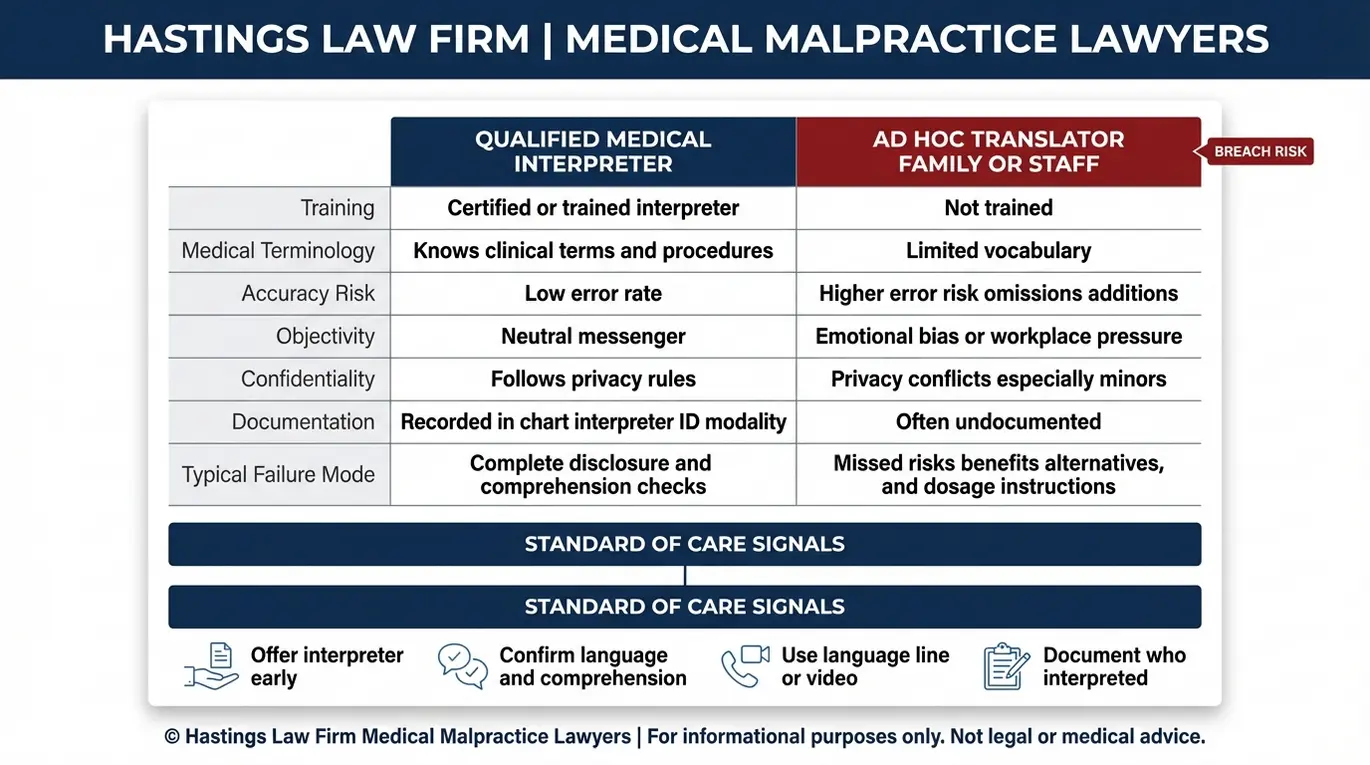
A medical malpractice claim typically involves a breach of the standard of care, which represents the accepted medical requirements for safe treatment. The standard typically requires that medical providers use a qualified medical interpreter. This is a professionally trained individual with fluency in medical terminology, ethical standards including patient confidentiality, and the ability to accurately convey clinical information.
Research from the Agency for Healthcare Research and Quality (AHRQ) Patient Safety Network shows that ad-hoc interpreters produce significantly more errors than professional interpreters. These errors are more likely to have potential clinical consequences. The National Board of Certification for Medical Interpreters (NBCMI) sets national standards for interpreter competency, including medical terminology knowledge, ethical conduct, and accuracy requirements.
| Qualified Medical Interpreter | Ad-Hoc Translator (Family/Staff) | |
|---|---|---|
| Medical Terminology | Fluent; trained in clinical language | Limited or no formal training |
| Accuracy | High; bound by professional standards | High error rate; frequent omissions |
| Objectivity | Neutral and objective | Emotional bias may alter information |
| Confidentiality | Bound by privacy standards | No formal confidentiality obligation |
| Risk Disclosure | Conveys all risks, benefits, alternatives | May soften, omit, or misstate risks |
For a Texas informed consent interpreter failure lawyer, the causation question is central: did the translation failure cause the patient to agree to something they would have otherwise refused? If a patient was not accurately told about a specific surgical risk or medication side effect, and that exact complication occurred, the interpreter negligence may be directly linked to the harm.
As a medical malpractice lawyer, our team works with medical experts and certified interpreters to reconstruct what was communicated, what was lost in translation, and how that gap led to injury. A failure to warn attorney or interpreter negligence attorney examines whether the provider’s reliance on unqualified translation fell below the accepted standard.
The Hastings Law Firm Difference
Results matter, but what truly sets us apart is how we achieve them. Every verdict, every settlement, and every Texas courtroom victory comes from one guiding promise: To treat each client’s fight for justice as if it were our own.
This balance of skill, experience, and empathy reflects our core philosophy that justice should not only compensate the injured, but also make healthcare safer nationwide.

Common Scenarios Where Language Barriers Lead to Patient Harm
Significant patient harm often arises when a healthcare provider uses minors to interpret complex medical diagnoses, or when discharge instructions regarding medication and post-operative care are not translated, leading to preventable complications.
In many cases, a child or relative is pulled in to translate during a medical encounter. This creates multiple problems.
A child may not understand medical terminology or may feel pressure to minimize frightening information. Family members of any age may unintentionally filter what the doctor says, potentially leading to misdiagnosis. Privacy is also compromised, as medical information is shared with individuals who have no professional obligation to keep it confidential.
Before any surgical procedure, the care team is required to perform a surgical “time out,” a standardized pause (part of the Universal Protocol) where the team confirms the correct patient, procedure, and site. If the patient does not speak the language being used during this verification, they cannot meaningfully participate. This creates a direct pathway to wrong-site surgery or procedures the patient never actually authorized.
Discharge instructions often contain critical information about medication dosages, timing, and warning signs. When these instructions are provided only in English to a patient who cannot read English, the risk of medication errors increases sharply.
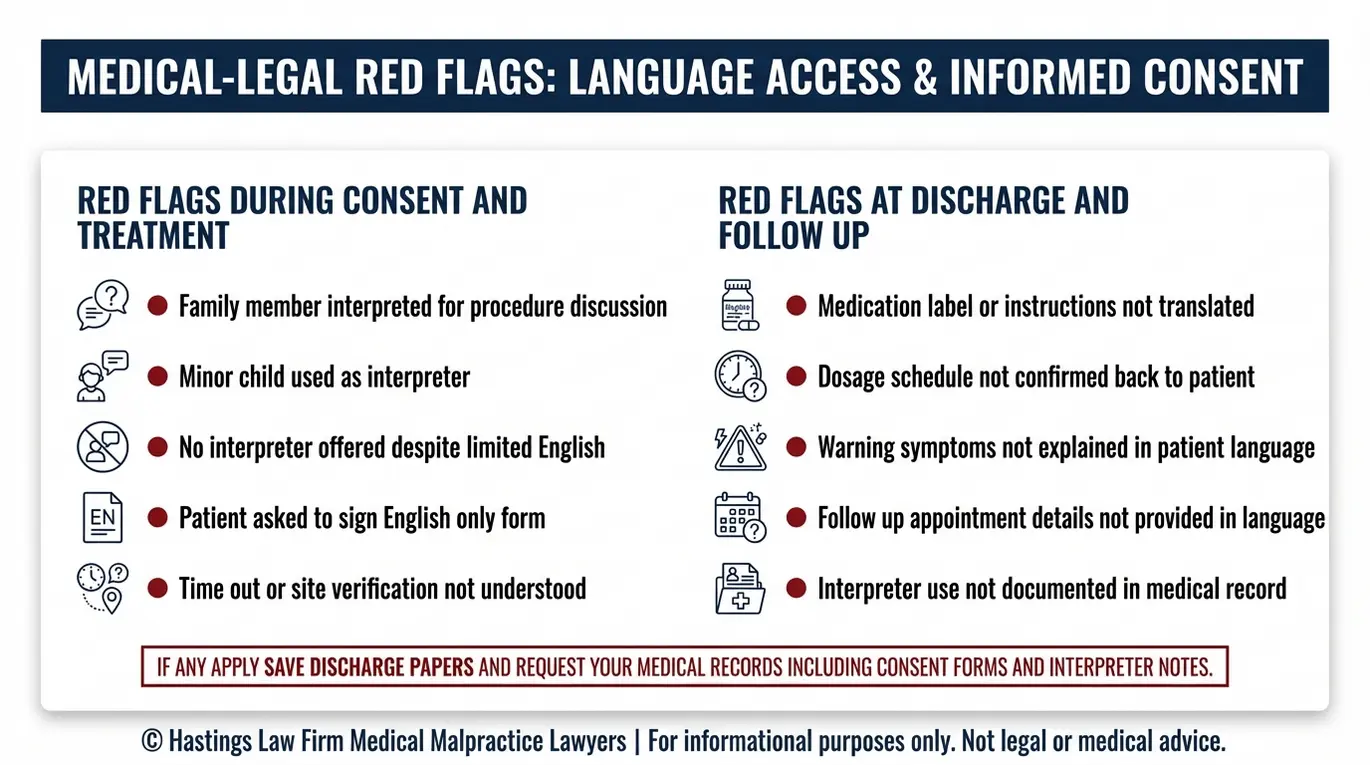
If any of these situations sound familiar, watch for these red flags that may indicate an informed consent failure:
- No interpreter was present during the consent conversation, which is a common sign of communication failure.
- Consent documents were provided only in English, preventing you from fully reviewing the procedure’s risks.
- A child or untrained family member translated medical information, which often leads to clinical errors.
- Discharge or medication instructions were not provided in your language, creating a risk for improper home care.
- You were not given the chance to ask questions through an interpreter to clarify complex medical details.
- You learned about alternatives, risks, or side effects only after the procedure, indicating that consent was not informed.
A lawyer for language barrier negligence can help determine whether these failures contributed to your injury.
Contact the Texas Hospital Malpractice Attorneys at Hastings Law Firm Today for Help
Every patient deserves to understand what is happening to their body before a medical procedure begins. Language should never be the reason someone is harmed by a treatment they did not fully understand or agree to.
Led by Tommy Hastings, a board-certified trial lawyer, our firm has the experience to investigate interpreter failures and build cases that hold providers accountable. Founded in 2005, Hastings Law Firm focuses exclusively on medical malpractice litigation. As a Texas informed consent interpreter failure lawyer, we work closely with medical experts to identify exactly where communication broke down and how it led to harm. Our team includes former defense attorneys and hospital nurses who understand how these systems work from the inside.
If you or a family member was injured because a healthcare provider failed to communicate in your language, our medical negligence firm is ready to listen. We offer a free, confidential case evaluation, and you pay no fees unless we recover compensation for you.
Call Hastings Law Firm today. Let us help you find the answers you deserve.
Frequently Asked Questions About Informed Consent Interpreter Failure in Texas


This content was researched and written by the Hastings Law Firm editorial team, which includes attorneys, medical professionals, and experienced researchers. Our writing is informed by internal knowledge and practical experience, and we cross-check critical details against authoritative sources cited throughout. Every piece undergoes human-led fact-checking and legal review. Because legal and medical information can change, if you spot an error, please contact us. Learn more about our content standards and review process on our editorial policy page.

Brady D. Williams is a nationally recognized medical malpractice attorney who has spent his career handling high-stakes litigation for injured patients and families across the country. Licensed in both Texas and California, Brady draws on experience from hundreds of resolved medical cases to break down complex legal and medical topics for the people who need that information most. His writing reflects the same attention to detail and commitment to clarity that he brings to every case he handles.
