


Texas ICU Monitoring Failure Lawyer
Written by: Hastings Law Firm | Reviewed by: Gabe Sassin | Updated: July 27, 2026
ICU monitoring failures can turn a critical illness into a preventable tragedy when warning signs are missed or ignored and care is not escalated in time. These events often involve gaps in vital sign surveillance, delayed responses to alarms, communication breakdowns, or equipment problems that leave families without clear explanations. Understanding how monitoring and rapid response should work can help clarify whether harm was avoidable and why outcomes became so severe. If you or a loved one were harmed or worse due to ICU monitoring failure in Texas, contact Hastings Law Firm for a free, confidential case review.
Trusted Texas Medical Attorneys for ICU Negligence Claims
What You Should Know About Failure to Escalate Care in ICU Claims in Texas:
- Outcomes can become severe when ICU warning signs are missed and care is not escalated in time.
- Accountability can extend beyond one clinician because hospitals, physicians, and sometimes equipment manufacturers may share responsibility for monitoring failures.
- Disputes often focus on whether the decline was avoidable because defense arguments may blame the underlying illness rather than the monitoring and response.
- Preventable harm can be tied to system breakdowns such as understaffing, communication failures, or alarm fatigue.
- Recovery can include economic losses and non economic losses, and fatal errors can also lead to wrongful death damages.
- Non economic recovery can be limited in Texas, while economic losses such as medical costs and lost wages are not capped.
- Options can be lost if required timing rules are missed because Texas imposes strict limits on when a claim can be filed.
- Case proof can depend on electronic records beyond the standard chart because audit trails and telemetry data can show when entries were made and how monitoring occurred.
- Clarity about what happened can hinge on documentation quality because gaps or inconsistent updates may indicate a breakdown in monitoring and response.

A Healthcare Focused Law Firm
When someone you love is admitted to an Intensive Care Unit, you trust that they will receive the highest level of attention and monitoring available. If that trust was broken and your family member suffered a preventable injury or death because critical warning signs were missed or ignored, you deserve answers.
At Hastings Law Firm, we focus exclusively on medical malpractice. Our team of attorneys, nurse consultants, and patient advocates understands both the medical and legal sides of ICU negligence claims. As a Texas ICU Monitoring Failure Lawyer, our firm knows how to investigate what happened, identify who is responsible, and hold them accountable.
If you believe you or a loved one was harmed by inadequate monitoring or a failure to act on changing conditions in the ICU, we can review what happened and explain your options during a free, confidential case evaluation.
Understanding Failure to Monitor & Escalate Care in the ICU
A failure to monitor claim arises when medical staff neglect to track a patient’s vital signs or fail to respond in time to signs of patient deterioration, breaching the duty of care and causing preventable injury. These cases often involve not just a lack of observation, but a failure to escalate care, a breach of duty which means a provider noticed a problem or had data showing a problem and did not take appropriate action.
In a properly functioning ICU, staff provide close, ongoing surveillance. Nurses and physicians must continuously assess vital signs, interpret trends, and activate a Rapid Response Team (RRT), a dedicated group of clinicians trained to intervene when a patient’s condition suddenly worsens. When this chain breaks down, the consequences can be severe.
The standard of care in an ICU setting generally requires:
- Continuous monitoring of heart rate, blood pressure, oxygen levels, and respiratory function
- Timely documentation of all vital sign changes
- Prompt notification of the attending physician when readings fall outside safe parameters
- Activation of rapid response protocols when a patient shows signs of clinical deterioration
- Proper functioning and calibration of monitoring equipment
Not every patient decline in the ICU is the result of negligence. Some patients are critically ill, and their conditions may worsen despite excellent care. The legal question is whether the decline was avoidable, whether earlier detection and faster intervention could have changed the outcome.
An ICU negligence attorney evaluates this distinction by comparing what happened against what the standard of care required. According to a report by the Office of Inspector General, adverse events in hospital settings remain a significant patient safety concern. Many of these events are tied to failures in monitoring and response.
Red Flags: How to Know if Your Loved One Was Neglected
Families often sense something went wrong before they can articulate what it was. Certain warning signs may suggest that a patient’s clinical deterioration, a worsening of their medical condition, was not properly managed.
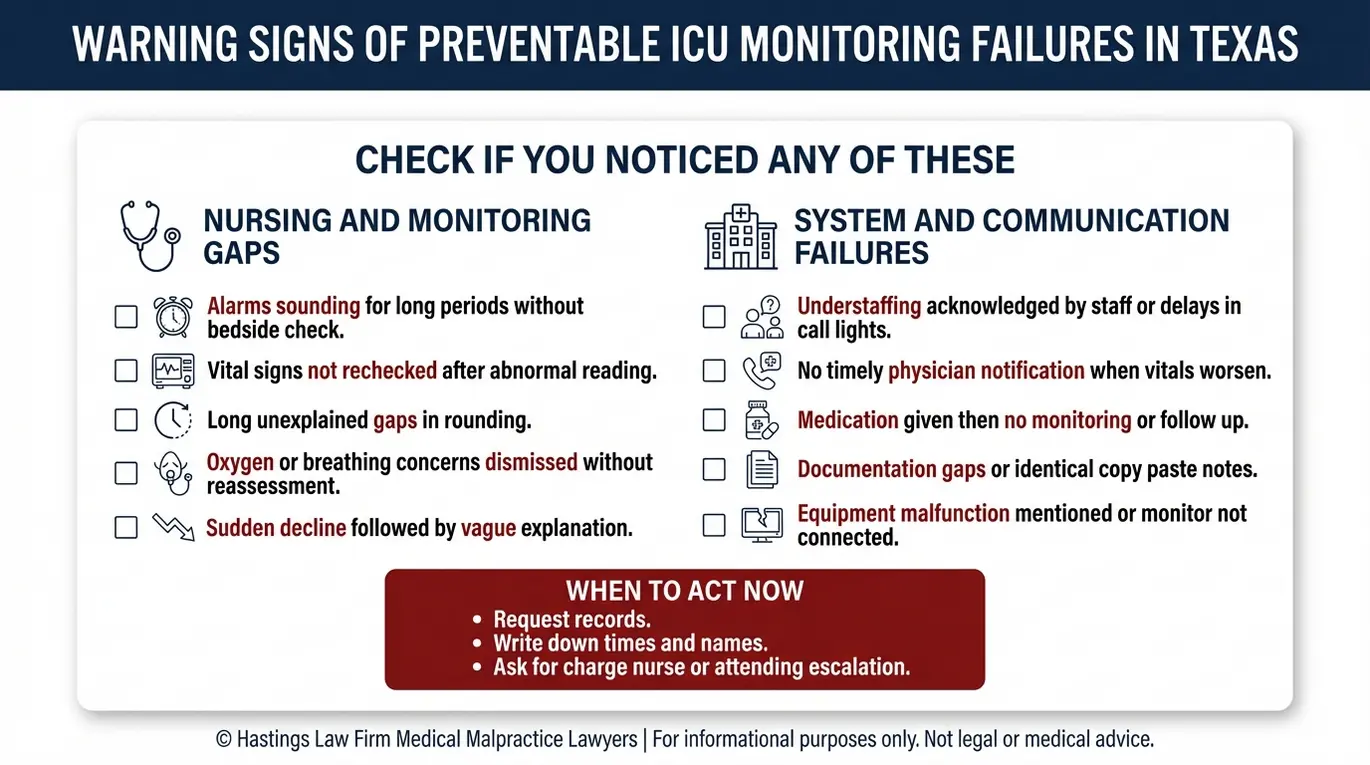
Watch for vague or inconsistent updates from medical staff, unexplained gaps in documentation, or a sudden decline that no one seemed to anticipate. If the care team could not clearly explain what happened or when they became aware of the change, those gaps may point to a breakdown in monitoring. A lawyer for ICU monitoring failures can help you obtain and analyze the records to determine whether the care met the required standard.

Common Causes of Preventable ICU Injuries
Common causes of preventable ICU injuries include ignoring vital signs alarms, understaffing that leads to infrequent bedside checks, failure to notify physicians of vital sign changes, and equipment malfunctions that go unnoticed. Each of these failures can set off a chain reaction that ends with a patient suffering harm that should have been avoided.
Staffing shortages are one of the most frequent contributing factors. When the nurse-to-patient ratio, the number of patients assigned to a single nurse, is too high, monitoring gaps become almost inevitable. A study published by JAMA Network Open on nursing team composition and mortality found a direct link between nursing staffing levels and patient outcomes following acute hospital admission. Overworked nurses may miss changes in a patient’s condition simply because they are spread too thin.
Communication failures also drive preventable injuries. In some cases, a nurse may observe a drop in oxygen levels, measured by pulse oximetry (SpO2), a sensor that reads the percentage of oxygen in the blood, but fail to page the physician or escalate the concern regarding respiratory function or heart rate. Nursing negligence in critical care settings can lead to irreversible harm.
Medication errors tied to monitoring lapses are another common scenario. When a patient receiving sedation or pain medication is not monitored closely enough, respiratory depression can go undetected until it becomes a crisis. A critical care negligence lawyer examines each of these potential breakdowns to determine where the system failed.
Alarm Fatigue and Equipment Failures
Alarm fatigue, a well-documented phenomenon in hospitals where staff become desensitized to the constant sounds of monitoring equipment, leads clinicians to ignore, silence, or delay responding to alerts. When alarms go off hundreds of times per shift, staff may begin to tune them out. If a genuine emergency alarm is dismissed because staff assumed it was another false alert, the result can be catastrophic.
Medical equipment malfunction presents a different but equally dangerous problem. A Texas ICU failure attorney will investigate whether monitoring devices were properly maintained, whether alarms were functioning correctly, and whether any malfunction contributed to the failure in causation between the missed warning and the patient’s injury.
The Hastings Law Firm Difference
Results matter, but what truly sets us apart is how we achieve them. Every verdict, every settlement, and every Texas courtroom victory comes from one guiding promise: To treat each client’s fight for justice as if it were our own.
This balance of skill, experience, and empathy reflects our core philosophy that justice should not only compensate the injured, but also make healthcare safer nationwide.

Proving ICU Malpractice: The Evidence We Gather
Proving medical negligence requires a thorough audit of the Electronic Health Record (EHR), specifically the audit trails that show exactly when vitals were recorded and when staff physically entered the room. The standard chart alone is not enough. Records can be amended, and entries can be made after the fact.
That is why an ICU malpractice attorney on our team digs deeper. We obtain the complete EHR audit trail, a digital log embedded in the hospital’s electronic system that timestamps every entry, edit, and access point. This trail reveals who opened the chart, when they did so, and whether documentation was created in real time or added later.
Here is what we typically gather when building an ICU malpractice case:
- Complete electronic health records with full audit trail metadata
- Continuous telemetry and bedside monitoring data
- Nursing assignment sheets and staffing records
- Physician order logs and communication records
- Equipment maintenance and calibration logs
- Witness statements from staff, family, or other patients
Expert testimony from qualified critical care specialists is essential. These experts review the records and establish what should have happened at each stage of the patient’s care. Their analysis helps establish causation by demonstrating the gap between what the standard of care required and what actually occurred.
Patients and families also have rights under federal privacy law. The U.S. Department of Health and Human Services’ HIPAA guidelines protect health information while also granting patients the right to access their own medical records, an important step in any investigation.
Using Electronic Logs and Telemetry to Expose Negligence
Our team uses metadata and telemetry logs, the continuous cardiac and respiratory monitoring data transmitted from bedside equipment, to reconstruct what was happening with the patient at every moment. These electronic monitoring logs can reveal whether a nurse was in the room when they claimed to be, or whether an alarm was silenced without anyone checking the patient.
This type of evidence is often the most powerful in an ICU case. A lawyer for hospital monitoring errors knows how to obtain, preserve, and interpret this data before it is overwritten or lost.

Who is Liable for ICU Monitoring Failures?
Hospital liability often extends beyond the individual nurse to include the hospital corporation, attending physicians, and potentially equipment manufacturers if a device failed.
The hospital itself can be held liable under two theories: vicarious liability for the actions of its employees, and corporate negligence for systemic failures like understaffing or inadequate training policies. If a hospital consistently assigns too many patients to a single ICU nurse, the institution bears responsibility for the predictable consequences of that decision.
Attending physicians, residents, and specialists may also share liability if they failed to provide adequate oversight or respond to notifications from nursing staff. In many cases, identifying all liable parties, which includes any person or company responsible for the care, is essential.
It is also common for defense teams to argue that the patient’s underlying condition caused the outcome, not the care they received. A hospital negligence lawyer anticipates this tactic and works with medical experts to distinguish between the natural progression of illness and the specific injury caused by monitoring failures.
Compensation for Victims of Critical Care Negligence
Victims and their families may recover damages for additional medical costs, pain and suffering, lost wages, and in cases of fatal error, wrongful death damages including loss of companionship.
The types of compensatory damages available in ICU injury cases generally fall into two categories:
| Damage Type | Examples |
|---|---|
| Economic Damages | Future medical care (especially for hypoxic brain injury, a condition caused by oxygen deprivation to the brain), rehabilitation costs, lost income, and life care expenses |
| Non-Economic Damages | Pain and suffering, physical impairment, mental anguish, and loss of enjoyment of life |
| Wrongful Death Damages | Loss of companionship, funeral expenses, loss of financial support, and mental anguish of surviving family members |
A Texas ICU injury lawyer evaluates the full scope of harm when building your case. For patients who survive with brain injuries caused by oxygen deprivation, the cost of lifetime care can reach into the millions. Economic damages are not capped under Texas law, making a thorough assessment of future needs critical.
An attorney for failure to escalate care ensures that every category of loss is documented, supported by expert analysis, and presented in a way that reflects the true impact on your family.
Why Choose Hastings Law Firm for Your ICU Injury Case
We are a board-certified specialist medical malpractice law firm that has secured millions for families harmed by ICU negligence, including an $8 million settlement for a monitoring failure in Dallas where a man suffered severe neurological injuries.
That result reflects how we approach every case. Our trial-ready team includes former defense attorneys who understand how hospitals and their insurers respond to claims, as well as in-house nursing professionals who can identify charting inconsistencies and protocol violations that others might overlook.
As a Texas ICU Monitoring Failure Lawyer, Tommy Hastings and his team prepare every case as if it will go to trial. That level of preparation sends a clear message during negotiations and puts our clients in the strongest possible position.
Throughout the process, we treat you as a partner, not a case file, keeping you informed and supported with empathy at every step as we fight for justice. We work on a contingency fee basis, which means you pay no attorney fees or costs unless we recover compensation for you.
Contact the Texas Healthcare Malpractice Attorneys at Hastings Law Firm Today for Help
Texas law generally gives you a limited window to file a medical malpractice claim, so the sooner you take action, the better your chances of preserving critical evidence like monitoring logs and staffing records.
Hastings Law Firm has the resources, the medical knowledge, and the trial experience to take on powerful hospital systems and uncover the truth about what happened to your loved one. If you suspect that inadequate ICU monitoring led to a preventable injury or death, we want to hear from you.
Contact us today for a free, confidential case evaluation. There is no fee unless we win, and taking that first step costs you nothing. Let us help you find the answers your family deserves.
Frequently Asked Questions About ICU Monitoring Failure in Texas


This content was researched and written by the Hastings Law Firm editorial team, which includes attorneys, medical professionals, and experienced researchers. Our writing is informed by internal knowledge and practical experience, and we cross-check critical details against authoritative sources cited throughout. Every piece undergoes human-led fact-checking and legal review. Because legal and medical information can change, if you spot an error, please contact us. Learn more about our content standards and review process on our editorial policy page.

Gabe Sassin has focused exclusively on medical malpractice law since 2007. After spending more than a decade as a malpractice defense attorney, he knows exactly how the other side works. He has seen firsthand how healthcare providers, insurers, corporate defendants, and their legal teams think, prepare, and build their defense against claims. That knowledge works for the people who need it most today, injured patients and their families. His unique experience shapes everything he writes, giving readers a look at how these cases actually work from someone who has handled them from both sides.
