


Houston Hysterectomy Malpractice Lawyer
Hysterectomy malpractice can leave patients facing serious injuries, lasting pain, and deep uncertainty about whether a preventable error occurred. Harm may result from surgical mistakes, failures to recognize complications after surgery, anesthesia problems, or a procedure performed without medical necessity or valid informed consent. The consequences can extend beyond physical recovery to emotional distress, loss of fertility, and in severe cases fatal outcomes. If you or a loved one were harmed or worse due to hysterectomy malpractice in Houston, Texas, contact Hastings Law Firm for a free, confidential case review.

Last Updated: July 27, 2026
Trusted Houston Medical Attorneys for Negligent Surgical Errors
A hysterectomy is one of the most common surgical procedures performed on women in the United States. When the surgery goes as planned, it can resolve serious health conditions and improve quality of life. But when a surgeon’s error causes preventable injury, the consequences can be life-altering.
If you or a loved one suffered harm during or after a hysterectomy, you may be dealing with more than physical pain. You may feel confused about what went wrong, uncertain whether your experience was simply a “known risk,” and unsure whether anyone will take your concerns seriously. Those feelings are valid, and you deserve honest answers.
As a Houston hysterectomy malpractice lawyer, Hastings Law Firm focuses exclusively on medical malpractice. Our team includes in-house nurse consultants and former defense attorneys who know how hospitals build their case. We can review what happened during your surgery and explain your legal options at no cost to you.

Understanding Hysterectomy Procedures and Standards of Care
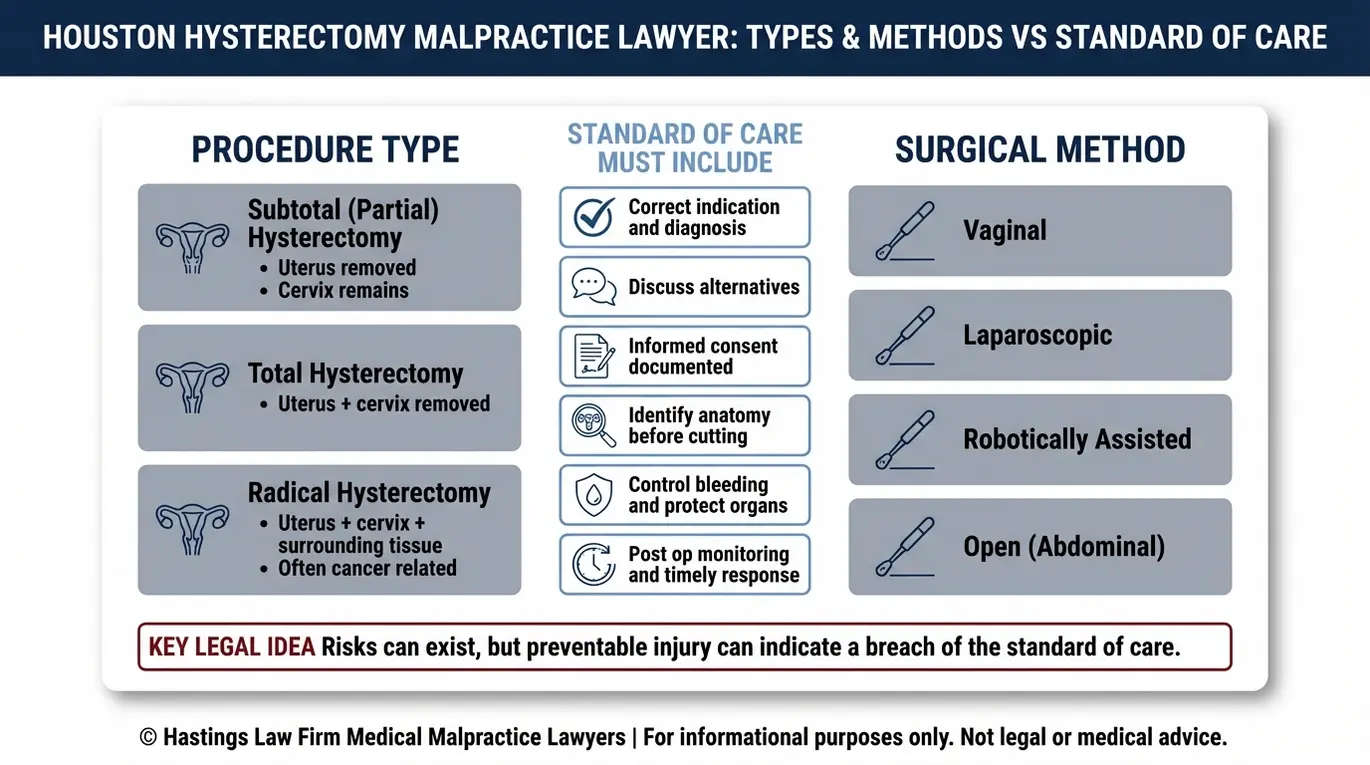
A hysterectomy is the surgical removal of the uterus, often performed to treat conditions like uterine fibroids or cancer, but surgeons must strictly adhere to the standard of care to avoid preventable injury. While it can be a medically appropriate procedure, surgeons must follow the standard of care, the level of treatment a reasonably competent surgeon would provide under similar circumstances. A Houston surgical negligence attorney can help determine if this standard was met.
The type of hysterectomy and the method used depend on the patient’s diagnosis, anatomy, and overall health. A supracervical (subtotal) hysterectomy removes the upper portion of the uterus while leaving the cervix intact. A total hysterectomy removes both the uterus and cervix. A radical hysterectomy, typically reserved for cancer cases, also removes surrounding tissue. In some procedures, the ovaries may be removed as well.
Surgical approach matters just as much as the type. Research published in Frontiers in Oncology comparing surgical methods for endometrial cancer management highlights how different approaches carry different risk profiles. A robotically assisted hysterectomy offers precision but requires significant training. Each method has specific technical demands, and the surgeon is legally obligated to perform the chosen approach with competence.
| Type | What Is Removed | Common Indications |
|---|---|---|
| Subtotal (Supracervical) | Upper uterus; cervix preserved | Fibroids, chronic pain |
| Total | Uterus and cervix | Fibroids, endometriosis, cancer |
| Radical | Uterus, cervix, surrounding tissue | Cervical or uterine cancer |
| Surgical Method | Approach | Key Considerations |
|---|---|---|
| Vaginal | Through the vagina, no external incision | Less invasive; not suitable for all patients |
| Laparoscopic | Small abdominal incisions with camera | Faster recovery; requires skilled technique |
| Robotically Assisted | Laparoscopic with robotic instruments, where a surgeon controls precision tools through a console | Increased precision potential; significant training required |
| Open (Abdominal) | Large abdominal incision | Used for complex cases; longer recovery |
Every hysterectomy carries inherent surgical risks. But there is a clear legal difference between a recognized complication and an injury caused by a surgeon who fell below the standard of care. A lawyer for hysterectomy errors knows that under the Texas Civil Practice and Remedies Code, Chapter 74, a patient must demonstrate that the surgeon’s actions deviated from what a competent professional would have done, and that deviation caused the injury.
Identifying Negligence and Common Surgical Errors
Surgical negligence occurs when a doctor fails to act as a reasonably prudent surgeon would under the same circumstances, resulting in preventable injuries such as organ damage, uncontrolled bleeding, or serious infection. A lawyer for hysterectomy errors evaluates whether the harm you experienced falls into that category. When suing a gynecologist, your attorney must prove that medical negligence occurred.
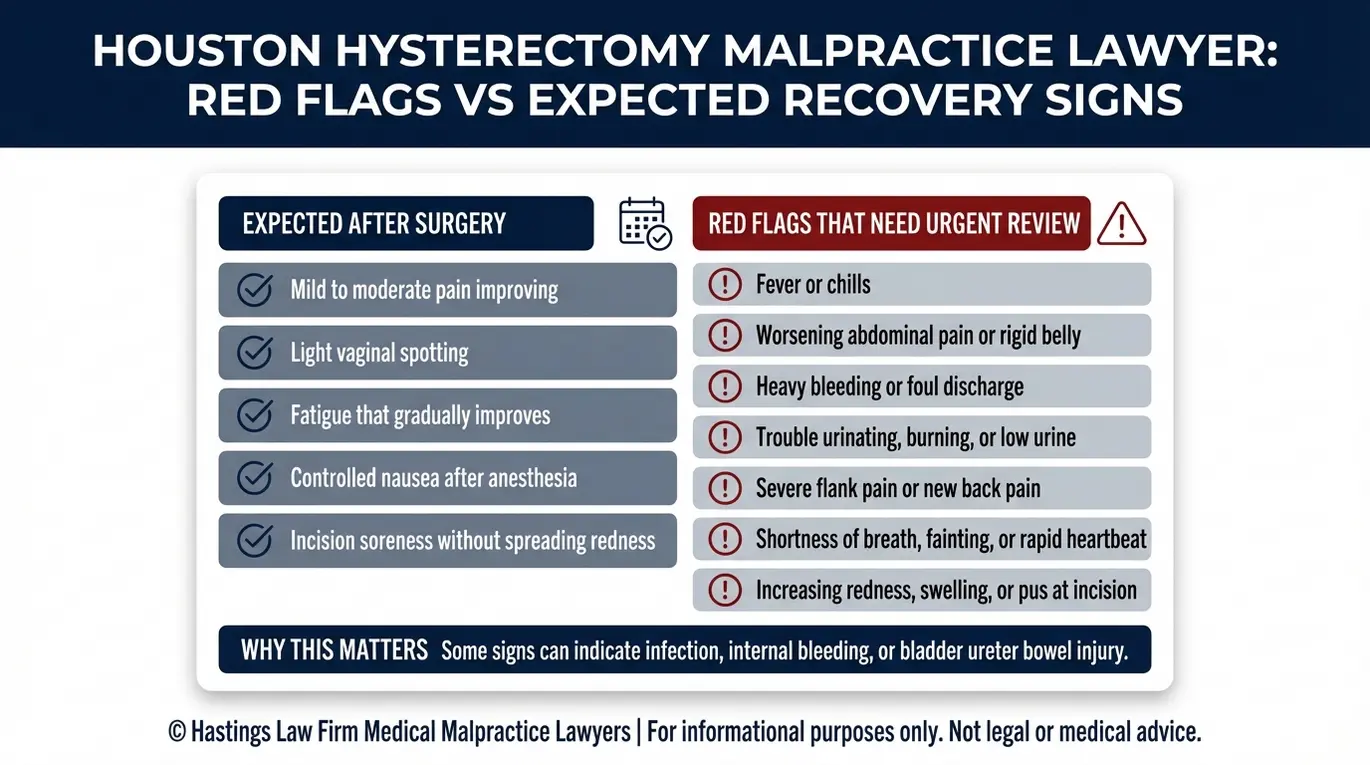
During a hysterectomy, the uterus sits close to the bladder, ureters (the tubes that carry urine from the kidneys to the bladder), and bowel. Ureteral transection causes significant ureter damage or injury to these structures and is one of the most commonly reported surgical injuries. A study published in PubMed Central on urinary tract injuries in gynecological surgery confirms that ureteral transection, where the ureter is accidentally cut or clamped, and bladder injury such as bladder perforation are significant risks tied to surgical technique and anatomical identification failures.
Bowel perforation during dissection can lead to peritonitis (an inflammation of the abdominal lining) and sepsis (a life-threatening response to infection) if not identified and repaired immediately. Vaginal cuff granulation tissue, an overgrowth of healing tissue at the vaginal vault closure site, can cause ongoing pain, bleeding, and infection when the surgical closure is performed poorly or follow-up care is inadequate.
Post-operative failures also give rise to malpractice claims in Houston. If a surgical team fails to recognize signs of postoperative infections, internal bleeding, or organ injury after the procedure, a delay in treatment can turn a manageable complication into a catastrophic one, potentially leading to wrongful death. UW Medicine’s post-laparoscopic surgery discharge guidelines outline the warning signs patients and providers should be monitoring.
Anesthesia errors and retained surgical instruments are less common but equally serious. A sponge or tool left inside the body, or an anesthesia dosage miscalculation, represents a clear departure from accepted practice.
Not every bad outcome is negligence. The distinction matters:
- Known complications (inherent risk): Mild bleeding, temporary nerve irritation, or minor infection that responds to standard treatment
- Preventable surgical errors (potential negligence): Unidentified ureter transection, unrepaired bowel perforation, retained foreign objects, failure to recognize post-operative hemorrhage, wrong-site surgery
Our surgical negligence attorneys work with independent medical experts to examine operative reports, anesthesia logs, and post-operative records. That review determines whether the injury resulted from an unavoidable risk or from a failure that should not have occurred.
The Hastings Law Firm Difference
Results matter, but what truly sets us apart is how we achieve them. Every verdict, every settlement, and every Houston courtroom victory comes from one guiding promise: To treat each client’s fight for justice as if it were our own.
This balance of skill, experience, and empathy reflects our core philosophy that justice should not only compensate the injured, but also make health care safer nationwide.

Unnecessary Hysterectomies and Lack of Informed Consent
Performing a hysterectomy without medical necessity or proper informed consent constitutes medical malpractice, especially when less invasive alternatives were available and never offered to the patient.
An unnecessary hysterectomy, a procedure performed when the patient’s condition could have been managed through conservative treatment such as medication, hormonal therapy, endometrial ablation, or monitoring, is a serious violation of trust. In some cases, a doctor may have misdiagnosed the underlying condition entirely, or may have overstated the severity of a diagnosis like uterine fibroids to justify surgery. When medical misdiagnosis happens, the patient loses an organ she may not have needed to lose.
The impact extends well beyond the physical. For women who planned to have children, the permanent loss of fertility can cause profound emotional harm. That loss is not just a medical consequence; it is a damage category that carries significant weight in a hysterectomy lawsuit. A lawyer for unnecessary surgery at a Houston malpractice firm can help you work through these complex claims.
Informed consent is equally important. Under the Texas Civil Practice and Remedies Code §§ 74.101–74.107, a physician has a duty to disclose the risks, benefits, and alternatives to hysterectomy before the patient agrees to it. Informed consent, the legal duty of a physician to ensure a patient genuinely understands what the surgery involves, what could go wrong, and what other options exist, means more than getting a signature on a form.
Our founder, Tommy Hastings, is Board Certified in Personal Injury Trial Law by the Texas Board of Legal Specialization, a distinction held by fewer than 2% of Texas attorneys. If your doctor failed to explain alternatives, minimized the risks, or pressured you into surgery, your consent may not have been legally valid. A Houston malpractice firm experienced in these claims can evaluate whether the informed consent process was adequate or whether it fell short of what the law requires.

Recovering Damages for Hysterectomy Complications
Victims of hysterectomy malpractice can recover compensation for economic losses like medical bills and lost wages, as well as non-economic damages for pain, suffering, and loss of enjoyment of life. The value of a claim depends on the severity of the injury, the extent of ongoing medical needs, and the degree to which the error changed the patient’s life.
Recoverable damages include the financial and personal losses you seek in a lawsuit, such as:
- Medical bills: Corrective surgeries, extended hospital stays, physical therapy, and future medical care costs
- Lost wages: Wages lost during recovery and reduced earning capacity if the injury is long-term
- Pain and suffering: Physical pain from the initial injury, subsequent procedures, and chronic complications
- Emotional distress: Psychological harm, including depression, anxiety, and trauma related to the surgical experience
- Loss of fertility: The permanent inability to bear children when the hysterectomy was unnecessary or improperly performed
- Loss of consortium: The impact on the patient’s relationship with their spouse or partner
- Wrongful death: If a patient died during or as a result of the procedure, surviving family members may pursue a claim for their loss, including funeral expenses, lost financial support, and loss of companionship
Every case is different, and no Houston injury attorney can guarantee a specific dollar amount. What we can do is build a thorough accounting of how the error affected your life and present that case with the evidence and expert testimony needed to pursue full compensation for surgical error or a fair medical malpractice settlement.
Contact the Houston Surgical Error Attorneys at Hastings Law Firm Today for Help
If something went wrong during your hysterectomy, we are here to help. Hastings Law Firm represents patients across Houston harmed by preventable errors.
As an inductee into the American Board of Trial Advocates, Tommy Hastings leads a team dedicated exclusively to medical negligence litigation. Our consultations are free, confidential, and on a contingency fee basis, meaning you pay no fees unless we recover compensation. Texas law imposes strict deadlines, so contact a Houston hysterectomy malpractice lawyer at Hastings Law Firm today to investigate your claim and protect your rights.
Frequently Asked Questions About Hysterectomy Malpractice in Houston


This content was researched and written by the Hastings Law Firm editorial team, which includes attorneys, medical professionals, and experienced researchers. Our writing is informed by internal knowledge and practical experience, and we cross-check critical details against authoritative sources cited throughout. Every piece undergoes human-led fact-checking and legal review. Because legal and medical information can change, if you spot an error, please contact us. Learn more about our content standards and review process on our editorial policy page.

Tommy Hastings, founder of Hastings Law Firm, is a board-certified personal injury trial lawyer dedicated exclusively to healthcare injury cases. Since 2001, he has represented injured patients and families in litigation against major hospital systems, pharmaceutical companies, and negligent healthcare providers nationwide. He has handled numerous high-profile cases that have drawn national media attention and resulted in multi-million dollar recoveries. He draws on that experience in his writing, helping readers understand how these cases work and what options may be available to them.
