


Texas Hernia Mesh Lawyer
Written by: Hastings Law Firm | Reviewed by: Brady D. Williams | Updated: July 27, 2026
Defective hernia mesh can leave patients with chronic pain, infection, and other serious complications that sometimes require revision surgery and ongoing care. Some claims focus on whether a manufacturer sold an unreasonably dangerous device or failed to warn about known risks, while others focus on whether a surgeon or hospital made preventable errors during implantation or follow up. Recalls and safety alerts can also affect which products are involved and how harm is evaluated. If you or a loved one were harmed or worse due to defective hernia mesh in Texas, contact Hastings Law Firm for a free, confidential case review.

Trusted Texas Medical Attorneys for Defective Hernia Mesh Claims
What You Should Know About Hernia Mesh Complications Claims in Texas:
- Long term health consequences can follow hernia repair when a mesh device fails and triggers chronic pain, infection, or the need for revision surgery.
- Recovery options can depend on whether the harm is tied to a defective product or to preventable errors in implantation or follow up care.
- Case outcomes can turn on whether the mesh was unreasonably dangerous due to design or materials or whether known risks were not adequately disclosed.
- Severe complications can become life threatening when mesh migration or erosion damages internal organs and leads to emergencies such as sepsis.
- Eligibility can be affected when symptoms appear long after surgery, since delayed onset can create disputes about when the problem reasonably should have been discovered.
- Financial recovery can include medical bills, lost wages, and non economic harms such as pain, suffering, and physical impairment.
- Wrongful death damages may be available when mesh complications contributed to a loved one’s death.
- Device identification can be central because operative reports may show the brand, product codes, and lot numbers needed to compare against recall and safety alert records.

A Healthcare Focused Law Firm
If you are dealing with pain, infections, or other complications after a hernia repair, you may be wondering whether the surgical mesh implanted during your procedure is to blame. You are not alone. Thousands of patients across Texas have experienced serious health problems linked to defective hernia mesh, a medical device made of synthetic material designed to reinforce weakened tissue after hernia surgery. Many of these patients have needed revision surgery, a second, often more complex operation to remove or replace the failed device.
At Hastings Law Firm, we focus exclusively on medical cases like these. Our legal and medical team works together to determine what went wrong, identify the device responsible, and hold the right parties accountable. If you or a loved one has been harmed by a hernia mesh implant, a Texas Hernia Mesh Lawyer at our firm can review your situation and explain your options at no cost.
Legal Representation for Defective Hernia Mesh Lawsuits in Texas
A hernia mesh lawsuit typically falls under product liability law, alleging that the device manufacturer sold a defectively designed product or failed to adequately warn patients and surgeons about known risks. This area of law holds companies responsible for injuries caused by their products.
In a product liability law claim, the focus is on the device itself. The question is whether the hernia mesh was unreasonably dangerous due to its design, materials, or the manufacturer’s failure to disclose risks. In a medical malpractice claim, by contrast, the focus is on the surgeon’s decisions, such as whether the doctor chose the wrong device, implanted it incorrectly, or failed to monitor for complications. Some cases involve both theories.
Here is how the two differ:
- Product Liability (Against the Manufacturer): Alleges the mesh was defective in design or that the company failed to warn about known complications. Evidence typically includes FDA records, internal company documents, clinical studies, and expert engineering analysis.
- Medical Malpractice (Against the Surgeon or Hospital): Alleges the healthcare provider deviated from the accepted standard of care during implantation or follow-up. Evidence typically includes operative reports, medical records, and expert medical testimony. Claims against healthcare providers in Texas are governed by Civil Practice and Remedies Code Chapter 74, which sets specific procedural requirements.
As Texas hernia mesh attorneys, we investigate both angles. Our team, which includes in-house nurse consultants and former defense attorneys, gathers medical records and retains qualified experts. We build the evidence needed to prove the defective device caused injuries like adhesions or a bowel obstruction. Because we prepare every case as if it will go to a jury, manufacturers and their insurers understand we will not accept less than fair value.
That trial-ready posture is especially important when going up against large medical device corporations with vast legal resources. If your case proceeds individually or as part of a multidistrict litigation (MDL), a federal court process grouping similar lawsuits, hernia mesh lawyers in Texas at our firm ensure your claim receives the individual attention it deserves.

Common Complications and Injuries Caused by Defective Mesh
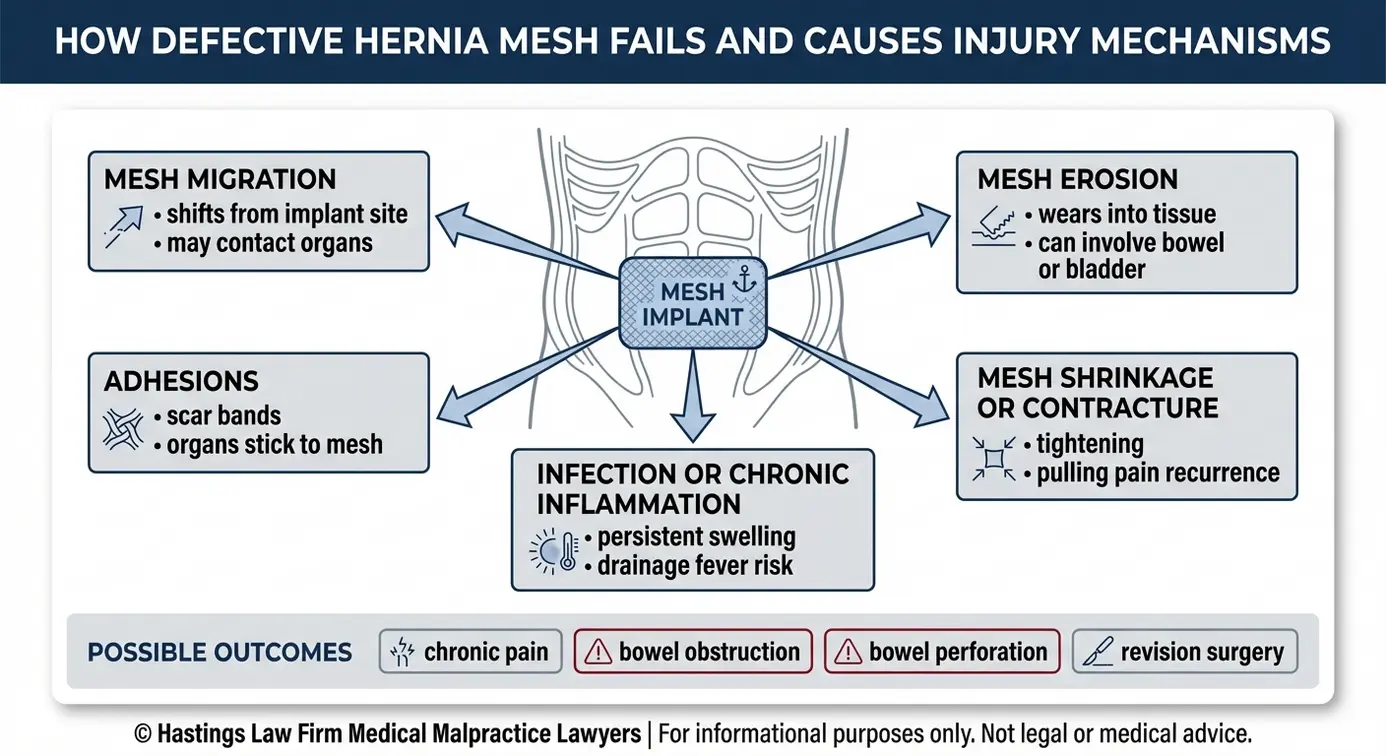
Defective hernia mesh can cause severe complications such as chronic pain, infection, mesh migration, the movement of the device into surrounding tissue, and mesh erosion, where the implant wears through adjacent organs, often requiring high-risk revision surgery to correct. For many patients, mesh failure leads to a cycle of worsening symptoms and dangerous additional operations.
The following table outlines the most common complications linked to defective surgical mesh:
| Complication | Description |
|---|---|
| Chronic Pain | Persistent, often debilitating pain at the implant site that does not resolve with medication or time. |
| Infection | Bacterial contamination around the mesh, sometimes requiring surgical removal of the device. |
| Mesh Migration | The device shifts from its original position, moving into surrounding tissue or organs and causing new damage. |
| Mesh Erosion | The mesh gradually wears through adjacent tissue or organs, potentially reaching the intestines or bladder. |
| Adhesions | Bands of scar tissue form where the mesh bonds to internal organs, causing pain and restricted organ function. Adhesions can lead to serious secondary complications, including bowel obstruction, a condition where the intestine becomes partially or fully blocked. |
| Bowel Perforation | The mesh punctures the intestinal wall, creating a medical emergency that can lead to sepsis. |
| Hernia Recurrence | The mesh fails to hold the repair, allowing the hernia to return, sometimes worse than before. |
A systematic review and meta-analysis published in PubMed has examined failure rates across different mesh types, confirming that certain synthetic products carry elevated risks of complications.
As hernia mesh injury lawyers, we see these injuries frequently. Each complication creates its own chain of medical consequences, and proving the connection between the device and the harm requires careful expert analysis. Revision surgery is often required to address these issues and involves removing the failed mesh.
Polypropylene Material Properties and Mesh Failure
Many synthetic hernia mesh devices are made from polypropylene, a type of synthetic plastic woven into a knitted mesh structure. This synthetic plastic is used to reinforce the abdominal wall during repair. Although promoted as biologically stable, evidence shows polypropylene can degrade inside the body, triggering chronic inflammation as the immune system attacks the deteriorating material.
Mesh shrinkage, where the implant contracts significantly after placement, also occurs with polypropylene devices. This shrinkage pulls on surrounding tissue, contributing to chronic pain, hernia recurrence, and repair site distortion.
The Hastings Law Firm Difference
Results matter, but what truly sets us apart is how we achieve them. Every verdict, every settlement, and every Texas courtroom victory comes from one guiding promise: To treat each client’s fight for justice as if it were our own.
This balance of skill, experience, and empathy reflects our core philosophy that justice should not only compensate the injured, but also make healthcare safer nationwide.

Manufacturer Recalls Involving Bard, Ethicon, and Atrium Devices
Major medical device manufacturers including Bard, Ethicon, and Atrium have faced FDA recalls and lawsuits due to high failure rates associated with specific mesh models. The U.S. Food and Drug Administration’s Medical Device Recalls and Early Alerts database tracks these actions and provides a public record of devices pulled from the market. FDA recalls often occur when a manufacturer or the agency identifies a significant safety risk to patients.
Key recalls and safety concerns include:
- Ethicon Physiomesh Flexible Composite Mesh: Ethicon Physiomesh, a multi-layered hernia repair device manufactured by a Johnson & Johnson subsidiary, was withdrawn from the global market in 2016 after studies showed higher-than-expected rates of hernia recurrence and revision surgery compared to other products.
- Bard Kugel Mesh: Recalled due to a defective memory recoil ring, a rigid ring embedded in the mesh designed to help it unfold during implantation. The ring was prone to breaking, creating sharp edges that could puncture the bowel wall. Adverse events linked to this device are documented in the FDA’s MAUDE database report for Bard surgical mesh.
- Atrium C-QUR Mesh: This device featured a fish-oil coating (Omega-3 fatty acid) intended to reduce adhesions. Reports indicate the coating could separate from the mesh, triggering severe inflammation and chronic pain.
Specific Design Defects in Leading Mesh Brands
Each of these devices failed in distinct ways. The Bard Kugel’s memory recoil ring, a rigid component intended to aid implantation, was a mechanical failure; it literally snapped inside patients. The Atrium C-QUR’s fish-oil coating was a material failure; sensitive to humidity, it peeled away and caused the very inflammatory response it was supposed to prevent. These are not cases of unforeseen accidents but point to design choices that created foreseeable risks, and a Texas lawyer for hernia mesh recalls can help determine whether your specific device is among those flagged for defects.
The Process of Filing a Hernia Mesh Product Liability Claim in Texas
Filing a claim involves securing medical records, identifying the specific product and its lot number, and filing a complaint within the statute of limitations to seek compensation for damages. Here is how a hernia mesh lawsuit attorney at our firm typically handles this process:
- Investigation and Record Collection: We begin by obtaining the operative report from your original hernia surgery. This document contains critical details about the procedure, including the specific device used. Our medical team reviews your complete surgical, revision surgery, and post-operative records to build a timeline of your treatment and symptoms.
- Expert Review and Causation Analysis: Qualified medical and engineering experts examine the evidence to determine whether the mesh defect directly caused your injuries. This step is essential for establishing that the device, not some other factor, is responsible for your complications.
- Filing the Claim: Once we have built a strong evidentiary foundation, we file the complaint against the manufacturer. If your device is part of an existing MDL, your case may be consolidated with similar lawsuits in federal court for pre-trial proceedings while still preserving your individual claim.
How to Identify Your Specific Mesh Implant
Most patients have no idea what brand or model of mesh was implanted during their surgery. Identifying the specific brand is necessary to determine if your device is subject to a recall. Our team retrieves the product codes and lot numbers from your operative report and cross-references them with FDA databases and manufacturer records to confirm exactly which device you received and whether it has been subject to recalls or safety alerts.

Texas Statute of Limitations and the Discovery Rule for Mesh Cases
In Texas, the statute of limitations for personal injury is generally two years, but the Discovery Rule may extend this deadline if you did not immediately know the mesh caused your injury. This distinction is critical in hernia mesh cases because complications can develop months or even years after the original implantation.
Under Texas Civil Practice and Remedies Code, Chapter 16, the standard deadline requires filing suit within two years of the date of injury. For most personal injury claims, the clock starts on the day the harm occurs. Missing this time limit can permanently bar your ability to recover compensation.
Hernia mesh cases, however, often involve a delayed onset of symptoms. A patient may not experience mesh migration, erosion, or chronic pain until well after surgery. The Discovery Rule recognizes this reality. Under this principle, the two-year clock may begin on the date you knew or reasonably should have known that the mesh was the cause of your problems, not the date it was implanted.
This is not a guarantee of extra time. Courts evaluate these situations case by case, and the burden falls on the patient to show the delay in discovery was reasonable. For example, if you experienced symptoms but waited years to seek medical attention, a court might argue you should have discovered the link sooner. Immediate legal investigation helps establish that you acted diligently.
Texas hernia mesh attorneys at our firm can assess your specific timeline and determine whether the Discovery Rule applies before any deadline passes.
Compensation Available for Hernia Mesh Victims
Patients harmed by defective hernia mesh may recover economic damages for medical bills and lost wages, as well as non-economic damages for pain, suffering, and physical impairment. The specific value of any claim depends on the severity of injuries, the cost of treatment, and the impact on your daily life.
Damages in a hernia mesh case may include:
- Past and future economic damages, including the substantial revision surgery costs, hospitalizations, physical therapy, medications, and ongoing care
- Lost wages and reduced earning capacity if complications have prevented you from working
- Chronic pain and physical impairment that diminishes your quality of life
- Mental and emotional suffering caused by prolonged illness and repeated surgeries
- Wrongful death damages if mesh complications contributed to a loved one’s death
Every Texas Hernia Mesh Lawyer at our firm evaluates these categories individually to pursue the full scope of compensation each client is owed.
Contact the Texas Medical Device Attorneys at Hastings Law Firm Today for Help
If you or a loved one is suffering from complications after a hernia mesh implant, you deserve answers about what went wrong and who is responsible. The team at Hastings Law Firm has the medical knowledge, legal experience, and trial-ready preparation needed to take on the manufacturers behind these defective devices.
Our firm operates on a contingency fee basis, which means you pay no attorney fees or costs unless we recover compensation on your behalf. Founded by board-certified trial lawyer Tommy Hastings, our team includes in-house medical professionals, former defense attorneys, and a national network of experts, all focused exclusively on cases like yours.
Contact a Texas Hernia Mesh Lawyer at Hastings Law Firm today for a free, confidential case evaluation. We are here to listen, investigate, and help you understand your legal options.
Frequently Asked Questions About Hernia Mesh in Texas


This content was researched and written by the Hastings Law Firm editorial team, which includes attorneys, medical professionals, and experienced researchers. Our writing is informed by internal knowledge and practical experience, and we cross-check critical details against authoritative sources cited throughout. Every piece undergoes human-led fact-checking and legal review. Because legal and medical information can change, if you spot an error, please contact us. Learn more about our content standards and review process on our editorial policy page.

Brady D. Williams is a nationally recognized medical malpractice attorney who has spent his career handling high-stakes litigation for injured patients and families across the country. Licensed in both Texas and California, Brady draws on experience from hundreds of resolved medical cases to break down complex legal and medical topics for the people who need that information most. His writing reflects the same attention to detail and commitment to clarity that he brings to every case he handles.
