


Houston Gallbladder Surgery Error Lawyer
Gallbladder removal is often expected to be routine, but surgical mistakes can cause serious injuries and long term complications. Errors such as misidentifying anatomy or continuing despite poor visibility can lead to bile duct damage, infection, and the need for additional procedures. Symptoms that worsen after surgery can be a warning sign that an internal injury was missed or dismissed. Understanding the difference between a known complication and preventable negligence can help clarify what happened and what comes next. If you or a loved one were harmed or worse due to a gallbladder surgery error in Houston, Texas, contact Hastings Law Firm for a free, confidential case review.

Last Updated: July 27, 2026
Trusted Houston Medical Attorneys for Surgical Negligence Claims
Gallbladder removal is one of the most commonly performed surgeries in the United States, and most patients expect to recover quickly. When a preventable surgical error turns a routine procedure into a life-altering injury, the confusion and frustration can feel overwhelming. You may be unsure whether what happened to you qualifies as malpractice, or whether you have the right to hold anyone accountable.
At Hastings Law Firm, we focus exclusively on medical malpractice. Our team of attorneys, in-house nurse consultants, and board-certified patient advocates has spent nearly two decades investigating surgical errors and holding negligent providers accountable. If you or a loved one was harmed during a gallbladder procedure in Houston, a Houston gallbladder surgery error lawyer at our firm can review your case, explain what may have gone wrong, and outline your legal options at no cost.

Common Gallbladder Surgery Errors in Houston Hospitals
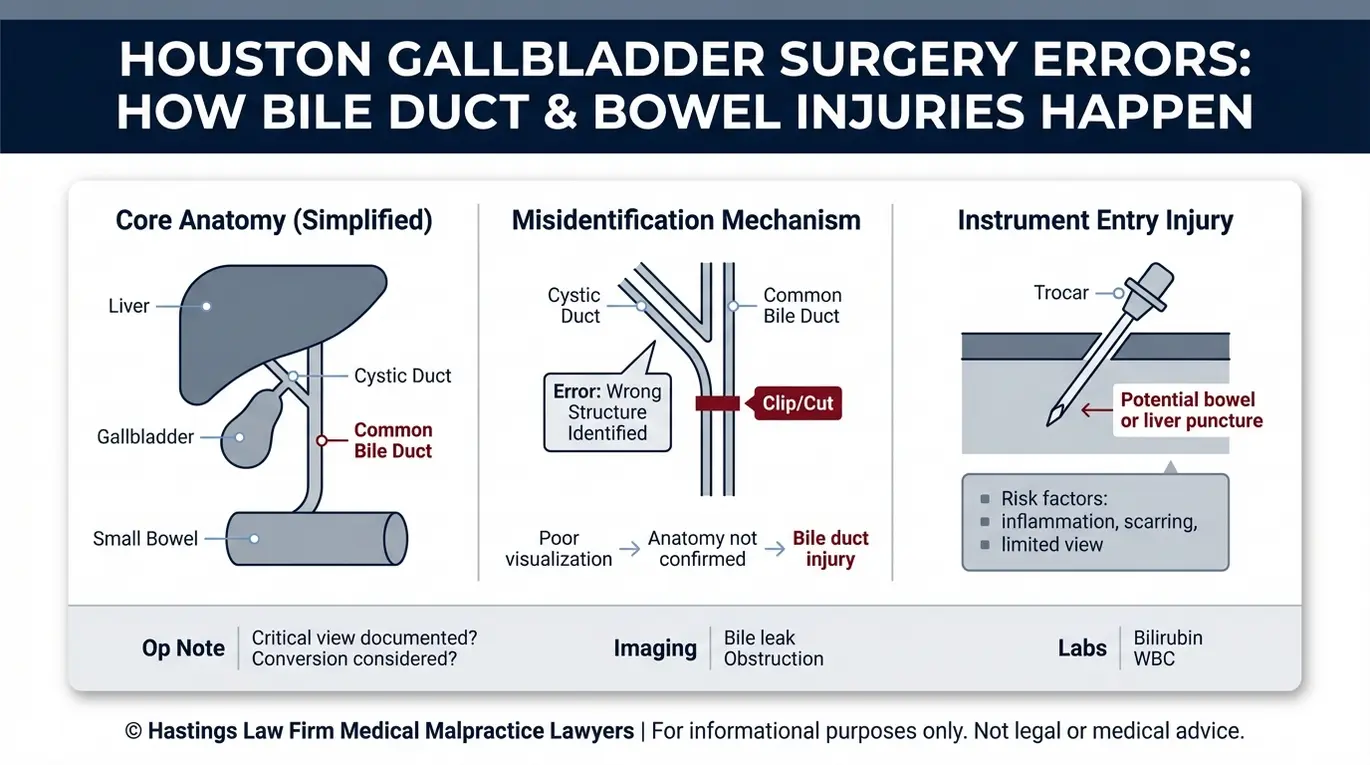
Surgical errors during cholecystectomies often involve the accidental clipping or cutting of the common bile duct or bowel, typically resulting from a failure to properly identify anatomical structures before cutting. A laparoscopic cholecystectomy is a minimally invasive surgery used to remove the gallbladder.
The surgeon operates through small incisions using a camera and instruments, including a trocar, which is a sharp, tube-like device used to puncture the abdomen and create access points. While this technique offers faster recovery times, it also limits the surgeon’s direct view of the surgical field.
That limited visibility often contributes to gallbladder surgery malpractice. According to research published in PubMed Central on rare anatomical variants during laparoscopic cholecystectomy, variations in bile duct anatomy can create confusion during dissection. A careful surgeon accounts for these possibilities by methodically identifying each structure before cutting. When that step is skipped or rushed, the risk of a severe bile duct injury increases significantly.
The most common surgical errors we see in botched gallbladder surgery cases include:
- Bile duct misidentification: Mistaking the common bile duct for the cystic duct, leading to the duct being clipped, cut, or completely severed. This is the most frequent cause of severe injury during gallbladder removal.
- Failure to convert to open surgery: When a surgeon encounters poor visualization, heavy inflammation, or unexpected anatomy during a laparoscopic procedure, the standard of care may require converting to an open surgery. Continuing with the laparoscopic approach despite complications can constitute physician error.
- Trocar or instrument injury: Accidental puncture of the bowel, liver, or blood vessels during trocar insertion or instrument manipulation, leading to bowel perforation or internal bleeding.
Detailed Consequences of Bile Duct Perforation
When the common bile duct, the tube that carries bile from the liver and gallbladder to the small intestine, is cut or damaged, the consequences can be severe. A bile leak, meaning bile escaping from the damaged duct into the abdominal cavity, triggers a dangerous chain of events.
Bile is caustic to surrounding tissue. When it pools in the abdomen, it can cause peritonitis, a serious infection of the abdominal lining that can rapidly progress to sepsis if untreated. Patients may also develop liver damage over time if bile flow is permanently disrupted. In many cases, the injury requires one or more reconstructive surgeries, and some patients face lifelong digestive complications.
Recognizing Signs of Malpractice Post-Surgery
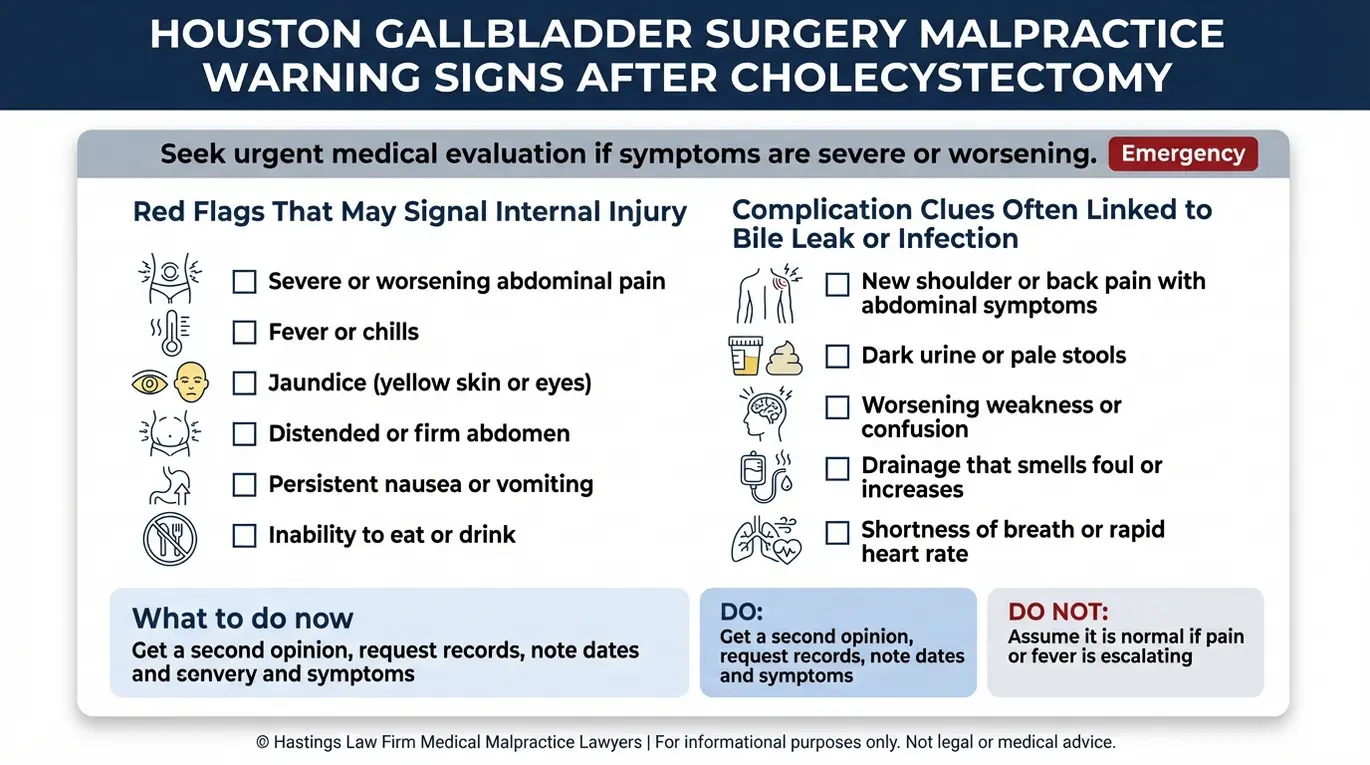
Signs of malpractice after a gallbladder operation typically include severe abdominal pain, fever, jaundice, or nausea that persists or worsens days after the procedure, often indicating untreated internal injuries. After surgery, patients must monitor for symptoms that indicate the body is not healing correctly. When medical professionals fail to identify these warning signs, it can lead to dangerous complications like sepsis or organ failure.
This delayed recognition is sometimes associated with postcholecystectomy syndrome (PCS), a term described by the NCBI Bookshelf’s overview of Postcholecystectomy Syndrome that refers to a range of gastrointestinal symptoms that develop after gallbladder removal. While PCS can occur without negligence, its symptoms can also mask a surgical injury that requires urgent treatment.
If you experienced any of the following after gallbladder surgery, you should seek a second opinion and consider speaking with a medical malpractice lawyer. Do not assume that these symptoms will resolve on their own; delayed treatment for a surgical error can lead to catastrophic health outcomes.
- Jaundice, which is a yellowing of the skin or eyes, suggesting bile is not draining properly
- A distended or swollen abdomen
- Persistent or worsening fever
- Inability to eat or drink without severe nausea
- Sharp, escalating abdominal pain that does not improve with prescribed medication
- Signs of sepsis, such as rapid heart rate, confusion, or extreme fatigue
If your original surgeon dismissed these symptoms, getting an independent medical evaluation is an important first step. A Houston medical malpractice attorney can then help determine whether the complications you experienced were the result of a preventable error.
The Hastings Law Firm Difference
Results matter, but what truly sets us apart is how we achieve them. Every verdict, every settlement, and every Houston courtroom victory comes from one guiding promise: To treat each client’s fight for justice as if it were our own.
This balance of skill, experience, and empathy reflects our core philosophy that justice should not only compensate the injured, but also make health care safer nationwide.

Proving Negligence in Laparoscopic Cholecystectomy Cases
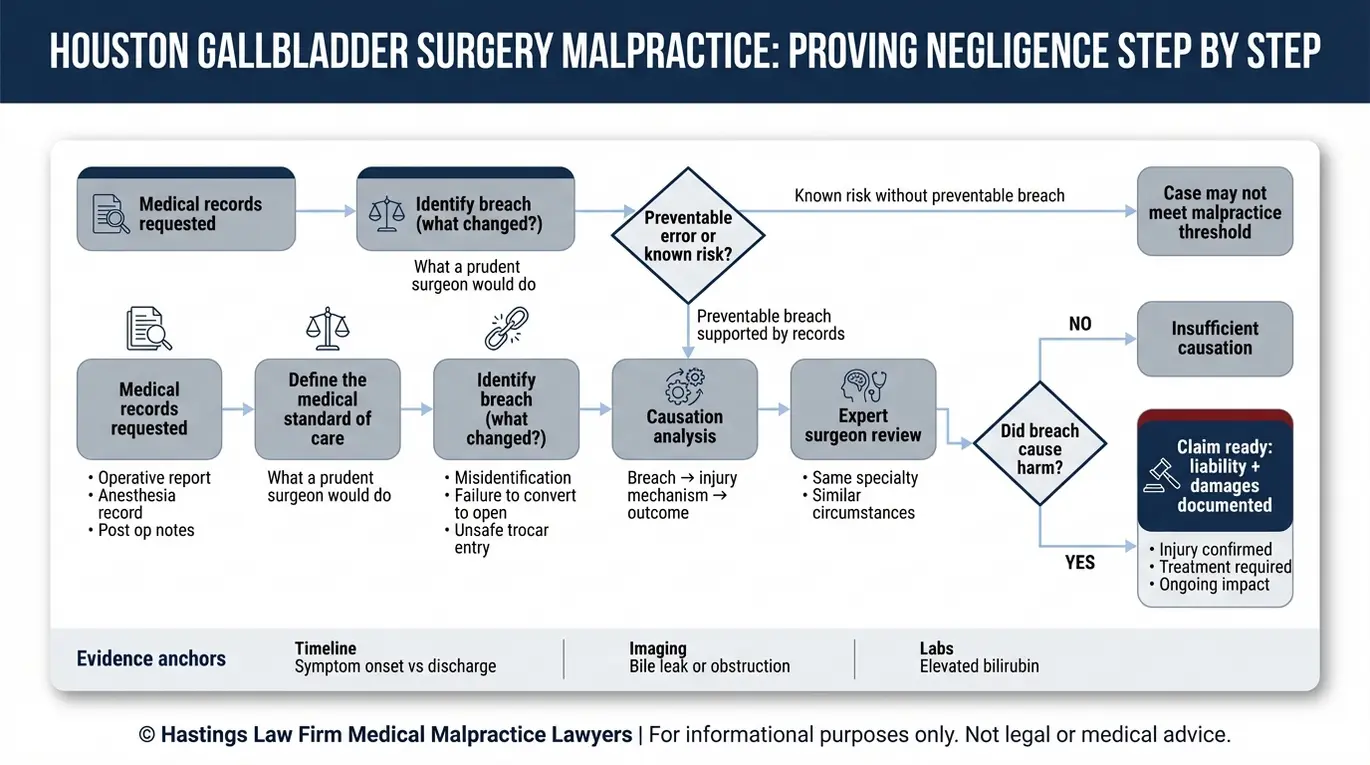
To prove negligence in a medical malpractice claim, a plaintiff must demonstrate that the surgeon deviated from the accepted medical standard of care, directly causing injury that a competent surgeon would have avoided under similar circumstances. Establishing negligence involves comparing the surgeon’s actions against the standard of care expected in the medical community.
Our legal and medical team begins by reconstructing exactly what happened during the procedure. We review the operative report, anesthesia records, nursing notes, and post-operative documentation to build a detailed timeline. From there, we work with qualified surgical experts to provide expert testimony regarding whether the surgeon met the standard of care, meaning the level of skill and caution that a reasonably competent surgeon would have exercised during the same procedure.
One concept that comes up frequently in these cases is the critical view of safety (CVS), a widely recognized surgical technique that requires the surgeon to clearly identify the cystic duct, the small tube connecting the gallbladder (often filled with gallstones) to the common bile duct, and the cystic artery before any cutting takes place. As detailed in the NCBI Bookshelf’s entry on Bile Duct Injury, failure to achieve this critical view is a well-documented cause of bile duct injuries. If operative records show CVS was not confirmed, that can be strong evidence of surgical negligence.
We also examine informed consent. This means your doctor explained the risks and you agreed to the treatment before the procedure. If those risks were not disclosed, or if you were not given adequate information to make an informed decision, that may form a separate basis for your claim.
Distinction Between a Surgical Complication and Medical Malpractice
Not every poor surgical outcome qualifies as malpractice. Surgery carries inherent risks, and a bile duct injury can occasionally occur even when the surgeon does everything right. The distinction is whether the injury resulted from a preventable error rooted in negligence, or from a known risk that arose despite the surgeon following proper technique.
Our job is to examine the evidence and determine which category your case falls into. If the records show the surgeon failed to identify critical anatomy, ignored warning signs, or continued a laparoscopic approach when conversion to open surgery was warranted, that is not a complication. That is an instance of surgical negligence.
Compensation for Bile Duct Injuries and Surgical Negligence
Patients harmed by gallbladder surgery errors may recover economic damages for medical bills and lost wages, as well as non-economic damages for pain, suffering, and physical impairment. Legal compensation aims to restore the patient’s financial security and cover future medical needs.
The value of any claim depends on the severity of the injury, the cost of corrective treatment, and the long-term impact on the patient’s quality of life. Bile duct injuries frequently require extensive reconstructive surgery, such as a Roux-en-Y hepaticojejunostomy (RYHJ), a reconstruction procedure that reroutes bile flow by connecting the remaining healthy bile duct directly to the small intestine. According to research published in PubMed on long-term results of Roux-en-Y hepaticojejunostomy, while this procedure can restore bile drainage, it involves significant recovery time, and some patients require additional surgeries or face lifelong digestive issues. These complications can prevent a patient from returning to work or enjoying daily activities, creating a ripple effect of financial and emotional strain.
| Economic Damages | Non-Economic Damages |
|---|---|
| Corrective and reconstructive surgery costs | Physical pain and suffering |
| Past and future medical costs | Mental anguish and emotional distress |
| Lost wages and reduced earning capacity | Loss of enjoyment of life |
| Ongoing monitoring and follow-up care | Physical impairment or disfigurement |
| Prescription medications and therapies | Loss of consortium (for spouses) |
In cases where a patient dies from complications such as sepsis or organ failure following a surgical error, surviving family members may pursue a wrongful death claim to recover damages for their loss, including funeral expenses, lost financial support, and the emotional toll of losing a loved one.
Texas Damage Caps on Non-Economic Damages
Texas law limits non-economic damages in medical malpractice cases. Under current statutory caps, recovery for pain and suffering is generally capped at $250,000 against all individual healthcare providers combined and $250,000 per healthcare institution, up to $500,000 total across all institutions. There is no cap on economic damages, meaning compensation for medical expenses, lost income, and future care costs is not subject to the same limits.
To maximize your financial recovery, thorough documentation of every financial loss is essential. Our team works with life care planners and economists to calculate the true value of your claim, ensuring that no expense, including revision surgeries and lost retirement benefits, is overlooked.
Contact the Houston Surgical Error Attorneys at Hastings Law Firm Today for Help
If you believe a surgical error during gallbladder removal caused you or a family member serious harm, you deserve honest answers about what happened and whether you have a legal path forward.
At Hastings Law Firm, our entire practice is dedicated to medical malpractice. Our team includes former defense attorneys who understand how hospitals and insurers respond to these claims, along with in-house nursing professionals who can analyze your medical records and identify where the standard of care may have broken down. Founded by board-certified trial attorney Tommy Hastings, our firm prepares every case as if it will go to trial, because that preparation is what drives fair results.
There are no upfront fees or costs. We work on a contingency basis, meaning you pay nothing unless we recover compensation on your behalf. If you are looking for a Houston gallbladder surgery error lawyer you can trust, contact us for a free, confidential case evaluation. Let us help you find the answers you deserve.
Frequently Asked Questions About Gallbladder Surgery Error in Houston


This content was researched and written by the Hastings Law Firm editorial team, which includes attorneys, medical professionals, and experienced researchers. Our writing is informed by internal knowledge and practical experience, and we cross-check critical details against authoritative sources cited throughout. Every piece undergoes human-led fact-checking and legal review. Because legal and medical information can change, if you spot an error, please contact us. Learn more about our content standards and review process on our editorial policy page.

Tommy Hastings, founder of Hastings Law Firm, is a board-certified personal injury trial lawyer dedicated exclusively to healthcare injury cases. Since 2001, he has represented injured patients and families in litigation against major hospital systems, pharmaceutical companies, and negligent healthcare providers nationwide. He has handled numerous high-profile cases that have drawn national media attention and resulted in multi-million dollar recoveries. He draws on that experience in his writing, helping readers understand how these cases work and what options may be available to them.
