


Texas Fertility Clinic Malpractice Lawyer
Written by: Hastings Law Firm | Reviewed by: Gabe Sassin | Updated: July 27, 2026
Fertility clinic negligence can shatter plans for a family when embryos, eggs, or sperm are mishandled during IVF or storage. The most serious problems often happen inside the laboratory, where identification failures, equipment malfunctions, and testing errors can lead to irreversible loss, failed transfers, miscarriage, severe emotional harm, or worse. Responsibility may extend beyond a physician to a clinic, lab, or product manufacturer, and key records can be difficult to obtain. If you or a loved one were harmed or worse due to fertility clinic negligence in Texas, contact Hastings Law Firm for a free, confidential case review.

Trusted Legal Representation for IVF and Fertility Negligence in Texas
What You Should Know About IVF Clinic Negligence Claims in Texas:
- Life changing reproductive losses can occur when embryos, eggs, or sperm are destroyed, damaged, or mixed up during IVF care.
- Severe emotional harm can follow wrong embryo implantation or genetic mix ups that change genetic parentage.
- Options for recovery can depend on whether responsibility lies with the clinic, the laboratory, or a product manufacturer.
- Compensation can include costs tied to failed IVF cycles and future fertility treatment along with mental anguish.
- Wrongful death theories may be limited because Texas law generally treats embryos as property for that purpose.
- Recovery can be reduced or barred when filing time limits are missed, especially when an error is discovered long after it occurred.
- Critical electronic records can be lost when monitoring systems overwrite older data, making early preservation important.
- Disputes about what happened can turn on chain of custody documentation and internal lab logs.
- Product related failures can expand the dispute beyond medical negligence when tanks, alarms, or culture media are defective.

A Healthcare Focused Law Firm
When you entrust a fertility clinic with your eggs, sperm, or embryos, you are placing your hope for a family in their hands. Learning that something went wrong during in vitro fertilization (IVF), a process where eggs are fertilized outside the body and transferred to the uterus, can leave you feeling devastated and unsure of what to do next.
These cases involve a unique intersection of medicine, science, and law that most firms are not equipped to handle. Our firm focuses exclusively on medical negligence and maintains the in-house medical staff and national expert network needed to investigate what happened inside the lab.
If you believe your embryos, eggs, or fertility treatment were compromised by a clinic’s error, we can review your situation and explain your legal options in a free, confidential consultation.
Common Types of Fertility Clinic Negligence in Texas
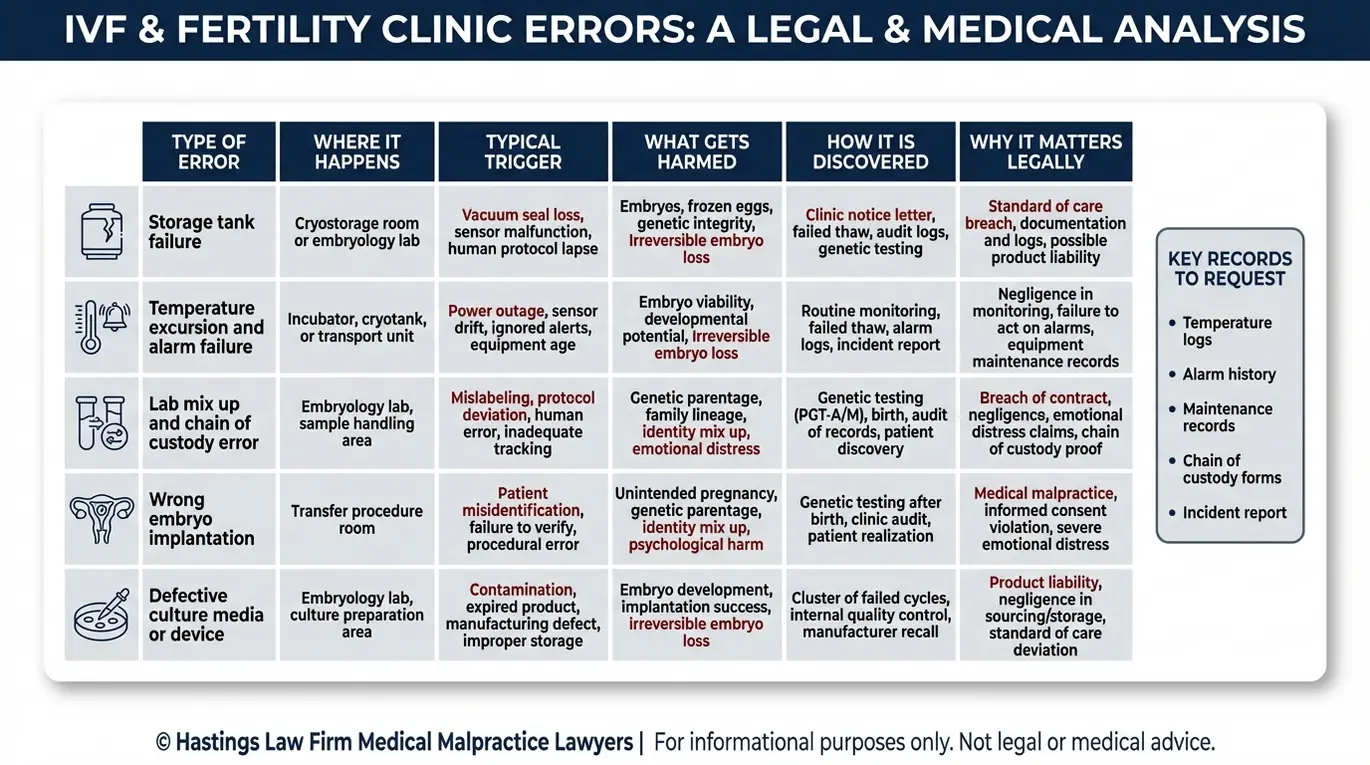
Fertility clinic negligence often involves laboratory errors such as the accidental destruction of embryos due to storage tank failures, implantation of the wrong embryo, or the use of defective culture media, the nutrient solution used to grow embryos, that arrests development. Because so much of the IVF process happens behind closed doors in a specialized lab, patients may not learn about these errors for months or even years.
We evaluate the specific type of failure that occurred to determine who is responsible and what compensation may be available. Below are the most common categories of error we see in these cases.
| Type of Error | What Happens | Potential Impact |
|---|---|---|
| Cryogenic Storage Failure | Tank malfunction causes temperature to rise, thawing stored eggs or embryos | Permanent loss of viable embryos or eggs |
| Wrong Embryo Implantation | A patient receives an embryo created from another couple’s genetic material | Pregnancy with a genetically unrelated child; severe emotional harm |
| Lab Mix-Up (Sperm/Egg) | Incorrect pairing of sperm and egg samples during fertilization | Child born with unexpected genetic parentage |
| Defective Culture Media | Contaminated or toxic growth solution used during embryo development | Embryos fail to develop or are irreparably damaged |
| Genetic Testing Errors (PGT-A) | Faulty pre-implantation genetic screening of embryos | Implantation of non-viable embryos or those with severe genetic conditions |
Storage Failures
Cryogenic storage tank failures are among the most widely reported fertility clinic errors. Embryos and eggs are stored in specialized containers called Dewars, which are vacuum-insulated tanks designed to hold liquid nitrogen at extremely low temperatures (approximately -196°C). When these tanks function properly, cryopreservation protocols allow genetic material to remain preserved for years.
Failures occur when the vacuum seal degrades, temperature sensors malfunction, or liquid nitrogen levels drop without triggering an alarm. Research published by PubMed Central on cryostorage tank failures has documented how quickly temperatures can rise after an induced failure, with catastrophic warming occurring in a matter of hours. Once the temperature inside the tank rises past a critical threshold, eggs and embryos begin to thaw, and the damage is irreversible.
Lab and Human Error
Wrong embryo implantation, where a patient receives an embryo that is not genetically hers, represents one of the most emotionally devastating IVF mix-ups. These errors typically stem from breakdowns in identification and labeling protocols within the lab. We investigate the chain-of-custody procedures and staffing levels to determine where the breakdown occurred and who bears responsibility.
A single mislabeled dish or sample vial can result in the wrong sperm being used, the wrong egg being fertilized, or the wrong embryo being transferred.
Genetic Testing Errors
Many patients elect pre-implantation genetic testing (PGT-A) to screen embryos for chromosomal abnormalities before transfer. When the testing itself is flawed, patients may unknowingly have a non-viable embryo implanted, leading to failed transfers, miscarriage, or the birth of a child with a severe genetic condition. These errors can also result in the discarding of healthy embryos that were incorrectly flagged as abnormal.
Understanding Cryogenic Storage Tank Failures
A cryogenic storage tank, commonly called a Dewar, works by maintaining a vacuum between its inner and outer walls. This vacuum acts as insulation, keeping the liquid nitrogen inside at a stable, ultra-cold temperature. The liquid nitrogen itself is what preserves the eggs and embryos stored within.
When the vacuum seal is compromised, or when a temperature sensor fails to detect rising heat, the liquid nitrogen begins to evaporate at an accelerated rate. This process, known as a temperature excursion, which is an unplanned rise in storage temperature beyond the safe range, can unfold rapidly. Depending on the severity of the breach, the tank’s internal temperature can climb to destructive levels within hours, causing irreversible thawing of every specimen inside.
This is why immediate preservation of the tank’s electronic monitoring data and alarm logs is important in these cases. That data can reveal exactly when the failure began, how quickly conditions deteriorated, and whether staff were alerted in time to intervene.
Identifying Liability in Assisted Reproductive Technology Cases
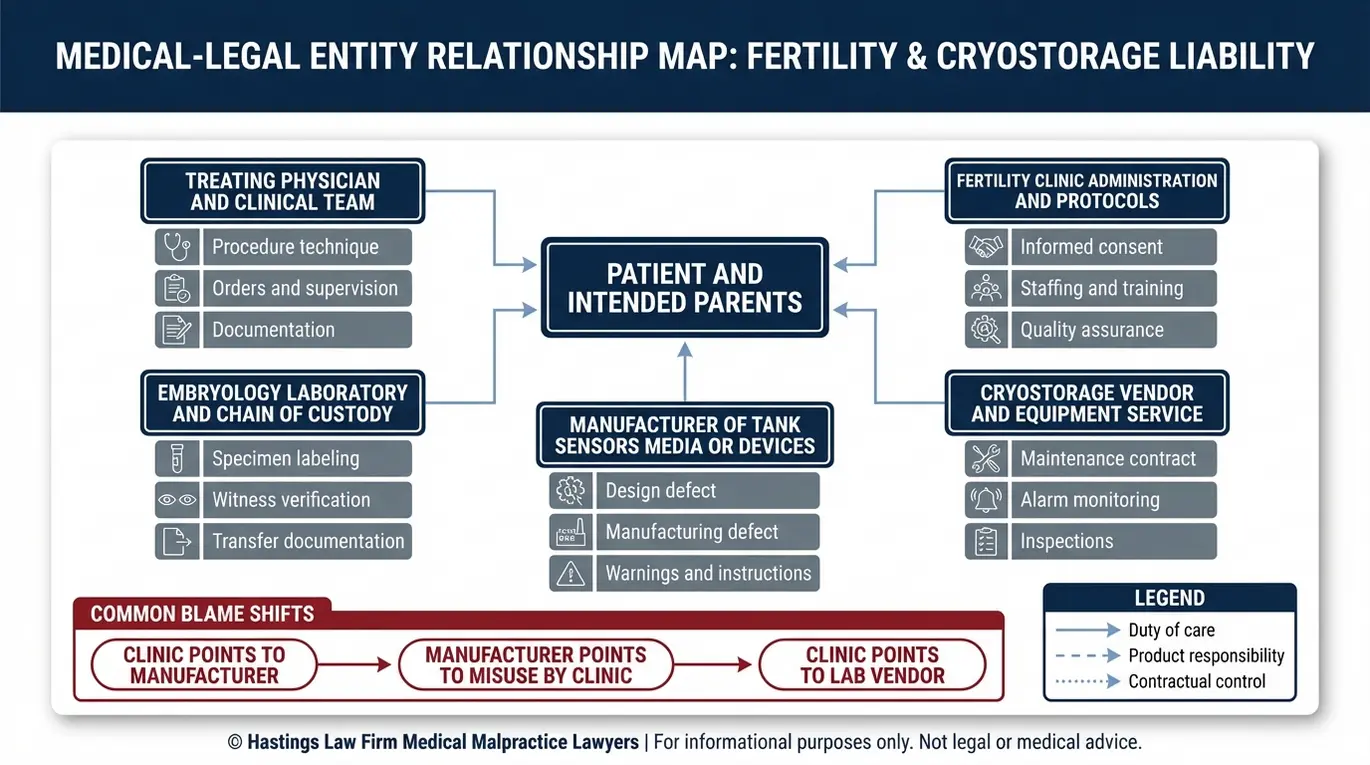
Liability in fertility cases can extend beyond the treating physician to include the fertility clinic for protocol failures, the laboratory for handling errors, or medical device manufacturers for defective storage tanks or culture media. Assisted reproductive technology (ART), which refers to any medical procedure that handles eggs or embryos outside the body, involves multiple parties at every stage, and each one may carry a share of legal responsibility.
As your legal team, our job is to trace the error back to its source and identify every responsible party. Here is how liability typically breaks down:
- The clinic and its physicians: The doctors overseeing your care may be liable for negligence in performing procedures, failing to diagnose complications, or failing to obtain informed consent before treatment. Clinics are also responsible for maintaining safe staffing levels and following proper protocols. The Texas Medical Board provides guidance on patient information and medical record requirements that clinics must follow.
- The laboratory and its staff: The lab is responsible for the chain of custody of your genetic material, meaning the documented tracking of every egg, sperm sample, and embryo. If the lab loses track of whose material is whose, contaminates samples, or fails to follow cryopreservation protocols, the lab and its parent organization may be liable.
- Product manufacturers: If a defective storage tank, faulty alarm system, or toxic culture media caused the loss, the manufacturer of that product may face a separate product liability claim. Companies that produce cryogenic equipment or the growth solutions used during embryo development can be held accountable for a defective medical device or manufacturing flaws.
- Fertility fraud: In some cases, providers have been found to have substituted their own genetic material or misrepresented the source of donor specimens. Texas law addresses parentage and genetic identity through the Texas Family Code, Chapter 160, which may provide additional legal avenues.
The Hastings Law Firm Difference
Results matter, but what truly sets us apart is how we achieve them. Every verdict, every settlement, and every Texas courtroom victory comes from one guiding promise: To treat each client’s fight for justice as if it were our own.
This balance of skill, experience, and empathy reflects our core philosophy that justice should not only compensate the injured, but also make healthcare safer nationwide.

Proving Negligence and Gathering Evidence
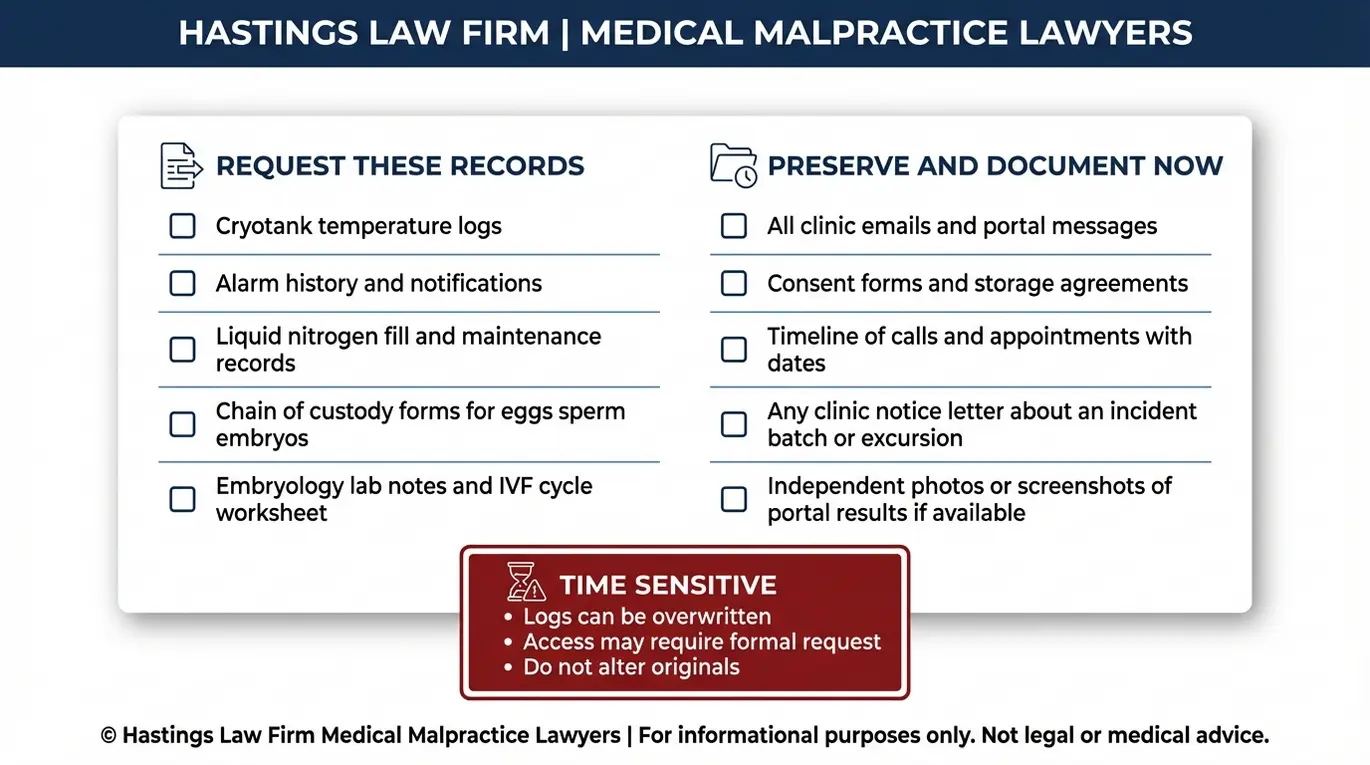
Proving negligence requires clear evidence that the clinic deviated from the standard of care, which is often established through electronic monitoring logs, cryo-tank alarm history, and chain-of-custody records analyzed by medical experts. A malpractice attorney for IVF errors works to secure this evidence early, before it can be altered, overwritten, or lost.
Why speed matters with electronic logs. Modern cryogenic tanks and IVF laboratories generate digital records, including temperature readings, alarm activations, and access logs. Some of these systems overwrite older data automatically. Requesting preservation of this information immediately after a suspected error is one of the most important steps in building a case. Under the Texas Rules of Civil Procedure, attorneys can file motions to compel the preservation and production of these records.
Establishing the standard of care. The standard of care is the level of treatment that a reasonably competent fertility specialist or embryologist would provide under similar circumstances. We work with qualified reproductive endocrinologists and embryologists to define exactly what protocols should have been followed, such as obtaining proper informed consent and maintaining accurate medical records, and where the clinic fell short.
The role of expert testimony. Texas medical malpractice law requires expert witnesses to establish both the breach and its connection to the harm. Our firm retains embryologists, reproductive endocrinologists, and biomedical engineers who can speak to lab protocols, equipment maintenance standards, and the precise mechanism of failure.
An important piece of evidence is the record of any temperature excursion, which is a deviation from safe storage limits, that can prove exactly when samples were compromised. We analyze this data alongside chain-of-custody records, which track the handling of every specimen, to pinpoint the error. Clinics are often reluctant to release these internal logs voluntarily, making legal intervention necessary to secure the full history of the equipment’s performance.
Here is a checklist of the critical evidence we work to obtain in fertility negligence cases:
- Cryo-tank temperature logs and data from alarm sensors
- Liquid nitrogen delivery and refill records
- Tank maintenance logs and inspection records
- Chain-of-custody documentation for all eggs, sperm, and embryos
- Internal incident reports or staff communications about the event
- Quality control logs for culture media and lab supplies
- Patient consent forms and treatment agreements
- Clinic staffing schedules and lab access records
- Manufacturer specifications and recall notices for equipment
At Hastings Law Firm, our in-house medical staff, including nurse practitioners and board-certified patient advocates, begins reviewing clinical records alongside our attorneys from the first day of investigation. This dual approach helps us identify inconsistencies that a legal team without medical training might miss.
Compensation for the Loss of Embryos and Fertility
Compensation in Texas fertility cases may cover the financial costs of failed IVF cycles, future fertility treatments, and significant mental anguish, though obtaining damages for the “wrongful death” of an embryo remains legally complex under state statutes. Understanding what types of damages in fertility cases are available is an important part of deciding how to move forward.
Economic Damages
Economic damages in fertility negligence cases are designed to reimburse you for the measurable financial losses caused by the error. These can include the cost of the IVF cycle that was compromised, fees paid for cryogenic storage of specimens that were destroyed, medication expenses, and travel costs associated with treatment.
If future fertility treatments, donor eggs, or surrogacy are now necessary because of the clinic’s error, the projected cost of those future treatments may also be recoverable. Reimbursement may also cover out-of-pocket expenses for specialized medication, which can run into thousands of dollars per cycle. A single IVF cycle in Texas can cost $15,000 to $30,000 or more, and many patients require multiple attempts.
Non-Economic Damages
The emotional toll of losing embryos or discovering a genetic mix-up is profound. For many patients, those embryos represented their best or only chance at having a biological child. We can help document the full scope of this mental anguish, often with the support of mental health professionals who can provide testimony about the ongoing effects.
Courts have recognized that the destruction of embryos or the implantation of the wrong genetic material can cause grief, anxiety, depression, and severe emotional distress.
The Legal Complexity of Embryo Status
Texas law does not currently treat embryos as “persons” for the purpose of wrongful death claims. Instead, embryos are generally classified as a form of property. This distinction affects the legal theories available and the categories of damages that can be pursued.
However, this does not mean compensation is limited. Skilled attorneys pursue claims through multiple legal channels, including breach of bailment, which is the clinic’s duty to safely store your property, as well as negligence and breach of contract. While embryos are property, they are unique property. Their value exceeds simple replacement cost because it incorporates the loss of reproductive potential.
The legal landscape around embryo status continues to evolve. Our team stays current with legislative developments and court rulings to build the strongest possible case under the law as it stands today.
Statute of Limitations for Fertility Negligence in Texas
In Texas, medical malpractice claims must generally be filed within two years of the negligent act, but the discovery rule may extend this deadline if the error, such as a tank failure or genetic mix-up, could not have been discovered immediately. Missing the filing deadline can result in your case being permanently dismissed.
The Two-Year Rule
Under Texas Civil Practice and Remedies Code Chapter 74, the standard two-year rule for a medical malpractice claim requires filing within two years from the date the negligence occurred. For some fertility cases, this deadline is straightforward. If a clinic notifies you that a storage tank failed on a specific date, the clock typically starts running from that date.
The Discovery Rule
Many fertility clinic errors are not immediately apparent. A wrong embryo implantation may not be discovered until a child is born and genetic testing reveals unexpected results. A storage failure that damaged some but not all embryos may only come to light when a patient attempts to use a frozen embryo years later.
In these situations, the discovery rule allows the time limit for IVF lawsuits to begin when the patient knew or should have known about the injury. This exception is important in fertility cases where the gap between error and discovery can span years.
The Statute of Repose
Texas also imposes an absolute 10-year statute of repose. This means that regardless of when the error is discovered, no medical malpractice claim can be filed more than 10 years after the date of the negligent act. For patients with embryos in long-term storage, this outer boundary is an important consideration.
This 10-year bar is strict. Even if a clinic actively concealed the error for a decade, once that ten-year anniversary passes, the right to sue is generally extinguished. This makes it important to investigate potential failures the moment a suspicion arises.
Contact the Texas Healthcare Malpractice Attorneys at Hastings Law Firm Today for Help
No amount of compensation can replace the embryos, eggs, or time that a fertility clinic’s negligence has taken from you. But holding the responsible parties accountable can provide the financial resources you need to pursue other paths to parenthood and help prevent the same failures from harming another family.
Hastings Law Firm is built for cases exactly like these. Our team, including board-certified trial lawyer Tommy Hastings and former defense counsel who understand hospital defense tactics, work together to investigate complex fertility negligence claims. We understand both the medical science and the emotional weight behind every case we take.
There is no fee unless we recover compensation for you. Contact us today for a free, confidential case evaluation. Let us help you find the answers you deserve.
Frequently Asked Questions About Fertility Clinic Malpractice in Texas


This content was researched and written by the Hastings Law Firm editorial team, which includes attorneys, medical professionals, and experienced researchers. Our writing is informed by internal knowledge and practical experience, and we cross-check critical details against authoritative sources cited throughout. Every piece undergoes human-led fact-checking and legal review. Because legal and medical information can change, if you spot an error, please contact us. Learn more about our content standards and review process on our editorial policy page.

Gabe Sassin has focused exclusively on medical malpractice law since 2007. After spending more than a decade as a malpractice defense attorney, he knows exactly how the other side works. He has seen firsthand how healthcare providers, insurers, corporate defendants, and their legal teams think, prepare, and build their defense against claims. That knowledge works for the people who need it most today, injured patients and their families. His unique experience shapes everything he writes, giving readers a look at how these cases actually work from someone who has handled them from both sides.
