


Arizona Failed Induction of Labor Lawyer
Labor induction can be a safe medical tool, but mistakes with Pitocin dosing, monitoring, or decision making can put both mother and baby at risk of severe and lasting harm. The risks rise when contraindications are missed, fetal distress is not recognized on electronic fetal monitoring, or a stalled induction is allowed to continue without timely reassessment. These situations can lead to oxygen deprivation, emergency complications, and permanent neurological injury. If your child suffered harm due to failed induction of labor in Arizona, contact Hastings Law Firm for a free, confidential case review.

Last Updated: July 27, 2026
Trusted Arizona Medical Attorneys for Labor Induction Malpractice Claims
When labor induction leads to a serious injury for your baby or complications for you as the mother, the emotional weight can be overwhelming. You trusted your medical team to keep you and your child safe, and something went wrong. Now, you may be left with questions, medical bills, and a deep sense that the care you received fell short.
Labor induction, the medical process of stimulating contractions before labor begins naturally, is one of the most common obstetric interventions in the country. When it is managed properly, it can be a safe and effective tool. But when errors occur during induction, the consequences can be life-altering for both mother and child.
As a dedicated Arizona failed induction of labor lawyer, Hastings Law Firm focuses exclusively on medical malpractice. Our team of attorneys, nurse consultants, and in-house medical staff can review your records, identify what happened, and explain your legal options. The consultation is free, confidential, and comes with no obligation.

Understanding the Risks of Pitocin and Labor Induction
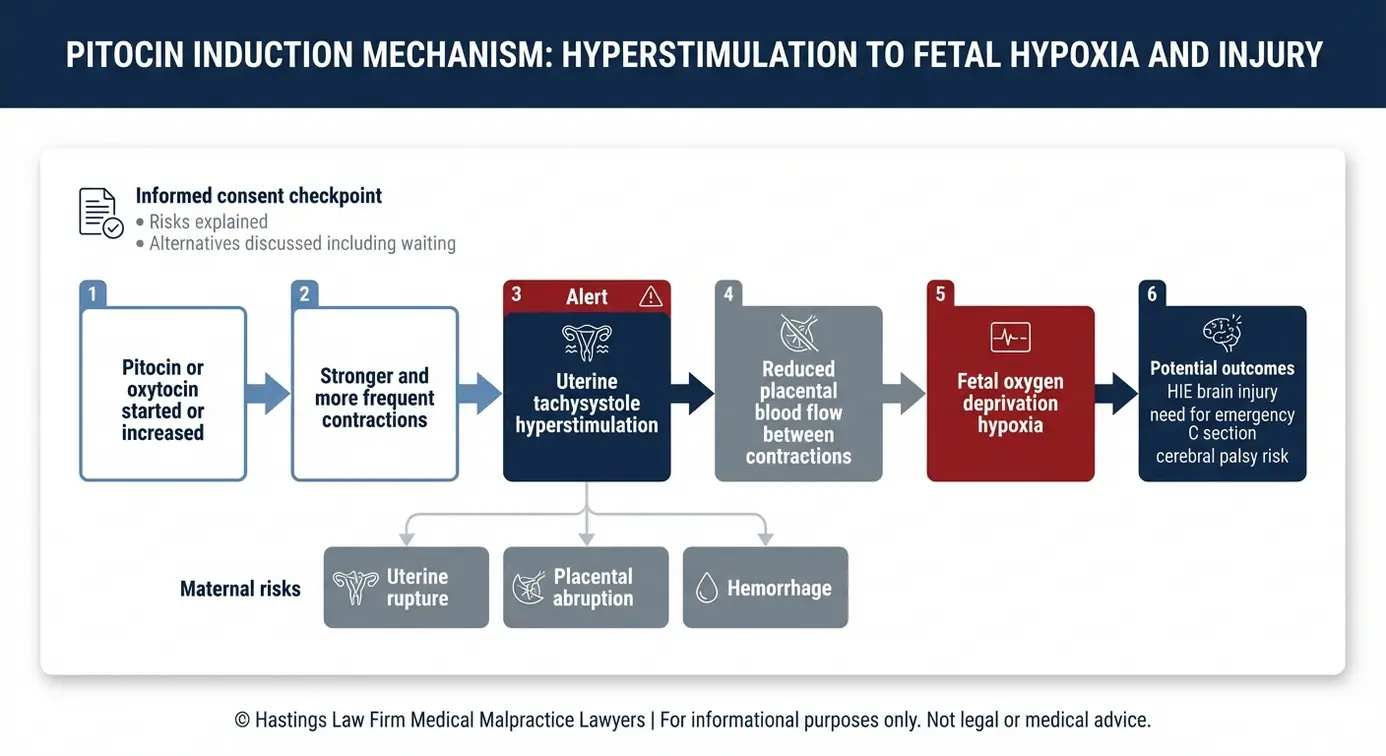
Labor induction involves stimulating uterine contractions before labor begins on its own, typically using the drug Pitocin, a synthetic form of the naturally occurring hormone oxytocin. While induction is effective in many cases, it carries significant risks if not carefully monitored, including uterine hyperstimulation, which can cut off oxygen to the baby and cause catastrophic brain injuries.
Pitocin is classified as a “high-alert” medication by patient safety organizations. Unlike natural oxytocin, which the body releases in pulses, synthetic Pitocin is administered through an IV drip at controlled rates. The dose must be increased gradually and monitored continuously because the uterus can respond unpredictably. Too much Pitocin can cause contractions that are too frequent or too strong, reducing the oxygen supply to the baby.
According to the American College of Obstetricians and Gynecologists, induction may be recommended when the benefits of delivery outweigh the risks of continuing the pregnancy. But the decision to induce should always involve informed consent, meaning your doctor must explain the risks, benefits, and alternatives. You have the right to refuse an elective induction, and that right should be clearly communicated and respected.
The physiological risks of induction go beyond discomfort. Uterine rupture, a tear in the wall of the uterus, is a rare but potentially fatal complication that is more likely when Pitocin is used improperly. Other serious risks include placental abruption, where the placenta separates from the uterine wall, and hemorrhage, which can be life-threatening for the mother.
Contraindications for Induction
Contraindications are medical reasons why a specific treatment should not be used because it could be harmful. Certain medical conditions make labor induction dangerous, and proceeding despite these conditions can constitute medical negligence. Before starting Pitocin, the medical team should screen for known contraindications, including:
- Prior classical cesarean incision: A vertical incision through the upper uterus from a previous C-section significantly increases the risk of uterine rupture during induced contractions.
- Placenta previa or vasa previa: When the placenta partially or fully covers the cervix, induction can trigger severe bleeding.
- Active genital herpes outbreak: Induction that leads to vaginal delivery during an active outbreak poses a serious infection risk to the newborn.
- Placental abruption: If the placenta has already begun separating from the uterine wall, stimulating contractions can worsen the separation and cause life-threatening hemorrhage.
- Abnormal fetal positioning: Certain presentations, such as a transverse lie, make vaginal delivery unsafe regardless of induction.
If induction is initiated despite one or more of these conditions, the medical team may have violated the standard of care.
Common Pitocin Errors Leading to Injury
Medical malpractice often occurs during induction when the medical staff fail to manage Pitocin dosage correctly. Common errors include administering excessive doses that trigger uterine tachysystole, failing to discontinue the drug when the baby shows signs of distress, or starting induction despite clear contraindications.
Pitocin is dose-dependent, meaning small increases can dramatically alter uterine response. Dosage protocols require incremental increases alongside continuous electronic fetal monitoring (EFM) to track contractions and fetal heart rate. Trained staff must interpret these EFM strips in real-time to assess how the baby is tolerating labor.
Research published by the National Certification Corporation (NCC) outlines standards for interpreting fetal monitoring data. A systematic review on PubMed confirms that discontinuing oxytocin during active labor can reduce cesarean delivery risks. Ignoring these protocols can lead to severe consequences.
The table below illustrates the difference between standard induction protocol and common negligent deviations:
| Area of Care | Standard Protocol | Negligent Action |
|---|---|---|
| Dosage management | Gradual increases at defined intervals with documented reassessment | Rapid or excessive dose increases without proper evaluation |
| Fetal monitoring | Continuous EFM with trained interpretation of heart rate patterns | Intermittent monitoring, ignored tracings, or understaffed unit |
| Response to tachysystole | Reduce or stop Pitocin; reposition patient; administer oxygen | Continuing Pitocin despite more than five contractions in ten minutes |
| Response to fetal distress | Immediate intervention, including possible emergency C-section | Delayed response to late decelerations or prolonged bradycardia |
| Documentation | Detailed charting of dosage changes, maternal vitals, and fetal status | Gaps in charting, missing strip segments, or incomplete records |
Identifying Fetal Distress on EFM Strips
Electronic fetal monitoring (EFM), a system that records the baby’s heart rate in relation to contractions, reveals when the baby is not getting enough oxygen. Late decelerations, where the heart rate drops after a contraction peaks, are one of the most concerning findings. They suggest the placenta is struggling to deliver oxygen during contractions, a precursor to hypoxia.
Other warning signs include minimal or absent heart rate variability and prolonged periods of bradycardia. When these patterns appear, especially during Pitocin-augmented labor, the standard of care requires prompt action. Failure to recognize or respond to these patterns is one of the most common forms of negligence in induction-related birth injuries.
Hypoxic-ischemic encephalopathy (HIE), a type of brain damage caused by oxygen deprivation during or near the time of birth, is one of the most devastating outcomes linked to these errors. HIE can lead to permanent neurological conditions, including cerebral palsy.

The Hastings Law Firm Difference
Results matter, but what truly sets us apart is how we achieve them. Every verdict, every settlement, and every Arizona courtroom victory comes from one guiding promise: To treat each client’s fight for justice as if it were our own.
This balance of skill, experience, and empathy reflects our core philosophy that justice should not only compensate the injured, but also make health care safer nationwide.

Negligence Claims Arising from Failed Induction
A failed induction claim arises when the induction process does not result in vaginal delivery within a reasonable time and the medical team fails to pivot to a cesarean section, causing injury to the mother or baby. Negligence may also involve the improper use of delivery instruments like forceps or vacuum extractors after a failed induction attempt.
When induction stalls or the baby shows signs of distress, the standard of care typically requires the medical team to reassess the plan and consider a cesarean section. A failed induction creates a dangerous environment for the fetus. As contractions continue without progression, the uterus may become hyper-stimulated, compressing the umbilical cord or reducing placental blood flow.
When this state persists, the window to prevent permanent injury narrows. The standard of care mandates that the medical team not only monitor for distress but also recognize when the induction has clinically failed. Continuing Pitocin during non-progressive labor, essentially forcing the baby against a closed birth canal, can lead to severe injury. This negligence can cause mechanical trauma, such as skull fractures, or metabolic acidosis from oxygen deprivation.
Prolonged labor following a failed induction puts the baby at increasing risk for oxygen deprivation, which can result in HIE, cerebral palsy, and other forms of permanent brain damage. The longer the delay in recognizing the need for surgical delivery, the greater the potential for irreversible harm. Maternal injuries from failed induction are equally serious, including uterine rupture and infection.
We evaluate whether the care team recognized and acted on indicators that the induction was not progressing safely. Warning signs that may support a birth injury claim include:
- Persistent lack of cervical change despite adequate Pitocin dosing over several hours
- Recurrent late decelerations or other non-reassuring fetal heart rate patterns on EFM
- Evidence of uterine tachysystole that was not addressed
- Prolonged labor without documented reassessment of the delivery plan
- Use of vacuum or forceps without meeting clinical criteria for operative vaginal delivery
Each of these factors becomes part of the medical record, and our in-house nursing staff and physician consultants review every detail when building a case.
Establishing Liability and the Standard of Care in Arizona
To prove malpractice in Arizona, a plaintiff must demonstrate that the healthcare provider violated the accepted medical standard of care, the level of treatment a reasonably competent OB-GYN would have provided under similar circumstances. This legal duty of care ensures patients receive safe treatment. This often requires expert testimony to establish what should have happened during the induction, such as discontinuing Pitocin or ordering an emergency C-section when distress was evident.
Arizona law sets specific requirements for expert witnesses in medical malpractice cases. Under Arizona Revised Statutes § 12-2604, the expert must be qualified by specialty and experience to testify about the standard of care that applied at the time of the injury. Arizona Revised Statutes § 12-2604 also demands strict adherence to specialty matching.
An expert witness must be licensed in the same health profession as the defendant and have devoted the majority of their professional time to active clinical practice or teaching in the same specialty during the year preceding the occurrence giving rise to the lawsuit. This requirement ensures that only truly qualified peers establish the benchmark for liability. This is why our firm maintains a national network of medical experts, including physician-attorney consultants and board-certified specialists in maternal-fetal medicine.
Hospital vs. Doctor Liability
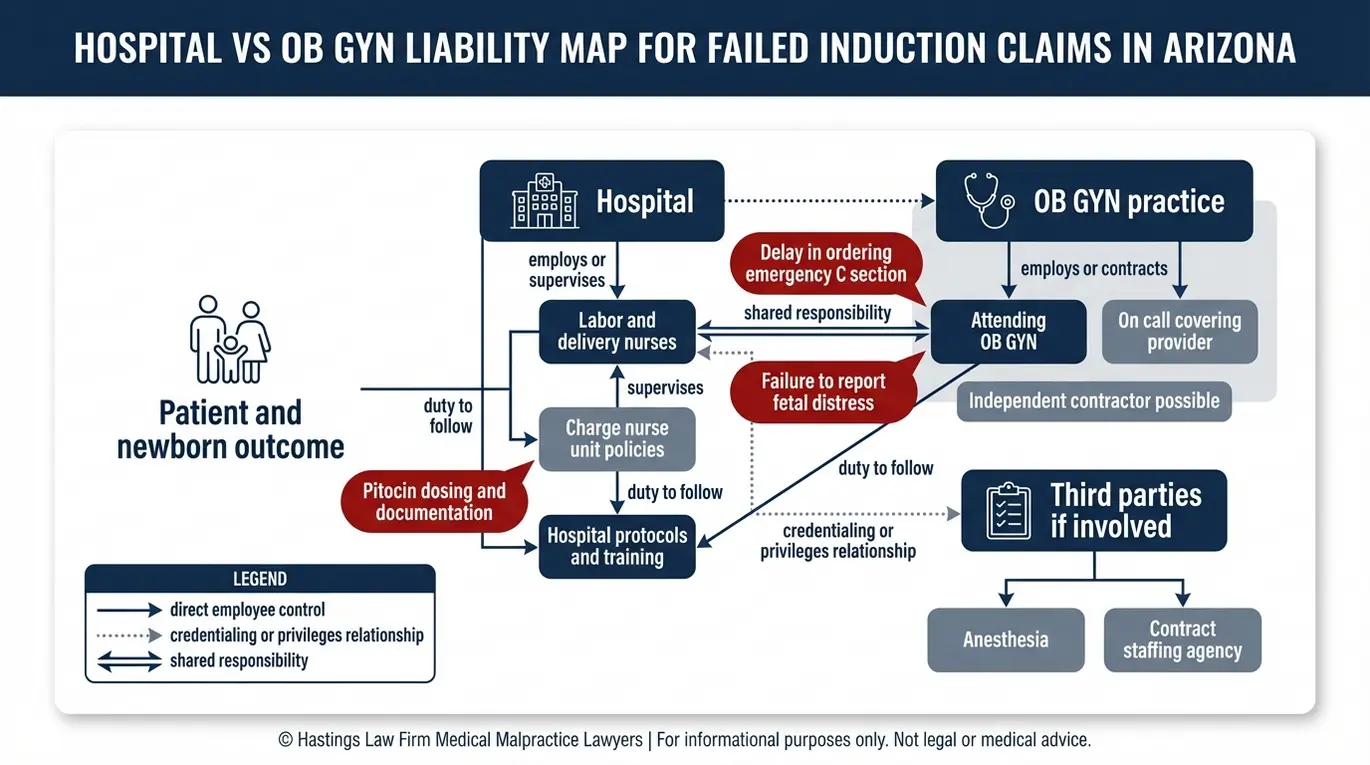
Liability in a failed induction case is not always limited to the attending physician. In many hospitals, OB-GYNs are independent contractors rather than employees of the facility. That distinction matters legally, but it does not necessarily shield the hospital from responsibility.
Hospitals can be held liable for the actions of their employees, including labor and delivery nurses who administer Pitocin and monitor fetal heart tracings. If a nurse fails to report non-reassuring fetal heart patterns, or if the hospital’s staffing levels were inadequate to provide continuous monitoring, the facility itself may bear direct liability.
The hospital may also face claims under a corporate negligence theory if it failed to enforce safety protocols or credentialed an unqualified physician. Our team, which includes former defense attorneys who previously worked for the systems they now challenge, understands how these entities structure their defenses and where the vulnerabilities lie.
Arizona Statute of Limitations for Induction-Related Birth Injuries
Arizona law imposes strict deadlines for filing medical malpractice lawsuits. Under Arizona Revised Statutes § 12-542, the general statute of limitations is two years from the date the injury occurred or was discovered. This exception, known as the discovery rule, acknowledges that some birth injuries are not immediately apparent.
For birth injuries affecting minors, the timeline may be extended. Arizona Revised Statutes § 12-502 provides tolling provisions that can pause the statute of limitations for a minor child until they reach the age of 18. While this legal deadline extension may provide additional time, waiting can make it harder to preserve critical evidence like fetal monitoring strips and nursing notes.
Filing sooner allows your legal team to secure the medical records and expert opinions needed to build a strong case. If a public hospital or government-affiliated facility was involved, even shorter notice deadlines may apply. Speaking with an attorney early gives your family the best opportunity to protect your rights and your child’s future.
Contact the Arizona Birth Injury Attorneys at Hastings Law Firm Today for Help
If you believe a medical error during labor induction caused your child’s injury, you do not have to face the aftermath alone. Hastings Law Firm focuses exclusively on medical malpractice, and our team includes in-house nurses, board-certified patient advocates, and former defense attorneys who know how hospitals respond to these claims.
As your Arizona failed induction of labor lawyer, board-certified trial lawyer Tommy Hastings and his team will investigate your case and identify what went wrong. Tommy Hastings is board-certified in Personal Injury Trial Law, a distinction held by less than 2% of attorneys. We operate on a contingency fee basis, meaning there is no cost to you unless we recover on your behalf.
Contact us today for a free, confidential case evaluation. Let us help you find the answers you deserve.
Frequently Asked Questions About Failed Induction of Labor in Arizona


This content was researched and written by the Hastings Law Firm editorial team, which includes attorneys, medical professionals, and experienced researchers. Our writing is informed by internal knowledge and practical experience, and we cross-check critical details against authoritative sources cited throughout. Every piece undergoes human-led fact-checking and legal review. Because legal and medical information can change, if you spot an error, please contact us. Learn more about our content standards and review process on our editorial policy page.

Tommy Hastings, founder of Hastings Law Firm, is a board-certified personal injury trial lawyer dedicated exclusively to healthcare injury cases. Since 2001, he has represented injured patients and families in litigation against major hospital systems, pharmaceutical companies, and negligent healthcare providers nationwide. He has handled numerous high-profile cases that have drawn national media attention and resulted in multi-million dollar recoveries. He draws on that experience in his writing, helping readers understand how these cases work and what options may be available to them.
