


Texas Epidural Injection Injury Lawyer
Written by: Hastings Law Firm | Reviewed by: Gabe Sassin | Updated: July 27, 2026
Epidural steroid injections are widely used for pain management and obstetric care, but preventable mistakes during needle placement, medication selection, monitoring, or sterility can cause lasting harm. Serious outcomes can involve infections, spinal headaches, permanent nerve injury, paralysis, and other life altering complications. Understanding whether a complication reflects an accepted risk or a deviation from the standard of care often depends on what was done during the procedure and how quickly warning signs were addressed. If you or a loved one were harmed or worse due to epidural malpractice in Texas, contact Hastings Law Firm for a free, confidential case review.

Trusted Texas Medical Attorneys for Epidural Malpractice Claims
What You Should Know About Spinal Injection Malpractice Claims in Texas:
- Long term harm can follow an epidural injection when preventable errors occur during needle placement, medication administration, monitoring, or sterility.
- Permanent injury risk can increase when real time imaging is not used in higher risk spinal areas.
- Recovery options can depend on showing that the outcome came from a specific procedural error rather than a known complication of the procedure.
- Irreversible damage can result when warning signs of spinal bleeding are missed or imaging is delayed.
- Severe infections can occur after sterility failures during an injection, including epidural abscess and meningitis.
- Lifelong disability can occur with adhesive arachnoiditis when spinal nerves become inflamed and scarred after substances are introduced near the dura.
- Financial recovery can be limited for pain and suffering in Texas even when medical bills and lost income are substantial.
- Responsibility can extend beyond the injecting clinician when a clinic or hospital bears liability for care delivered in its facility.
- A signed consent form does not eliminate rights when the provider deviated from the standard of care.
- Case strength can turn on what procedural records and clinical notes show about technique, imaging use, and response to symptoms.

A Healthcare Focused Law Firm
An epidural steroid injection (ESI) is one of the most frequently performed procedures in pain management and obstetric care. Epidural injections, a method where medication is delivered into the space near the spinal cord to block pain or reduce inflammation, can provide significant relief when done correctly. When a provider makes a preventable error during the injection, the consequences can be severe and permanent.
If you or a loved one suffered nerve damage, paralysis, or other serious complications after an epidural procedure, you may have questions about what went wrong and whether negligence was involved. Founded by board-certified trial attorney Tommy Hastings in 2005, Hastings Law Firm focuses exclusively on medical malpractice and has the medical-legal team to evaluate your case. Contact us for a free, confidential consultation to review what happened and understand your options.
Common Causes of Spinal Injection Injuries & Malpractice
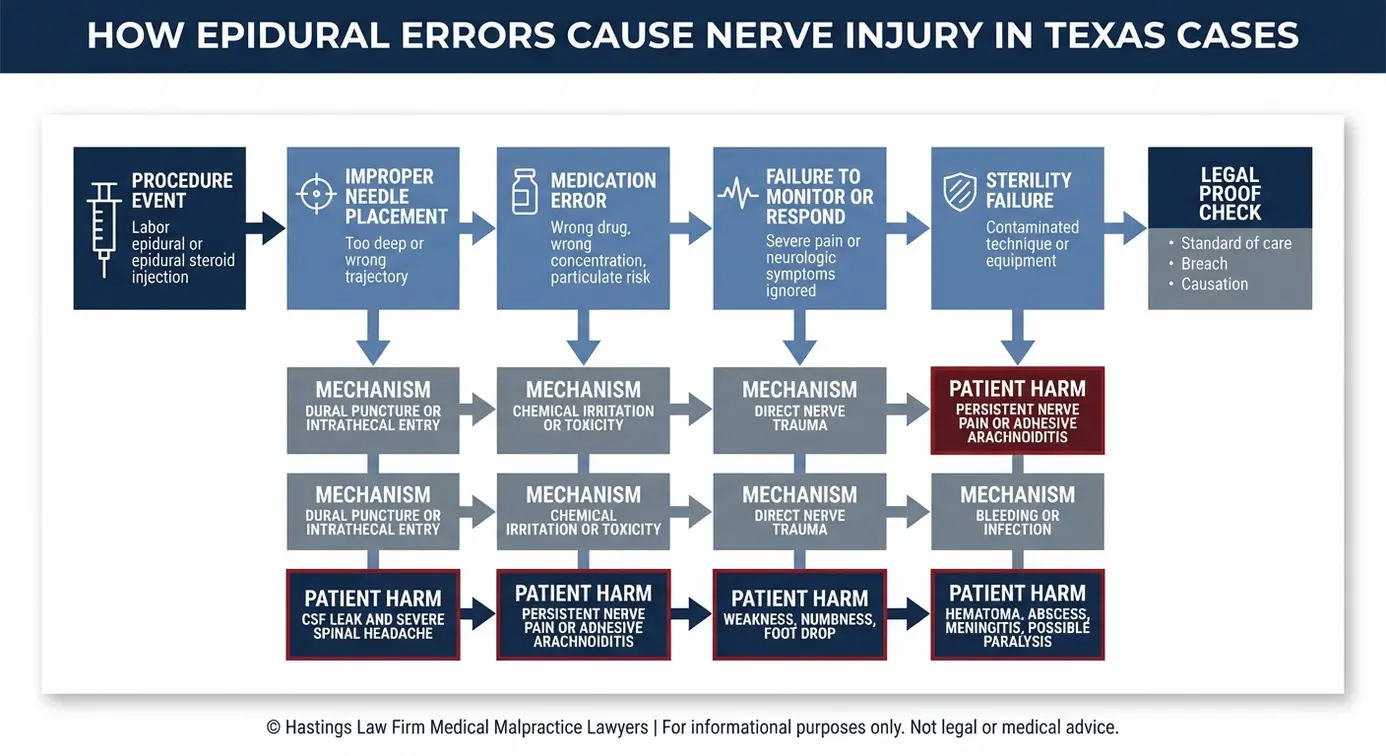
Epidural malpractice occurs when a medical provider deviates from the standard of care, such as placing the needle incorrectly, failing to use fluoroscopic guidance, or administering the wrong dosage of corticosteroids. This involves looking at how the procedure was performed compared to medical standards.
Not every complication after a spinal injection means something went wrong. Certain errors during the procedure do cross the line from an accepted risk into medical negligence. As a Texas epidural injury attorney, we investigate these deviations to determine liability. Here are some of the most common acts our team investigates:
- Improper needle placement: The needle or catheter enters the epidural space, the fat-filled area surrounding the protective membrane of the spinal cord. If the needle advances too far, it can puncture the dura mater (called a dural puncture, a tear in the protective membrane surrounding spinal fluid) or make direct contact with the spinal cord or nerve roots.
- Medication errors: Injecting the wrong drug, using a non-approved particulate steroid, or administering an incorrect dose of anesthetic or corticosteroid into or near the spinal canal.
- Failure to monitor the patient: Ignoring a patient’s complaints of sudden, severe pain during the injection, which can indicate the needle has contacted a nerve. According to the CDC’s Patient Safety Analysis Resources, adherence to established safety protocols is essential to preventing healthcare-associated complications.
- Sterility failures: Using contaminated equipment or failing to follow proper aseptic technique, which can introduce bacteria and lead to dangerous infections such as an epidural abscess or meningitis.
Each of these errors points to a breakdown in the expected standard of care. Our in-house medical staff, including nurse practitioners and board-certified patient advocates, review clinical records and procedural notes to identify exactly where that breakdown occurred.
The Critical Role of Fluoroscopic Guidance
One of the most important factors we examine is whether the provider used real-time imaging during the injection. Fluoroscopic guidance, or fluoroscopy, is a type of live X-ray that allows the physician to see the needle’s position as it approaches the spine. This imaging helps confirm accurate placement before any medication is delivered.
A “blind injection,” one performed without any imaging, relies entirely on the provider’s feel and anatomical landmarks. While blind technique may still be used in some clinical settings, failing to use fluoroscopy in high-risk spinal areas, particularly for ESIs near the cervical or thoracic spine, can be a significant indicator of negligence and a breach of the standard of care. We regularly work with anesthesiology and radiology experts to evaluate whether imaging should have been used and whether its absence contributed to the injury as part of our work as a Texas epidural injury attorney.
Severe Complications Caused by Negligent Epidural Administration
Negligent epidural administration can result in life-altering injuries ranging from debilitating spinal headaches and infections to permanent nerve damage, paralysis, or adhesive arachnoiditis. The type and severity of injury often depends on what specifically went wrong during the procedure.
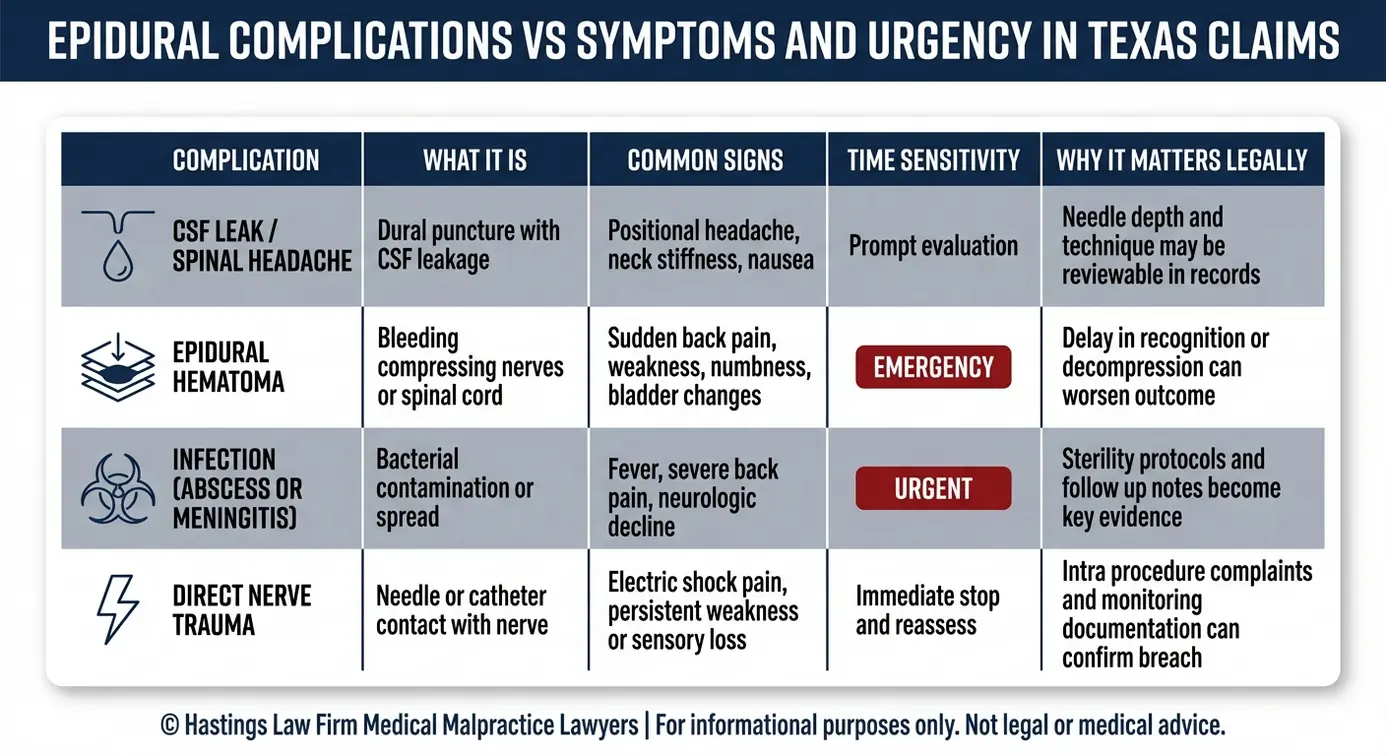
The table below outlines common complications linked to epidural errors, along with the symptoms that may signal each condition:
| Complication | Hallmark Symptoms | Urgency |
|---|---|---|
| Epidural hematoma (a blood clot or collection of blood pressing on the spinal cord) | Sudden severe back pain, progressive weakness or numbness in legs, loss of bladder/bowel control | Emergency: requires surgical decompression within hours |
| Epidural abscess (a pocket of infection forming near the spinal cord) | Fever, worsening back pain, neurological decline over days | Urgent: may require surgery and IV antibiotics |
| Meningitis | Severe headache, neck stiffness, fever, light sensitivity | Emergency: requires immediate medical treatment |
| Direct nerve trauma | “Foot drop,” numbness, shooting pain, loss of sensation in extremities | Varies: some resolve; others are permanent |
| CSF leak / spinal headache | Intense positional headache (worse when upright), nausea, vision changes | Moderate: may require a blood patch procedure |
An epidural hematoma is among the most dangerous complications. As detailed in the MSD Manual Professional Edition’s overview of spinal subdural or epidural hematoma, bleeding that compresses the spinal cord can cause irreversible damage if not surgically decompressed within a narrow time window. A provider’s failure to recognize the warning signs, or delay in ordering imaging, can turn a treatable condition into a permanent one.
Infections such as an epidural abscess or meningitis are frequently traced back to sterility failures during the injection. A recent analysis published in PubMed Central on risks and adverse events for epidural spinal injections confirms that procedural contamination remains a recognized and preventable source of serious post-injection infection.
Hastings Law Firm works with qualified medical experts to connect the specific procedural error to the injury our client suffered, fulfilling our role as a Texas epidural injection injury lawyer. That connection between the breach and the harm is what transforms a bad outcome into a viable malpractice claim.
Adhesive Arachnoiditis: A Long-Term Consequence
One of the most devastating injuries we see is adhesive arachnoiditis, a chronic condition in which the spinal nerves become inflamed and clump together, often as a result of chemical irritation from corticosteroids or other substances introduced near the dura mater. This condition involves permanent scarring of the nerves within the spinal canal. The inflammation causes scar tissue to form around the nerves, leading to burning pain, numbness, and, in many cases, permanent disability.
Adhesive arachnoiditis is often irreversible. Patients living with this condition may experience constant pain that does not respond well to conventional treatment. When this condition develops after a spinal injection, our medical team investigates whether the type of medication used, the injection technique, or repeated procedures contributed to the nerve inflammation.
The Hastings Law Firm Difference
Results matter, but what truly sets us apart is how we achieve them. Every verdict, every settlement, and every Texas courtroom victory comes from one guiding promise: To treat each client’s fight for justice as if it were our own.
This balance of skill, experience, and empathy reflects our core philosophy that justice should not only compensate the injured, but also make healthcare safer nationwide.

Can You Sue for a Botched Epidural in Texas?
Yes, you can sue for a botched epidural if you can prove the provider breached the standard of care—such as ignoring imaging protocols or failing to treat complications timely—and that this breach directly caused your injury. A bad result alone is not enough. The legal question is whether the provider’s technique or decision-making fell below what a competent professional would have done in the same situation.
Proving the breach is the foundation of any epidural malpractice case. We work with board-certified anesthesiologists and pain management specialists who review the procedural records and compare what was done against what should have been done. Our team’s former defense attorneys understand how the other side builds their case, which allows us to anticipate their arguments and address them early.
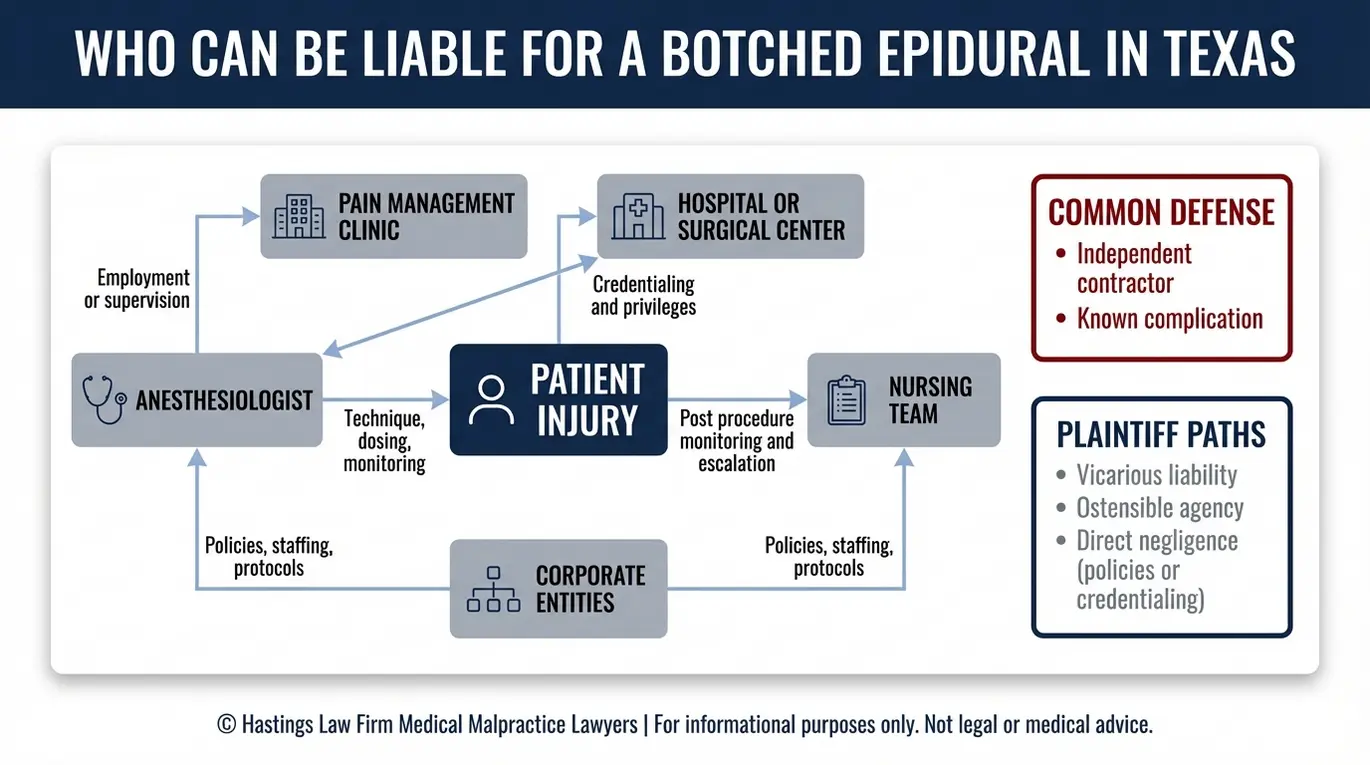
Identifying liability in these cases can involve multiple parties. The anesthesiologist who performed the injection may be one target, but the pain clinic that employed them or the hospital where the procedure took place may also bear responsibility. Under Texas law, hospitals can sometimes be held liable through vicarious liability even for the acts of physicians who work within their facility. A Texas Supreme Court opinion has addressed the conditions under which institutional liability may apply in medical negligence cases, and our legal team evaluates these relationships in every case we accept.
The “known complication” defense is one of the most common arguments we face. The defense will often argue that the injury was simply a recognized risk of the procedure, not the result of negligence. We counter this by showing that the injury did not result from an inherent risk but from a specific, identifiable error in how the procedure was performed.
Does Signing a Consent Form Waive Your Rights?
Many clients worry that signing a consent form before the procedure means they gave up the right to take legal action. That is not how informed consent works. A consent form acknowledges that you understood the known risks of the procedure. It does not give a provider permission to be careless.
Informed consent means the doctor explained the risks and alternatives, and you agreed to the treatment as described. You did not consent to a contaminated needle, a misplaced injection, or a failure to enforce hospital protocol. No consent form in Texas acts as a waiver of your legal rights to competent medical care. If the provider deviated from the standard of care, the consent form does not shield them from a Texas epidural injection injury lawyer holding them accountable.
Compensation for Nerve Damage and Spinal Injuries
Victims of epidural malpractice may recover economic damages for medical bills and lost wages, as well as non-economic damages for pain, suffering, and physical impairment, subject to Texas statutory caps.
Recoverable damages in spinal injection injury cases typically include:
- Medical expenses: Costs of corrective surgeries, hospitalization, rehabilitation, medications, and any future medical care related to the injury.
- Lost income and earning capacity: Wages lost during recovery, and the long-term reduction in earning ability for patients who can no longer work or must change careers due to paralysis or chronic pain.
- Pain and suffering: Compensation for the physical pain, emotional distress, and diminished quality of life caused by the injury.
- Loss of enjoyment of life: The impact on daily activities, hobbies, relationships, and independence.
Under the Texas Civil Practice and Remedies Code § 74.301, non-economic damages are capped at $250,000 against all physicians and individual healthcare providers combined, with a combined cap of roughly $750,000 when multiple institutions are also involved. There is no cap on economic damages, which means the full cost of medical bills, lost wages, and future care can be recovered without a statutory ceiling.
For patients facing permanent disability or paralysis after a negligent epidural, economic damages often represent the largest portion of a recovery. Our team works with life-care planners and vocational experts to document the true financial impact of the injury over a lifetime.
Contact the Texas Healthcare Malpractice Attorneys at Hastings Law Firm Today for Help
If a routine pain management procedure or labor epidural left you with nerve damage, chronic pain, or worse, you deserve answers from a team that understands both the medicine and the law. Hastings Law Firm focuses exclusively on medical malpractice, and our medical-legal team includes nurse practitioners, former defense counsel, and board-certified patient advocates who know how to identify what went wrong.
As a Texas epidural injection injury lawyer, we charge no fees unless we recover compensation for you. Every consultation is free and confidential, led by a patient advocate who will listen to your experience and help determine whether you have a case.
Call us or complete our online form to schedule your risk-free case evaluation. Let us review your records and explain your options.
Frequently Asked Questions About Epidural Injection Injury in Texas


This content was researched and written by the Hastings Law Firm editorial team, which includes attorneys, medical professionals, and experienced researchers. Our writing is informed by internal knowledge and practical experience, and we cross-check critical details against authoritative sources cited throughout. Every piece undergoes human-led fact-checking and legal review. Because legal and medical information can change, if you spot an error, please contact us. Learn more about our content standards and review process on our editorial policy page.

Gabe Sassin has focused exclusively on medical malpractice law since 2007. After spending more than a decade as a malpractice defense attorney, he knows exactly how the other side works. He has seen firsthand how healthcare providers, insurers, corporate defendants, and their legal teams think, prepare, and build their defense against claims. That knowledge works for the people who need it most today, injured patients and their families. His unique experience shapes everything he writes, giving readers a look at how these cases actually work from someone who has handled them from both sides.
