


Texas Ectopic Pregnancy Misdiagnosis Lawyer
Written by: Hastings Law Firm | Reviewed by: Brady D. Williams | Updated: July 27, 2026
A missed or delayed ectopic pregnancy diagnosis can turn early pregnancy symptoms into a life threatening emergency. When warning signs are dismissed or testing is not completed, internal bleeding, emergency surgery, loss of fertility, and fatal outcomes can follow. These situations often involve breakdowns in triage, imaging interpretation, follow up, or discharge decisions across multiple providers. Clear documentation of symptoms, test results, and clinical decisions can shape what happened and why it was preventable. If you or a loved one were harmed or worse due to ectopic pregnancy misdiagnosis in Texas, contact Hastings Law Firm for a free, confidential case review.

Trusted Texas Medical Attorneys for Missed Ectopic Pregnancy Diagnosis Claims
What You Should Know About Missed Ectopic Pregnancy Diagnosis Claims in Texas:
- Harm can escalate quickly when an ectopic pregnancy is not identified promptly because rupture can cause massive internal bleeding and life threatening consequences.
- Fertility can be permanently affected when delayed diagnosis leads to emergency surgery and loss of reproductive organs.
- Options can narrow when patients are discharged without completing appropriate evaluation for ectopic pregnancy after presenting with abdominal pain or vaginal bleeding.
- Severe outcomes can follow when classic red flags are dismissed as routine miscarriage or minor discomfort.
- Liability can extend beyond one clinician when radiology reads, ER triage, OB GYN follow up, or hospital discharge protocols contribute to a missed diagnosis.
- A dangerous ectopic pregnancy can be overlooked even after an intrauterine pregnancy is seen on ultrasound when clinicians stop looking too soon.
- A wanted viable pregnancy can be lost when Methotrexate is given after an incomplete diagnostic workup.
- Recovery in Texas can be limited for non economic harms while economic losses like medical bills, lost wages, and future treatment costs are not capped.
- Case clarity can depend on whether records show symptoms were documented but diagnostic testing and follow up were not completed or acted on.

A Healthcare Focused Law Firm
If you or someone you love suffered serious harm because a doctor failed to diagnose an ectopic pregnancy, you already know something went wrong. You may be dealing with the physical aftermath of emergency surgery, the emotional weight of lost fertility, or the grief of losing a family member entirely. These are not small things, and you deserve honest answers about what happened and why.
At Hastings Law Firm, our medical-legal team focuses exclusively on medical malpractice. Our firm was founded by Tommy Hastings, a board-certified trial lawyer with over 20 years of experience who focuses solely on these complex medical cases. Our in-house nurses and former defense attorneys review the clinical records, identify where the standard of care broke down, and build cases designed to hold negligent providers accountable. As a Texas ectopic pregnancy misdiagnosis lawyer, we understand both the medicine and the law behind these preventable tragedies.
If you believe your ectopic pregnancy was missed or diagnosed too late, we can review what happened and explain your options in a free, confidential consultation.
Understanding Ectopic Pregnancy and the Dangers of Delayed Treatment
An ectopic pregnancy occurs when a fertilized egg implants outside the uterus, most commonly in the fallopian tube. This type of implantation, often called a tubal pregnancy, cannot result in a viable birth. It is a medical emergency because the growing tissue can rupture the tube, causing massive internal bleeding that is life-threatening.
Time is the defining factor in these cases. When ectopic pregnancy is caught early, treatment options such as medication or minimally invasive surgery can preserve the fallopian tube and protect future fertility. However, the window for effective intervention is narrow.
When diagnosis is delayed, the tube can rupture, leading to catastrophic hemorrhage that requires emergency surgery and may result in permanent organ loss or death. Because the embryo cannot survive, the priority must be the patient’s safety. This requires immediate medical intervention rather than “wait and see” approaches. According to the National Center for Biotechnology Information (NCBI), ectopic pregnancy remains a leading cause of maternal mortality in the first trimester.
What makes many of these cases actionable from the perspective of an ectopic pregnancy malpractice attorney is that doctors already know who is at higher risk. A thorough medical history often reveals warning signs that mandate closer scrutiny. Certain factors should immediately raise clinical suspicion:
- History of pelvic inflammatory disease (PID)
- Endometriosis
- Prior tubal surgery or tubal ligation
- Previous ectopic pregnancy
- IVF or other assisted reproductive treatments
- Use of an intrauterine device (IUD)
When these risk factors are present and a provider still fails to investigate, ignoring the potential for a non-viable pregnancy, the consequences can be devastating and preventable.
Common Warning Signs and Symptoms Doctors Ignore
Medical negligence often begins when doctors dismiss classic ectopic pregnancy symptoms as a routine miscarriage or minor cramping, sending patients home without the tests that could save their lives.
Sharp, one-sided pelvic pain and vaginal bleeding in early pregnancy are well-established warning signs. So is referred shoulder pain, or Kehr’s sign, which occurs when blood from a ruptured tube irritates the diaphragm. This symptom strongly suggests hemoperitoneum, the accumulation of blood in the abdominal cavity, and it signals a surgical emergency. Yet patients report being told it is simply muscle strain or anxiety.
Dizziness, fainting, and signs of shock all point to active internal bleeding. When ER staff or OB-GYNs attribute these symptoms to “normal pregnancy discomfort” without further workup, the window for safe treatment can close. As Cedars-Sinai explains, prompt recognition of these symptoms is essential to preventing rupture.
A missed ectopic pregnancy lawyer often sees the same pattern repeated in medical records: symptoms were documented, but no one connected the dots.
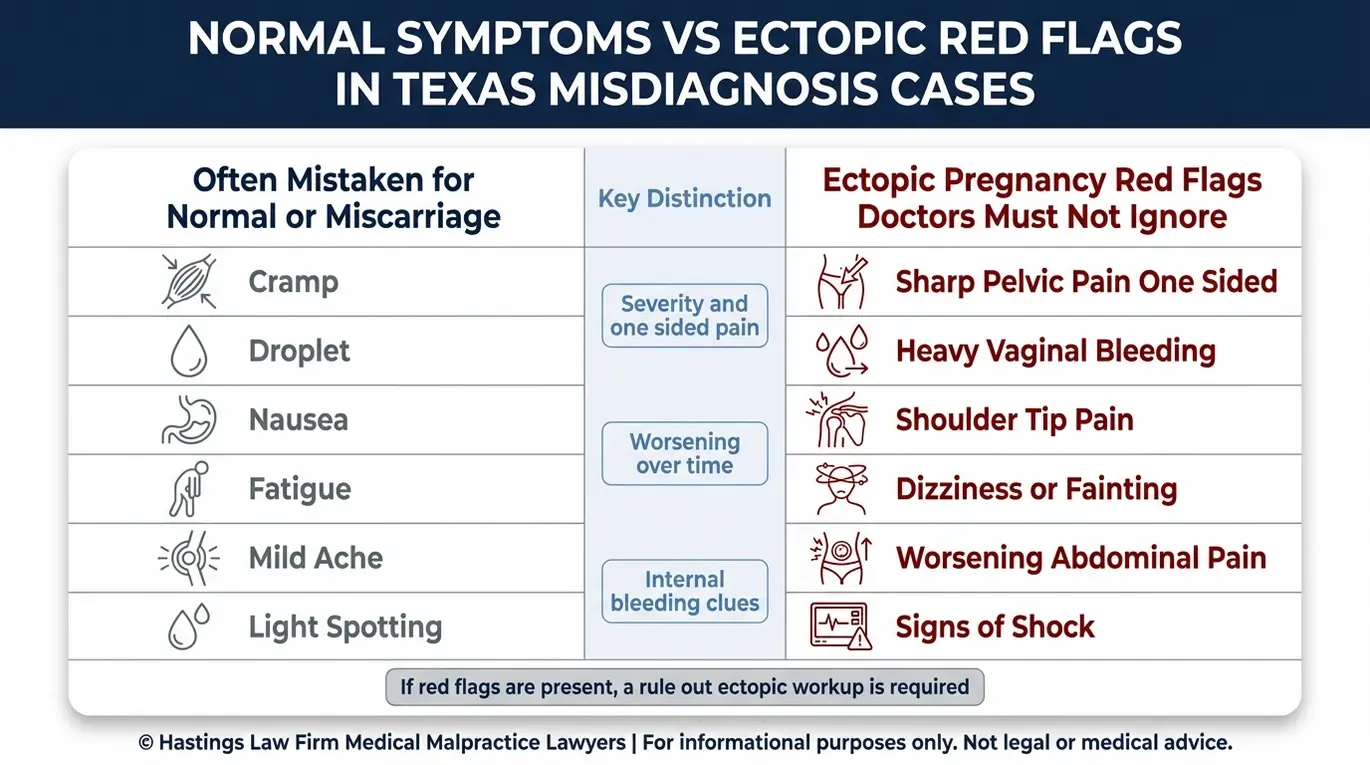
The following comparison illustrates what a careful clinician should distinguish:
| Normal Early Pregnancy Symptoms | Ectopic Pregnancy Red Flags |
|---|---|
| Mild, generalized cramping | Sharp, one-sided pelvic or abdominal pain |
| Light spotting (implantation bleeding) | Persistent or heavy vaginal bleeding |
| Mild nausea or fatigue | Dizziness, lightheadedness, or fainting |
| Gradual onset of breast tenderness | Sudden shoulder tip pain (Kehr’s sign) |
| Stable vital signs | Rapid heart rate, low blood pressure, signs of shock |
When these red flags appear together, the standard of care requires immediate diagnostic testing, not reassurance and discharge.
The Hastings Law Firm Difference
Results matter, but what truly sets us apart is how we achieve them. Every verdict, every settlement, and every Texas courtroom victory comes from one guiding promise: To treat each client’s fight for justice as if it were our own.
This balance of skill, experience, and empathy reflects our core philosophy that justice should not only compensate the injured, but also make healthcare safer nationwide.

The Standard of Care: Diagnostic Tests Doctors Must Perform
The standard of care demands that any woman of childbearing age who presents with abdominal pain or vaginal bleeding must be evaluated for ectopic pregnancy through transvaginal ultrasound and serial beta-hCG blood tests to rule out the condition conclusively. Skipping or shortcutting these steps often leads to care that falls below the accepted level of medical practice.
According to research published in PubMed Central, the diagnostic protocol follows a clear, sequential process:
- Pregnancy test. The first step is confirming pregnancy status with a urine or serum test. This should happen immediately upon presentation for any patient with relevant symptoms.
- Transvaginal ultrasound (TVUS). Transvaginal ultrasound, the gold standard for locating a gestational sac, provides a detailed view of the uterus and surrounding structures. If the pregnancy test is positive but the uterus appears empty on ultrasound, the case is classified as a Pregnancy of Unknown Location (PUL), a finding that essentially means the pregnancy has not been confirmed inside the uterus and may be ectopic. A PUL requires immediate follow-up, not discharge.
- Serial beta-hCG monitoring. Beta-hCG, or human chorionic gonadotropin, is a hormone produced during pregnancy. Doctors track these levels over 48 to 72 hours to evaluate whether they are rising at the expected rate. In a healthy intrauterine pregnancy, hCG levels typically double within that window. Levels that plateau or rise abnormally suggest an ectopic or otherwise non-viable pregnancy.
Discharging a patient before completing this workup is a deviation from the standard of care. This rigorous rule-out process is essential to patient safety. Our medical negligence attorney team investigates these gaps in detail, reconstructing the diagnostic workup timeline to identify exactly where the breakdown occurred.
Heterotopic Pregnancy: When Doctors Stop Looking Too Soon
A heterotopic pregnancy, a rare condition where two pregnancies exist simultaneously, involves one embryo inside the uterus and one in the fallopian tube or another ectopic location. While rare in natural conception, the incidence is significantly higher in patients undergoing IVF or fertility treatments.
The danger here is premature reassurance. A doctor performs an ultrasound, sees a normal intrauterine pregnancy, and stops looking. The ectopic pregnancy goes undetected, continues to grow, and can rupture with life-threatening consequences for the patient. In these cases, the presence of an intrauterine pregnancy does not rule out an ectopic one, and a thorough examination should evaluate both adnexal regions, especially in patients with known risk factors.

Liability and Negligence in Ectopic Pregnancy Cases
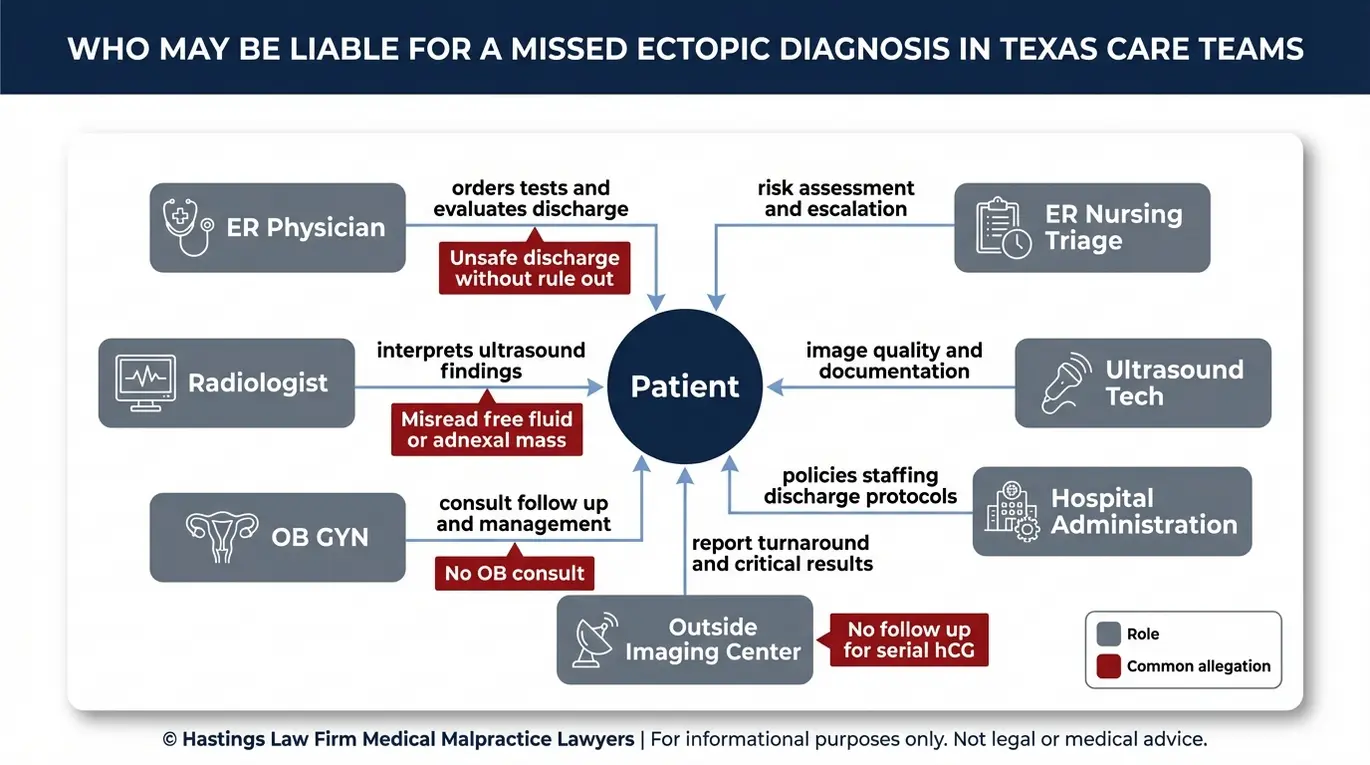
Liability for a missed ectopic diagnosis often extends beyond the attending physician to include radiologists who misread ultrasounds, ER clinicians who failed to triage correctly, or hospitals that enforce unsafe discharge protocols. Liability refers to the legal responsibility a medical provider or facility has for injuries caused by substandard care.
As recently reported by the Texas Tribune, these institutional protocols can directly harm patients, underscoring the need for accountability.
An ectopic pregnancy misdiagnosis attorney typically examines several potential sources of liability:
- ER clinicians who fail to order an OB-GYN consult or transvaginal ultrasound when symptoms warrant it
- Radiologists who misinterpret imaging, overlooking free fluid or an adnexal mass that should have raised suspicion
- OB-GYNs who do not follow up on serial hCG results or fail to schedule timely repeat imaging
- Hospitals and health systems that enforce discharge protocols prioritizing bed turnover over patient safety
In these cases, we examine the full chain of care. We operate with a trial-ready philosophy developed since 2005, using our experience as former hospital defense counsel to identify breaches in protocol. Beta-hCG, or human chorionic gonadotropin, is a hormone whose levels must be tracked over time through serial hCG monitoring to evaluate whether the pregnancy is progressing normally. When any provider in that chain fails to order, complete, or act on these results, this form of hospital negligence leaves the patient vulnerable to a rupture that may have been entirely preventable.
Our investigation identifies every handoff point, every missed result, and every provider who had the opportunity and the obligation to act.
The Wrongful Administration of Methotrexate
Medical errors can also occur when a physician misdiagnoses a healthy intrauterine pregnancy as ectopic. In some cases, a doctor may administer Methotrexate, a medication used to stop the growth of ectopic tissue by targeting rapidly dividing cells. When given to a patient whose pregnancy is actually healthy and developing normally inside the uterus, the drug destroys the embryo or fetus.
This type of error represents a severe form of medical malpractice. It typically results from an incomplete diagnostic workup, where hCG levels were not properly tracked or ultrasound findings were misread. The loss of a wanted, viable pregnancy due to a medication that should never have been prescribed carries profound physical and emotional consequences.
Compensation for Infertility and Wrongful Death in Texas
Victims of ectopic pregnancy malpractice in Texas may be entitled to economic damages for medical bills and lost wages, as well as non-economic damages for physical pain, mental anguish, loss of fertility, and the wrongful death of the patient. The scope of compensation depends on the severity of the injury, the long-term medical consequences, and whether the malpractice resulted in a patient’s death.
Physical damages in these cases can be significant:
- Loss of a reproductive organ (salpingectomy or ovary), permanently reducing natural fertility
- Scarring and recovery from an emergency laparotomy, a major open abdominal surgery, rather than the minimally invasive laparoscopy that timely diagnosis would have allowed
- Chronic pain and complications from internal bleeding or infection
Future costs are another important category. If a patient can no longer conceive naturally because of the negligence, the cost of future fertility treatment, such as IVF costs which can run in the tens of thousands per cycle, becomes a recoverable damage. These are real, ongoing financial burdens directly caused by the provider’s failure.
In the most tragic cases, wrongful death claims arise when a patient dies from a ruptured ectopic pregnancy and resulting hemorrhage. Families who have lost a wife, mother, or daughter may pursue claims for loss of companionship, mental anguish, funeral expenses, and lost financial support.
Under Texas Civil Practice and Remedies Code Chapter 74, non-economic damages in medical malpractice cases, which compensate for pain and suffering, are subject to statutory caps. However, there is no cap on economic damages such as medical bills, lost income, and future treatment costs. An experienced attorney can help identify every category of loss to ensure the full scope of harm is accounted for in an ectopic pregnancy malpractice settlement.
Contact the Texas Healthcare Malpractice Attorneys at Hastings Law Firm Today for Help
No one should lose their fertility, their health, or their life because a provider dismissed their symptoms or skipped the tests that could have caught a dangerous condition in time.
At Hastings Law Firm, our team of attorneys, nurse consultants, and patient advocates works together to uncover the truth in your medical records and determine whether the care you received met the standard. We treat every client with the empathy and the respect they deserve, because we understand you are dealing with more than a legal case.
We operate on a contingency fee basis, which means you pay no attorney fees or costs unless we recover compensation for you. If you believe an ectopic pregnancy was missed or misdiagnosed, a Texas ectopic pregnancy misdiagnosis lawyer at our firm is ready to listen. Contact us today for a free, confidential case evaluation.
Frequently Asked Questions About Ectopic Pregnancy Misdiagnosis in Texas


This content was researched and written by the Hastings Law Firm editorial team, which includes attorneys, medical professionals, and experienced researchers. Our writing is informed by internal knowledge and practical experience, and we cross-check critical details against authoritative sources cited throughout. Every piece undergoes human-led fact-checking and legal review. Because legal and medical information can change, if you spot an error, please contact us. Learn more about our content standards and review process on our editorial policy page.

Brady D. Williams is a nationally recognized medical malpractice attorney who has spent his career handling high-stakes litigation for injured patients and families across the country. Licensed in both Texas and California, Brady draws on experience from hundreds of resolved medical cases to break down complex legal and medical topics for the people who need that information most. His writing reflects the same attention to detail and commitment to clarity that he brings to every case he handles.
