


Texas Drop Foot Lawyer
Written by: Hastings Law Firm | Reviewed by: Gabe Sassin | Updated: July 27, 2026
Foot drop after a medical procedure can leave a person struggling with walking, bracing, and lasting limits that affect work and daily life. It is often linked to injury of the common peroneal nerve, including compression from positioning or direct trauma during surgery. Some cases improve over time, while others become permanent and require ongoing care. When foot drop follows preventable errors, responsibility may involve surgeons, hospitals, or operating room staff. If you or a loved one were harmed or worse due to foot drop medical malpractice in Texas, contact Hastings Law Firm for a free, confidential case review.

Trusted Texas Medical Attorneys for Foot Drop Negligence Claims
What You Should Know About Foot Drop From Medical Negligence Claims in Texas:
- Long term disability can follow when foot drop becomes permanent and requires lifelong bracing or surgical intervention.
- Liability can extend beyond the surgeon when positioning, padding, or postoperative monitoring failures contribute to nerve injury.
- Recovery options can be limited when procedural requirements are not met under Texas medical malpractice law.
- Compensation can be reduced for non economic harm in Texas because medical malpractice caps can restrict pain and suffering damages.
- A claim can be disputed when providers frame foot drop as a known complication rather than a preventable error.
- Permanent impairment can be tied to surgical errors such as wrong level spine surgery or hardware that impinges on a nerve root.
- Future financial losses can be significant when foot drop affects earning capacity and requires ongoing treatment and devices.
- Case outcomes can depend on what operative records, anesthesia logs, nursing notes, and imaging show about nerve protection and response to warning signs.

A Healthcare Focused Law Firm
If you or someone you love developed foot drop after a medical procedure, you likely have questions that no one has been willing to answer. You may be dealing with a brace on your leg, difficulty walking, and the growing sense that something went wrong during your care. That instinct deserves to be taken seriously.
Founded by board-certified trial attorney Tommy Hastings, Hastings Law Firm focuses exclusively on medical malpractice. Our team of attorneys, nurse consultants, and in-house medical staff has the experience needed to investigate foot drop injuries and determine whether the care you received fell below the accepted standard. As a trusted Texas drop foot lawyer, our firm understands both the medical science and the legal framework these cases require.
If you believe a medical error caused your foot drop, contact us for a free, confidential case evaluation. There is no fee unless we recover compensation for you.
Understanding Foot Drop Injuries Caused by Medical Malpractice
Foot drop is a neuromuscular condition most often caused by damage to the peroneal nerve during a medical procedure, and it is characterized by the inability to lift the front part of the foot. For patients who develop this condition after surgery or a hospital stay, the cause may not be simple bad luck. It may be medical negligence.
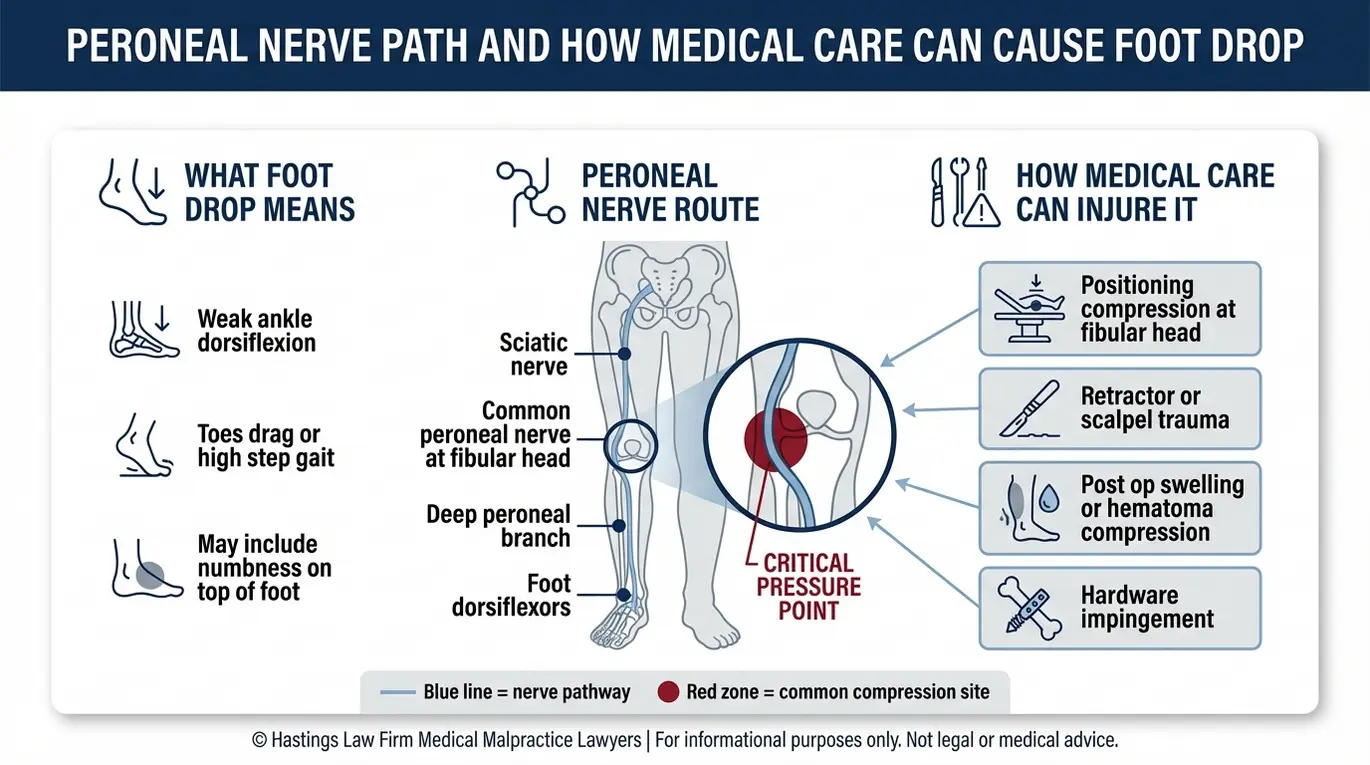
The common peroneal nerve, also called the fibular nerve, is the nerve responsible for controlling the muscles that lift the foot and toes. It wraps around the neck of the fibula, the narrow bone just below the outer side of the knee. This path makes the nerve uniquely vulnerable. Because the nerve runs so close to the surface at this point, with very little tissue protecting it, even modest pressure or a misplaced instrument can injure it. According to MedlinePlus, common peroneal nerve dysfunction can result from nerve compression, trauma, or damage during medical procedures.
When the nerve is injured, the severity can vary. In some cases, the damage is a temporary condition called neuropraxia, where the nerve is bruised but not severed, and function may return over weeks or months. In more serious cases, the nerve fibers are partially or fully cut, leading to permanent foot drop that requires lifelong bracing or surgical intervention.
This distinction matters in a legal claim. A Texas foot drop lawyer will work with medical experts to determine whether your nerve damage was temporary or permanent, because the answer directly affects both liability and the value of your case. If a provider’s actions caused lasting nerve damage that a competent professional would have avoided, that is the foundation of a drop foot attorney’s case on your behalf.
Common Medical Errors That Lead to Permanent Foot Drop
Medical errors leading to foot drop frequently include surgical mistakes during knee or hip replacements, improper patient positioning that compresses the peroneal nerve, and direct laceration of the nerve during an operation. These are preventable failures involving surgical negligence that a drop foot malpractice lawyer sees repeatedly.
Foot drop injuries are associated with several types of procedures and medical settings:
- Total knee arthroplasty (TKA), a full knee replacement, where retractors or surgical manipulation can stretch or sever the peroneal nerve
- Hip replacement surgery, where leg lengthening or improper positioning places tension on the nerve
- Spine surgery, particularly lumbar procedures where nerve roots can be damaged during decompression or fusion
- Knee arthroscopy, where tourniquet pressure or positioning can compress the nerve
- Misplaced injections near the knee or lateral leg, where a needle can directly injure the nerve
Beyond the procedure itself, a surgical error resulting in direct surgical trauma occurs when a scalpel, retractor, or drill damages the nerve. In procedures performed by an orthopedic surgeon, the peroneal nerve can be stretched by excessive manipulation or cut during tissue dissection. These errors often reflect a surgeon’s failure to identify and protect the nerve throughout the operation. If you are looking for a lawyer for foot drop caused by one of these procedures, the specific mechanism of injury is something we investigate closely.
Surgical Table and Positioning Errors
One of the most preventable causes of foot drop is positioning palsy, a nerve injury caused by the patient’s body pressing against the surgical table, leg holders, or stirrups during an operation. The peroneal nerve is especially vulnerable at the point where it crosses the fibular head near the outer knee.
During long procedures, the anesthesia team and nursing staff share responsibility for ensuring that pressure points are properly padded and that the patient’s legs are repositioned at regular intervals. When padding is inadequate or a patient remains in stirrups too long without adjustment, sustained compression can damage the nerve. Positioning palsy, a temporary nerve injury from pressure, is the mildest outcome. But prolonged compression can cause permanent damage that no physical therapy will reverse. An attorney for nerve injury caused by positioning errors will examine anesthesia logs, nursing notes, and operative records to determine whether monitoring protocols were followed.
The Hastings Law Firm Difference
Results matter, but what truly sets us apart is how we achieve them. Every verdict, every settlement, and every Texas courtroom victory comes from one guiding promise: To treat each client’s fight for justice as if it were our own.
This balance of skill, experience, and empathy reflects our core philosophy that justice should not only compensate the injured, but also make healthcare safer nationwide.

Surgical Negligence When Operations Result in Nerve Damage
Surgical negligence occurs when a surgeon deviates from the standard of care, the level of treatment a reasonably competent professional in the same specialty would provide under similar circumstances. When that deviation results in preventable foot drop, such as operating on the wrong level of the spine or placing hardware that impinges on a nerve root, it may constitute grounds for a medical malpractice claim.
Wrong-level spine surgery is one of the most well-documented forms of surgical error. For example, consider a case study where a patient requires fusion at the L4-L5 level. If the surgeon fails to verify the vertebral level with intraoperative imaging and fuses L3-L4 instead, this wrong-level spine surgery can cause direct nerve root injury and foot drop that would not have occurred had the correct level been identified. A review published in PubMed Central on preventing wrong-level spine surgery outlines how verification protocols exist specifically to prevent this type of error, yet failures still occur.
Pedicle screw malposition, where screws used in spinal fusion are placed outside their intended path, is another common source of nerve injury. A mispositioned screw can impinge directly on a nerve root, causing immediate or progressive foot drop. Postoperative imaging should confirm correct placement, and when it does not, prompt intervention can sometimes prevent permanent damage.
A Texas medical malpractice lawyer also examines what happens after surgery. In some cases, a postoperative epidural hematoma, a collection of blood that forms near the spinal cord or nerve roots, compresses nerves and causes worsening symptoms. When surgical teams fail to recognize deteriorating neurological function and delay taking the patient back to surgery, a recoverable window can close. Foot drop attorneys investigate these timelines carefully, because the difference between a known complication and negligence often comes down to whether providers responded appropriately when warning signs appeared.
A surgical error lawyer uses qualified medical experts to review your records. These board-certified surgeons evaluate imaging studies and operative reports to determine whether the standard of care was met.
Liability for Foot Drop: Suing Surgeons, Hospitals, and Staff
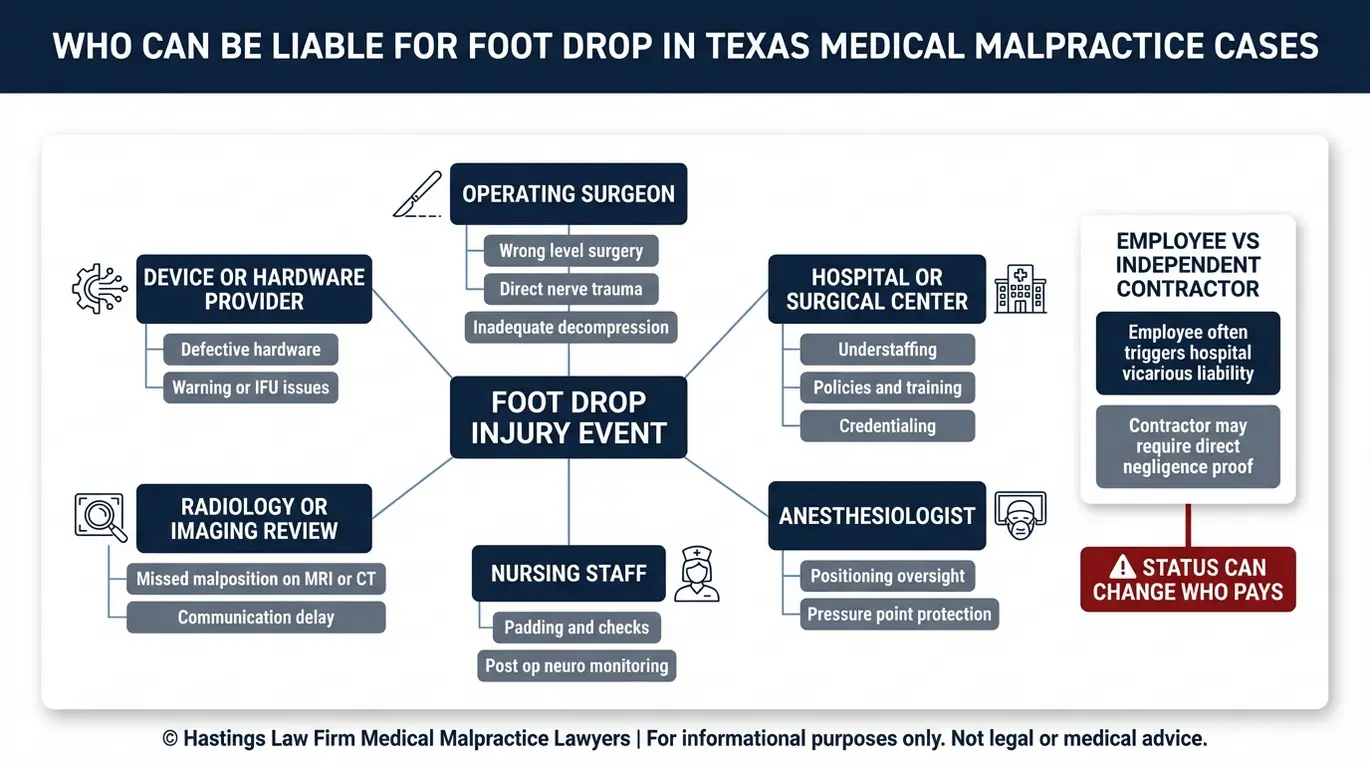
Liability for foot drop may extend beyond the lead surgeon to include the hospital for nursing failures, anesthesiologists for positioning errors, or surgical centers for inadequate staffing. Understanding who can be held responsible is an important part of building a strong hospital malpractice claim.
Under Texas law, the legal framework for medical malpractice claims is governed by Texas Civil Practice and Remedies Code Chapter 74, which establishes the requirements and procedures for bringing these cases. A key issue in many foot drop claims is whether the surgeon was an independent contractor or a hospital employee, because this determines whether the hospital itself can be held liable through a legal concept called vicarious liability. Research from the University of Houston Law Center on medical malpractice updates explains how these relationships affect liability analysis. Hospitals often argue that surgeons are not employees to avoid liability, but exceptions exist if the hospital retains control over the surgeon’s practice or holds them out as an employee.
When suing a hospital for foot drop, multiple parties may share responsibility. The following table outlines how liability can apply:
| Party | Potential Basis of Negligence |
|---|---|
| Surgeon | Wrong-level surgery, nerve laceration, hardware malposition |
| Anesthesiologist | Failure to monitor or reposition the patient during surgery |
| Nursing Staff | Failure to pad pressure points, inadequate post-op neurological monitoring |
| Hospital/Facility | Understaffing, inadequate training, failure to enforce safety protocols |
| Surgical Center | Lack of proper equipment or qualified personnel |
As medical negligence attorneys, we review records from every provider involved in your care to identify each party whose actions or inactions may have contributed to the injury. Our team includes former defense attorneys who understand how hospitals and their insurers assign blame internally, which gives us an advantage when building your case.
Calculating Damages for Life with Foot Drop
Damages for foot drop include economic costs like orthotic devices, physical therapy, and lost earning capacity, as well as non-economic damages for physical impairment, disfigurement, and mental anguish. The full scope of a foot drop compensation claim reflects how the injury reshapes daily life.
Economic damages cover the measurable financial losses tied to the injury. These economic damages often include:
- Medical expenses for ongoing treatment, including physical therapy and potential tendon transfer surgeries
- The cost of an ankle-foot orthosis (AFO), a brace worn inside the shoe that holds the foot in a neutral position to prevent tripping, which often requires replacement every few years due to wear and tear
- Lost wages from time away from work during recovery
- Reduced earning capacity if the injury limits your ability to stand, walk, drive, or perform your job long-term
Non-economic damages address the harm that does not come with a receipt. A permanent gait disturbance can affect your ability to run, exercise, or play with your children. The visible limp, the brace, and the daily physical limitations all contribute to damages for nerve injury related to pain and suffering, mental anguish, and loss of enjoyment of life. Many clients find that they can no longer participate in hobbies they once loved, such as hiking or dancing, which fundamentally alters their life experience.
Every foot drop case is different, and the value depends on factors like your age, occupation, severity of the nerve damage, and how the injury has changed your ability to function. We work with medical and economic experts to document the full cost of living with foot drop, both now and in the future.
Proving Negligence in Texas Foot Drop Cases
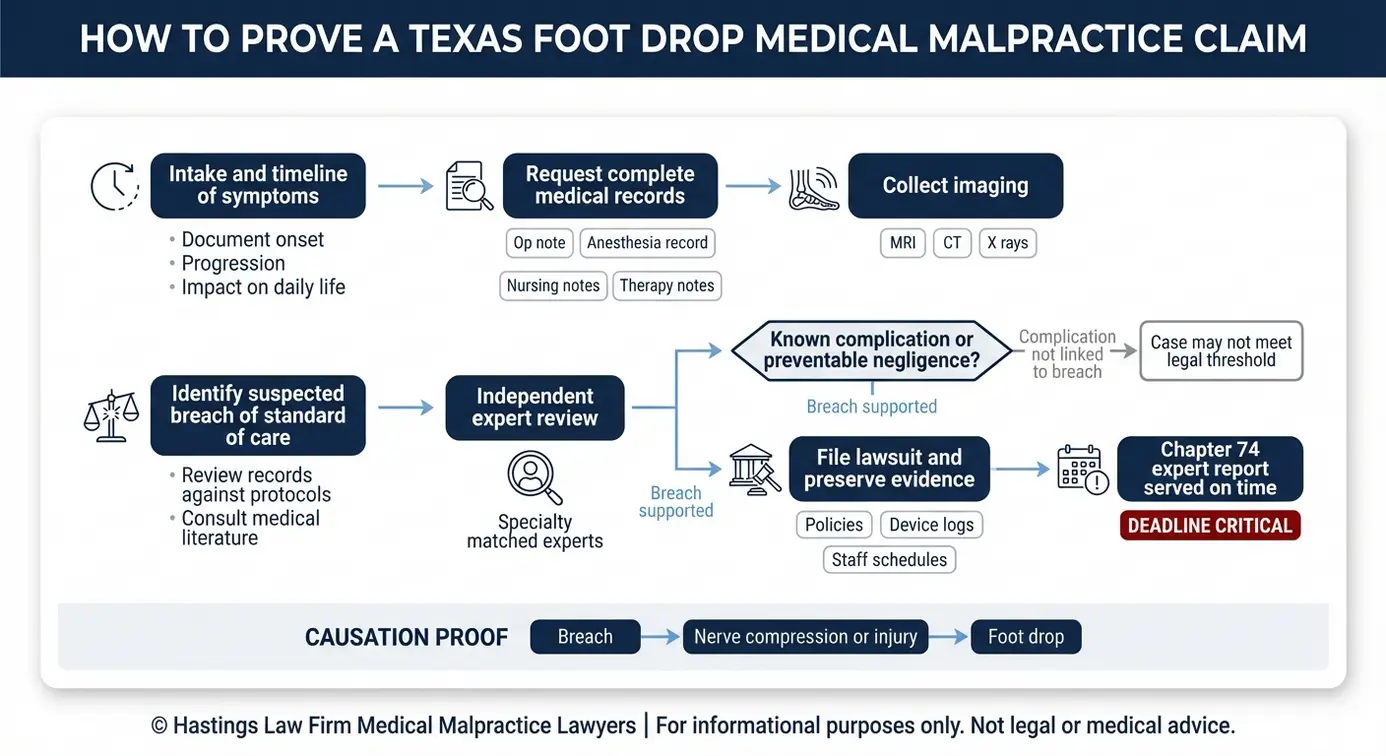
Proving negligence requires a thorough review of medical records and imaging by expert witnesses to establish that the provider violated the standard of care and directly caused the nerve injury. Texas medical malpractice laws impose specific procedural requirements that make qualified legal representation essential.
The process typically follows these steps:
- Records review: We obtain and analyze all surgical reports, anesthesia logs, nursing notes, and post-operative records to build a detailed timeline of your care.
- Imaging analysis: An independent review of MRIs, CT scans, and X-rays helps determine whether hardware was properly placed, whether the correct surgical level was addressed, and whether post-operative complications were identified in time.
- Expert consultation: We retain board-certified medical experts in the relevant specialty to evaluate whether the standard of care was met and to prepare a formal expert report.
- Filing suit: Under Chapter 74 of the Texas Civil Practice and Remedies Code, plaintiffs must serve an expert report within 120 days of the defendant’s original answer. This report must identify the standard of care, how it was breached, and how the breach caused the foot drop. Failure to meet this deadline can result in dismissal.
One of the most common defense arguments in foot drop cases is that nerve damage was a “known complication” rather than negligence. To meet the burden of proof, we must demonstrate causation. Proving medical negligence means showing that the injury resulted from a specific error rather than an accepted risk. This might involve wrong-level surgery or improper screw placement. We also look for failures to treat an epidural hematoma, which is a blood collection that compresses nerves.
Our team’s in-house medical staff, including nurse practitioners and Board Certified Patient Advocates, works alongside our attorneys to bridge the gap between clinical evidence and legal proof.
Contact the Texas Healthcare Malpractice Attorneys at Hastings Law Firm Today for Help
Foot drop can permanently change how you walk, work, and live. If your injury followed a surgery or medical procedure, you deserve to know whether the care you received met the standard your providers were trained to uphold. That answer should not remain out of reach.
At Hastings Law Firm, our team of attorneys, nurses, and medical consultants investigates these cases from day one with the depth and preparation needed to hold the right parties accountable. As a Texas drop foot lawyer, our firm understands the medical science behind nerve injuries and the legal strategy required to prove them.
Time matters. Texas law imposes strict deadlines for filing medical malpractice claims, and evidence can become harder to preserve as time passes.
Contact our Texas medical law firm today for a free case evaluation. There is no fee unless we recover compensation for you. Let us review what happened and explain your options.
Frequently Asked Questions About Drop Foot in Texas


This content was researched and written by the Hastings Law Firm editorial team, which includes attorneys, medical professionals, and experienced researchers. Our writing is informed by internal knowledge and practical experience, and we cross-check critical details against authoritative sources cited throughout. Every piece undergoes human-led fact-checking and legal review. Because legal and medical information can change, if you spot an error, please contact us. Learn more about our content standards and review process on our editorial policy page.

Gabe Sassin has focused exclusively on medical malpractice law since 2007. After spending more than a decade as a malpractice defense attorney, he knows exactly how the other side works. He has seen firsthand how healthcare providers, insurers, corporate defendants, and their legal teams think, prepare, and build their defense against claims. That knowledge works for the people who need it most today, injured patients and their families. His unique experience shapes everything he writes, giving readers a look at how these cases actually work from someone who has handled them from both sides.
