


Fort Worth Doctor Malpractice Lawyer
Written by: Hastings Law Firm | Reviewed by: Gabe Sassin | Updated: July 27, 2026
Physician negligence can leave patients facing lasting injuries, mounting medical costs, and a deep loss of trust in the health care system. In Texas, outcomes often turn on whether a doctor was a hospital employee or an independent contractor, what insurance coverage applies, and whether the evidence supports a breach of the standard of care and causation. Claims can also be shaped by strict filing requirements and limits on certain types of compensation. If you or a loved one were harmed or worse due to physician negligence in Fort Worth, Texas, contact Hastings Law Firm for a free, confidential case review.

Top Rated Physician Negligence Attorneys in Fort Worth
What You Should Know About Physician Negligence Claims in Fort Worth:
- Recovery can be limited when a hospital is not responsible for a non employee physician, which can shift the claim toward the doctor and personal malpractice insurance.
- Compensation can change significantly based on available insurance coverage, since hospital policies often provide higher limits than individual physician policies.
- Hospital liability can still be disputed when a patient reasonably believed the physician was a hospital employee, which can affect who may share responsibility.
- Severe harm can result from physician negligence, including surgical mistakes, diagnostic errors, and medication or treatment errors.
- Options can be lost if a required expert report is not served on time, since the case can be dismissed and barred from being refiled.
- Recovery can be reduced or eliminated when proportionate responsibility is applied, including a complete bar if the plaintiff is found more responsible than the defendant.
- Non economic compensation can be limited in Texas, even when economic losses like medical bills and lost wages are not capped.
- A claim can be barred if filing deadlines are missed, including strict limits tied to the medical event and an absolute outer limit.
- Proving causation can be especially difficult in delayed diagnosis cases, since Texas generally requires proof that negligence more likely than not caused the ultimate harm.
- Accountability can be influenced by hospital credentialing practices, since failures in vetting physicians can be linked to repeated patient harm.

A Healthcare Focused Law Firm
When a doctor’s mistake changes your life or the life of someone you love, it can feel like the people you trusted most let you down. That sense of betrayal is real, and so is the uncertainty about what to do next. You may not be sure whether what happened qualifies as negligence, or whether you even have the right to question a medical professional’s decisions. You do.
At Hastings Law Firm, we focus exclusively on medical malpractice. Founded by Tommy Hastings, a board-certified trial lawyer, our team includes attorneys, in-house nurses, and board-certified patient advocates. This team has the medical knowledge to evaluate whether a doctor failed to meet the standard of care. If you are looking for a Fort Worth doctor malpractice lawyer, we welcome the chance to review your situation. Contact us for a free, confidential case evaluation and let us explain your options.
Liability Standards for Independent Doctors Versus Hospital Staff
In Texas, liability often hinges on whether the physician is a hospital employee or an independent contractor, because hospitals are generally not held responsible for the actions of non-employee doctors. This distinction can shape your entire case, from who you name as a defendant to the insurance policies available to cover your damages.
Many patients assume the doctor who treated them at a hospital works for that hospital. In reality, many physicians hold what is known as privileging, the formal authorization a hospital grants to a doctor allowing them to practice at that facility, without actually employing them. When the doctor is an independent contractor, a medical malpractice claim is typically directed at the physician and their personal malpractice insurance rather than at the hospital system.
There is an exception. Under a legal theory called ostensible agency, a plaintiff may argue that the hospital should share liability if the patient reasonably believed the doctor was a hospital employee. This can arise when the hospital does not clearly disclose the doctor’s independent status, or when the patient had no meaningful choice in selecting the treating physician. In these complex scenarios, establishing a clear link between the hospital’s representations and the patient’s reliance is essential to overcoming the independent contractor defense. The University of Miami Law Digital Commons offers an in-depth analysis of why the ostensible agency doctrine remains one of the more contested areas in tort law.
Insurance coverage adds another layer of complexity. Hospital systems typically carry institutional policies with high coverage limits, while a private practice physician may carry a smaller individual policy. The difference can significantly affect the compensation available to you.
Our doctor malpractice attorneys investigate these relationships early to identify any potential breach of duty. We review contracts, hospital bylaws, and credentialing records to identify every party that may bear responsibility under Texas Civil Practice and Remedies Code, Chapter 74. Understanding who is liable, and who carries the insurance, is one of the first steps in building a strong claim.
| Factor | Hospital Employee | Independent Contractor |
|---|---|---|
| Hospital Liability | Generally yes (vicarious liability) | Generally no, unless ostensible agency applies |
| Who You Sue | Hospital and/or physician | Physician directly |
| Insurance Coverage | Hospital institutional policy (often higher limits) | Physician’s personal malpractice policy |
| Key Evidence | Employment records, pay structure | Privileging agreements, contracts, hospital disclosures |

Common Forms of Physician Negligence and Surgical Errors
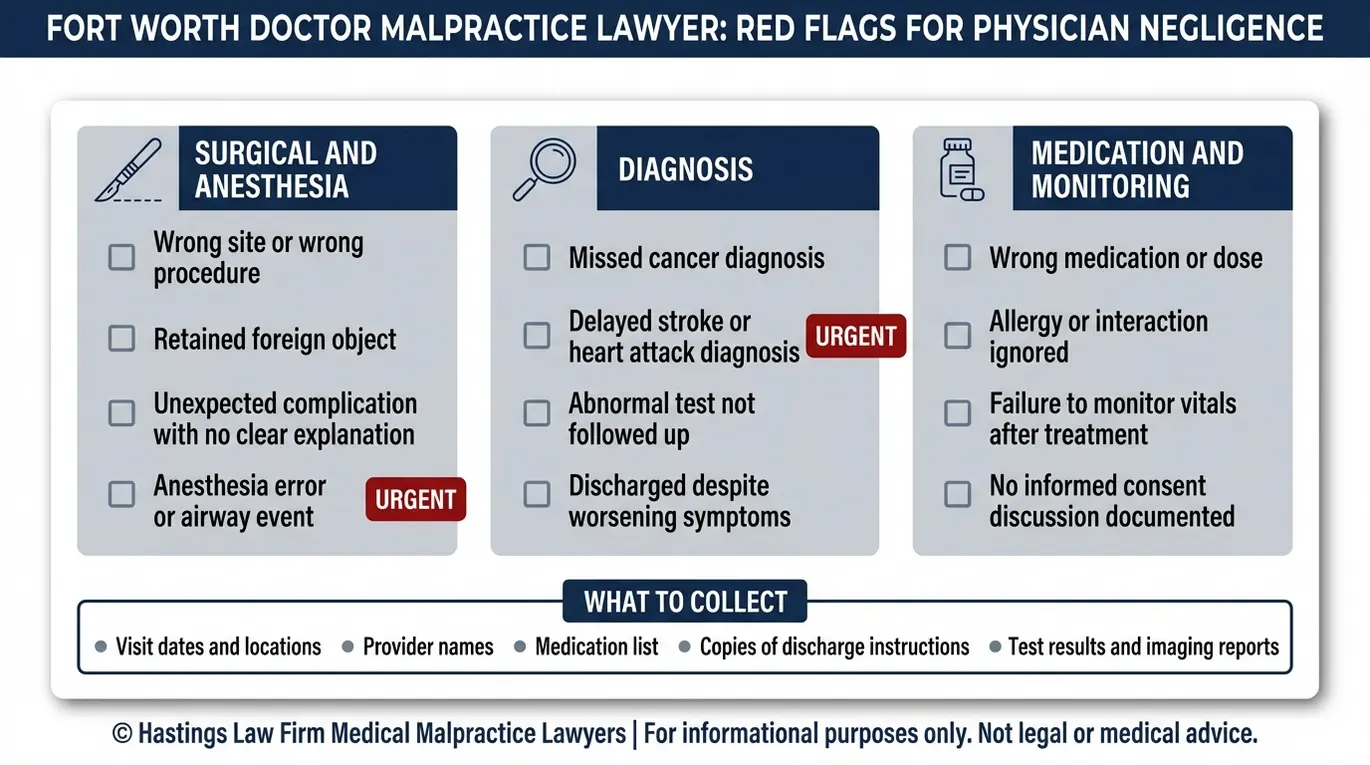
Doctor negligence occurs when a physician deviates from the accepted standard of care, the level of treatment a reasonably competent doctor in the same specialty would provide under similar circumstances, resulting in preventable harm such as surgical mistakes, misdiagnoses, birth injury, or medication errors.
These cases take many forms. As medical malpractice lawyers, we see patterns that fall into several broad categories:
Surgical Errors
- Wrong-site surgery (WSS), where a procedure is performed on the wrong body part or even the wrong patient, is classified as a never event, a serious medical error that should never occur under proper safety protocols. Issues regarding informed consent also fall under this umbrella when a surgeon fails to fully explain the risks of a procedure to a patient. The Agency for Healthcare Research and Quality (AHRQ) Patient Safety Network provides detailed data on how these preventable errors continue to happen nationwide.
- Retained foreign objects, such as sponges or instruments left inside a patient’s body after surgery.
- Anesthesia errors, including incorrect dosing or failure to review a patient’s medical history for contraindications.
Diagnostic Errors
- Failure to diagnose or delayed diagnosis of conditions like cancer, stroke, or heart attack. When a diagnosis is missed or delayed, the patient may lose the opportunity for earlier, more effective treatment. Texas courts generally require proof that the negligence more likely than not caused the ultimate harm, which means causation must be clearly established even when the missed window affected survival odds. This is particularly challenging in cases involving a “loss of chance.” A patient might have survived if diagnosed earlier, but the law requires proof that the delay was the primary cause of death.
- Misdiagnosis, where the wrong condition is identified and treated while the real problem goes unaddressed.
Medication and Treatment Errors
- Prescribing the wrong medication or an incorrect dosage.
- Failing to monitor a patient’s response to treatment, including vital signs in critical care settings.
- Ignoring known drug interactions or allergies documented in the patient’s chart.
The Dr. Death Context and Patient Safety Rankings
The DFW area knows firsthand how dangerous a poorly credentialed surgeon can be. The Christopher Duntsch case, widely known as the “Dr. Death” case, exposed catastrophic failures in credentialing, the process by which hospitals verify a physician’s qualifications, training, and competence before granting them the right to practice. Duntsch was allowed to operate at multiple facilities despite a clear pattern of patient harm.
That case underscored the importance of hospital accountability in vetting their medical staff. Patients can also research facility safety through tools from the Leapfrog Group, like the Leapfrog Hospital Safety Grade, an independent rating system that evaluates hospitals on patient safety measures including infection rates, surgical outcomes, and error prevention protocols.
The Hastings Law Firm Difference
Results matter, but what truly sets us apart is how we achieve them. Every verdict, every settlement, and every Fort Worth courtroom victory comes from one guiding promise: To treat each client’s fight for justice as if it were our own.
This balance of skill, experience, and empathy reflects our core philosophy that justice should not only compensate the injured, but also make healthcare safer nationwide.

Meeting the Chapter 74 Expert Report Requirement
Texas law (Chapter 74) requires plaintiffs to serve an expert report detailing the standard of care, breach, and causation within 120 days of the defendant filing an original answer, or the case will be dismissed.
The expert report must address three specific elements:
- Standard of care: What a competent physician in the same specialty would have done.
- Breach: How the defendant doctor’s actions fell below that standard.
- Causation: How that breach directly caused or contributed to the patient’s injury.
This document serves as a verified medical opinion that your claim has legal and clinical merit. The report must be authored by a qualified physician with relevant expertise and active clinical practice, capable of providing valid expert testimony. A vague or poorly supported report can result in dismissal with prejudice, meaning the case cannot be refiled, and the patient may be ordered to pay the defendant’s attorney fees.
Here is how the timeline generally works for doctor malpractice claims:
- Day 1: Lawsuit is filed in Tarrant County or the appropriate jurisdiction.
- Immediately after filing: Medical records are gathered and reviewed by the legal and medical team.
- After the defendant answers: The 120-day deadline to serve the expert report on all named defendants begins when the defendant files an original answer. This deadline is strict.
- If the report is challenged: The court evaluates whether it meets the statutory requirements. Deficiency can mean dismissal.
Working with a Fort Worth medical negligence lawyer who handles these cases every day matters. Our in-house medical staff, including nurse practitioners and board-certified patient advocates, works alongside our attorneys to build the clinical foundation for the expert report from the start. Terms like retained surgical item (RSI), referring to instruments or materials unintentionally left in a patient after surgery, or differential diagnosis, the systematic process a doctor uses to identify a condition by ruling out alternatives, often become central to the report’s analysis.
Recoverable Damages and the Impact of Texas Tort Reform
Texas law allows patients to recover economic damages, such as medical bills and lost wages, which have no cap, alongside non-economic damages, such as pain and suffering, which are generally capped at $250,000 per claimant against all individual physicians and health care providers under the state’s tort reform framework.
That cap is one of the most debated features of Texas medical malpractice law. Research published through PubMed Central has examined the broader effects of tort reform on physician supply in Texas, but for injured patients, the practical impact is that non-economic compensation has a firm ceiling in most cases.
Here is how damages typically break down:
Economic Damages (No Cap)
- Past and future medical expenses, including surgeries, rehabilitation, and ongoing care
- Lost wages and loss of future earning capacity
- Cost of adaptive equipment or home modifications
Non-Economic Damages (Capped)
- Physical pain and mental anguish
- Disfigurement and physical impairment
- Loss of companionship or consortium
Wrongful Death
- When a patient dies due to medical negligence, surviving family members may pursue a wrongful death claim. These cases involve distinct damage categories, including loss of financial support, loss of guidance and companionship, and funeral expenses.
Most damages awarded are compensatory damages, designed to reimburse the patient for actual losses. In cases of malicious intent or extreme recklessness, punitive damages may also be sought, though these are rarer. Since trials are unpredictable, many claims result in settlement negotiations, where the non-economic cap often is a baseline for the defense’s valuation of the case. Experienced malpractice attorneys know how to document economic losses thoroughly so that the full financial picture is presented, even when non-economic recovery is limited by the cap.
Understanding the Statute of Limitations for Doctor Malpractice
The general statute of limitations for medical malpractice in Texas is two years from the date of the negligence, though exceptions like the Discovery Rule may extend this timeline. Not two years from when you felt something was wrong, but from the date of the actual medical event. This statute of limitations deadline is strict. Exceptions also apply to children under the concept of minor tolling, which pauses the limitations period for minors until a certain age.
The Two-Year Rule. In most cases, you have two years from the date the negligence occurred to file suit. This strict deadline applies to most medical negligence claims in Texas. This statute of limitations deadline is strict.
The Discovery Rule. Sometimes the injury is not immediately apparent. A delayed diagnosis, where a condition that should have been caught goes unreported for months or years, is a common example. In those situations, the discovery rule may apply, starting the clock from the date you knew or should have known about the injury rather than the date it occurred.
The Statute of Repose. Texas imposes an absolute 10-year outer limit on medical malpractice claims. Even if you did not discover the injury until year nine, you must file before the 10-year mark. After that, the claim is barred regardless of the circumstances.
Filing Deadlines for Minors
Exceptions also apply to children under the concept of minor tolling, which pauses the limitations period for minors until a certain age. If you are unsure whether your deadline has passed, a Fort Worth doctor malpractice legal team can review your timeline and advise you on filing in Tarrant County.
Contact the Fort Worth Doctor Malpractice Attorneys at Hastings Law Firm Today for Help
If you believe a doctor’s negligence caused harm to you or someone in your family, you do not have to figure out the next step alone. Hastings Law Firm focuses exclusively on medical malpractice. Our team includes board-certified trial attorneys and former defense lawyers. Tommy Hastings is a member of the American Board of Trial Advocates (ABOTA), an invitation-only organization for elite trial lawyers.
We work on a contingency fee basis, which means you pay no attorney fees or costs unless we recover compensation for you. There is no financial risk in reaching out.
Contact us today for a free case evaluation. Let us review what happened, explain your legal options, and help you understand whether you have a claim worth pursuing.
Frequently Asked Questions About Doctor Malpractice in Fort Worth


This content was researched and written by the Hastings Law Firm editorial team, which includes attorneys, medical professionals, and experienced researchers. Our writing is informed by internal knowledge and practical experience, and we cross-check critical details against authoritative sources cited throughout. Every piece undergoes human-led fact-checking and legal review. Because legal and medical information can change, if you spot an error, please contact us. Learn more about our content standards and review process on our editorial policy page.

Gabe Sassin has focused exclusively on medical malpractice law since 2007. After spending more than a decade as a malpractice defense attorney, he knows exactly how the other side works. He has seen firsthand how healthcare providers, insurers, corporate defendants, and their legal teams think, prepare, and build their defense against claims. That knowledge works for the people who need it most today, injured patients and their families. His unique experience shapes everything he writes, giving readers a look at how these cases actually work from someone who has handled them from both sides.
