


Texas Dialysis Malpractice Lawyer
Written by: Hastings Law Firm | Reviewed by: Brady D. Williams | Updated: July 27, 2026
Dialysis is life sustaining care, and patients with end stage renal disease rely on clinics to deliver treatment safely and consistently. When a dialysis center makes preventable mistakes, the results can be severe, including infections, dangerous blood pressure drops, blood loss, and other life threatening complications. Responsibility may involve multiple layers of care, from technicians and nurses to nephrologists and corporate owners, especially when staffing or safety practices fall short. If you or a loved one were harmed or worse due to dialysis malpractice in Texas, contact Hastings Law Firm for a free, confidential case review.

Compassionate Texas Medical Attorneys for Kidney Dialysis Injury Claims
What You Should Know About Dialysis Negligence Claims in Texas:
- Harm can be severe when dialysis care falls below accepted standards, including sepsis, cardiac arrest, stroke, fatal blood loss, and other irreversible outcomes.
- Responsibility can extend beyond a single staff member, since technicians, nurses, nephrologists, facilities, corporate owners, and vendors may share liability.
- Recovery options can be limited by Texas rules that impose strict filing constraints and require an expert report to proceed.
- Compensation can be restricted by Texas caps on non economic damages, while economic losses like medical bills and lost wages are not capped.
- Patient safety can be compromised by chemical errors in dialysate preparation, which can trigger dangerous pH and electrolyte shifts.
- Catastrophic events can follow ignored machine alarms, including air embolisms, severe blood loss, and dangerous drops in blood pressure.
- Life threatening infections can result from infection control failures, including contaminated lines and improper sterilization.
- Health outcomes can worsen when clinics shorten prescribed treatment times, since inadequate clearance has been linked to increased mortality risk.
- Key facts can depend on electronic evidence such as machine logs, surveillance video, and electronic medical records.
- Facility wide problems can be central when high patient volume and limited resources lead to understaffing and rushed procedures.

A Healthcare Focused Law Firm
If you or someone you love has been harmed during dialysis treatment, you already know how frightening and isolating that experience can be. Dialysis patients living with end-stage renal disease (ESRD) suffer from the final stage of chronic kidney disease. At this stage, the kidneys can no longer sustain life without treatment.
These patients place extraordinary trust in the clinics and staff who perform their hemodialysis, which is the process of filtering waste and excess fluid from the blood. When that trust is broken by carelessness or error, the physical and emotional toll can be devastating.
You deserve to know what happened and whether the care you received met acceptable medical standards. As a Texas dialysis malpractice lawyer, Hastings Law Firm focuses exclusively on medical negligence, and our team has the clinical and legal experience to evaluate your situation thoroughly. Contact us for a free, confidential case review. We can examine the facts and explain your options.
Understanding Liability in Dialysis Center Negligence Cases
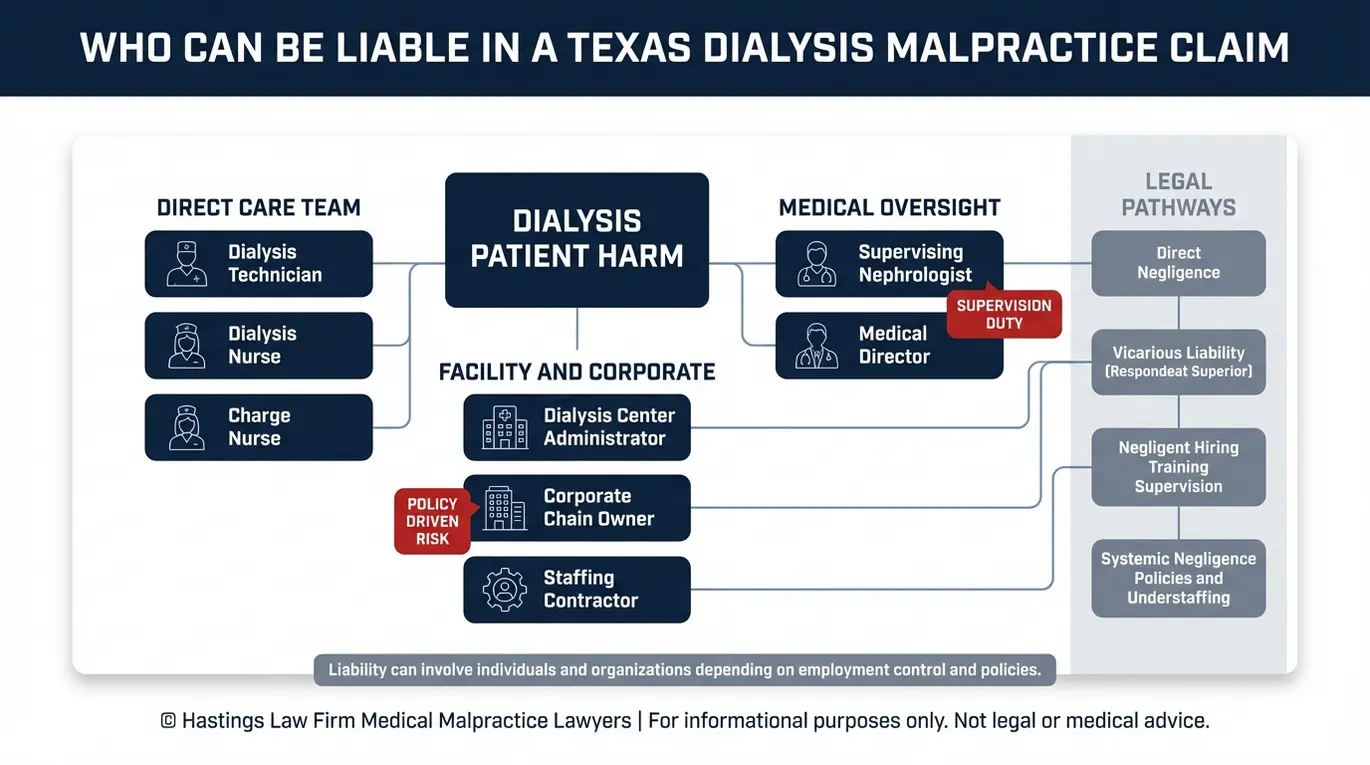
Liability in dialysis cases often extends well beyond the individual technician to include the supervising nephrologist, a physician specializing in kidney disease, and the corporate entity that owns or manages the facility. Understanding who may be responsible is one of the first and most important steps in building a medical malpractice claim. Establishing the correct standard of care (the level of care a competent professional would provide) is important for patients with end-stage renal disease (ESRD) seeking justice.
Dialysis centers operate with a layered hierarchy of care. Technicians perform the hands-on work of connecting patients to machines and monitoring treatments. Registered nurses oversee the technicians, manage medications, and respond to complications. Nephrologists are responsible for prescribing the dialysis orders, reviewing lab results, and adjusting treatment plans. Each level carries its own duty, and negligence at any point in this chain can cause serious harm.
Many dialysis clinics in Texas are not independent medical offices. They are operated by large corporate chains. Under the legal doctrine of vicarious liability (where an employer is responsible for an employee’s actions), a corporation can be held responsible for the negligent acts of its employees. This means that if a technician or nurse causes an injury while carrying out their assigned duties, the parent company may share legal responsibility.
Vascular access, the surgically created connection point used to draw and return blood during treatment, requires careful handling. When an arteriovenous fistula (AVF), a surgical connection between an artery and vein used for dialysis access, is damaged due to improper technique, liability can attach to the technician, the supervising nurse, and the facility itself.
There are also cases where the negligence is not a single mistake but a pattern of institutional shortcuts. This often occurs when high patient volume or resource limitations compromise safety, leading to understaffed shifts and rushed procedures. Texas medical malpractice claims are governed by Texas Civil Practice and Remedies Code, Chapter 74, which establishes specific procedural requirements for these cases.
Potentially liable parties in a dialysis malpractice case may include:
- The dialysis technician who performed the treatment
- The registered nurse supervising the session
- The nephrologist who prescribed and oversaw the dialysis orders
- The dialysis center or clinic itself
- The parent corporation or management company operating the facility
- Third-party vendors responsible for equipment maintenance or water purification
A Texas dialysis malpractice lawyer can help identify which parties may bear responsibility based on the facts of your case.
Common Errors Committed by Texas Dialysis Clinics
Common errors at dialysis clinics include medication mix-ups, failure to monitor vital signs, improper machine sterilization, and vascular access injuries. These errors fall into distinct categories, each with serious potential consequences for patients who are already medically vulnerable.
Chemical Errors
Every hemodialysis treatment requires a precisely mixed dialysate, the fluid solution used in the dialysis machine to draw toxins out of the blood. The dialysate contains an acid concentrate, a chemical component that must be measured and mixed to exact specifications to maintain safe pH and electrolyte levels. When staff mix these solutions incorrectly, the result can be chemical burns to the blood, dangerous pH imbalances, or acute electrolyte shifts that trigger cardiac events.
Peritoneal dialysis patients face similar risks. Errors in solution preparation or contamination of supplies can cause peritonitis, a painful and potentially life-threatening infection of the abdominal lining.
Mechanical and Monitoring Errors
Dialysis machines generate alarms for a reason. They detect air in the bloodline, pressure changes, and temperature shifts that signal danger. When staff ignore or silence these alarms, patients may suffer air embolisms (air entering the bloodstream), severe blood loss from line separation, or dangerous drops in blood pressure known as hypotension.
Federal regulations under 42 CFR Part 494, Conditions for Coverage for End-Stage Renal Disease Facilities, establish minimum safety standards that every dialysis facility must meet. Falling below these standards can be strong evidence of negligence.
Infection Control Failures
Reuse of dialyzers, the filters that clean the blood, without proper sterilization is a known source of infection. Contaminated lines and unsterile catheter handling can introduce bacteria directly into the bloodstream. These failures can lead to sepsis and other healthcare-associated infections.
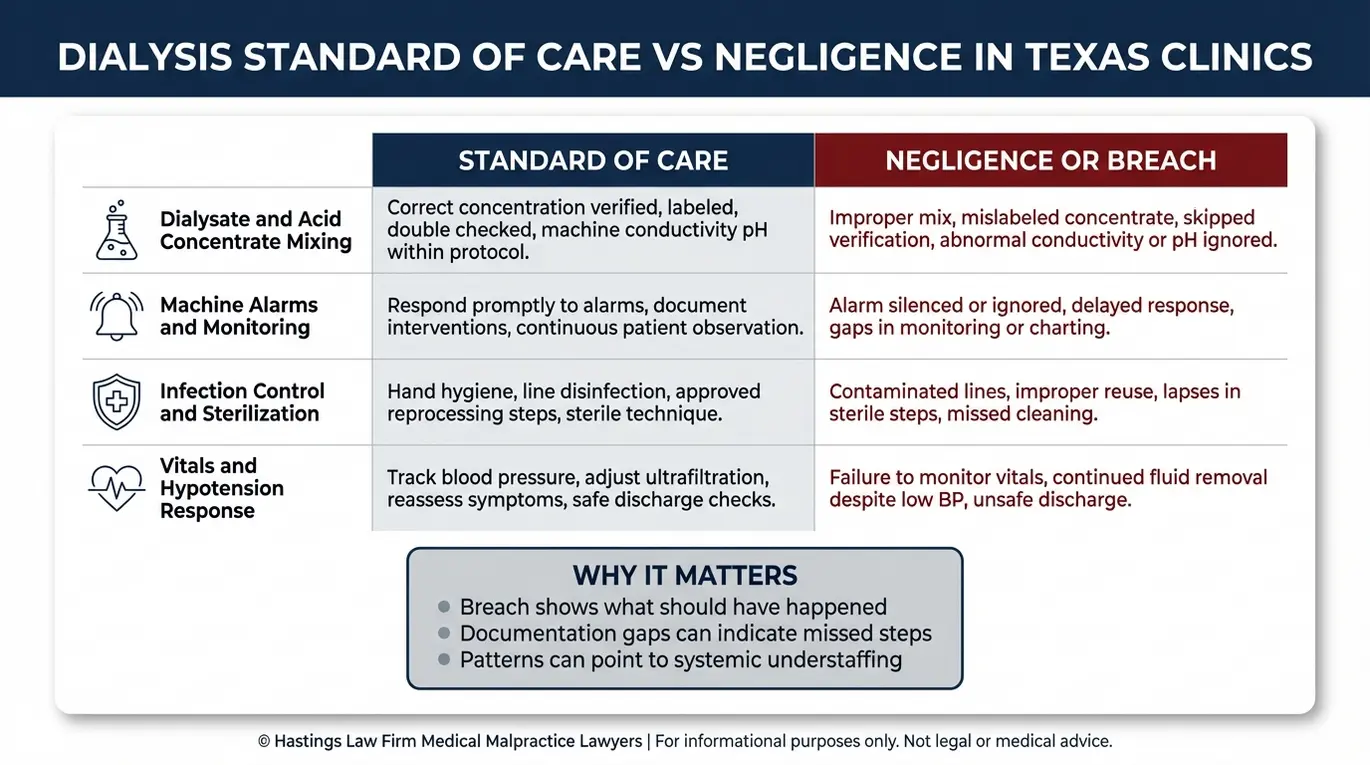
The following table illustrates the difference between expected care and potential negligence in common treatment areas:
| Treatment Area | Standard of Care | Potential Negligence |
|---|---|---|
| Dialysate preparation | Verify chemical concentrations before each session | Using incorrect acid concentrate or skipping verification |
| Machine alarms | Respond immediately and document cause | Silencing alarms without investigation |
| Infection control | Sterilize or properly dispose of dialyzers per protocol | Reusing equipment without adequate sterilization |
| Vital sign monitoring | Check blood pressure at regular intervals during treatment | Failing to monitor or respond to hypotension |
| Vascular access care | Use sterile (aseptic) technique for all needle insertions | Improper needle insertion (cannulation) causing fluid leaking into tissue (infiltration) or damage |
Shortened Dialysis Times and Mortality Risks
Another area of concern involves shortened treatment times, which may occur when clinics experience high patient turnover, a practice known as churning. Patients with chronic kidney disease and kidney failure require a prescribed duration of dialysis to adequately filter waste from the blood. When facilities shorten delivered treatment times below what the nephrologist ordered, patients may not receive adequate clearance.
Research has linked insufficient dialysis to increased mortality risk, particularly in patients already managing advanced kidney failure. A Texas dialysis malpractice lawyer can evaluate whether shortened treatments contributed to a patient’s decline or wrongful death.
The Hastings Law Firm Difference
Results matter, but what truly sets us apart is how we achieve them. Every verdict, every settlement, and every Texas courtroom victory comes from one guiding promise: To treat each client’s fight for justice as if it were our own.
This balance of skill, experience, and empathy reflects our core philosophy that justice should not only compensate the injured, but also make healthcare safer nationwide.

Severe Injuries Resulting from Dialysis Malpractice
Negligence during dialysis can lead to catastrophic outcomes, including sepsis, air embolisms, cardiac arrest, and fatal blood loss. Because dialysis patients are already managing serious illness, even a single error during treatment can have irreversible consequences.
Vascular Access Injuries
Patients receiving hemodialysis rely on a vascular access point, typically an arteriovenous fistula (AVF), an arteriovenous graft (AVG), or a central line catheter. Repeated improper needle placement can damage the fistula or graft, potentially requiring surgical repair and interrupting life-sustaining treatments. Catheter sites are also vulnerable. Poor handling or inadequate dressing changes can introduce bacteria directly into the central venous system.
Infections
Central Line-Associated Bloodstream Infections (CLABSIs) remain one of the most serious risks for dialysis patients. The Centers for Disease Control and Prevention (CDC) Dialysis Event Surveillance program tracks these healthcare-associated infections (HAIs) across dialysis facilities nationwide.
When unsterile equipment or technique introduces bacteria into the bloodstream, the result can be sepsis, a life-threatening condition in which the body’s response to infection begins damaging its own organs. An air embolism, the entry of air into the bloodstream through the dialysis circuit, can cause stroke, respiratory failure, or death if not detected and treated immediately.
Cardiovascular Events and Falls
Rapid fluid removal during hemodialysis can cause sudden drops in blood pressure. When staff fail to monitor patients or adjust treatment parameters, severe hypotension can trigger cardiac arrest or stroke. The risk does not end when the machine is disconnected. Post-treatment blood pressure drops can cause patients to fall, resulting in fractures, head injuries, or worse.
Injuries commonly associated with dialysis negligence include:
- Sepsis and bloodstream infections from contaminated equipment or catheters
- Air embolisms from undetected air in the dialysis circuit
- Cardiac arrest or stroke caused by unmanaged hypotension
- Exsanguination (severe blood loss) from disconnected or improperly secured lines
- Nerve damage or tissue death from infiltrated needle sites
- Falls due to unmonitored post-treatment blood pressure drops
- Death resulting from any of the above complications
If you or a loved one has experienced any of these injuries following dialysis, a Texas dialysis malpractice lawyer can help determine whether the care provided fell below accepted standards.
How We Investigate and Prove Dialysis Negligence
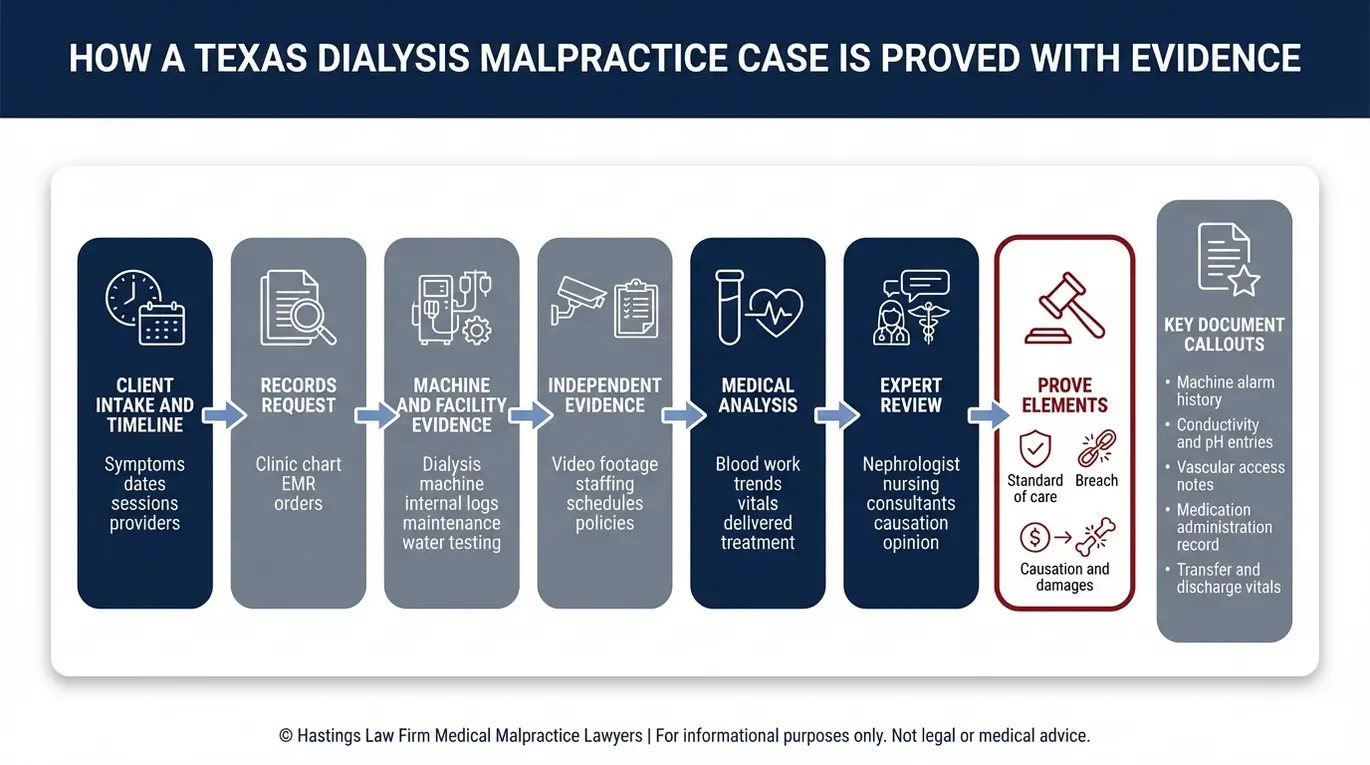
We use internal machine maintenance logs, video surveillance, and electronic medical records to establish whether the standard of care was breached. Proving medical malpractice in a dialysis case requires a detailed, evidence-driven investigation that goes far beyond reviewing the patient chart. A Texas dialysis malpractice lawyer leads this forensic process.
Machine Logs
Modern dialysis machines store internal logs recording treatment parameters, alarm events, and operator responses in real time. These electronic records are separate from the handwritten treatment sheets that staff complete during each session. Discrepancies can reveal unacknowledged alarms, shortened treatment times, or ignored settings. We secure these logs quickly before systems overwrite data.
Video Evidence
Many dialysis facilities have surveillance cameras in treatment areas. This footage can document whether staff were present and attentive during treatment, or whether patients were left unmonitored. We work to secure this evidence early, before it is deleted or recorded over, through preservation letters and, when necessary, court orders.
Expert Review
Our firm maintains a national network of qualified medical experts, including nephrologists and dialysis nursing specialists. These experts analyze blood work trends, treatment adequacy reports, and clinical documentation to determine whether the care delivered met the accepted standard. Under Texas law, an expert report is a mandatory requirement to proceed with a malpractice claim. Expert testimony from these professionals is necessary.
The Noridian End-Stage Renal Disease (ESRD) Dialysis Documentation Requirements outline the records that dialysis facilities are expected to maintain, providing a baseline for evaluating whether proper documentation practices were followed.
Key evidence we examine in dialysis malpractice investigations:
- Internal dialysis machine memory logs and alarm histories
- Handwritten treatment sheets and nursing notes
- Electronic medical records and physician orders
- Facility surveillance video from treatment areas
- Blood work and lab results over time
- Equipment maintenance and sterilization records
- Staffing schedules and training documentation
- Water purification system testing and maintenance logs
Systemic Risks from Third-Party Vendors
Dialysis centers often contract with third-party vendors for machine maintenance and water purification. The reverse osmosis (RO) water purification system, the filtration technology used to remove contaminants from water before it enters the dialysate, must meet strict safety standards.
A central venous catheter (CVC), a tube placed in a large vein for dialysis access, is particularly susceptible to infection when water quality is compromised or contaminated lines are used. If a vendor fails to properly maintain equipment or water systems, vendor liability may attach alongside the dialysis center’s responsibility. We investigate these relationships as part of every case evaluation.
The Hastings Law Firm Difference in Medical Litigation
Our firm is dedicated exclusively to medical malpractice, combining compassionate client care with a rigorous, trial-ready approach to pursue maximum compensation for dialysis injury patients and their families.
Every attorney, nurse consultant, and staff member on our team works on medical cases and nothing else. This singular focus means we understand the clinical details that can make or break a claim, from interpreting lab trends to identifying charting inconsistencies. Our firm has focused solely on medical negligence since 2005, ensuring every team member is specialized in this complex field.
Founder Tommy Hastings is Board Certified in Personal Injury Trial Law by the Texas Board of Legal Specialization, a distinction held by fewer than 2% of Texas attorneys. Our team also includes former defense attorneys who previously represented hospitals and in-house medical staff who review records with clinical precision. This insider knowledge allows us to anticipate defense strategies and counter them effectively on your behalf. We know how to fight for you.
As the Office of Inspector General, U.S. Department of Health and Human Services has documented, systemic barriers continue to impede progress toward reducing patient harm in hospitals and healthcare facilities. Holding negligent providers accountable is one of the most direct ways to drive meaningful change.
We represent clients on a contingency fee basis. You pay no attorney fees and no upfront costs. If we do not recover compensation for your damages, including medical bills, lost wages, pain and suffering, and other losses, you owe us nothing.
Contact the Texas Healthcare Malpractice Attorneys at Hastings Law Firm Today for Help
Dialysis patients who have been injured by negligent care face an uphill effort. Facilities and their corporate owners have legal teams, insurance carriers, and institutional resources designed to protect their interests. You do not have to face that alone.
Hastings Law Firm is ready to listen, investigate, and pursue the compensation you need for medical bills, lost wages, and the suffering you have endured. Our team understands the medical and legal challenges specific to dialysis injury claims, and we prepare every case as though it will go before a jury.
If you believe negligence during dialysis treatment caused harm to you or someone in your family, reach out to a Texas dialysis malpractice lawyer at our firm today. The consultation is free, confidential, and carries no obligation. You pay nothing unless we recover for you.
Call our Texas medical law firm today for help.
Frequently Asked Questions About Dialysis Malpractice in Texas


This content was researched and written by the Hastings Law Firm editorial team, which includes attorneys, medical professionals, and experienced researchers. Our writing is informed by internal knowledge and practical experience, and we cross-check critical details against authoritative sources cited throughout. Every piece undergoes human-led fact-checking and legal review. Because legal and medical information can change, if you spot an error, please contact us. Learn more about our content standards and review process on our editorial policy page.

Brady D. Williams is a nationally recognized medical malpractice attorney who has spent his career handling high-stakes litigation for injured patients and families across the country. Licensed in both Texas and California, Brady draws on experience from hundreds of resolved medical cases to break down complex legal and medical topics for the people who need that information most. His writing reflects the same attention to detail and commitment to clarity that he brings to every case he handles.
