


Texas Dialysis Error Lawyer
Written by: Hastings Law Firm | Reviewed by: Gabe Sassin | Updated: July 27, 2026
Dialysis care requires careful monitoring, sterile technique, and accurate machine settings because small mistakes can quickly become life threatening. When a preventable error happens, families are often left with fear, uncertainty, and serious medical consequences that may include infection, rapid blood loss, cardiac events, or fatal outcomes. Understanding how dialysis negligence is identified and who may be responsible can help clarify what happened and what options exist. If you or a loved one were harmed or worse due to dialysis negligence in Texas, contact Hastings Law Firm for a free, confidential case review.

Trusted Texas Medical Attorneys for Dialysis Negligence Claims
What You Should Know About Dialysis Treatment Negligence Claims in Texas:
- Life threatening harm can result from dialysis errors because treatment depends on precise monitoring, sterile technique, and correct machine settings.
- Recovery can turn on whether the harm came from a preventable staff error rather than expected complications of advanced kidney disease.
- Liability can extend beyond an individual clinician because a dialysis clinic may be responsible for unsafe staffing, training, or equipment practices.
- Severe outcomes can follow monitoring failures because missed changes in blood pressure or electrolytes can progress to cardiac arrest or sudden cardiac death.
- Catastrophic injury can occur from vascular access mistakes because dislodgement or improper needle placement can cause rapid blood loss or permanent access damage.
- Long term medical and financial losses can follow dialysis negligence because damages may include medical bills, lost wages, and non economic harms.
- Compensation may be limited for certain losses in Texas because non economic damages in medical malpractice cases are subject to caps.
- Options can narrow if action is delayed because evidence such as run sheets, machine logs, staffing schedules, and incident reports can be lost or altered.

A Healthcare Focused Law Firm
When someone you love depends on dialysis to survive, you trust that every session at an outpatient dialysis center, a freestanding clinic where patients receive routine kidney treatment outside of a hospital, will be performed safely. If that trust was broken by a preventable error, the confusion and fear you feel right now are completely understandable. You may not know exactly what went wrong or who is responsible, but you know something was not right.
As a Texas dialysis error lawyer team that focuses exclusively on medical malpractice, Hastings Law Firm has the medical knowledge and litigation experience to examine what happened during treatment and determine whether negligence caused harm. Our in-house nursing staff and national network of physician experts allow us to evaluate dialysis injury claims with the clinical precision these cases demand.
If you or a family member suffered a serious injury or loss related to dialysis care, we welcome the chance to review the details and explain your legal options during a free, confidential consultation.
Identifying Medical Malpractice in Dialysis Treatment
Dialysis malpractice occurs when a healthcare provider, such as a nephrologist or dialysis technician, fails to meet the accepted standard of care and that failure directly causes patient injury or death. The standard of care is the level of treatment a reasonably competent medical professional would provide under similar circumstances.
For patients undergoing hemodialysis, which filters blood through an external machine, or peritoneal dialysis, which uses the lining of the abdomen to filter waste internally, that standard covers everything from machine settings and infection prevention to real-time monitoring of vital signs. This standard is rigorous because the kidneys perform essential functions that, when artificially replicated, require absolute precision to prevent toxicity or volume overload.
Not every bad outcome during dialysis qualifies as medical negligence. Patients with end-stage renal disease (ESRD) or chronic kidney disease (CKD) already face serious health risks, and some complications are expected even with proper care.
The critical distinction is between a known risk of the disease and a preventable error caused by a provider’s failure to follow established protocols. A sudden drop in blood pressure during treatment, for example, can be a recognized complication. But if the care team failed to monitor the patient’s vitals and respond in time, that may suggest a breach.
To pursue a dialysis malpractice claim in Texas, four legal elements must be established. First, the provider owed the patient a duty of care. Second, the provider breached that duty. Third, the breach directly caused the injury. Fourth, the patient suffered actual damages as a result.
These elements are governed by Texas Civil Practice and Remedies Code Chapter 74, which sets the procedural framework for all medical malpractice claims in the state. Proving these elements requires clear evidence that the breach was the primary cause of the injury, rather than the underlying disease progression.
As a Texas dialysis error lawyer team and experienced dialysis malpractice attorneys, we work with nephrologists and critical care specialists to determine whether the treatment you or your loved one received fell below the standard. This approach, led by our founder Tommy Hastings, a board-certified trial lawyer, provides the clinical foundation for every case we build.

Common Types of Dialysis Injuries and Staff Errors
Common dialysis errors include vital sign monitoring failures that lead to cardiac arrest, vascular access mishaps, contamination causing sepsis, and medication or fluid administration mistakes. Each of these errors can cause life-threatening harm. A qualified dialysis negligence lawyer knows that many are preventable with proper training, staffing, and adherence to clinical protocols.
Infections and Bloodstream Contamination
Patients receiving hemodialysis through a central line catheter face a heightened risk of developing a CLABSI, a serious and often deadly infection that enters the blood through a contaminated catheter site. This occurs when germs enter the bloodstream through the central line insertion point. These systemic infections are often the result of improper hygiene or equipment maintenance in the clinic.
Poor sterilization technique, reuse of contaminated supplies, or failure to follow hand hygiene protocols can introduce bacteria directly into the bloodstream. When these infections are not identified and treated quickly, they can progress to sepsis, a systemic inflammatory response that can cause organ failure. The Centers for Disease Control and Prevention’s Dialysis Event surveillance program tracks these types of preventable infections at the national level.
Vascular Access Errors
Dialysis requires reliable vascular access, typically through an arteriovenous fistula (AVF), an arteriovenous graft (AVG), or a central line catheter. This access point serves as the patient’s lifeline for every treatment session. Errors during needle insertion into a fistula or graft can cause hemorrhage, nerve damage, or vessel collapse.
Staff must verify the “thrill” (vibration) and “bruit” (sound) of the access point before every session to ensure patency. Failure to perform these checks or using improper cannulation techniques can destroy a patient’s access route.
A catheter dislodgement during treatment may lead to rapid blood loss, a catastrophic event that requires immediate intervention. These injuries often point to inadequate technician training or rushed procedures during high-volume shifts.
Monitoring Failures
Intradialytic hypotension, a dangerous drop in blood pressure during a dialysis session, is one of the most common and preventable emergencies in dialysis care. When staff fail to monitor blood pressure and electrolyte levels throughout treatment, the patient’s condition can deteriorate into cardiac arrest or sudden cardiac death.
Strict monitoring of fluid removal rates relative to the patient’s dry weight is essential to preventing vascular collapse. Dry weight refers to a patient’s weight without the excess fluid that builds up between treatments. The Texas Healthcare Safety Network definitions page provides standardized terminology for many of these reportable events.
Falls During Transfer
Patient drops during transfer to or from the dialysis chair represent another category of preventable harm. Post-treatment weakness is a common risk factor for these accidents. These falls often occur when staff do not properly assess a patient’s mobility limitations or fail to use appropriate transfer equipment.
This is particularly dangerous after a session when patients may be weak, dizzy, or disoriented from fluid removal. This requires staff to follow established fall prevention protocols until the patient is stable.
Dialysate Acid Concentrate and Chemical Mix-Up Errors
One of the most dangerous dialysis errors involves the improper preparation of dialysate, the specially formulated fluid used to draw toxins from the blood during treatment. Dialysate acid concentrate is a component mixed to precise chemical specifications before each session.
When the wrong concentrate is selected or the chemical composition is mixed incorrectly, it can cause severe electrolyte imbalances, acute toxicity, or cardiac failure. These errors are often the result of inadequate labeling, lack of double-check protocols, or poorly trained staff handling the mixing process.
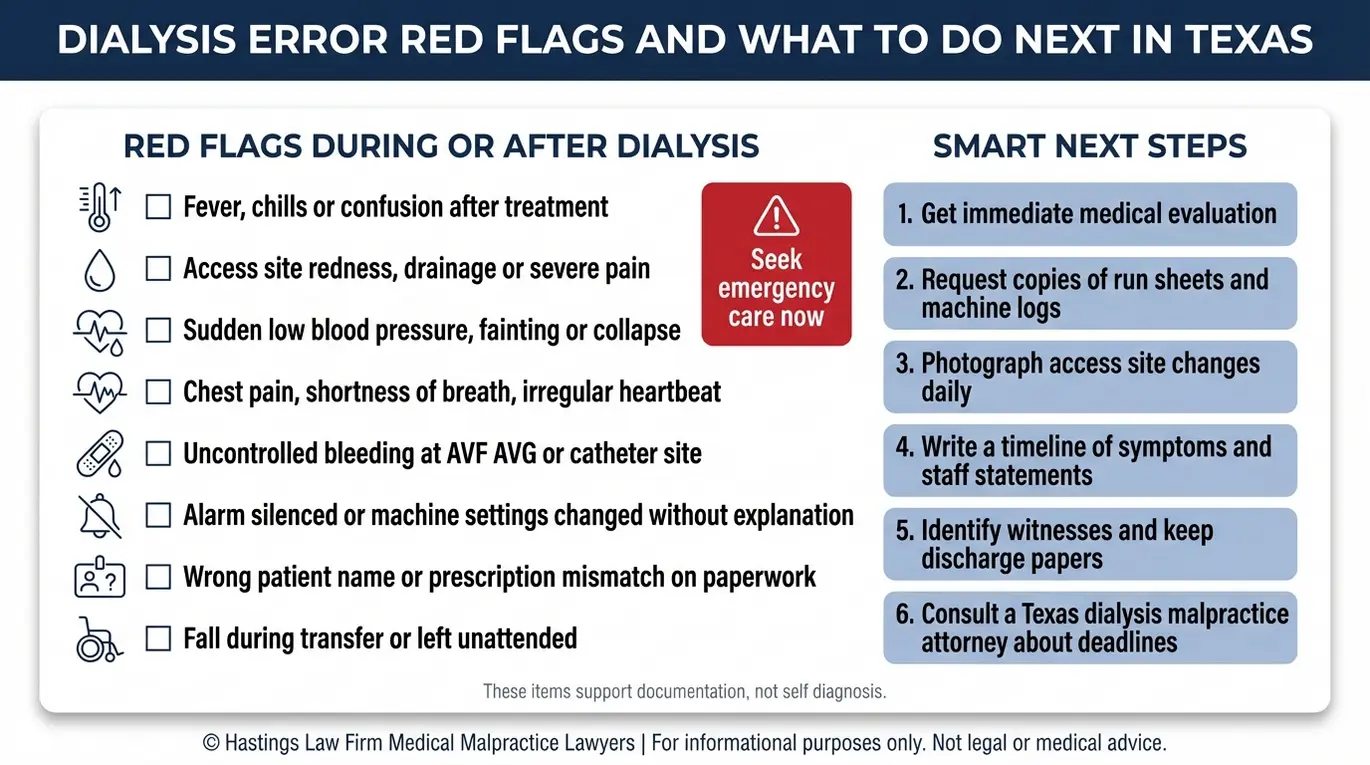
Staff errors that may indicate dialysis negligence include:
- Failure to verify dialysate chemical composition before treatment begins
- Skipping or falsifying blood pressure and vital sign checks during a session
- Improper sterilization of catheter sites or vascular access points
- Neglecting to respond to alarms on the dialysis machine
- Using damaged or malfunctioning equipment without reporting it
- Inadequate patient assessment before or after fluid removal
- Failing to follow fall prevention protocols during patient transfers
If any of these issues contributed to your loved one’s injury, a Texas dialysis injury attorney at Hastings Law Firm can help determine what went wrong and who is responsible.
The Hastings Law Firm Difference
Results matter, but what truly sets us apart is how we achieve them. Every verdict, every settlement, and every Texas courtroom victory comes from one guiding promise: To treat each client’s fight for justice as if it were our own.
This balance of skill, experience, and empathy reflects our core philosophy that justice should not only compensate the injured, but also make healthcare safer nationwide.

Determining Liability for Dialysis Center Negligence
Liability in a dialysis injury case may extend to the dialysis clinic itself for corporate negligence, the attending nephrologist for treatment errors, or third-party equipment manufacturers for defective machines. Identifying the correct parties is one of the most important steps in building a strong claim, and it requires understanding how dialysis care is structured.
Many patients receive treatment at an outpatient dialysis center operated by large corporate chains. These facilities function differently from hospital-based dialysis units. In a corporate-run clinic, the company typically employs the nurses and technicians who deliver hands-on care, while the overseeing nephrologist may be an independent contractor.
This distinction matters because it affects how legal responsibility, known as vicarious liability, is assigned. It also helps distinguish direct corporate liability from individual provider errors. An employer can be held responsible for the negligent acts of its employees, but the rules differ when the provider is an independent contractor.
As a Texas dialysis error lawyer team with former defense attorneys on staff, we know how hospitals and corporate chains structure these relationships to limit their exposure. Our experience on both sides of medical litigation allows us to identify those arrangements and hold the right parties accountable.
Corporate negligence applies when the facility itself created the conditions for harm. This can include chronic understaffing, inadequate training of dialysis technicians, failure to maintain or calibrate equipment, or policies that prioritize patient volume over safety.
We investigate whether corporate policies encouraged speed over safety, directly contributing to the injury. Under Texas Civil Practice and Remedies Code § 74.051, a formal notice must be sent to each party before suit is filed, which makes early identification of all liable entities essential.
| Liable Party | Basis for Liability | Common Examples |
|---|---|---|
| Dialysis Clinic (Corporate Entity) | Corporate negligence; vicarious liability for employees | Understaffing, poor training, equipment failures, protocol violations |
| Attending Nephrologist | Direct medical negligence | Prescribing incorrect dialysate orders, mishandling an arteriovenous fistula (AVF), inadequate patient assessments |
| Equipment Manufacturer | Product liability | Defective dialysis machines, faulty alarms, contaminated disposable supplies |
When suing a dialysis center, we examine staffing records, training certifications, incident reports, and corporate policies alongside the clinical evidence. This multi-party approach ensures that every entity that contributed to the injury is held to account.

Compensation and Damages in Renal Failure Negligence Cases
Patients and families harmed by dialysis negligence may recover economic damages for medical bills and lost wages, as well as non-economic damages for pain, suffering, and physical impairment. The specific compensation available depends on the severity of the injury, the long-term medical needs of the patient, and whether the case involves a surviving patient or a wrongful death claim.
Recoverable damages in Texas dialysis malpractice cases may include:
- Past and future medical expenses, including corrective surgeries, extended hospitalization, rehabilitation, and ongoing dialysis costs.
- Lost wages and diminished earning capacity if the injury prevents the patient from returning to work.
- Pain and suffering caused by the injury and its physical consequences, such as the agony of sepsis or the trauma of a cardiac event.
- Mental anguish resulting from trauma, fear, or reduced quality of life.
- Loss of consortium, which compensates a spouse for the loss of companionship and support.
- Wrongful death damages for surviving family members, including spouses, children, and parents, if a loved one died as a result of negligent care.
Under Texas Civil Practice and Remedies Code § 74.301, non-economic damages in medical malpractice cases are subject to statutory caps. Economic damages for medical expenses and lost wages are generally not capped, allowing for full recovery of financial losses.
A dialysis wrongful death lawyer can help your family understand the full scope of compensation for dialysis errors available based on the specific facts of your case. For families who lost a loved one during or shortly after dialysis, the grief is compounded by the knowledge that the death may have been preventable.
These cases often involve cardiac arrest from monitoring failures or sepsis from untreated infections. Compensation for dialysis errors in wrongful death claims can cover funeral expenses, loss of financial support, and the profound emotional loss endured by surviving family members.
How Our Trial-Ready Attorneys Investigate Dialysis Claims
We conduct a thorough investigation involving immediate evidence preservation, expert medical review, and strategic legal filing to prevent evidence destruction. As a Texas dialysis error lawyer team, we understand that critical evidence in these cases can disappear quickly if steps are not taken early.
The first priority is securing dialysis run sheets, the detailed treatment logs that record machine settings, fluid removal rates, vital signs, and staff interventions throughout each session. These logs provide a minute-by-minute account of the session, revealing if vitals were checked at required intervals or if alarms were ignored.
We also request dialysis machine data logs, surveillance video from the facility, staffing schedules, and incident reports. These documents form the factual backbone of every claim.
Our in-house nursing staff reviews the clinical records and flags discrepancies. We then engage specialists from our national expert network, retaining a qualified expert witness such as a nephrologist or critical care physician, to evaluate whether the treatment met the standard of care. This expert analysis determines the strength of the claim and identifies each point of failure.
As a dialysis malpractice law firm that operates on a contingency fee basis, we charge no attorney fees or costs unless we secure a recovery for you. The consultation and full case evaluation are free and confidential.
Contact the Texas Healthcare Malpractice Attorneys at Hastings Law Firm Today for Help
If you or someone in your family was seriously harmed during dialysis treatment, you deserve answers about what happened and whether it could have been prevented. At Hastings Law Firm, our entire team of attorneys, nurse consultants, and patient advocates is dedicated to holding negligent providers accountable and protecting the families they failed.
We prepare every case from day one as though it will go before a jury. That trial-ready approach, combined with the clinical insight of our medical staff and former defense attorneys, positions us to pursue the full value of your claim against even the largest healthcare corporations.
Time limits under Texas law are strict, and evidence can be lost or altered if action is delayed. Contact us today for a free, confidential case evaluation. There is no fee unless we win.
Frequently Asked Questions About Dialysis Error in Texas


This content was researched and written by the Hastings Law Firm editorial team, which includes attorneys, medical professionals, and experienced researchers. Our writing is informed by internal knowledge and practical experience, and we cross-check critical details against authoritative sources cited throughout. Every piece undergoes human-led fact-checking and legal review. Because legal and medical information can change, if you spot an error, please contact us. Learn more about our content standards and review process on our editorial policy page.

Gabe Sassin has focused exclusively on medical malpractice law since 2007. After spending more than a decade as a malpractice defense attorney, he knows exactly how the other side works. He has seen firsthand how healthcare providers, insurers, corporate defendants, and their legal teams think, prepare, and build their defense against claims. That knowledge works for the people who need it most today, injured patients and their families. His unique experience shapes everything he writes, giving readers a look at how these cases actually work from someone who has handled them from both sides.
