


Texas Dialysis Center Malpractice Lawyer
Written by: Hastings Law Firm | Reviewed by: Gabe Sassin | Updated: July 27, 2026
Dialysis is a repeated, high risk treatment where safety depends on careful monitoring, infection control, and properly maintained equipment. When a clinic falls short, patients can suffer rapid and severe harm from missed warning signs, contaminated supplies or water, medication mistakes, or failures to respond to alarms. Some errors stem from systemic problems like understaffing, inadequate training, or unsafe policies that erode patient safety over time. If you or a loved one were harmed or worse due to dialysis center malpractice in Texas, contact Hastings Law Firm for a free, confidential case review.

Trusted Legal Advocacy for Victims of Dialysis Clinic Negligence
What You Should Know About Dialysis Clinic Negligence Claims in Texas:
- The risk of catastrophic harm can rise quickly when dialysis care breaks down because treatment errors can trigger sepsis, cardiac arrest, air embolism, severe bleeding, or wrongful death.
- Accountability can extend beyond individual staff when institutional problems like chronic understaffing, inadequate training, or unsafe operational policies contribute to unsafe care.
- Preventable infections can become life threatening when clinics fail at basic infection control such as sterilizing ports and following hand hygiene protocols.
- Severe bleeding can occur within minutes when vascular access is mishandled or a needle dislodges and staff do not detect and respond promptly.
- Life threatening complications can follow water treatment failures when reverse osmosis systems malfunction or water quality testing is not performed and contaminants enter dialysate.
- Recovery options in Texas can be shaped by limits on non economic damages even when the injury is severe, while economic losses like medical bills and lost income are not capped.
- Additional damages may be possible in rare situations when conduct rises to gross negligence, such as concealing known contamination problems.
- Liability may include a corporate dialysis chain when systemic failures are tied to staffing levels, training programs, or clinic policies.
- A separate claim path may exist when a dialysis machine or dialyzer malfunction is tied to a manufacturing or design defect.
- Key records can be central when care is disputed, including staffing logs, incident reports, machine data, maintenance logs, and treatment notes.

A Healthcare Focused Law Firm
Dialysis patients depend on their treatment to stay alive. When a clinic fails to provide safe, competent care, the consequences can be devastating, and the sense of betrayal runs deep. You trusted a facility with your life or your loved one’s life, and something went terribly wrong. That feeling of confusion, anger, and helplessness is valid.
At Hastings Law Firm, we focus exclusively on medical malpractice. Our team includes former defense attorneys and nurses who understand how clinics build their cases and where errors are often hidden. As a Texas Dialysis Center Malpractice Lawyer team led by Tommy Hastings, a trial lawyer board-certified in Personal Injury Trial Law by the Texas Board of Legal Specialization, we are prepared to investigate what happened, identify who is responsible, and pursue accountability.
If you believe a dialysis clinic’s negligence caused serious harm, we welcome you to contact us for a free, confidential case evaluation. There is no fee unless we recover compensation for you.
Common Forms of Malpractice in Texas Dialysis Centers
Malpractice in dialysis centers typically involves staffing shortages, failure to monitor vital signs, equipment contamination, or medication errors that breach the accepted standard of care, the level of treatment a reasonably competent provider would deliver under similar circumstances.
Unlike a one-time surgical procedure, dialysis is a repeated, high-risk treatment. Patients with end-stage renal disease rely on these sessions multiple times per week just to survive. That repetition should breed precision. Instead, in clinics where systemic problems go uncorrected, it can breed complacency.
Systemic Failures That Put Patients at Risk
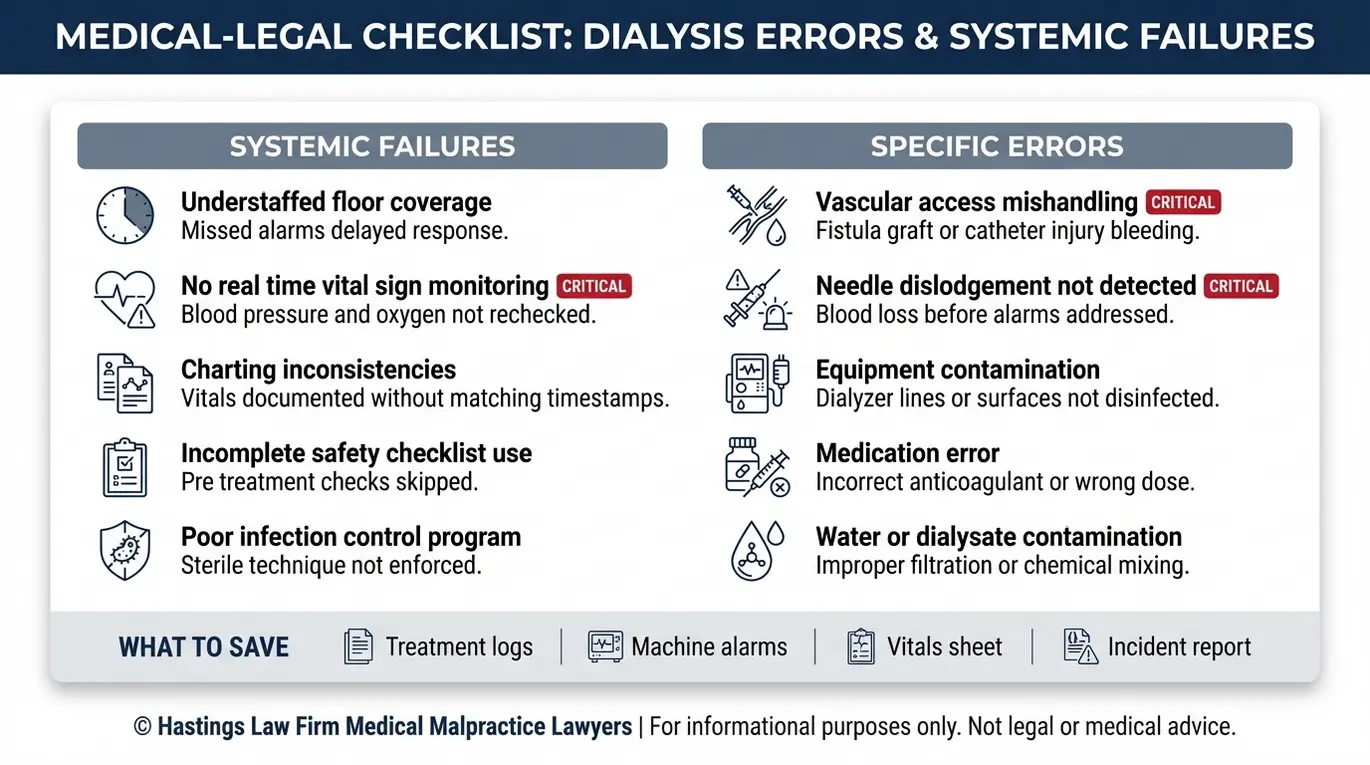
Many of the most dangerous errors in outpatient dialysis facilities are not isolated mistakes by a single nurse or technician. They may be the result of institutional issues, such as chronic understaffing, inadequate training, or operational policies that can erode patient safety over time.
When a dialysis clinic schedules more patients than its staff can safely monitor, alarms may go unanswered. Blood pressure changes during treatment may not be caught in time. A dialysis patient experiencing distress may sit unnoticed for important minutes because a single technician is responsible for too many chairs.
These patterns are exactly what our dialysis malpractice attorneys investigate. We review staffing logs, incident reports, and facility records to determine whether the clinic’s own policies, or lack of them, created the conditions for harm.
Specific Errors We Commonly See
Beyond systemic staffing issues, specific clinical mistakes frequently give rise to dialysis negligence claims. These errors happen when medical staff fail to follow established protocols during treatment.
- Vascular access mishandling: Dialysis requires vascular access, a surgically created connection to the bloodstream, typically through an AV fistula, AV graft, or central venous catheter. Improper needle insertion, failure to assess access site integrity, or rough handling of a fistula or graft can cause dangerous bleeding, clotting, or permanent damage to the access point. A patient can suffer a life-threatening bleed-out in minutes if a needle dislodges and is not immediately detected by distracted staff.
- Infection control failures: Bloodstream infections (BSIs), which occur when bacteria enter the blood, remain one of the most preventable yet persistent dangers in dialysis settings. Reusing supplies, failing to sterilize ports, or not following proper hand hygiene protocols can introduce pathogens directly into a patient’s bloodstream. The Centers for Disease Control and Prevention’s best practices for dialysis infection prevention outline clear protocols that clinics are expected to follow.
- Medication and dosing errors: Administering the wrong dose of heparin, miscalculating dry weight targets, or failing to adjust prescriptions based on recent lab values can cause internal bleeding, dangerous fluid shifts, or cardiovascular complications.
- Failure to respond to alarms or deteriorating vital signs: Ignoring machine alarms, skipping scheduled blood pressure checks, or failing to act on dropping oxygen levels during treatment.
If any of these issues sound familiar, a lawyer for dialysis negligence can help you determine whether the care you or your loved one received fell below acceptable standards.
The Danger of Water Treatment and Chemical Contamination
One of the most technically specific, and often overlooked, forms of dialysis negligence involves the water used during treatment. During a single hemodialysis session, a patient’s blood is exposed to roughly 120 liters of water. That water must be purified through a reverse osmosis (RO) water treatment system, a filtration process that removes contaminants, bacteria, and chemical impurities before the water is mixed into the dialysate.
Dialysate, the specially formulated fluid that draws waste products and excess electrolytes from the patient’s blood during treatment, contains carefully balanced levels of sodium, potassium, and other electrolytes. If the RO system malfunctions, or if staff fail to perform required water quality testing, contaminants can enter the dialysate and pass directly into the patient’s bloodstream.
Errors in acid concentrate mixing can also create dangerous electrolyte imbalances. Too much potassium can trigger cardiac arrest. Too little sodium can cause hemolysis, the rupturing of red blood cells. These are not subtle complications. They can be fatal within minutes, and they are entirely preventable with proper equipment maintenance and quality checks.
Risks and Errors in Hemodialysis vs. Peritoneal Dialysis
While hemodialysis errors often involve machine malfunction or vascular access hemorrhage, peritoneal dialysis malpractice frequently centers on training failures and peritonitis infections. Both treatment types carry distinct risks, and the type of negligence involved depends heavily on which modality the dialyzer treatment used.
Hemodialysis (In-Clinic)
Hemodialysis is the process of filtering a patient’s blood through an external machine and dialyzer, a specialized filter that removes waste before returning the blood to the body. Most sessions take place in outpatient clinics under direct staff supervision, which means errors during treatment are often the result of clinical failures.
Machine calibration problems can deliver incorrect fluid removal rates or create dangerous pressure changes. Air embolisms, where air enters the bloodstream through the dialysis circuit, can occur if tubing connections are loose or air detection sensors malfunction. Patients receiving treatment through a central line are especially vulnerable if catheter caps are not strictly managed.
Handoff failures between the vendor’s technician and clinic staff can leave equipment improperly calibrated without anyone catching it. Skipping pre-treatment safety checklists is another recurring problem. These checklists exist to verify machine settings, confirm patient identity, and assess the access site. When they are rushed or skipped, preventable errors become almost inevitable.
Peritoneal Dialysis (At-Home or Clinic-Assisted)
Peritoneal dialysis (PD) uses the lining of the patient’s own abdomen as a natural filter. Dialysate is introduced through a catheter into the peritoneal cavity, where it absorbs waste before being drained. Many PD patients manage their treatments at home, which shifts responsibility onto the clinic for proper initial training and ongoing support.
When clinics fail to adequately train patients on sterile technique, catheter care, or how to recognize early signs of infection, the risk of peritonitis, a dangerous infection of the peritoneal membrane, increases substantially. It is the facility’s legal duty to ensure that the patient or their caregiver is fully competent before transitioning to independent home care. Rushing this educational phase to cut costs is a frequent cause of subsequent hospitalizations.
Research published by PubMed Central on peritoneal dialysis-related peritonitis confirms that infection rates are closely linked to training quality and follow-up care. Improper catheter placement by a nephrologist or surgeon can also lead to chronic drainage problems, pain, and repeated infections requiring hospitalization.
A dialysis injury lawyer can evaluate whether the clinic or provider failed to meet its obligations under either treatment model. As Texas dialysis negligence counsel, we examine training records, machine maintenance logs, and clinical documentation to identify where the standard of care broke down.
| Risk Category | Hemodialysis (In-Clinic) | Peritoneal Dialysis (At-Home/Clinic-Assisted) |
|---|---|---|
| Primary infection risk | Bloodstream infection from vascular access | Peritonitis from catheter contamination |
| Equipment-related errors | Machine miscalibration, air embolism | Catheter malposition, drainage failure |
| Staff responsibility | Direct monitoring during treatment | Training, follow-up, and infection response |
| Common systemic failure | Skipped safety checklists, alarm fatigue | Inadequate patient education and support |
The Hastings Law Firm Difference
Results matter, but what truly sets us apart is how we achieve them. Every verdict, every settlement, and every Texas courtroom victory comes from one guiding promise: To treat each client’s fight for justice as if it were our own.
This balance of skill, experience, and empathy reflects our core philosophy that justice should not only compensate the injured, but also make healthcare safer nationwide.

Catastrophic Injuries Caused by Dialysis Errors
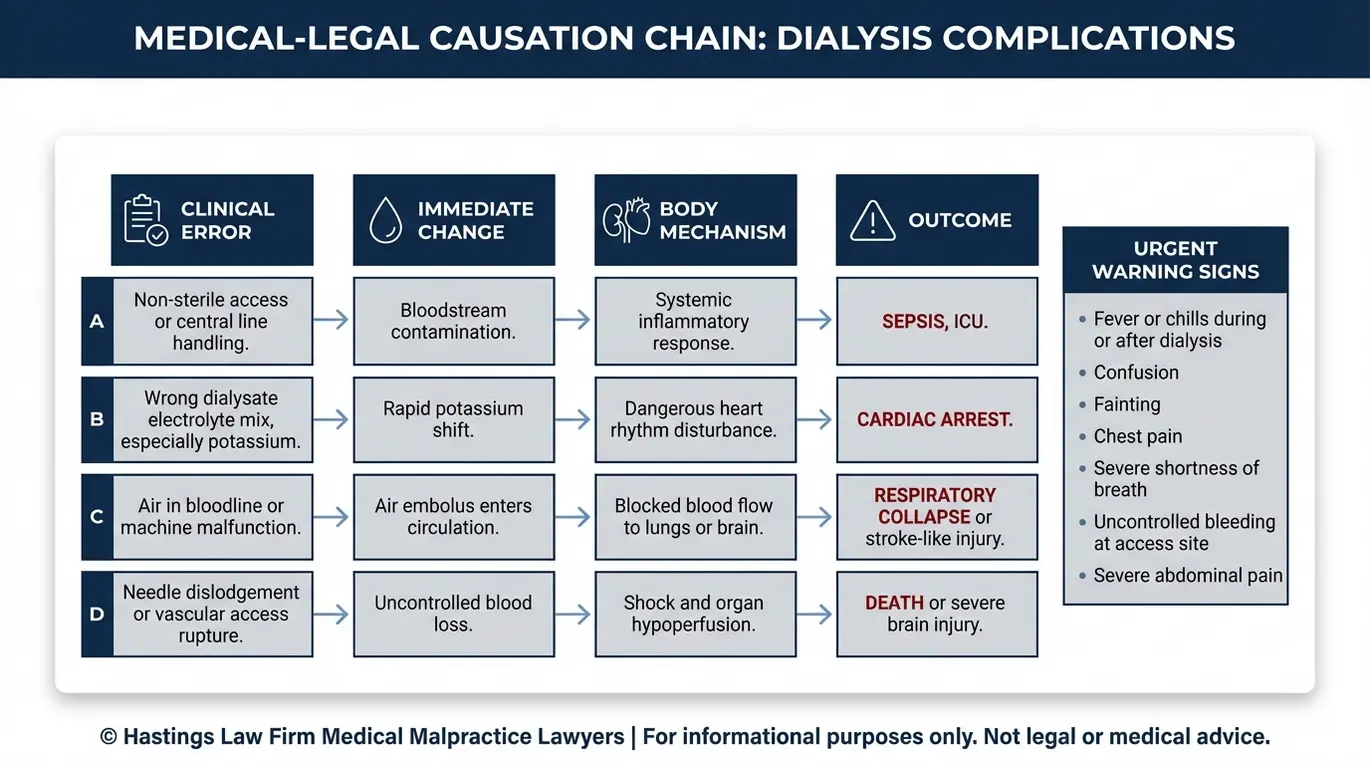
Negligence during dialysis can result in immediate life-threatening conditions including sepsis, cardiac arrest from electrolyte imbalance, air embolisms, and fatal hemorrhaging. Because dialysis patients already live with compromised kidney function, their ability to survive a medical error is significantly reduced compared to healthier individuals.
Patients with end-stage renal disease (ESRD) and chronic kidney disease depend on dialysis to perform the work their kidneys can no longer do. When the treatment itself becomes the source of harm, the consequences escalate quickly.
The Most Serious Injuries We See in These Cases
Dialysis errors can lead to fatal complications or permanent disability. We examine the timeline of care to determine if these injuries were preventable.
- Sepsis from bloodstream infections: Sepsis, the body’s extreme and often fatal response to infection, can spread rapidly when bacteria enter the bloodstream through a contaminated central line, improperly sterilized needle, or unclean access site. The CDC’s dialysis event surveillance data tracks these infections as a persistent safety concern across U.S. facilities.
- Cardiac arrest from electrolyte imbalances: If potassium levels in the dialysate are mixed incorrectly, even slightly, the resulting imbalance can disrupt the heart’s electrical system. High potassium levels, known as hyperkalemia, prevent the heart muscles from functioning correctly, while low potassium can cause paralysis of the respiratory muscles, leading to arrhythmia, cardiac arrest, or death during treatment.
- Air embolisms: Air embolisms, which occur when air bubbles enter the bloodstream through the dialysis circuit, can block blood flow to the brain, lungs, or heart. Even a small volume of air can cause stroke, respiratory failure, or sudden cardiac death.
- Hemorrhage from dislodged needles or ruptured access sites: If a needle becomes dislodged during treatment and staff do not respond immediately, a patient can lose a dangerous amount of blood in minutes. Because dialysis patients are often administered blood thinners like heparin to prevent clotting in the machine, a bleed event can become uncontrollable much faster than in a typical patient.
- Wrongful death: In the most tragic cases, dialysis negligence proves fatal. Families of patients with kidney failure who die as a result of clinic errors may have grounds to pursue a wrongful death claim.
A dialysis wrongful death attorney can help families understand what went wrong and whether the clinic’s actions, or inaction, caused the death. Lawsuits for kidney failure patients who suffered catastrophic harm begin with a thorough medical record review and expert analysis to connect the specific error to the resulting injury.
Compensation for Victims of Dialysis Negligence
Patients and families may recover damages for medical expenses, pain and suffering, lost income, and funeral costs, though Texas law imposes specific caps on non-economic damages in medical malpractice cases. Seeking a full financial recovery requires identifying all current and future losses.
Economic Damages
These cover the measurable financial losses caused by the injury. In a medical malpractice lawsuit, accurately calculating these figures is important. Past and future medical bills, including corrective surgeries, extended hospitalizations, additional dialysis treatments, and rehabilitation, fall into this category.
Life care plans may also be necessary to project the cost of long-term nursing needs. Lost wages and reduced earning capacity are also recoverable if the injury affects the patient’s ability to work. There is no cap on economic damages in Texas.
Non-Economic Damages
Pain, suffering, mental anguish, and loss of quality of life are classified as non-economic damages. Under the Texas Civil Practice and Remedies Code Chapter 74, these damages are subject to statutory caps.
Generally, non-economic damages are limited to $250,000 per claimant against all individual healthcare providers and up to $250,000 per healthcare institution, with a maximum of $500,000 across all institutions. These limits apply even in cases of wrongful death, making it necessary to separate capped non-economic losses from uncapped economic ones.
Punitive Damages
In rare cases involving medical negligence that rises to the level of gross negligence, a jury may award punitive damages to punish particularly egregious conduct. An example might involve a facility that knew about contaminated water systems and concealed the problem.
Gross negligence is a higher bar than standard negligence; it implies a conscious indifference to the patient’s welfare. Punitive damages are not available in every case, but when the evidence supports them, they can meaningfully increase the total recovery.
Pursuing fair compensation for dialysis errors requires both legal skill and deep medical knowledge. Our team works with qualified experts to build a clear picture of the harm and the losses involved.
Contact the Texas Healthcare Malpractice Attorneys at Hastings Law Firm Today for Help
If you or someone you love was seriously harmed by negligent care at a dialysis clinic, Hastings Law Firm is here to help you find answers. Our team includes former defense attorneys who understand how hospitals and clinics build their cases, in-house nurse consultants who can interpret medical records, and experienced trial lawyers who prepare every case as though it will go before a jury.
We operate on a contingency fee basis, which means you pay no attorney fees or costs unless we secure a recovery for you. Our mission is to restore trust for patients and families who have been failed by the healthcare system, and to hold negligent providers accountable so this does not happen to someone else.
As a trusted Texas Dialysis Center Malpractice Lawyer team, we welcome your call. Contact us today to speak with a patient advocate for a free, confidential case evaluation.
Frequently Asked Questions About Dialysis Center Malpractice in Texas


This content was researched and written by the Hastings Law Firm editorial team, which includes attorneys, medical professionals, and experienced researchers. Our writing is informed by internal knowledge and practical experience, and we cross-check critical details against authoritative sources cited throughout. Every piece undergoes human-led fact-checking and legal review. Because legal and medical information can change, if you spot an error, please contact us. Learn more about our content standards and review process on our editorial policy page.

Gabe Sassin has focused exclusively on medical malpractice law since 2007. After spending more than a decade as a malpractice defense attorney, he knows exactly how the other side works. He has seen firsthand how healthcare providers, insurers, corporate defendants, and their legal teams think, prepare, and build their defense against claims. That knowledge works for the people who need it most today, injured patients and their families. His unique experience shapes everything he writes, giving readers a look at how these cases actually work from someone who has handled them from both sides.
