


Fort Worth Defective Medical Device Lawyer
Written by: Hastings Law Firm | Reviewed by: Brady D. Williams | Updated: July 27, 2026
A defective medical device can turn treatment into a new source of injury and uncertainty. People may face revision surgery, unexpected complications, and long recoveries that disrupt work and daily life. These cases often involve questions about whether a device was unsafe by design, flawed in manufacturing, or sold without adequate warnings. Accountability can also overlap with medical malpractice when implantation or follow up care falls below the standard of care. If you or a loved one were harmed or worse due to a defective medical device in Fort Worth, Texas, contact Hastings Law Firm for a free, confidential case review.
Trusted Medical Product Liability Attorneys in Fort Worth
What You Should Know About Medical Equipment Failure Claims in Fort Worth:
- Long term harm can follow when a device marketed as safe fails inside the body and triggers additional procedures and prolonged recovery.
- Liability can extend beyond the manufacturer when implantation, monitoring, or response to complications falls below the standard of care.
- Recovery options can depend on whether the defect is tied to the product design, a manufacturing error, or inadequate warnings about known risks.
- Safety assumptions can be misplaced because some devices reach the market through a clearance pathway that may not require independent clinical trials.
- Lawsuits can be limited or blocked when federal preemption applies to certain devices that went through a more rigorous approval process.
- Compensation can include financial losses and personal harms such as pain, suffering, physical impairment, and reduced quality of life.
- Total recovery can increase when evidence supports fraud, malice, or gross negligence, although limits on punitive damages may apply.
- Wrongful death claims may be available to surviving family members when a defective device causes a patients death.
- Proving a defect can become significantly harder if an explanted device is discarded or altered after revision surgery.
- Options can narrow quickly when filing deadlines or repose limits are missed, which can bar recovery entirely.

A Healthcare Focused Law Firm
When a medical device that was supposed to improve your health causes harm instead, the experience can feel deeply disorienting. You may be facing additional procedures, including revision surgery (a second operation to remove or replace a failed device), mounting medical bills, and a recovery that was never part of the plan. These situations raise serious legal questions, and you deserve clear answers.
At Hastings Law Firm, our team of attorneys, in-house nurse consultants, and former defense lawyers focuses exclusively on cases where the medical system has failed patients. Founded by Tommy Hastings, a board-certified trial lawyer and 2025 inductee into ABOTA, we bring specialized expertise to every case, achieving a status held by less than 2% of attorneys in the state. As a Fort Worth defective medical device lawyer team, we understand both the medical science behind device failures and the legal strategies needed to hold manufacturers accountable. If you or a loved one has been injured by a medical device, we can review what happened and explain your options in a free, confidential consultation.
Common Defective Medical Devices in Tarrant County Litigation
Defective medical devices frequently cited in litigation include failing hip and knee implants, transvaginal and hernia mesh, IVC filters, and faulty pacemakers that cause injury requiring revision surgery. These are not theoretical risks. Patients across Tarrant County and throughout Texas are living with the consequences of devices that were marketed as safe but performed dangerously once inside the body.
Some of the most common device failures our medical device attorneys in Fort Worth evaluate include:
- Metal-on-metal hip implants, devices where both the ball and socket components are made of metal alloys. Over time, friction between these metal surfaces can release microscopic debris into surrounding tissue, causing metallosis, a form of metal poisoning that destroys bone and muscle.
- Surgical mesh products, including transvaginal mesh used for pelvic organ prolapse and hernia mesh. These products can shrink, erode through tissue, or trigger chronic infection that requires multiple corrective surgeries.
- IVC filters, small wire devices placed in the inferior vena cava (the large vein carrying blood from the lower body to the heart) to catch blood clots. Some of these filters fracture, migrate, or perforate the vein wall, creating life-threatening complications.
- CPAP machines and components linked to toxic foam degradation, where patients inhale or ingest contaminated particles during sleep therapy.
- Pacemakers and defibrillators with faulty leads or software malfunctions that can deliver inappropriate shocks or fail to regulate heart rhythm.
- Spinal cord stimulators that malfunction, migrate, or cause nerve damage rather than relieve chronic pain.
Many of these devices have been the subject of an FDA recall or safety communications posted to the U.S. Food and Drug Administration’s Medical Device Recalls and Early Alerts database. Research published through PubMed Central on adverse events reported to the FDA’s MAUDE database also documents the scope of harm caused by certain implanted devices. Cases involving these products are regularly filed in Tarrant County courts, where patients seek accountability for injuries that were entirely preventable.
Identifying Design Manufacturing and Failure to Warn Defects
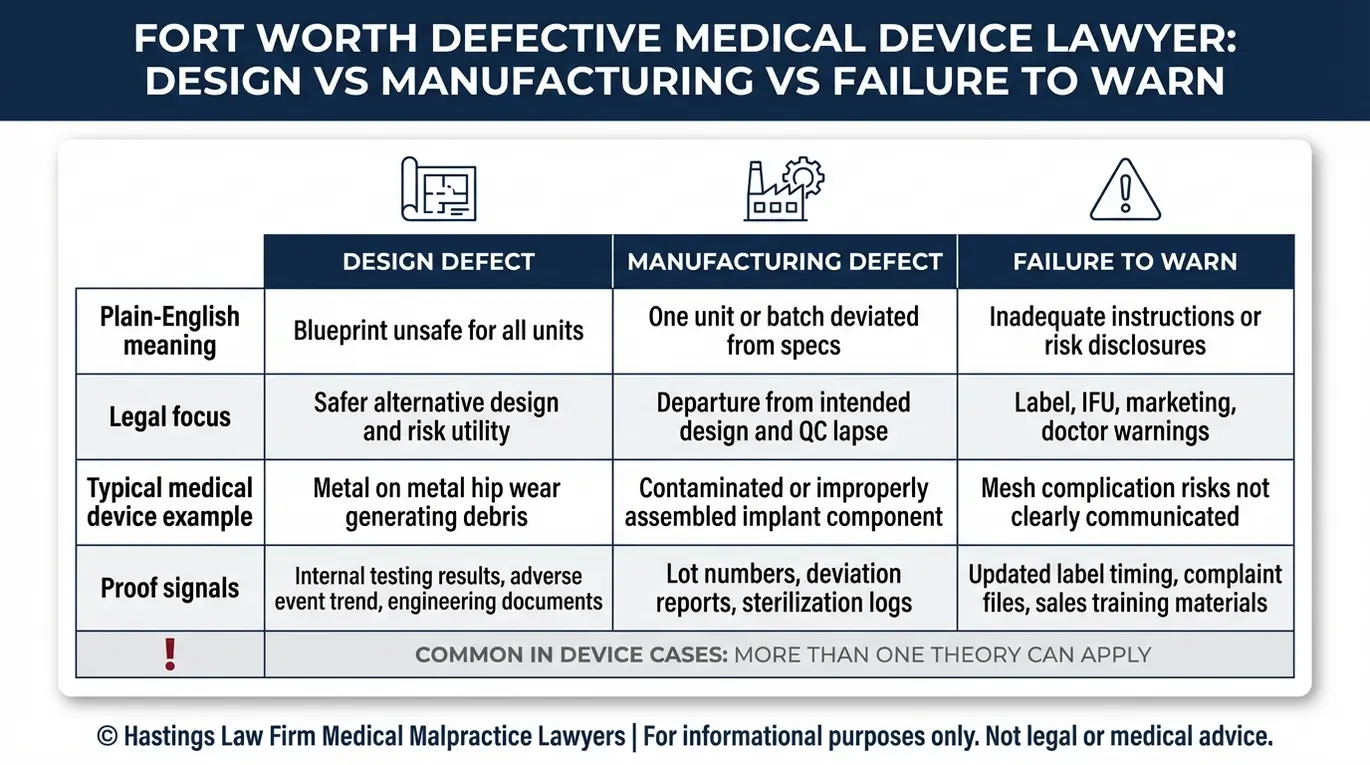
Product liability claims typically fall into three categories: design defects where the product is inherently dangerous, manufacturing defects where an error occurred during production, and failure-to-warn defects involving inadequate safety instructions. Understanding which category applies to your situation shapes the entire legal strategy.
| Defect Type | Legal Definition | Example in Medical Devices |
|---|---|---|
| Design Defect | The product’s blueprint or engineering concept is inherently unsafe, making every unit dangerous regardless of how well it is made. | A metal-on-metal hip implant designed with surfaces that inevitably generate toxic metal debris through normal use. |
| Manufacturing Defect | The design is sound, but an error during production, assembly, or sterilization makes a specific unit or batch defective. | A contaminated batch of surgical mesh where improper sterilization introduced bacteria into the packaging. |
| Failure to Warn | The manufacturer knew or should have known about risks but failed to provide adequate warnings to doctors or patients. | A device maker that withheld clinical data showing high fracture rates in IVC filters from the physicians who implanted them. |
A design defect means the product was dangerous from the start. No amount of careful manufacturing can fix a flawed concept. When every unit poses the same risk, the entire product line is at issue.
A manufacturing defect is different. The design may have been reasonable, but something went wrong during production. One lot may have been contaminated, or one shipment may have used substandard materials. The defect is limited to specific units rather than the product as a whole.
Failure-to-warn claims focus on what the manufacturer communicated about known risks. If a company had data suggesting its device could migrate (shift from its intended position inside the body) or cause a specific complication, and it did not pass that information along to the medical community, that silence can form the basis of a claim.
In cases involving strict liability, the injured patient does not need to prove the manufacturer was careless. This legal standard in Texas focuses on whether the product itself was unreasonably dangerous when it left the manufacturer’s control. A defective medical device lawyer builds the case around the product’s performance, the available safety data, and the gap between what the manufacturer knew and what it disclosed.
FDA 510k Fast Track Approval Flaws
Many patients assume that if a device is on the market, it passed rigorous safety testing. That is not always the case. The 510(k) clearance, a regulatory pathway that allows manufacturers to bring a new device to market by demonstrating it is “substantially equivalent” to a device already being sold, often skips independent clinical trials. This pathway was designed to speed up access to technology, but it has allowed devices with serious design problems to reach patients without thorough evaluation.
The FDA’s MAUDE database, a system for medical device reporting and adverse event tracking, collects reports of device-related adverse events, malfunctions, and deaths. When problems surface after a device is already implanted in thousands of patients, the damage is already done. An FDA recall, a formal action where the manufacturer must correct or remove a device from the market, often comes only after a pattern of serious injuries has been documented.
Federal preemption rules can sometimes shield manufacturers from state lawsuits when their devices went through the more rigorous premarket approval process. However, devices cleared through 510(k) generally do not receive the same level of federal protection, which can open the door to state-level product liability claims. These distinctions require an attorney who understands the intersection of federal regulatory law and Texas product liability statutes.
The Hastings Law Firm Difference
Results matter, but what truly sets us apart is how we achieve them. Every verdict, every settlement, and every Fort Worth courtroom victory comes from one guiding promise: To treat each client’s fight for justice as if it were our own.
This balance of skill, experience, and empathy reflects our core philosophy that justice should not only compensate the injured, but also make healthcare safer nationwide.

Distinguishing Product Liability Claims From Medical Malpractice
Product liability claims target the manufacturer for a defective item, while medical malpractice claims target healthcare providers for negligent care; however, many cases involve overlapping liability where both parties are at fault.
Consider the difference this way: sometimes manufacturer negligence produces a flawed device, yet a breach in the standard of care by the physician also occurs. This makes pursuing both the doctor and the manufacturer necessary. Other times, a well-designed device is implanted incorrectly. For example, metallosis, a form of metal poisoning, might stem from a design defect, while complications with surgical mesh could involve surgical error.
| Who May Be Liable | Type of Error | Claim Category |
|---|---|---|
| Device manufacturer | Design, manufacturing, or warning defect | Product Liability |
| Surgeon or physician | Improper implantation, failure to monitor, or failure to act on complications | Medical Malpractice |
| Hospital or surgical center | Selecting a recalled device, inadequate protocols, or poor post-operative care | Hospital Negligence |
| Sales representative | Providing inadequate training or misleading device information to the surgeon | Product Liability |
Many firms struggle with this overlap because they limit their focus to either malpractice or product liability. In Fort Worth and throughout Texas, Hastings Law Firm handles both types of claims, providing legal representation for device failure with a team that includes former defense attorneys, in-house nurse consultants, and access to a national network of medical experts. This structure allows us to investigate the full picture, from the device’s design history to the surgical technique, so no responsible party is overlooked.
When the manufacturer, the surgeon, and the hospital may all bear some degree of fault, having legal representation that can pursue every angle of liability protects your ability to recover full compensation.

Mass Tort Litigation Versus Individual Lawsuits
Mass torts consolidate many similar cases against a manufacturer to share evidence while keeping individual verdicts separate, whereas class actions combine all plaintiffs into a single lawsuit with one split settlement. This coordination allows individuals to seek justice without being absorbed into a single group settlement.
Most defective medical device cases are handled through multidistrict litigation, or MDL. Under 28 U.S.C. § 1407, a panel of federal judges can transfer similar cases filed across the country to a single federal court for coordinated pretrial proceedings. This allows patients to benefit from shared discovery, including access to internal manufacturer documents, without losing their individual claims.
Potential benefits of MDL participation:
- Shared discovery reduces costs for each plaintiff
- Access to internal manufacturer safety data uncovered through coordinated litigation
- Bellwether trials (early test cases) help establish the value of claims and pressure manufacturers toward fair settlements
- Each plaintiff retains their own case and can accept or reject any settlement offer individually
Considerations for filing an individual state court claim:
- May allow faster resolution if the evidence in your case is strong
- Avoids the potentially longer MDL timeline
- Keeps the case in local courts, such as Tarrant County, where jurors understand the community impact
- Requires independent resources for discovery and expert testimony
The right approach depends on the specific device and where your case stands in the broader litigation landscape. Our team evaluates each case individually to determine whether MDL participation or a standalone lawsuit better serves your interests.
Preserving Evidence and The Chain of Custody for Explanted Devices
Preserving the explanted device after revision surgery is critical for a product liability claim; the hardware must be kept in its original state and tracked via a strict chain of custody to prevent spoliation of evidence. Without the physical device, proving a design or manufacturing defect becomes significantly harder. The device must be kept in its original post-removal state to prevent spoliation of evidence, which is the legal term for destruction or alteration of evidence.
Hospitals routinely dispose of removed implants as medical waste unless specifically instructed otherwise. This means the burden often falls on you or your family to ensure evidence preservation happens. If you or a loved one is scheduled for revision surgery, these steps can protect your ability to pursue a claim:
- Before surgery, tell your surgeon in writing that you want the explanted device preserved and not discarded.
- Request that the device be photographed in its removed condition before any cleaning or handling.
- Ask the hospital to document the implant’s lot number, manufacturer, and model from the operative and implant logs.
- Do not allow the device to be sent to pathology for destructive testing without first consulting an attorney.
- Contact an attorney as soon as possible so a formal preservation letter can be sent to the hospital and surgical facility, creating a legal obligation to maintain the evidence.
Once a lawyer is involved, the device can be secured and sent to an independent engineering or metallurgical expert for testing. That analysis often reveals fracture patterns or material degradation that would otherwise go undetected. Time matters here. The sooner the device is preserved and the chain of custody is established, the stronger the foundation for your case.

Recovering Compensation for Injuries Caused by Faulty Devices
Patients injured by defective medical devices may recover economic damages for revision surgeries and lost wages, as well as non-economic damages for pain, suffering, and physical impairment. The specific damages available depend on the severity of the injury, the number of corrective procedures required, and the long-term impact on your daily life.
Economic damages, a type of compensatory damages, cover the measurable financial losses tied to the device failure. These can include the cost of revision surgery and hospitalization, ongoing rehabilitation, prescription medications, assistive devices, lost income, and future medical needs.
Non-economic damages address the personal toll that no receipt can capture: chronic pain, reduced mobility, scarring or disfigurement, emotional distress, and the loss of activities that defined your quality of life.
In cases where the evidence shows a manufacturer acted with fraud, malice, or gross negligence, Texas law may allow punitive damages. Under the Texas Civil Practice and Remedies Code, Chapter 41, these are designed to punish egregious conduct and deter similar behavior in the future. While awards are subject to statutory caps, they can increase the total recovery in cases involving clear misconduct.
When a defective device causes a patient’s death, surviving family members may pursue a wrongful death claim to recover funeral expenses and loss of companionship. Every category of damage requires documentation, which is why we work with medical experts, economists, and life care planners from the earliest stages of investigation.
Contact the Fort Worth Medical Device Attorneys at Hastings Law Firm Today for Help
Living with the consequences of a device that was supposed to help you is a burden no patient should carry alone. At Hastings Law Firm, we prepare every case from day one as if it is going to trial, because that preparation is what drives fair outcomes. Our team of attorneys, in-house nurses, and former defense lawyers works together to identify every responsible party and build the strongest possible case.
Texas law imposes strict deadlines on product liability and medical malpractice claims, and evidence like an explanted device can be lost if action is not taken quickly. We operate on a contingency fee basis, which means you pay no attorney fees or costs unless we secure a recovery for you.
If you or a loved one has been harmed by a medical device, contact our Fort Worth defective medical device lawyer team for a free, confidential case evaluation. Let us help you find the answers you deserve.
Frequently Asked Questions About Defective Medical Device in Fort Worth


This content was researched and written by the Hastings Law Firm editorial team, which includes attorneys, medical professionals, and experienced researchers. Our writing is informed by internal knowledge and practical experience, and we cross-check critical details against authoritative sources cited throughout. Every piece undergoes human-led fact-checking and legal review. Because legal and medical information can change, if you spot an error, please contact us. Learn more about our content standards and review process on our editorial policy page.

Brady D. Williams is a nationally recognized medical malpractice attorney who has spent his career handling high-stakes litigation for injured patients and families across the country. Licensed in both Texas and California, Brady draws on experience from hundreds of resolved medical cases to break down complex legal and medical topics for the people who need that information most. His writing reflects the same attention to detail and commitment to clarity that he brings to every case he handles.
