


Texas CT Scan Radiation Overdose Lawyer
Written by: Hastings Law Firm | Reviewed by: Brady D. Williams | Updated: July 27, 2026
A CT scan radiation overdose can leave a patient with painful burns, hair loss, and serious worry about long term health risks. Overexposure may happen when scanner settings are not properly adjusted, safety stops are bypassed, equipment malfunctions, or facility protocols fail. Some effects appear quickly, while others can emerge much later and include increased cancer risk and lasting emotional distress. Understanding possible causes and responsible parties can help clarify what happened and what harm may follow. If you or a loved one were harmed or worse due to CT scan radiation overdose in Texas, contact Hastings Law Firm for a free, confidential case review.
Trusted Texas Medical Attorneys for Radiation Overdose Claims
What You Should Know About Radiation Overdose From Imaging Claims in Texas:
- Lasting health risks can follow a CT scan radiation overdose because ionizing radiation can permanently alter DNA and increase the risk of cancer years later.
- Serious short term harm can occur after overexposure, including skin burns, blistering, open sores, and localized hair loss that matches the scan path.
- Options for accountability can depend on who contributed to the overdose, since responsibility may involve a hospital, radiology staff, a device manufacturer, or a maintenance company.
- Recovery can be limited in Texas because non economic damages in medical malpractice cases are capped while product liability claims may be treated differently.
- Proof issues can shape outcomes because key dose information may be missing from a general record summary without the technical imaging dose data.
- Safety failures can be central to a dispute because overdoses are often linked to operator error, equipment malfunction, or breakdowns in institutional protocols.
- Long term quality of life can be affected because patients may live with persistent anxiety about future cancer risk after an overexposure event.
- Regulatory noncompliance can matter in Texas because facilities must record radiation dose metrics and undergo inspections, and gaps in those records can become important evidence.

A Healthcare Focused Law Firm
When a routine CT scan causes unexpected pain, skin burns, or hair loss, the experience can be deeply unsettling. You trusted a medical facility to follow safety protocols, and something went wrong. That kind of betrayal raises serious questions, and you deserve clear answers.
At Hastings Law Firm, our team focuses exclusively on medical malpractice. Our founder, Tommy Hastings, is a board-certified trial lawyer with over two decades of experience in these specialized cases. We use our deep medical and legal knowledge to review what happened and explain your options at no cost to you.
Recognizing Symptoms of CT Scan Radiation Overdose
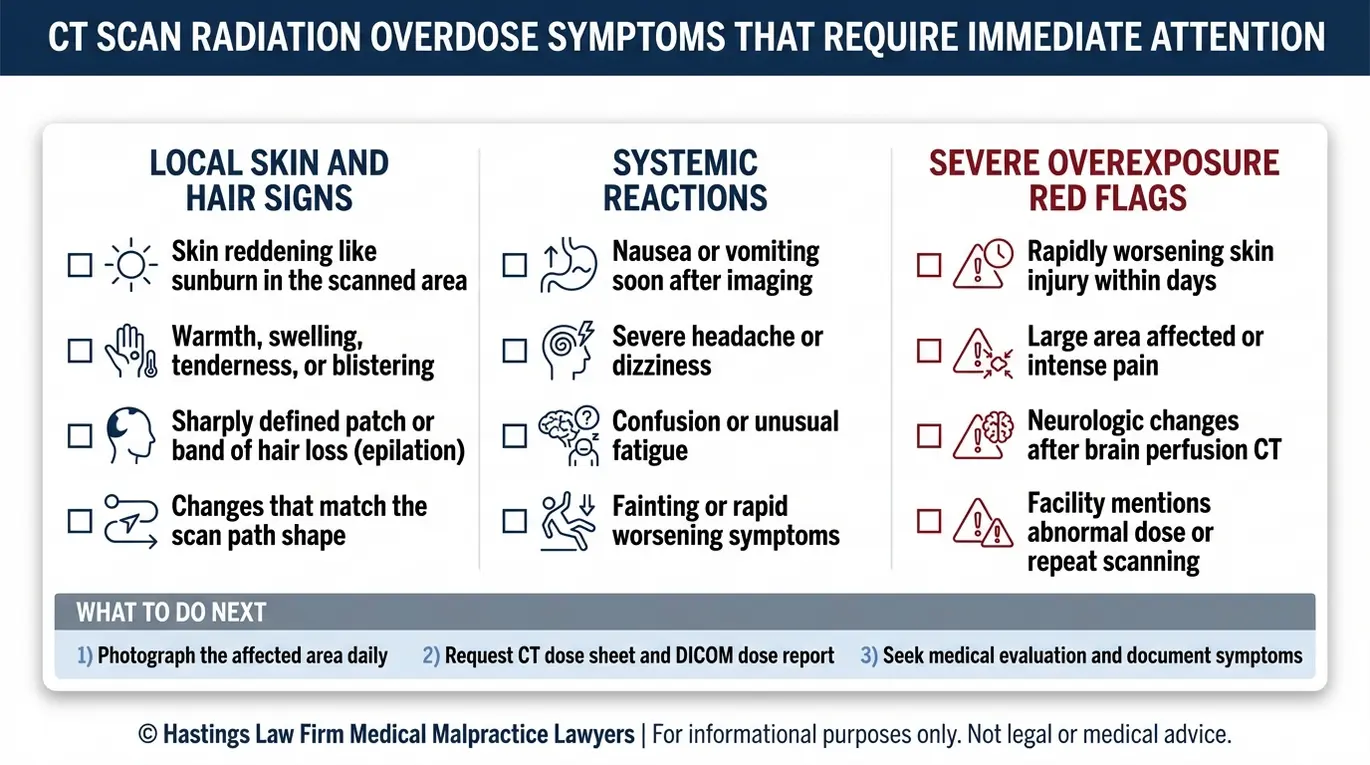
Radiation overdose symptoms from a CT scan often appear as skin reddening, sometimes called erythema (a visible redness similar to a severe sunburn), localized hair loss in the area that was scanned, and nausea or confusion shortly after the procedure. Recognizing these signs early matters because they can indicate that you received a radiation dose far beyond what was medically appropriate.
Symptoms like erythema or visible skin burns can develop when radiation safety protocols are not strictly followed. Identifying these markers helps determine the extent of the exposure.
Immediate signs tend to develop within hours or days of the scan. Skin reddening may appear in a distinct pattern that mirrors the path of the scanner. In some cases, the reddening progresses to blistering or open sores. Band-like hair loss, where a strip of hair falls out along the scan trajectory, is another telltale indicator.
Systemic reactions point to a more severe radiation overexposure. Nausea, vomiting, and confusion can signal acute radiation syndrome (ARS), often called radiation sickness, a condition that occurs when the body absorbs a dangerously high dose of ionizing radiation in a short period. ARS requires immediate medical attention and can affect the blood, gastrointestinal system, and nervous system.
Hair loss as a clinical marker is especially significant in brain perfusion CT scans. Known medically as epilation, this type of hair loss is a hallmark indicator that the radiation dose delivered during a cranial scan was excessive. According to the National Cancer Institute’s overview of CT scans and cancer risk, CT scans use higher doses of ionizing radiation than standard X-rays, which makes proper calibration and dose management essential.
If you have experienced any of these symptoms after a CT scan, consider consulting radiation overdose attorneys in Texas who can help determine whether the dose you received fell outside accepted safety limits.
Symptoms to watch for after a CT scan:
- Skin reddening or burns that follow the shape of the scan area
- Blistering or peeling skin at the scan site
- Band-like or patchy hair loss on the head or body
- Nausea or vomiting within hours of the procedure
- Persistent headaches or confusion
- Fatigue or dizziness that does not resolve
These symptoms help medical and legal teams evaluate the radiation level your body absorbed during the imaging process.
Common Causes of Radiation Overexposure in Medical Imaging
Radiation overexposure typically results from human error, such as improper calibration of the CT scanner, or mechanical failure where the device delivers a dose far exceeding safety protocols. In many cases, the cause is preventable.
When human error occurs in a radiology department, the consequences for the patient can be life-altering. Ionizing radiation is powerful enough to damage cells at the molecular level, making adherence to safety standards vital.
The medical standard of care generally follows the ALARA principle (As Low As Reasonably Achievable), which requires using the lowest dose necessary to produce a diagnostic image. When that principle breaks down, patients bear the consequences.
Operator error is one of the most common factors. Often attributable to user error, technicians may bypass built-in safety stops, repeat scans of the same area without tracking the cumulative dose, or fail to adjust machine settings for a patient’s size and age. Pediatric patients and smaller adults are especially vulnerable because their bodies absorb radiation differently than a larger adult.
Equipment failure is another frequent cause. A software glitch or miscalibrated sensor can cause the scanner to deliver a dose many times higher than intended, a risk notably seen in complex brain perfusion CT procedures. When facilities fail to maintain or update their equipment, these errors may go undetected for weeks or months.
Lack of institutional protocols ties both problems together. Protocol failures mean that without clear guidelines for dose monitoring and quality checks, individual mistakes and mechanical failures are more likely to go uncorrected within a hospital or imaging center.
| Cause Category | Example | Potential Consequence |
|---|---|---|
| Operator Error | Re-scanning the same area without logging cumulative dose | Dose stacking leading to burns or hair loss |
| Equipment Failure | Software glitch delivers incorrect dose settings | Massive single-exposure overdose |
| Protocol Breakdown | No dose adjustment for pediatric patients | Disproportionate radiation exposure for body size |
A Texas radiation injury lawyer can investigate which of these factors contributed to your injury by reviewing dose records, maintenance logs, and staff training documentation.
The Brain Perfusion CT Overdose Cluster
One of the most well-documented examples of CT radiation overexposure involved brain perfusion CT scans, which evaluate blood flow in the brain during stroke therapy. In several widely reported cases, scanners were left on default settings rather than adjusted for the specific protocol, delivering radiation doses up to eight times higher than intended.
Patients who underwent these scans developed severe epilation, which is hair loss concentrated on the scalp in the path of the radiation beam. These incidents show how a single protocol failure, leaving a machine on factory default, can cause serious harm during specialized neurological imaging.

The Hastings Law Firm Difference
Results matter, but what truly sets us apart is how we achieve them. Every verdict, every settlement, and every Texas courtroom victory comes from one guiding promise: To treat each client’s fight for justice as if it were our own.
This balance of skill, experience, and empathy reflects our core philosophy that justice should not only compensate the injured, but also make healthcare safer nationwide.

Long-Term Health Risks and Damages
Beyond immediate burns, radiation overdose can permanently alter DNA, significantly increasing the risk of brain tumors, cataracts, and other cancers years or even decades after the initial exposure. The long-term effects and full scope of harm from a single overdose event may not become apparent for a long time.
Severe DNA damage can lead to permanent genetic mutations. While the body attempts to repair these cells, improper repairs may eventually result in various forms of cancer.
Latent injuries are one of the most concerning aspects of radiation overexposure during medical imaging. Ionizing radiation can break and rearrange strands of DNA inside cells. While the body can repair some of this damage, errors in the repair process may lead to genetic damage and mutations that develop into cancer over time. The Radiation Risk Assessment Tool (RadRAT), developed by the National Cancer Institute, is one resource used to estimate lifetime cancer risk based on radiation exposure history.
Quality of life often suffers in ways that go beyond physical symptoms for patients recovering from radiation overexposure. Many patients who have been overexposed live with persistent anxiety about whether they will develop cancer in the future. This psychological burden can affect daily life, relationships, and mental health for years.
Recoverable damages in these cases may include compensation for ongoing medical monitoring, future cancer treatment if it becomes necessary, lost income, physical pain, and the emotional distress of living with heightened health risks. In fatal cases, families may also pursue claims for wrongful death. A CT scan overdose attorney can help you understand what types of compensation may apply based on the specifics of your exposure and its documented effects.
Liability: Who Is Responsible for Radiation Injuries?
Liability may fall on the hospital for negligent staffing, the radiology technician for operational errors, or the equipment manufacturer if a software defect caused the overdose. In many radiation injury cases, more than one party shares responsibility.
A product liability claim targets the manufacturer of the CT scanner, arguing that a defect in the device caused the overdose. These legal theories can be pursued alongside medical malpractice claims to hold all responsible parties accountable.
Medical malpractice versus product liability involves different legal theories. A malpractice claim targets the healthcare providers and the facility for failing to meet the accepted standard of care. A product liability claim targets the manufacturer of the CT scanner, arguing that a defect in the device caused the overdose. These theories can be pursued simultaneously in the same case.
The hospital’s duty extends beyond the scan itself. Facilities must ensure that radiology staff are properly trained, that equipment is maintained, and that protocols exist for monitoring dose levels. When we investigate these cases, we review training records, supervision logs, maintenance schedules, and internal incident reports to identify where the system broke down.
Equipment manufacturers can also bear responsibility. If a scanner’s software failed to alert the operator to a dangerously high dose, the manufacturer may be liable under product liability law. Companies like Varian Medical Systems and other device makers have faced scrutiny in cases involving linear accelerators and CT systems that delivered excessive radiation.
Parties that may be liable in a radiation overdose case:
- The radiology technician who operated the scanner
- The supervising radiologist responsible for oversight
- The hospital or imaging center that set staffing and training policies
- The equipment manufacturer for software or hardware defects
- Third-party maintenance companies responsible for calibration
A Texas medical malpractice lawyer for radiation injuries can evaluate the evidence to determine which parties should be held accountable.

Texas Laws and Protocols for Radiation Safety
Texas imposes strict regulations on the use of radiation machines, including mandatory dose recording and regular inspections by a qualified medical physicist. These regulations apply to healthcare facilities that operate CT scanners, X-ray machines, and other diagnostic imaging equipment.
The Texas Administrative Code requires that facilities document and track radiation doses for each patient procedure. Two key metrics that must be recorded are the Volume Computed Tomography Dose Index (CTDIvol), which measures the radiation output per scan rotation, and the Dose-Length Product (DLP), which accounts for the total radiation delivered across the entire scan length. As explained by UC Davis Health’s Radiation Dose Reporting program, these values are critical for identifying whether a scan exceeded safe limits.
The Texas Department of State Health Services (DSHS) oversees compliance and can investigate facilities that fail to meet these standards. Equipment must also pass periodic inspections. If a facility’s equipment has not been properly inspected or calibrated, those records become valuable evidence in a legal claim.
A radiation overdose law firm with experience in Texas medical malpractice cases will know exactly which records to request and how to interpret them.
Contact the Texas Healthcare Malpractice Attorneys at Hastings Law Firm Today for Help
If you suspect that you or a loved one was harmed by a CT scan or X-ray radiation overdose, you do not have to face the healthcare system alone. Our team of attorneys, nurse consultants, and medical staff is dedicated to uncovering the truth behind what happened and holding the responsible parties accountable.
Contact a Texas CT Scan Radiation Overdose Lawyer at Hastings Law Firm for a free, confidential case evaluation.
You pay no fees unless we recover compensation on your behalf. Let us help you find the answers you deserve.
Frequently Asked Questions About CT Scan Radiation Overdose in Texas


This content was researched and written by the Hastings Law Firm editorial team, which includes attorneys, medical professionals, and experienced researchers. Our writing is informed by internal knowledge and practical experience, and we cross-check critical details against authoritative sources cited throughout. Every piece undergoes human-led fact-checking and legal review. Because legal and medical information can change, if you spot an error, please contact us. Learn more about our content standards and review process on our editorial policy page.

Brady D. Williams is a nationally recognized medical malpractice attorney who has spent his career handling high-stakes litigation for injured patients and families across the country. Licensed in both Texas and California, Brady draws on experience from hundreds of resolved medical cases to break down complex legal and medical topics for the people who need that information most. His writing reflects the same attention to detail and commitment to clarity that he brings to every case he handles.
