


Texas Contrast Dye Injury Lawyer
Written by: Hastings Law Firm | Reviewed by: Gabe Sassin | Updated: July 27, 2026
Contrast dye used in MRI and similar scans can sometimes lead to serious kidney injury and long term tissue damage when gadolinium is not cleared from the body. The risk can be higher for people with impaired kidney function, and harm may also involve skin thickening, joint immobility, and internal organ damage. The discussion often turns on whether proper screening occurred before contrast was given and whether warnings about retention risks were adequate. If you or a loved one were harmed or worse due to contrast dye injuries in Texas, contact Hastings Law Firm for a free, confidential case review.

Trusted Texas Medical Attorneys for Contrast Induced Nephropathy Claims
What You Should Know About Contrast Induced Nephropathy Malpractice Claims in Texas:
- Long term health and financial stability can be disrupted when gadolinium is retained after contrast enhanced imaging and causes kidney injury or tissue damage.
- Severe and lasting complications can follow when impaired kidney function is not identified before a gadolinium based contrast agent is administered.
- The risk profile can differ by agent type, with linear agents described as having a higher risk of releasing free gadolinium than macrocyclic agents.
- Accountability can turn on whether a provider screened renal function before contrast administration or whether a manufacturer gave adequate warnings about retention risks.
- Recovery options in Texas can include compensation tied to medical expenses, pain and suffering, physical impairment, and lost wages.
- The most serious outcomes can include fatal outcomes when organ failure or cardiac fibrosis is linked to gadolinium toxicity.
- Claim strength can depend on what warnings were available at the time of administration and whether the prescribing physician received and acted on them.
- Case viability can depend on whether records identify the specific contrast agent used and whether pre scan blood work was obtained and documented.

A Healthcare Focused Law Firm
If you or a loved one suffered kidney damage or other serious complications after receiving contrast dye during a medical imaging procedure, you are not alone, and you are right to ask questions. Contrast-induced nephropathy, a form of acute kidney damage triggered by contrast agents used in diagnostic scans, can cause lasting harm that upends your health, your independence, and your financial stability. Consulting a Texas contrast dye attorney is the first step toward reclaiming control.
At Hastings Law Firm, our team of attorneys, in-house nurse consultants, and medical experts focuses exclusively on medical malpractice. As an experienced Texas Contrast Dye Injury Lawyer, we can review what happened, identify where the standard of care may have been breached, and explain your legal options at no cost to you.
Understanding Contrast Dye Injuries and Gadolinium Toxicity
A contrast dye injury typically occurs when a patient with pre-existing kidney impairment receives a gadolinium-based contrast agent (GBCA) during an MRI or similar scan, leading to conditions like Nephrogenic Systemic Fibrosis (NSF) or heavy metal toxicity. GBCAs are drug products used to help physicians see abnormalities on diagnostic scans.
Contrast agents are used in Magnetic Resonance Imaging (MRI) and Magnetic Resonance Angiography (MRA) to improve the visibility of blood vessels, organs, and tissues. GBCAs contain gadolinium, a heavy metal that enhances image quality so radiologists can detect abnormalities that might otherwise go unnoticed. In most patients, the kidneys filter gadolinium out of the body within hours.
The problem arises when the kidneys cannot do their job effectively. In patients with kidney impairment, the body cannot clear gadolinium efficiently. Instead, the metal lingers in the tissues, a phenomenon known as gadolinium retention, where the substance deposits in bone, skin, and organs over time.
This prolonged exposure can trigger gadolinium toxicity, a condition where the accumulated metal causes direct harm to the body’s tissues and systems. Often resulting in contrast-induced nephropathy, these complications require immediate legal and medical attention.
Distinct reactions can occur depending on the patient’s sensitivity. An allergic reaction to contrast dye, such as hives, nausea, or breathing difficulty, typically happens during or shortly after the injection and is treated as an acute medical event. Long-term gadolinium toxicity and fibrosis are different. These conditions develop over days, weeks, or months as retained gadolinium damages tissue at a cellular level, potentially causing irreversible organ and skin changes.
The U.S. Food and Drug Administration has issued safety communications confirming that GBCAs are retained in the body, including in patients with normal kidney function, and now requires new class warnings on these products. If you suspect a contrast dye injury, a Texas contrast dye injury lawyer can help you determine whether the administering provider or the manufacturer may bear responsibility. Our team at Hastings Law Firm includes in-house medical professionals who understand how to trace the clinical timeline from contrast administration to injury.
The Dangers of Gadolinium-Based Contrast Agents (GBCAs)
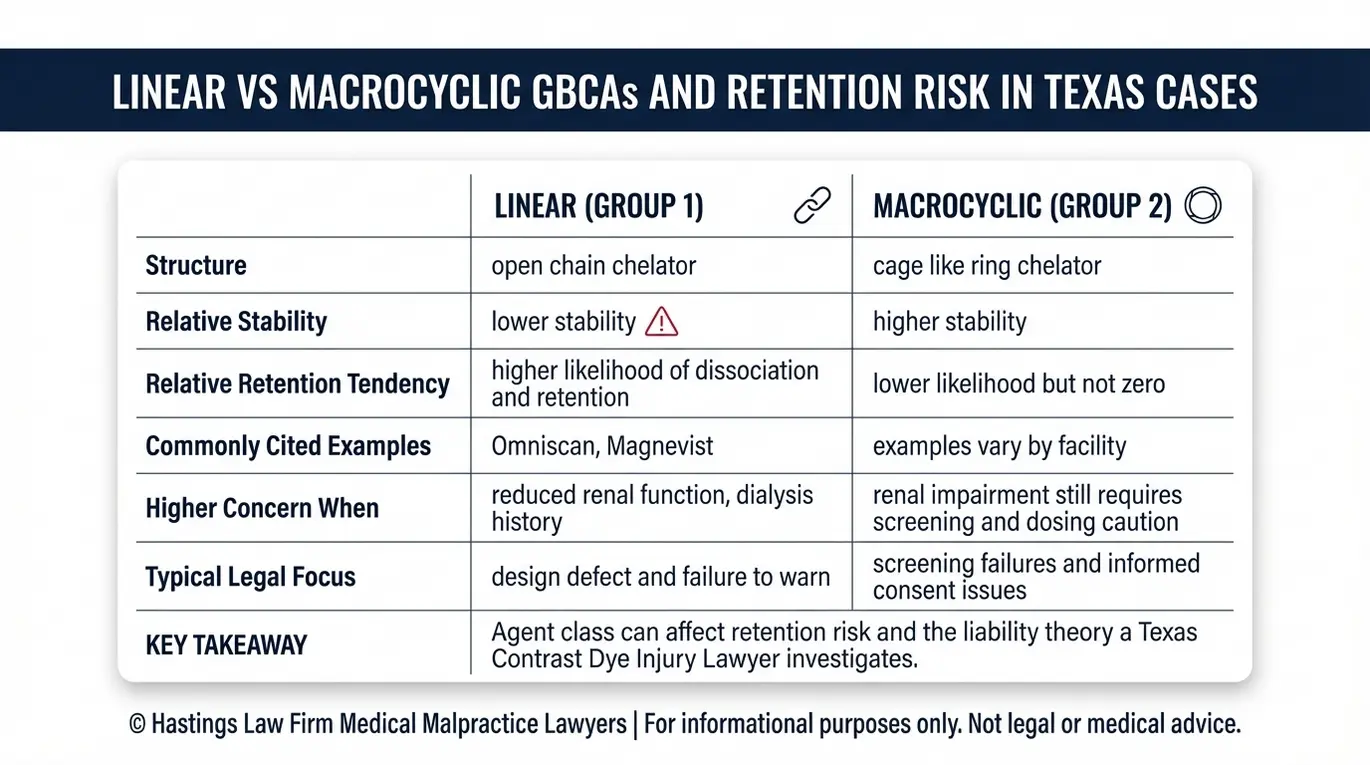
Gadolinium-based contrast agents, the injectable compounds used to enhance MRI and MRA imaging, are classified into two primary categories based on their chemical structure: linear agents and macrocyclic agents. Linear agents pose a higher risk of separating from their chelating molecules and depositing toxic gadolinium into the body, particularly in patients with reduced kidney function. These chemicals are designed to highlight specific tissues in the body during scans.
The distinction matters because the chemical design of a GBCA directly affects how securely the gadolinium ion is held within the compound. This process, called chelation, is how the toxic gadolinium metal is bound to a carrier molecule so it can be safely excreted. When that bond is unstable, the gadolinium breaks free and accumulates in the body.
Group 1 (Linear) agents, such as Omniscan (gadodiamide) and Magnevist (gadopentetate dimeglumine), use an open-chain molecular structure that wraps around the gadolinium ion less tightly. This makes them more prone to releasing free gadolinium, especially in patients whose kidneys cannot clear the compound quickly. These agents have been linked to the highest rates of NSF and are restricted or withdrawn in several countries.
Group 2 (Macrocyclic) agents, such as ProHance and Dotarem, cage the gadolinium ion within a ring-shaped molecular structure that holds it more securely. While these agents carry a lower risk of gadolinium retention and NSF, they still require careful screening, particularly in patients with renal insufficiency.
| Feature | Linear (Group 1) Agents | Macrocyclic (Group 2) Agents |
|---|---|---|
| Structure | Open-chain; less stable bond | Ring-shaped; more stable bond |
| Gadolinium Retention Risk | Higher | Lower |
| Examples | Omniscan, Magnevist, OptiMARK | ProHance, Dotarem, Gadavist |
| NSF Association | Strongly linked | Rarely linked |
| Current Status | Restricted or suspended in many markets | Preferred in current clinical practice |
Recent research, including data reviewed by the FDA’s Medical Imaging Drugs Advisory Committee, has confirmed that gadolinium retention occurs even in patients with normal kidney function. The ACR Manual on Contrast Media 2024 provides updated guidance on screening protocols and agent selection based on renal risk.
Stability and Design Defects in Contrast Agents
The chemical instability of certain GBCAs, or gadolinium-based contrast agents, raises a direct question of product liability. A design defect argument focuses on the product being unreasonably dangerous for its intended use because of how it was made. This applies if a contrast agent is designed in a way that allows the toxic gadolinium ion to separate from its chelating molecule at predictable rates.
The FDA has issued multiple safety communications requiring updated warning labels on GBCAs, a development our Texas contrast dye injury counsel monitors closely. When manufacturers fail to adequately disclose the risk of gadolinium retention or organ damage, a lawyer for contrast dye injuries in Texas can evaluate whether a failure-to-warn claim is viable.
At Hastings Law Firm, our attorneys work alongside medical professionals to analyze the specific agent used, its known risk profile, and whether the manufacturer met its disclosure obligations.
The Hastings Law Firm Difference
Results matter, but what truly sets us apart is how we achieve them. Every verdict, every settlement, and every Texas courtroom victory comes from one guiding promise: To treat each client’s fight for justice as if it were our own.
This balance of skill, experience, and empathy reflects our core philosophy that justice should not only compensate the injured, but also make healthcare safer nationwide.

Identifying Symptoms of Nephrogenic Systemic Fibrosis (NSF)
Nephrogenic Systemic Fibrosis (NSF), sometimes referred to by its earlier name Nephrogenic Fibrosing Dermopathy (NFD), is a rare but serious condition characterized by the thickening and hardening of the skin, particularly on the arms and legs, which can progress to joint immobility and internal organ damage. NSF causes scarring that affects the body’s ability to move and function properly.
NSF typically develops days to weeks after exposure to a gadolinium-based contrast agent, though symptoms can appear months later. The condition was first identified in the late 1990s and was formally linked to GBCA exposure in patients with impaired kidney function. Because it is uncommon and its symptoms can resemble other conditions, NSF is sometimes misdiagnosed or overlooked entirely.
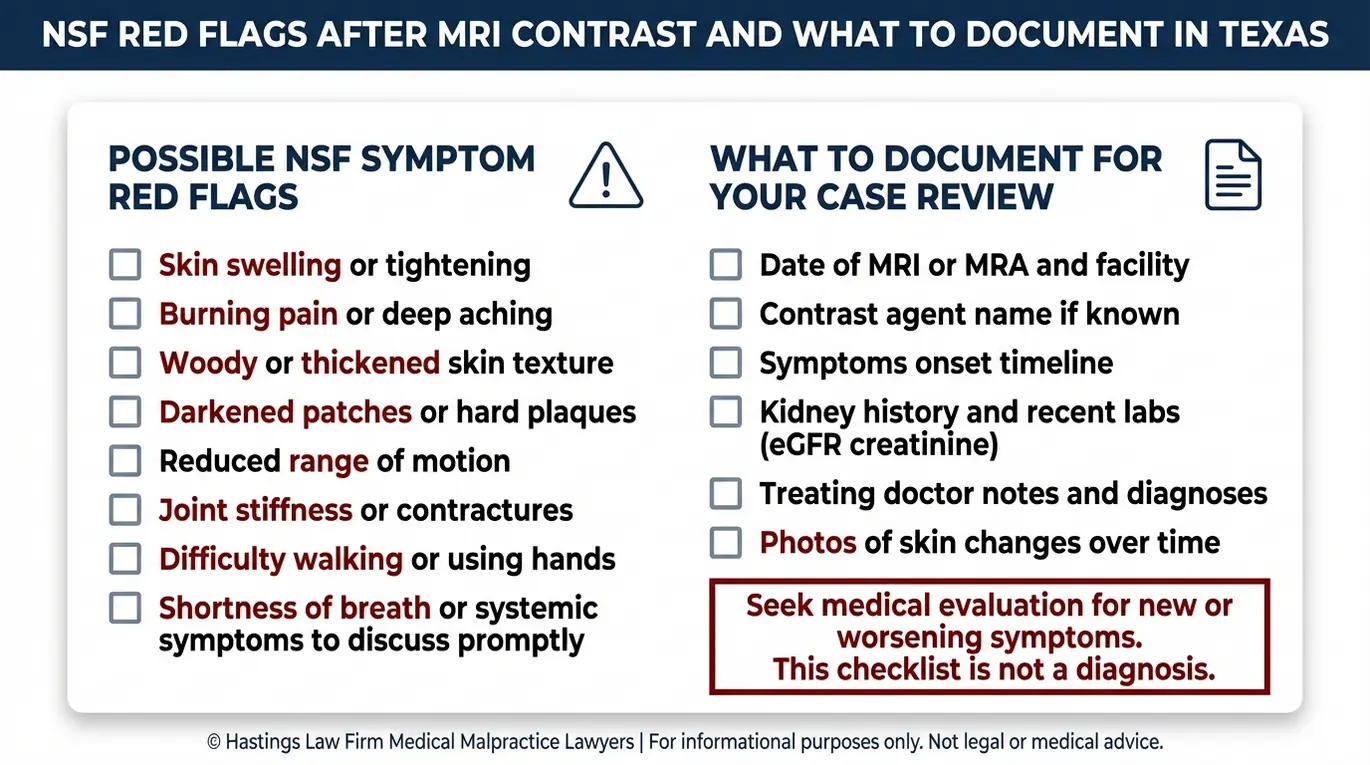
If you received a contrast agent and are experiencing any of the following, consider seeking both medical evaluation and legal guidance from a contrast dye injury lawyer in Texas:
Dermatological Symptoms:
- Swelling, tightening, or hardening of the skin on the arms, legs, or torso
- A burning or itching sensation in affected areas
- Skin that develops a “wood-like” or rough texture
- Dark or reddened patches on the skin surface
Musculoskeletal Symptoms:
- Joint stiffness or contractures, where joints become fixed in a bent position, limiting movement
- Muscle weakness or difficulty with fine motor tasks
- Reduced range of motion in the hands, wrists, ankles, or knees
While skin changes are the most visible sign, internal scarring can be far more dangerous. Fibrosis in the lungs can lead to restrictive breathing issues, while cardiac fibrosis may result in reduced heart function. These systemic effects show why early detection and legal intervention are essential for long-term care planning.
According to the clinical overview published on the NCBI Bookshelf, NSF has no consistently effective treatment, making prevention through proper screening the most important safeguard. If you recognize these symptoms in yourself or a loved one, an attorney for contrast dye lawsuits can help you connect the timeline between your imaging procedure and your diagnosis.
Liability: Medical Malpractice vs. Product Liability
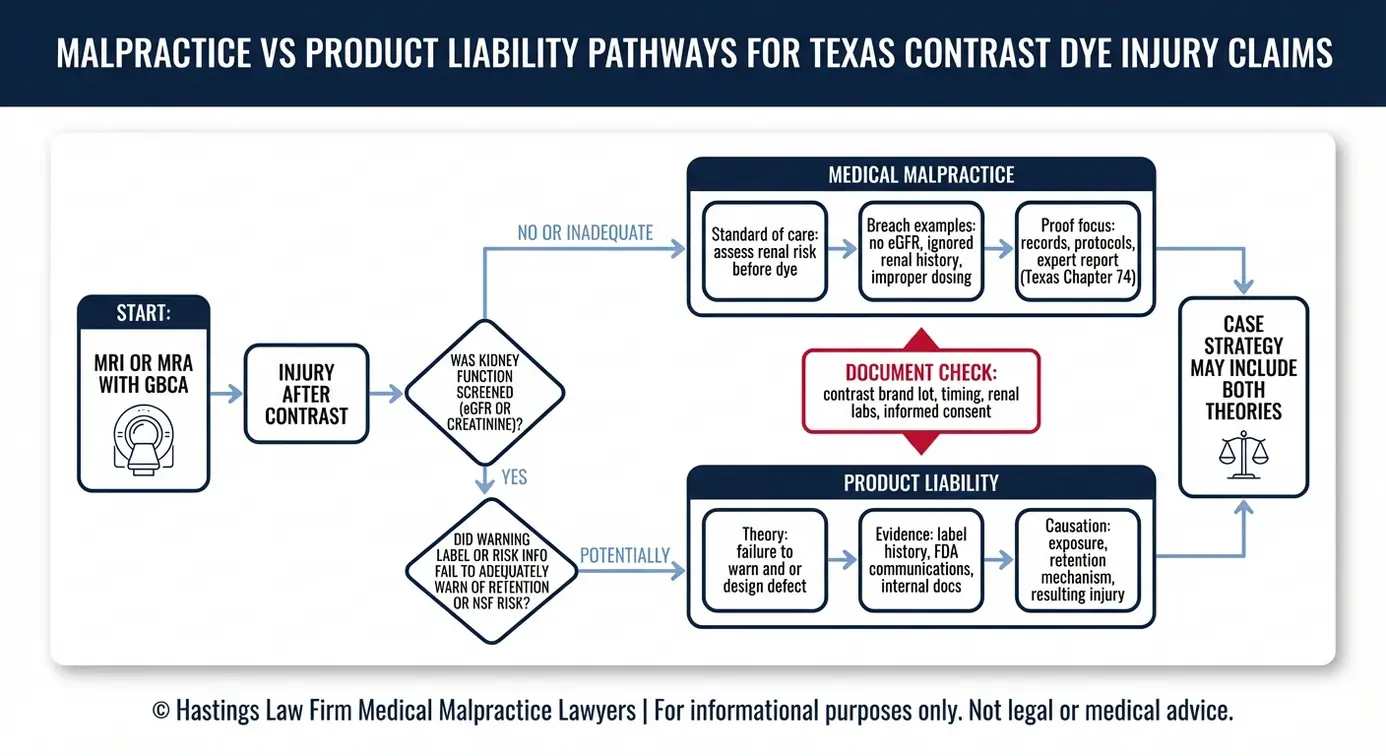
A contrast dye injury claim may be filed as medical malpractice if the treating provider failed to screen for kidney dysfunction before administering the agent, or as product liability if the manufacturer failed to adequately warn about the risks of gadolinium retention. Liability depends on whether medical standards or product safety rules were followed.
The Malpractice Angle
Before administering a GBCA, the standard of care generally requires the ordering or administering physician to assess the patient’s renal function. This typically involves checking the patient’s estimated glomerular filtration rate (eGFR), a blood test that measures how well the kidneys filter waste. An eGFR below certain thresholds signals that gadolinium may not be safely cleared from the body.
At Hastings Law Firm, our team includes former defense attorneys who previously worked for the hospitals we now challenge. This background provides a strategic advantage in identifying charting inconsistencies. When a provider administers a high-risk contrast agent to a patient with chronic renal insufficiency without performing this basic screening, it may constitute a breach of the standard of care.
The Product Liability Angle
On the manufacturer’s side, the legal question centers on whether companies like GE Healthcare (Omniscan) or Bayer (Magnevist) provided adequate warnings about the risk of NSF and gadolinium retention. The FDA required updated warning labels on December 19, 2017, to disclose that gadolinium deposits remain in the body. For injuries that occurred before adequate warnings were in place, a failure-to-warn claim may hold the manufacturer accountable for marketing a product without sufficient disclosure of known risks.
The Learned Intermediary Doctrine
Texas follows the learned intermediary doctrine, which generally shields manufacturers from direct patient claims if the manufacturer adequately warned the prescribing physician. This means the strength of a product liability claim can depend on the specific warnings available at the time of administration, and whether the physician received and acted on them. A contrast dye malpractice attorney can evaluate both sides of this equation to determine the strongest path forward.
Recoverable Damages in Texas Contrast Dye Injury Cases
Patients harmed by contrast dye injuries in Texas may recover compensation for past and future medical expenses, pain and suffering, physical impairment, and lost wages. In Texas, legal damages refer to the financial compensation paid to an injured person to cover their losses. Organ damage resulting from chronic renal insufficiency and toxic exposure creates a substantial financial burden.
Under Texas Civil Practice and Remedies Code, Chapter 74, medical liability claims allow for both economic and non-economic damages. A Texas contrast dye injury lawyer can help calculate the full scope of harm based on your medical records, treatment history, and long-term prognosis.
Economic Damages:
- Dialysis treatments and ongoing nephrology care
- Future kidney transplant costs, including surgery and medications
- Physical therapy and rehabilitation for joint contractures or mobility loss
- Lost income and diminished earning capacity due to disability
Non-Economic Damages:
- Physical pain and suffering caused by NSF, fibrosis, or chronic kidney failure
- Mental anguish related to a dramatically altered quality of life
- Loss of physical capacity, including the inability to perform daily tasks independently
Wrongful Death: When organ failure, cardiac fibrosis, or other complications from gadolinium toxicity result in death, surviving family members may pursue a wrongful death claim for loss of companionship, funeral expenses, and financial support.
Because contrast dye injuries often require lifelong medical management, the full value of a claim extends well beyond current bills. An experienced lawyer for MRI dye injuries can ensure no cost is overlooked. While we have seen millions recovered in complex medical injury cases, each claim is unique. Our team works with medical experts and economists to project future costs so that any recovery reflects the true long-term burden of the injury.
Proving Negligence in Contrast Dye Malpractice Claims
To prove negligence, a patient must demonstrate that the provider violated the standard of care, typically by failing to assess kidney function before imaging, and that this failure directly caused the NSF or gadolinium toxicity. Proving negligence requires showing how a healthcare provider failed to meet professional duties. Texas law imposes specific procedural requirements that make early legal involvement essential.
Step 1: Securing Medical Records
The first step is obtaining complete medical records from the imaging facility. These records should identify the specific contrast agent used, including the brand name, dosage, and lot number. According to the Harris County Medical Society, patients have the right to request their full medical file. Our contrast dye injury attorneys assist in gathering and auditing these records to confirm what was administered and when.
Step 2: Analyzing Pre-Scan Blood Work
We review the patient’s blood work from around the time of the scan, focusing on serum creatinine levels and the corresponding eGFR. Serum creatinine is a blood marker used to estimate kidney function. If these tests were never ordered, or if the results showed acute kidney injury and the scan proceeded anyway, that gap can form the basis of a negligence claim.
Step 3: Meeting Texas Chapter 74 Requirements
Texas law requires that a qualified physician produce an expert report within 120 days after each defendant’s original answer is filed in a medical malpractice lawsuit. This report must identify the applicable standard of care, explain how it was breached, and connect that breach to the patient’s injury. As a lawyer for contrast toxicity, Hastings Law Firm maintains a national network of medical experts who can provide the analysis and testimony these cases demand. Our attorneys and in-house medical staff work together to build a detailed, evidence-based case from the earliest stages of investigation.
Contact the Texas Healthcare Malpractice Attorneys at Hastings Law Firm Today for Help
If you or a loved one developed Nephrogenic Systemic Fibrosis, kidney complications, or other unexplained symptoms after receiving contrast dye during an MRI, you deserve clear answers about what happened and why. Every member of our team is dedicated to holding negligent medical providers and manufacturers accountable for the harm they cause. The firm’s founder, Tommy Hastings, is Board Certified in Personal Injury Trial Law by the Texas Board of Legal Specialization.
We understand the weight of what you are carrying. Our role is to investigate the facts, identify who is responsible, and protect your financial future. We handle these cases on a contingency fee basis, meaning you pay nothing unless we recover compensation on your behalf.
Contact our team today for a free, confidential case evaluation. As a trusted Texas contrast dye injury lawyer, we are here to listen, review your records, and help you understand your options.
Frequently Asked Questions About Contrast Dye Injury in Texas


This content was researched and written by the Hastings Law Firm editorial team, which includes attorneys, medical professionals, and experienced researchers. Our writing is informed by internal knowledge and practical experience, and we cross-check critical details against authoritative sources cited throughout. Every piece undergoes human-led fact-checking and legal review. Because legal and medical information can change, if you spot an error, please contact us. Learn more about our content standards and review process on our editorial policy page.

Gabe Sassin has focused exclusively on medical malpractice law since 2007. After spending more than a decade as a malpractice defense attorney, he knows exactly how the other side works. He has seen firsthand how healthcare providers, insurers, corporate defendants, and their legal teams think, prepare, and build their defense against claims. That knowledge works for the people who need it most today, injured patients and their families. His unique experience shapes everything he writes, giving readers a look at how these cases actually work from someone who has handled them from both sides.
