


Texas Compartment Syndrome Malpractice Lawyer
Written by: Hastings Law Firm | Reviewed by: Gabe Sassin | Updated: July 27, 2026
A delayed or missed diagnosis of acute compartment syndrome can turn a treatable emergency into permanent harm. Rising pressure inside a muscle compartment can cut off blood flow and oxygen, leading to irreversible tissue damage when care is not provided quickly. Warning signs like escalating pain and numbness can be overlooked, and waiting for late findings can worsen outcomes. The result can be amputation, lasting nerve damage, chronic pain, disability, or life threatening complications. If you or a loved one were harmed or worse due to failure to diagnose compartment syndrome in Texas, contact Hastings Law Firm for a free, confidential case review.

Trusted Texas Medical Attorneys for Failure to Diagnose Compartment Syndrome Claims
What You Should Know About Failure to Diagnose Compartment Syndrome Claims in Texas:
- Permanent disability can result when acute compartment syndrome is not recognized and treated quickly.
- Amputation risk can rise sharply after delays because muscle and nerve tissue can become irreversibly damaged.
- Severe harm can occur even when pulses appear normal because late findings may not appear until damage is advanced.
- Recovery options can depend on whether early warning signs like escalating pain and numbness were documented and acted on.
- Liability disputes can focus on whether compartment pressure was measured when symptoms suggested compartment syndrome.
- Outcomes can worsen when emergency fasciotomy is delayed after elevated pressure is confirmed or strongly suspected.
- The ability to pursue compensation in Texas can be lost if the legal filing deadline is missed.
- Compensation for pain and suffering can be limited in Texas medical malpractice cases due to caps on non economic damages.
- Life threatening complications can occur when rhabdomyolysis leads to acute kidney failure.
- Case clarity can depend on whether hospital records show monitoring, reassessment, and serial neurovascular checks for high risk injuries.

A Healthcare Focused Law Firm
When a doctor overlooks or delays the diagnosis of compartment syndrome, the consequences can be devastating and permanent. What might have been treatable with timely intervention can instead lead to amputation, lasting nerve damage, or the loss of an entire limb’s function. If you or someone you love suffered serious harm because a medical provider failed to act on clear warning signs, you deserve answers about what went wrong and why.
As a Texas compartment syndrome malpractice lawyer, Hastings Law Firm focuses exclusively on medical malpractice. Founder Tommy Hastings is Board Certified in Personal Injury Trial Law, a credential held by fewer than 2% of Texas lawyers. Our team of attorneys, nurse consultants, and medical staff investigates these cases from the inside, using the same clinical knowledge that should have protected you in the first place. If you believe a delayed or missed diagnosis caused harm, we can review what happened and explain your options in a free, confidential case evaluation.
Understanding Acute Compartment Syndrome and the Risk of Medical Negligence
Acute compartment syndrome is a medical emergency where excessive pressure builds within a muscle compartment, cutting off blood flow and oxygen to nerves and muscle tissue. It demands immediate recognition and treatment, and a failure to provide either one can give rise to a claim handled by a Texas compartment syndrome attorney.
To understand how this condition develops, it helps to understand the anatomy involved. Muscles in the arms and legs are grouped into compartments, each surrounded by a tough, inelastic membrane called the fascia. Because fascia does not stretch, any significant swelling inside the compartment has nowhere to go. The pressure rises, compresses blood vessels and nerves, cuts off circulation, and begins to starve the tissue of oxygen. According to research published in The Open Orthopaedics Journal, this pressure-driven cascade can quickly progress to irreversible damage if not addressed surgically.
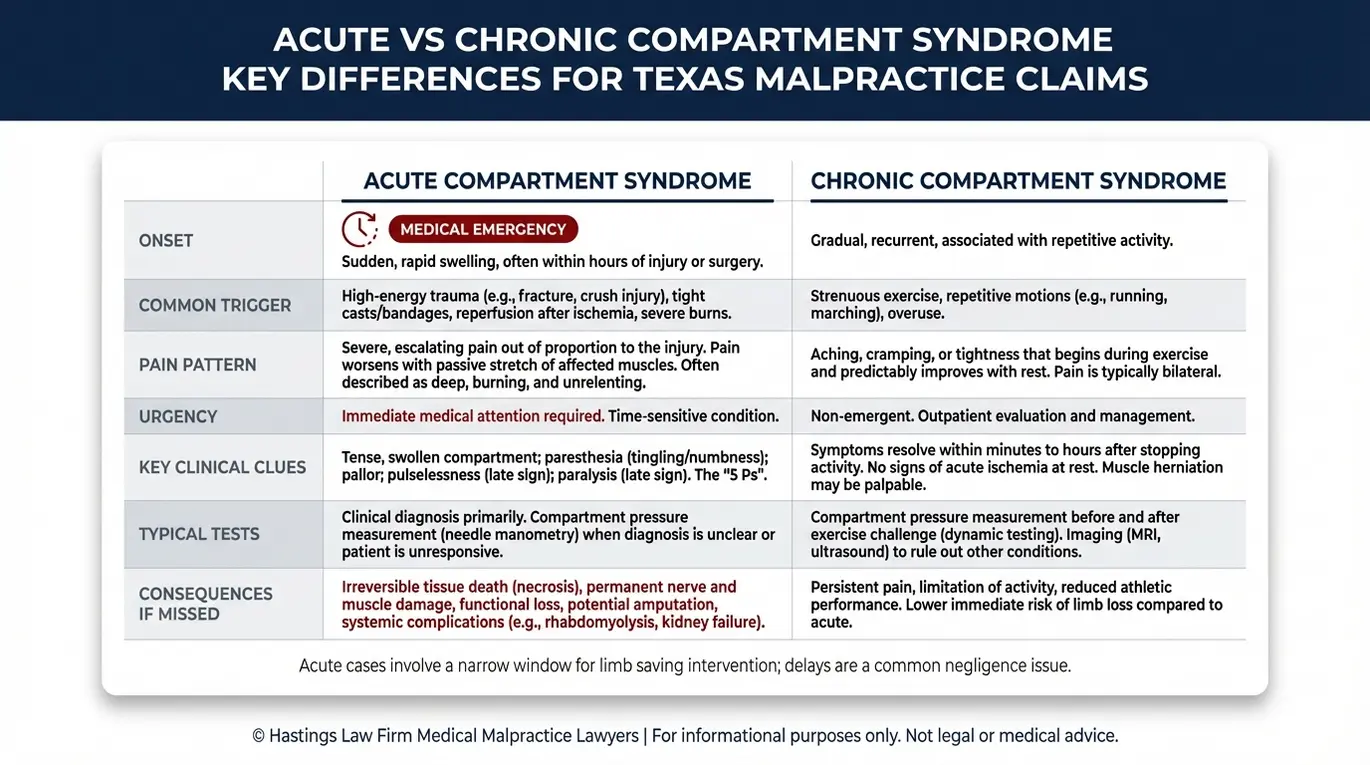
While compartment syndrome can present in different forms, the distinction between acute and chronic matters significantly from both a medical and legal standpoint.
| Feature | Acute Compartment Syndrome | Chronic (Exertional) Compartment Syndrome |
|---|---|---|
| Onset | Sudden, often following injury or surgery | Gradual, typically during repetitive exercise |
| Severity | Medical emergency requiring immediate surgery | Managed conservatively; rarely life-threatening |
| Malpractice Risk | High, due to narrow treatment window | Lower, though misdiagnosis can still cause harm |
| Typical Cause | Fractures, crush injuries, tight casts | Repetitive physical activity |
| Treatment | Emergency fasciotomy | Activity modification, physical therapy, or elective surgery |
Acute compartment syndrome is the primary focus of malpractice claims because the window for intervention is so narrow. The consequences of a missed or delayed diagnosis are often catastrophic.
The Critical Timeline for Irreversible Tissue Death
The urgency of acute compartment syndrome cannot be overstated. Medical literature generally identifies a window of approximately six hours or less from the onset of elevated pressure before necrosis, the death of muscle and nerve tissue, may become irreversible. Once that threshold passes, the damage is permanent. This window is a clinical standard used to determine when internal muscle pressure becomes fatal to tissue.
Muscles that have been deprived of blood flow begin to break down, nerves lose function, and the risk of amputation increases sharply. This is why a compartment syndrome malpractice lawyer examines the timeline so closely. Every hour that passes without a pressure measurement or surgical intervention is an hour that can mean the difference between recovery and permanent disability.
Recognizing the Warning Signs and Symptoms of Compartment Syndrome
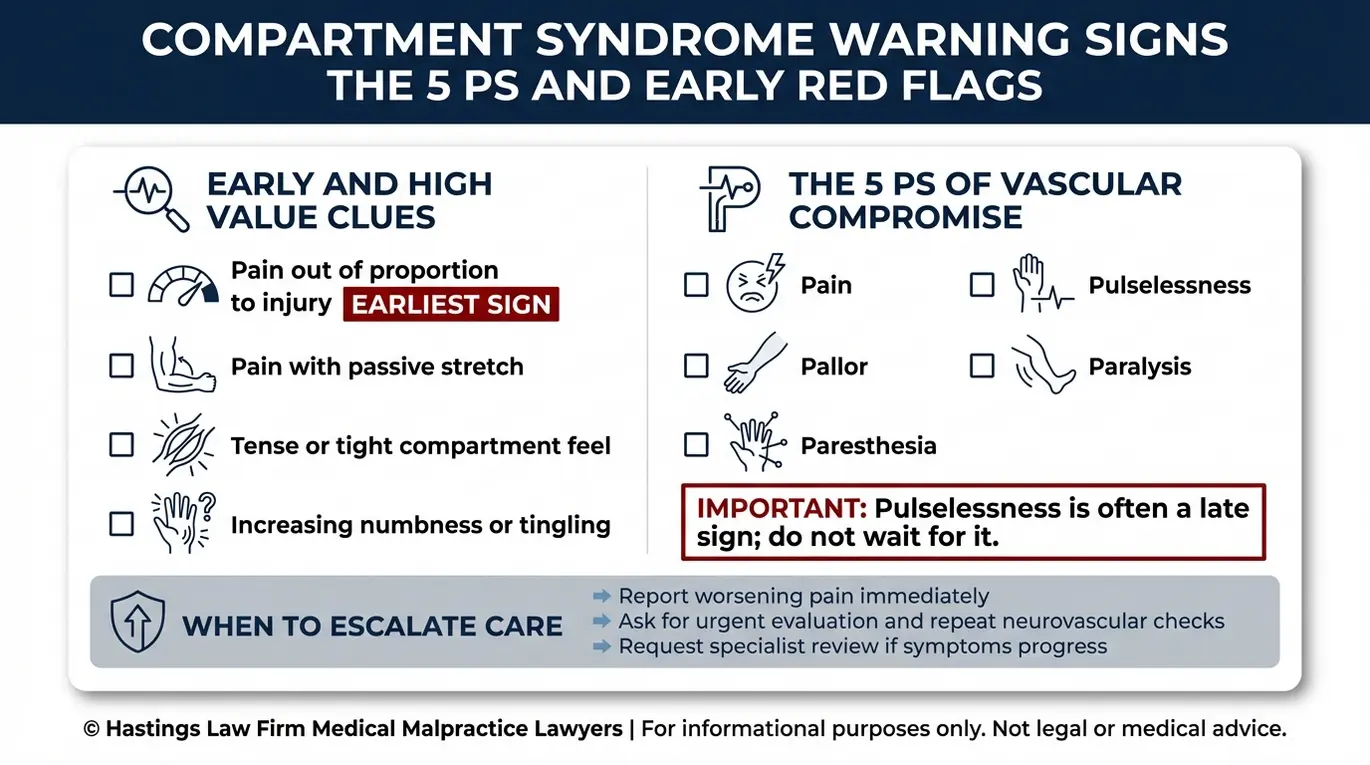
The hallmark symptom of compartment syndrome is pain that is out of proportion to the injury and does not respond to medication, often accompanied by the “5 Ps” indicating vascular compromise. Physicians look for a cluster of clinical signs known as the “5 Ps” to identify vascular compromise and provide immediate attention.
Pain out of proportion to the injury means the patient experiences severe, escalating pain that cannot be explained by the underlying fracture or trauma alone. It typically worsens with passive stretching of the affected muscles. This is the earliest and most reliable warning sign, and it is frequently the one that gets dismissed or undertreated. The pressure inside the compartment can compromise circulation well before other visible signs appear, as noted by Banner Health.
The “5 Ps” are the recognized clinical indicators of developing compartment syndrome:
- Pain: Severe, disproportionate to the injury, and worsening despite pain medication
- Pallor: The skin over the affected area appears pale or ashen due to reduced blood flow
- Paresthesia: Numbness, tingling, or a “pins and needles” sensation from compressed nerves
- Pulselessness: A weakened or absent pulse downstream from the affected compartment
- Paralysis: Inability to move the affected muscles, signaling advanced tissue compromise
One of the most dangerous clinical errors is waiting for all five signs to appear before acting. Pulselessness and paralysis are often late findings, meaning muscle damage and nerve damage are already severe by the time they develop. When a medical provider relies on a normal pulse to rule out compartment syndrome, that delay can form the basis of a claim for malpractice for compartment syndrome. A competent provider should act on early signs, particularly escalating pain and paresthesia, rather than waiting for the full picture to present itself, to prevent unnecessary pain and suffering.
The Hastings Law Firm Difference
Results matter, but what truly sets us apart is how we achieve them. Every verdict, every settlement, and every Texas courtroom victory comes from one guiding promise: To treat each client’s fight for justice as if it were our own.
This balance of skill, experience, and empathy reflects our core philosophy that justice should not only compensate the injured, but also make healthcare safer nationwide.

Establishing Liability for Failure to Diagnose Compartment Syndrome in Texas
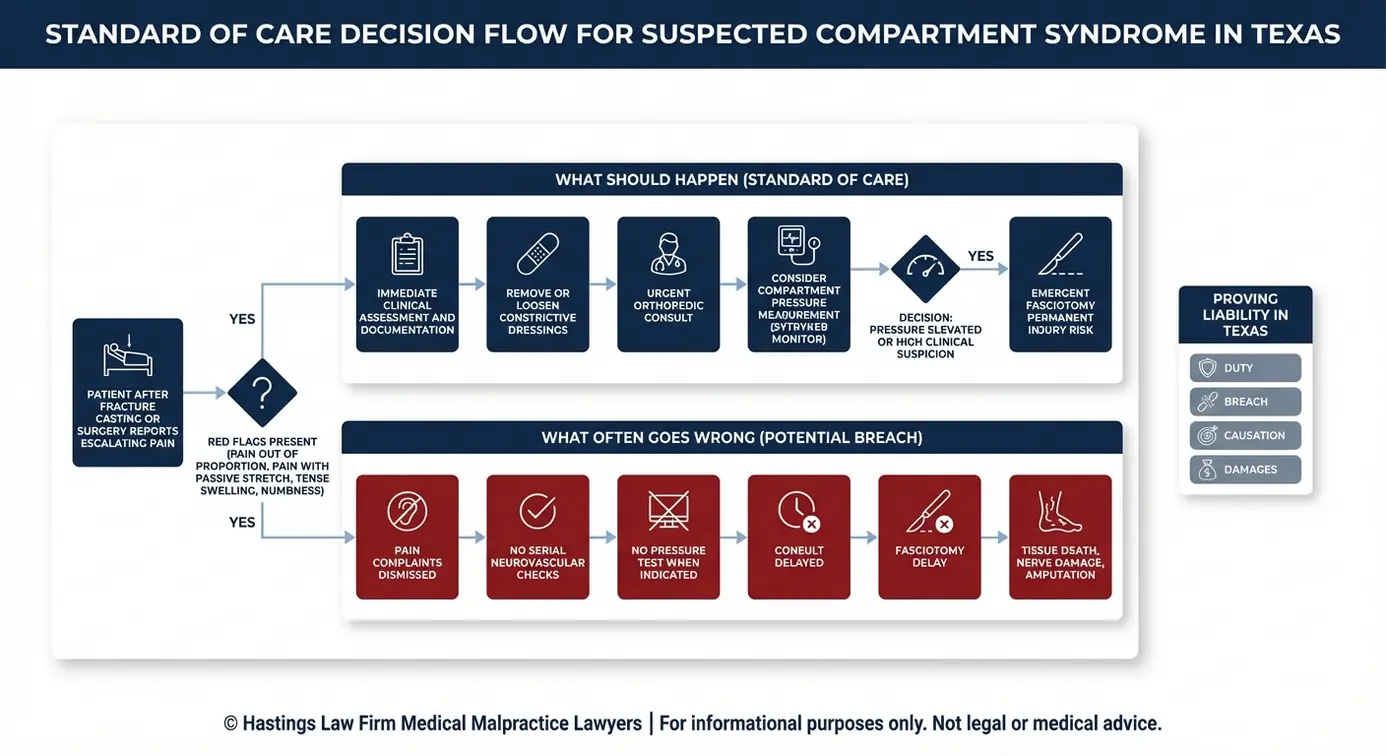
Liability is established by proving the medical provider deviated from the standard of care, such as failing to perform a compartment pressure test or delaying a necessary fasciotomy. The standard of care refers to the accepted level of treatment that a reasonably competent professional would have provided under similar circumstances. Common deviations include failing to perform a compartment pressure test or delaying a necessary fasciotomy, which is a surgical procedure to relieve internal pressure.
As a Texas compartment syndrome malpractice lawyer, Hastings Law Firm examines the full medical timeline to identify where the breakdown in care occurred. We look for specific, documentable breaches, including:
- Failure to monitor: Ignoring or inadequately responding to a patient’s complaints of escalating pain after a fracture, casting, or surgery
- Failure to measure compartment pressure: Not using an intracompartmental pressure measurement device, commonly known as a Stryker monitor, when symptoms suggest compartment syndrome. This bedside tool provides an objective pressure reading and is considered standard diagnostic practice when clinical suspicion exists.
- Surgical delay: Waiting too long to perform an emergency fasciotomy after elevated pressure is confirmed or strongly suspected
- Failure to reassess: Discharging or downgrading monitoring of a patient who presented with high-risk injuries without serial neurovascular checks
Identifying the breach is only part of the equation. Texas law also requires proof of causation, which means demonstrating that the provider’s delay or omission directly caused the patient’s injury. If a fasciotomy performed within the safe window would have preserved the limb, but the delayed diagnosis pushed the patient past the point of recovery, that causal link becomes the core of the case. Proving negligence in these complex medical scenarios requires a deep understanding of pathophysiology and legal standards.
Our team, which includes in-house nurse consultants and former defense attorneys, reconstructs the clinical timeline using hospital records, nursing notes, and medication logs. This detailed investigation is important because hospital defendants often argue that the injury was inevitable regardless of the treatment timing. By analyzing the evidence, we counter these defenses to show that timely action would have changed the outcome. We then work with qualified medical experts, typically orthopedic surgeons, to evaluate whether the care met the standard.
Common Causes and High-Risk Procedures Associated with Compartment Syndrome
While often associated with traumatic fractures, this condition can also result from tight casts, crush injuries, or surgical complications that induce rapid swelling. Tibial shaft fractures, which involve the shinbone, are the most common cause of acute compartment syndrome. These injuries can trigger dangerous swelling within the lower leg’s anterior compartment, which has rigid boundaries.
Research published in PubMed Central confirms the elevated risk of compartment syndrome in tibial fractures, particularly in younger patients. Other high-risk scenarios include:
- Constrictive casts or bandages: A cast applied too tightly, or one that is not adjusted as post-injury swelling increases, can act like a tourniquet and trigger pressure buildup
- Crush injuries: Prolonged compression of a limb, whether from a vehicle accident, industrial accident, or being pinned beneath a heavy object
- Surgical positioning: Patients placed in certain positions during long operations can develop compartment syndrome from sustained external compression on a limb
- IV infiltration and bleeding disorders: Fluid leaking into a compartment from a blown IV line, or excessive internal bleeding, can also create the conditions for acute compartment syndrome
A compartment syndrome lawyer in Texas evaluates whether the medical team recognized these risk factors and acted on them appropriately. When a provider knows a patient has sustained a high-risk injury but fails to implement serial monitoring, that gap in care can form the foundation of a medical malpractice claim.
The Life-Altering Consequences of Untreated Compartment Syndrome
Survivors of untreated compartment syndrome often face amputation, permanent nerve damage, kidney failure from rhabdomyolysis, and a lifetime of chronic pain and disability. These are not abstract medical possibilities. They are the lived reality for patients whose providers failed to act within the critical treatment window.
The physical consequences can be severe. Dead muscle tissue may require surgical debridement or amputation. Nerve damage can lead to drop foot, where the patient cannot lift the front part of the foot, or Volkmann’s contracture, a permanent shortening of the forearm muscles that results in a claw-like deformity of the hand. Chronic infections at the site of tissue death may require repeated surgeries over months or years.
One of the most dangerous systemic complications is rhabdomyolysis, a condition where dead muscle fibers break down and release proteins into the bloodstream that can overwhelm the kidneys. According to the National Center for Biotechnology Information (NCBI), rhabdomyolysis can lead to acute kidney failure, a life-threatening condition that may require dialysis.
The financial impact is equally staggering. Patients who lose a limb face the cost of prosthetics, which must be replaced periodically, along with ongoing physical therapy and occupational rehabilitation. Many are unable to return to their previous careers, resulting in lost earning capacity. A lawyer for compartment syndrome lawsuits works to document every category of harm, including medical bills, lost wages, and future care costs.
Contact the Texas Healthcare Malpractice Attorneys at Hastings Law Firm Today for Help
If you or a loved one suffered permanent injury because compartment syndrome was not diagnosed or treated in time, you have a limited window to take legal action in Texas. Waiting too long can mean losing the right to file a claim entirely. Our firm provides a path toward understanding what happened through a thorough review of your medical records.
Hastings Law Firm works on a contingency fee basis, meaning you pay no attorney fees or costs unless we secure a recovery on your behalf. Our Texas compartment syndrome malpractice attorneys are here to help you understand what happened, determine whether negligence occurred, and pursue accountability.
Contact us today for a free and confidential case evaluation. Let our medical-legal team work to find the answers you deserve.
Frequently Asked Questions About Compartment Syndrome Malpractice in Texas


This content was researched and written by the Hastings Law Firm editorial team, which includes attorneys, medical professionals, and experienced researchers. Our writing is informed by internal knowledge and practical experience, and we cross-check critical details against authoritative sources cited throughout. Every piece undergoes human-led fact-checking and legal review. Because legal and medical information can change, if you spot an error, please contact us. Learn more about our content standards and review process on our editorial policy page.

Gabe Sassin has focused exclusively on medical malpractice law since 2007. After spending more than a decade as a malpractice defense attorney, he knows exactly how the other side works. He has seen firsthand how healthcare providers, insurers, corporate defendants, and their legal teams think, prepare, and build their defense against claims. That knowledge works for the people who need it most today, injured patients and their families. His unique experience shapes everything he writes, giving readers a look at how these cases actually work from someone who has handled them from both sides.
