


Texas Colonoscopy Perforation Lawyer
Written by: Hastings Law Firm | Reviewed by: Brady D. Williams | Updated: July 27, 2026
A colonoscopy is usually routine, but a perforated bowel can lead to emergency surgery, serious infection, and other life threatening complications. Some perforations are unavoidable risks, while others may reflect preventable errors in technique, equipment handling, or post procedure care. Liability can also arise when warning signs are missed and diagnosis or treatment is delayed. Understanding how perforations happen and how symptoms present can clarify whether the outcome was a known complication or negligence. If you or a loved one were harmed or worse due to colonoscopy perforation in Texas, contact Hastings Law Firm for a free, confidential case review.

Trusted Texas Medical Attorneys for Colonoscopy Perforation Claims
What You Should Know About Endoscopy Perforation Malpractice Claims in Texas:
- Outcomes can become life threatening when a colon perforation allows intestinal contents to leak into the abdomen and trigger peritonitis and sepsis.
- Liability can arise even when the perforation itself was a known risk if symptoms were dismissed and diagnosis or treatment was delayed.
- Recovery can turn on whether the injury was a known complication or a preventable error tied to technique, judgment, or post procedure care.
- Options can be limited when a signed consent form is treated as a blanket defense even though it does not excuse careless conduct.
- Long term impact can be severe when delayed repair leads to more invasive surgery and the possibility of a permanent ostomy.
- Disputes often focus on whether excessive force, inadequate visualization, or rushed technique contributed to the perforation.
- Serious infections can compound the harm when endoscopes are contaminated or improperly reprocessed.
- Medical costs and income loss can be central to damages in Texas because economic losses are not capped.
- Compensation for pain and suffering can be limited in Texas because non economic damages are capped.
- Proof can depend on what the operative report, nursing notes, and pre procedure assessment show about difficulty, symptoms, and response.

A Healthcare Focused Law Firm
A colonoscopy is one of the most common medical procedures in the United States, and most are completed without incident. But when a doctor’s error causes a perforation of the colon wall, the consequences can be severe, sometimes life-threatening. If you or a loved one suffered a bowel perforation during or after a colonoscopy, you may be wondering whether what happened was a known risk or a preventable mistake.
That distinction matters, and it is exactly what our team at Hastings Law Firm is built to investigate. As a firm that focuses exclusively on medical malpractice, we combine legal strategy with in-house medical expertise to evaluate whether a physician’s conduct fell below the accepted standard of care. If you need a Texas colonoscopy perforation lawyer, we are here to review what happened and explain your options in a free, confidential consultation.
Common Complications and Perforation Injuries During Colonoscopy
While colonoscopies are routine, perforation is a serious risk that occurs when the colon wall is punctured, often requiring emergency surgery to prevent life-threatening infection.
During a colonoscopy, a long, flexible tube called an endoscope is guided through the rectum and into the colon. The scope has a camera and tools that allow the endoscopist, the doctor performing the procedure, to examine the gastrointestinal tract and take tissue samples through biopsy. Doctors also remove precancerous growths during polyp removal, which involves cutting away potentially harmful tissue. During polypectomy, the manipulation of tissue increases the likelihood of accidental injury compared to simple observation.
Because the colon wall is thin and flexible, there is always some baseline risk involved in maneuvering the scope through the intestine. Colonic perforation, a full or partial puncture of the bowel wall, is one of the most serious complications associated with colonoscopy and endoscopy procedures. Endoscopy is a broader term for medical procedures where a camera is used to look inside the body. When the colon is perforated, intestinal contents can leak into the abdominal cavity, creating the conditions for peritonitis and sepsis.
Less commonly, the procedure can also cause splenic injury, which is damage to the spleen resulting from tension on the ligament connecting the spleen to the colon. A clear distinction exists between a “known complication” and a preventable error. A known complication is a risk that exists even when the procedure is performed correctly. A preventable error occurs when the physician’s technique, judgment, or post-procedure care falls below professional standards. Not every perforation is malpractice, but not every perforation is unavoidable either.
Research from Yale suggests that the true rate of colonoscopy complications may be significantly higher than commonly reported. The study found that complication rates documented in clinical studies often underestimate what happens in real-world practice, where factors like physician experience and patient health details vary widely. The study highlighted that administrative claims data often lacks the clinical nuance to capture every incident. This means patients may be unaware of the actual frequency of adverse events.
Key statistics to be aware of:
- Perforation occurs in an estimated 1 in every 500 to 1,000 colonoscopies, though rates vary by study and setting.
- The risk increases substantially during therapeutic procedures like polyp removal compared to diagnostic-only exams.
- Delayed perforations, those that develop hours or days after the procedure, account for a meaningful percentage of cases and are frequently missed on initial evaluation.
Understanding these numbers helps frame the central question for any Texas colonoscopy malpractice attorney evaluating a case: did the physician’s conduct cause this injury, or was it truly unavoidable?
Is a Perforated Bowel During Colonoscopy Considered Medical Malpractice
A perforated bowel is not automatically malpractice; it becomes actionable negligence only if the physician deviated from the accepted standard of care during the procedure or failed to diagnose the injury promptly.
This is one of the most misunderstood areas in medical malpractice law. Many patients assume that any serious injury during a procedure means something went wrong. Others assume that because they signed a consent form, they have no legal options at all. The truth sits between those two extremes, and we can help you understand whether your situation involves actionable negligence. This means the medical provider’s error was preventable and fell below the accepted standard of care.
The “Known Complication” Defense
Defense attorneys in colonoscopy perforation cases almost always argue that the patient accepted the risk. Before the procedure, you likely signed an informed consent form listing bowel perforation as a possible complication. The defense will point to that signature as proof you were warned.
But informed consent has limits. Signing a form acknowledges that you understood the risks of a properly performed procedure, meaning the standard surgical risks. It does not give a doctor permission to be careless. A consent form does not excuse surgical errors, rushed technique, or the failure to respond to warning signs.
The law protects patients from negligence, regardless of the paperwork signed beforehand.
Overcoming the Defense
To move a case past the “known complication” defense, we must demonstrate that the endoscopist’s actions fell below the standard of care, the level of treatment a reasonably competent physician would have provided under the same circumstances. This can involve showing that the doctor used excessive force, failed to adequately visualize the colon, or ignored anatomical risk factors that should have prompted extra caution.
We scrutinize the operative report for evidence of difficulty. Did the doctor document poor preparation? Did they note tortuous anatomy? If the doctor proceeded with a standard colonoscopy despite significant anatomical challenges that required a pediatric scope or different approach, that decision itself may constitute negligence.
A “known complication” defense fails when the complication was triggered by a departure from safety protocols.
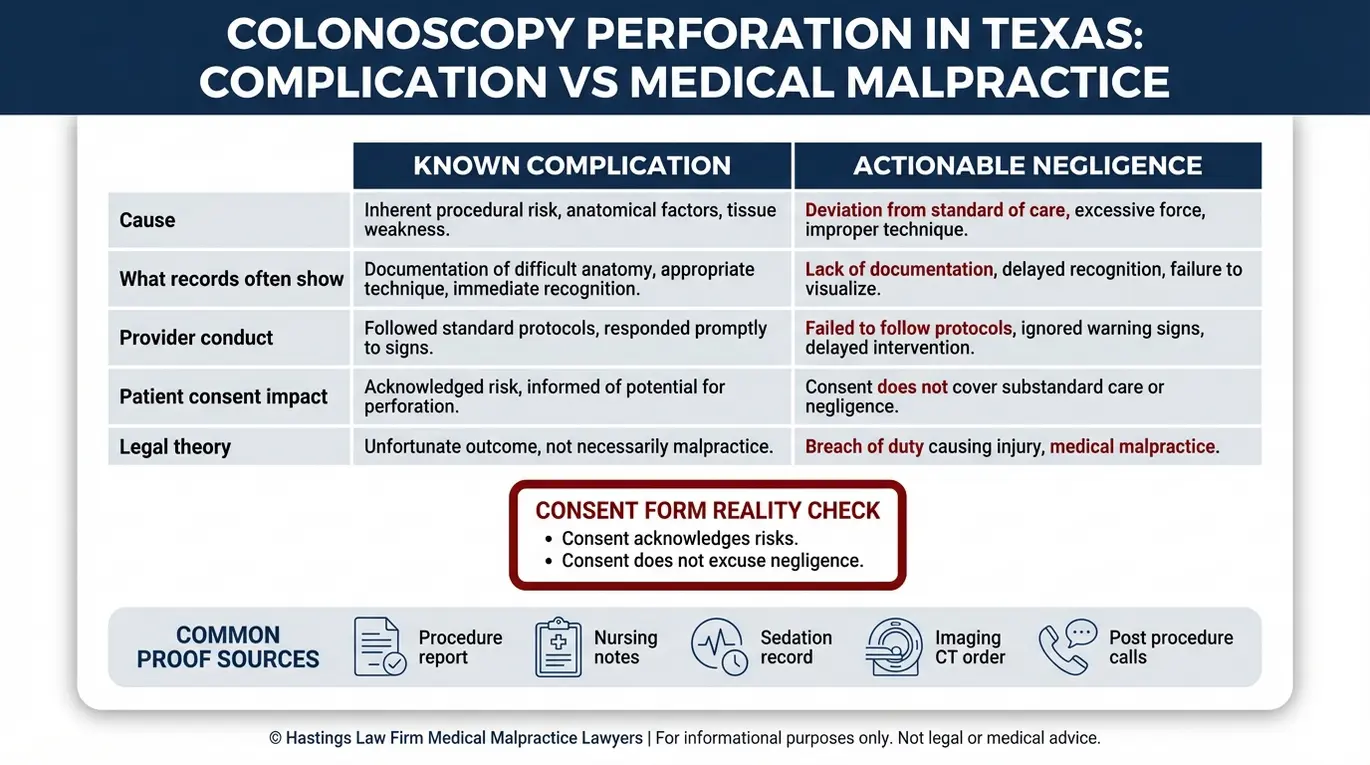
The following table illustrates the difference between a recognized risk and actionable negligence:
| Factor | Known Complication | Potential Negligence |
|---|---|---|
| Technique | Perforation during a technically difficult procedure despite proper care | Excessive force applied while advancing the scope through a known stricture |
| Patient History | Perforation in a patient with undiagnosed, thin-walled colon | Failure to review imaging showing diverticulitis or prior abdominal surgery |
| Post-Procedure Response | Perforation identified and repaired during the procedure | Patient reports severe pain; physician dismisses symptoms and discharges without imaging |
| Informed Consent | Risks were clearly explained and documented | Key risks were omitted, or the patient was not alert enough to consent due to sedation |
| Equipment | Proper use of standard instruments | Use of damaged or improperly reprocessed endoscope |
When we evaluate a case, our in-house medical staff reviews the operative report, nursing notes, and pre-procedure assessment to determine whether the physician’s conduct was consistent with accepted practice or whether it crossed the line into negligence.
The Hastings Law Firm Difference
Results matter, but what truly sets us apart is how we achieve them. Every verdict, every settlement, and every Texas courtroom victory comes from one guiding promise: To treat each client’s fight for justice as if it were our own.
This balance of skill, experience, and empathy reflects our core philosophy that justice should not only compensate the injured, but also make healthcare safer nationwide.

Types of Negligent Errors Leading to Colon Perforation
Negligence often involves mechanical trauma from excessive force, thermal injury during polyp removal, or failure to visualize the colon wall properly due to rushed procedures.
Not all perforations happen the same way. Understanding the mechanism of the injury is one of the first steps in determining whether malpractice occurred. Here are the most common categories of negligent error we evaluate as a negligent endoscopy attorney.
- Mechanical Trauma: The most frequent cause of perforation is direct mechanical injury from the scope itself. This can happen when the endoscopist pushes the instrument through a loop or past a narrowed segment of the colon with too much force. Scope looping, a situation where the flexible tube coils or bends inside the intestine rather than advancing smoothly, can create pressure points along the colon wall. Forceful movement in a looped colon stretches the wall, thinning it until it bursts.
This is often described as a “blow-out” perforation. A skilled physician monitors for resistance and adjusts technique accordingly. Patients with a history of diverticulitis, where small pouches in the colon become inflamed, are at higher risk.
When that vigilance is absent, the wall can tear. Deep sedation can mask patient pain responses, preventing the doctor from realizing they are applying too much force.
- Thermal Injury: When polyps are removed during a colonoscopy, the endoscopist often uses electrocautery, a technique that applies electrical current to cut tissue and seal blood vessels simultaneously. If the energy is applied too aggressively or directed at the wrong tissue depth, it can burn through the colon wall. According to a case report published in PubMed Central on thermal injury during colonic polypectomy, thermal damage can extend beyond the visible treatment site, sometimes causing delayed perforations that present days later.
- Splenic Injury: A lesser-known but serious risk involves injury to the spleen. The spleen is connected to the colon’s splenic flexure by the splenocolic ligament. During scope advancement, traction on this ligament can tear the spleen, causing internal bleeding and hemorrhaging that may not be immediately apparent. This type of injury requires careful post-procedure monitoring.
- Equipment-Related Negligence: Contaminated or improperly reprocessed endoscopes present a real risk of bacterial transmission. Inadequate drying or storage of scopes allows biofilms to form, shielding bacteria from disinfectants. Between procedures, endoscopes must be thoroughly cleaned and disinfected following strict protocols.
The U.S. Food and Drug Administration has issued detailed guidance on reprocessing standards for reusable medical devices. When facilities cut corners on these protocols, patients can develop serious infections on top of any procedural injury.
Under Texas Civil Practice and Remedies Code, Chapter 74, medical malpractice claims in Texas require proof that the provider’s conduct fell below the standard of care and directly caused the patient’s injury. Each of the mechanisms described above can form the basis of a valid claim when supported by expert analysis and medical records.
Recognizing Symptoms of a Perforated Bowel After a Procedure
Symptoms of a perforation may be immediate or delayed, including severe abdominal pain, distention, fever, and rectal bleeding, which require urgent medical attention to prevent sepsis.
Some perforations are detected during the procedure itself. Others develop or worsen in the hours and days that follow. A microperforation, a tiny tear in the colon wall, may not produce dramatic symptoms right away. Instead, it can gradually worsen as intestinal bacteria leak into the surrounding tissue.
This is why understanding the symptoms of botched colonoscopy is so important. Research published in PubMed Central on recognition and management of colonic perforation following endoscopy emphasizes that prompt identification of perforation symptoms significantly affects patient outcomes.
Immediate vs. Delayed Symptoms
Patients with large perforations may feel intense, sharp abdominal pain almost immediately after the procedure. But delayed perforations, often caused by thermal injury or microperforations, may take 24 to 72 hours to become symptomatic. During that window, patients may attribute their discomfort to normal post-procedure soreness.
The Danger of Sepsis
When fecal matter escapes through a perforation into the sterile abdominal cavity, it triggers peritonitis, a severe inflammation of the peritoneal lining. Left untreated, peritonitis progresses to sepsis, a systemic inflammatory response where the body’s reaction to infection damages its own tissues.
Septic shock creates a cascade of organ dysfunction. The kidneys and lungs are often the first to fail, requiring dialysis or mechanical ventilation. The transition from manageable injury to life-threatening emergency can happen within hours.
Red Flag Symptom Checklist
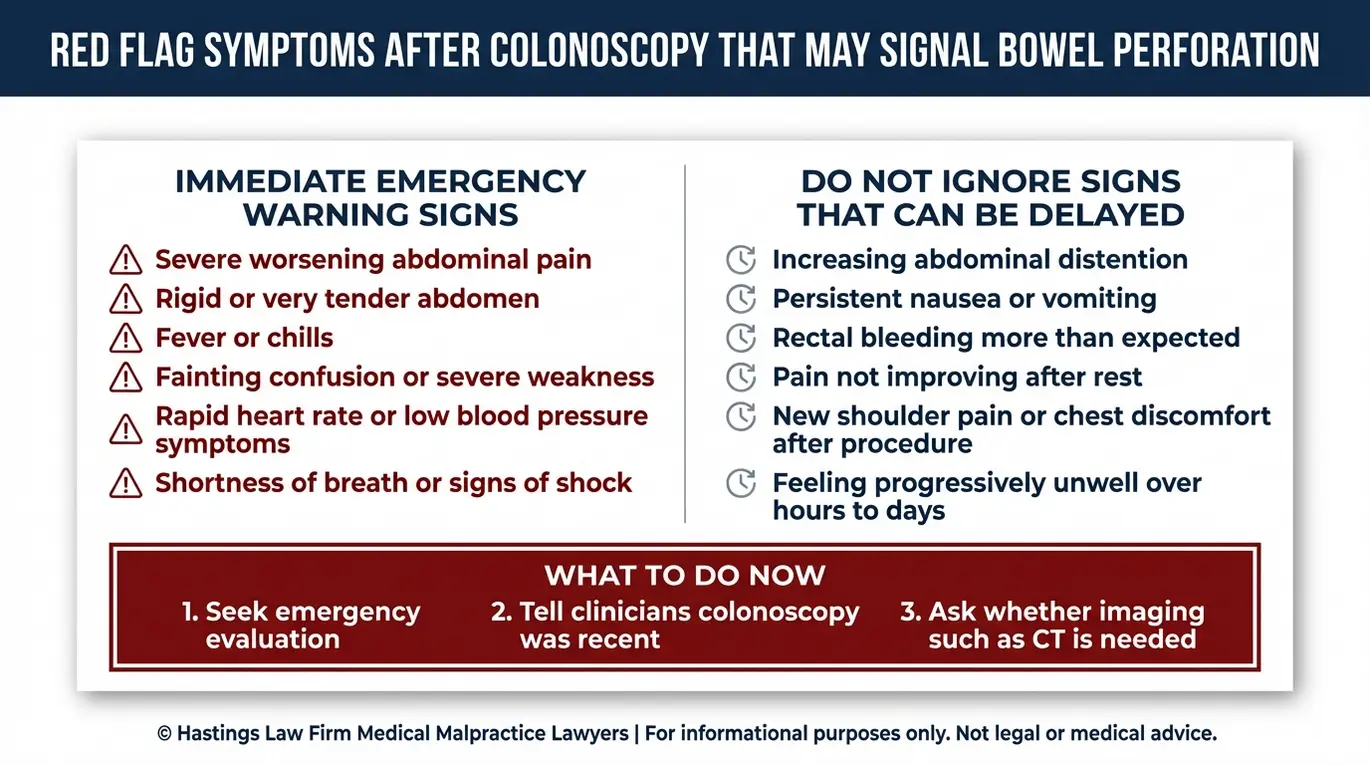
If you or a loved one experience any of the following after a colonoscopy, seek emergency medical care immediately:
- Severe or worsening abdominal pain that does not improve with rest or medication
- Abdominal distention, a visible bloating or swelling of the belly
- Fever or chills developing within hours or days of the procedure
- Rectal bleeding that is heavy, persistent, or worsening
- Nausea and vomiting, especially when combined with abdominal pain
- Rapid heart rate, dizziness, or feeling faint
- Peritoneal signs such as guarding and rebound tenderness, which refers to sharp pain when pressure is applied to and then released from the abdomen
- Shoulder pain (which can indicate air or fluid irritating the diaphragm)
Do not dismiss severe pain as “just gas” or normal recovery discomfort. A Texas colonoscopy perforation lawyer often sees cases where the outcome worsened because the patient or a follow-up physician minimized symptoms that should have triggered immediate evaluation.
Failure to Diagnose and Treat Bowel Perforation Liability Issues
Even if the perforation itself was a non-negligent complication, a doctor may be liable for malpractice if they fail to recognize the injury and delay necessary life-saving treatment.
Many patients overlook this aspect of liability. The question of liability does not always center on what happened during the colonoscopy. Sometimes, the more critical failure occurs afterward, when a physician dismisses symptoms, delays ordering imaging, or sends a patient home without proper follow-up.
The Critical Treatment Window
There is a narrow window after a perforation occurs when prompt surgical intervention can prevent catastrophic outcomes. Within the first several hours, a contained perforation may be repaired with relatively limited surgery. As time passes and contamination spreads, the surgical options become more invasive and the risk of sepsis increases dramatically.
Peritonitis can set in rapidly. Once the bowel contents spill, the clock starts ticking. Every hour of delay increases the mortality rate.
When a patient calls the office with worsening abdominal pain and fever after a colonoscopy, the standard of care generally requires the physician to consider perforation as a likely diagnosis and act accordingly. Dismissing those symptoms or advising the patient to “wait and see” can turn a survivable injury into a fatal one.
Diagnostic Negligence
A CT scan is one of the primary tools for identifying a bowel perforation. Free air in the abdominal cavity, which is air that has escaped from the digestive tract into the surrounding space, is a strong indicator that the colon wall has been breached. When a physician fails to order a CT scan despite the patient presenting with classic perforation symptoms, that delay in treatment can form the basis of a separate malpractice claim.
Sometimes, X-rays are ordered instead of CT scans, but X-rays may miss smaller pockets of free air. The failure to order the correct imaging modality is a critical error.
Our team examines the timeline closely: when did the patient first report symptoms, what clinical assessments were performed, and how much time elapsed before imaging was ordered or surgical intervention began. These gaps in the record are often where the strongest evidence of delayed diagnosis lies.
The Consequences of Delayed Repair
When a perforation is caught early, a surgeon may be able to close the tear with sutures during a laparotomy, a surgical procedure in which the abdomen is opened to access and repair internal organs. But if the injury has progressed, the contaminated section of bowel may need to be removed entirely. Surgeons must often perform emergency surgery to wash out the abdomen.
In those cases, the patient may require an ostomy, a surgically created opening in the abdomen that diverts intestinal waste into an external collection bag. A colostomy diverts from the colon; an ileostomy diverts from the small intestine. Some ostomies are temporary and can be reversed after healing.
Others are permanent, fundamentally changing the patient’s daily life, body image, and long-term health. The difference between a simple repair and a permanent ostomy often comes down to hours. That timeline is exactly what a failure to diagnose perforation lawyer will reconstruct when building a case.

Compensation and Damages Recoverable in Texas Perforation Cases
Patients who suffer colonoscopy malpractice in Texas can recover damages for medical bills, lost wages, pain and suffering, and permanent impairment, subject to state-specific limitations.
A bowel perforation caused by negligence can result in prolonged hospitalization, multiple surgeries, and months or years of recovery. The financial and personal toll is significant, and Texas law provides a framework for recovering recoverable damages that reflects the full scope of that harm.
Economic Damages
Economic damages cover the measurable financial losses you have suffered and will continue to face. These include:
- Past and future medical expenses: Emergency surgery, ICU stays, follow-up procedures, colostomy reversal surgeries, wound care, and ongoing monitoring
- Lost income: Wages missed during recovery, reduced earning capacity if you can no longer perform your job
- Home care and rehabilitation costs: Physical therapy, in-home nursing assistance, and medical equipment
There is no cap on economic damages in Texas medical malpractice cases. Every dollar of documented financial loss can be pursued.
Patients seeking compensation for colonoscopy injury in Texas should be aware that future medical expenses are often underestimated. If a patient requires a permanent ostomy, the lifetime cost of supplies, such as bags, wafers, and skin barriers, can range into the tens of thousands of dollars. We work with life care planners to project these costs accurately.
Non-Economic Damages
Non-economic damages compensate for the personal suffering that does not come with a receipt. These include:
- Physical pain and discomfort from surgeries and recovery
- Mental anguish and emotional distress
- Scarring and disfigurement, particularly from ostomy placement
- Loss of enjoyment of life and daily activities
- Loss of consortium for a spouse or partner
Under the Texas Civil Practice and Remedies Code, Chapter 74, Section 301, non-economic damages in medical malpractice cases are capped. For claims against individual physicians or healthcare providers, the cap is $250,000 combined across all such providers. For claims involving a hospital or healthcare institution, an additional $250,000 may apply per institution, with a combined cap of $500,000 for institutional defendants. These caps apply to intangible losses but do not limit economic recovery.
Wrongful Death
When a colonoscopy perforation leads to sepsis or surgical complications that result in death, surviving family members may bring a wrongful death claim. These cases allow families to recover damages for loss of financial support, loss of companionship, and funeral expenses.
While caps on damages can feel discouraging, they do not eliminate your right to meaningful compensation. A Texas colonoscopy perforation lawyer experienced in these cases will work to document the full economic impact so that the recoverable damages reflect the real cost of the injury.
Ensuring Patient Safety Questions to Ask Before Your Procedure
Patients can help protect themselves by asking about the doctor’s adenoma detection rate, procedure volume, and protocols for handling complications before undergoing a colonoscopy.
Being informed before a procedure is a key step in preventing colonoscopy errors, but it puts you in a better position to make decisions about your care. Here are questions worth asking during your pre-procedure consultation.
Questions to Ask Your Doctor Before a Colonoscopy
- What is your annual colonoscopy volume, and what is your perforation rate?
- What is your adenoma detection rate (ADR), the percentage of screening colonoscopies in which you find at least one precancerous polyp? This metric measures how effectively a doctor identifies potential issues during the exam.
- Are you board-certified in gastroenterology?
- What is the facility’s accreditation status? (Organizations like the Accreditation Association for Ambulatory Health Care (AAAHC) set quality benchmarks for outpatient surgical facilities.)
- What is your protocol if a perforation or other complication occurs during the procedure?
- How is the endoscope cleaned between patients? (Endoscope reprocessing, the multi-step process of disinfecting and sterilizing the scope, is essential for preventing infection.)
- What should I watch for after the procedure, and who should I call if I have concerns?
Why These Questions Matter
Studies consistently show a correlation between a physician’s annual procedure volume and complication rates. Doctors who perform a high volume of colonoscopies tend to have lower rates of perforation and other adverse outcomes. Doctor experience is a critical predictor of safety. High-volume endoscopists develop the tactile feedback necessary to navigate difficult colons without causing injury.
Asking about experience is not rude; it is responsible.
If you are scheduling a colonoscopy and want guidance on how to evaluate your provider, a patient advocate can help. And if you have already been injured and are unsure whether what happened was preventable, a Texas colonoscopy perforation lawyer can review your records and help you understand what went wrong.
Contact the Texas Healthcare Malpractice Attorneys at Hastings Law Firm Today for Help
If a routine colonoscopy led to a serious injury for you or someone you love, you deserve to know what happened and why. At Hastings Law Firm, our team of medical malpractice attorneys, in-house nurse consultants, and former defense lawyers works together to investigate these cases with the medical depth they require.
We prepare every case as if it is going to trial, because that preparation is what drives fair outcomes. Our firm handles colonoscopy perforation cases on a contingency fee basis, which means you pay no attorney fees unless we recover compensation on your behalf.
Contact a Texas Colonoscopy Perforation Lawyer at Hastings Law Firm today for a free, confidential case evaluation. We will review your medical records, explain your legal options, and help you take the first step toward accountability and answers.
Frequently Asked Questions About Colonoscopy Perforation in Texas


This content was researched and written by the Hastings Law Firm editorial team, which includes attorneys, medical professionals, and experienced researchers. Our writing is informed by internal knowledge and practical experience, and we cross-check critical details against authoritative sources cited throughout. Every piece undergoes human-led fact-checking and legal review. Because legal and medical information can change, if you spot an error, please contact us. Learn more about our content standards and review process on our editorial policy page.

Brady D. Williams is a nationally recognized medical malpractice attorney who has spent his career handling high-stakes litigation for injured patients and families across the country. Licensed in both Texas and California, Brady draws on experience from hundreds of resolved medical cases to break down complex legal and medical topics for the people who need that information most. His writing reflects the same attention to detail and commitment to clarity that he brings to every case he handles.
