


Texas Cauda Equina Syndrome Malpractice Lawyer
Written by: Hastings Law Firm | Reviewed by: Brady D. Williams | Updated: July 27, 2026
Cauda equina syndrome is a time sensitive medical emergency where delayed recognition and treatment can leave a person with permanent nerve damage, paralysis, and loss of bladder or bowel function. Many disputes arise when warning signs are documented but urgent imaging or surgical evaluation does not happen. The resulting harm can affect mobility, independence, relationships, and long term medical needs. If you or a loved one were harmed or worse due to Cauda Equina Syndrome malpractice in Texas, contact Hastings Law Firm for a free, confidential case review.

Trusted Texas Medical Attorneys for Cauda Equina Syndrome Negligence Claims
What You Should Know About Failure to Diagnose Cauda Equina Syndrome Claims in Texas:
- Permanent paralysis and loss of bladder or bowel control can result when cauda equina syndrome is not treated urgently.
- Recovery prospects can drop quickly when care is delayed past the incomplete stage and progresses to urinary retention.
- A missed opportunity for timely imaging can be central when red flag symptoms are present but an emergency MRI is not ordered.
- Options for recovery can be limited if required case filings are not completed on time under Texas medical liability rules.
- Compensation can be constrained by limits on non economic damages in Texas even when the injury is severe.
- Financial recovery can still reflect large long term costs because economic damages like medical care and lost earning capacity are not capped.
- Causation disputes can hinge on whether records show function was still present on arrival and worsened during periods of inaction.
- Liability questions can turn on whether basic bedside checks for urinary retention were performed and documented.
- The full scope of harm can depend on thorough documentation of long term needs such as catheter supplies and mobility support.

A Healthcare Focused Law Firm
A diagnosis of Cauda Equina Syndrome can change everything in a matter of hours. If you or someone you love is now living with permanent nerve damage, paralysis, or loss of bladder and bowel function after a delayed diagnosis, we understand how overwhelming this moment feels. You trusted your doctors to act quickly, and something went wrong.
At Hastings Law Firm, we focus exclusively on medical negligence, representing patients who have been betrayed by the healthcare system. Our team of attorneys, in-house nurses, and board-certified patient advocates has the experience and resources to investigate what happened and evaluate whether a healthcare provider’s failing to act caused preventable harm. Tommy Hastings, a board-certified trial lawyer, and his team prepare every case as if it is going to trial because that preparation is what drives fair results.
If you believe your CES diagnosis was missed or delayed, we are here to help. Contact us for a free, confidential case evaluation to understand your legal options.
Understanding Cauda Equina Syndrome as a Medical Emergency
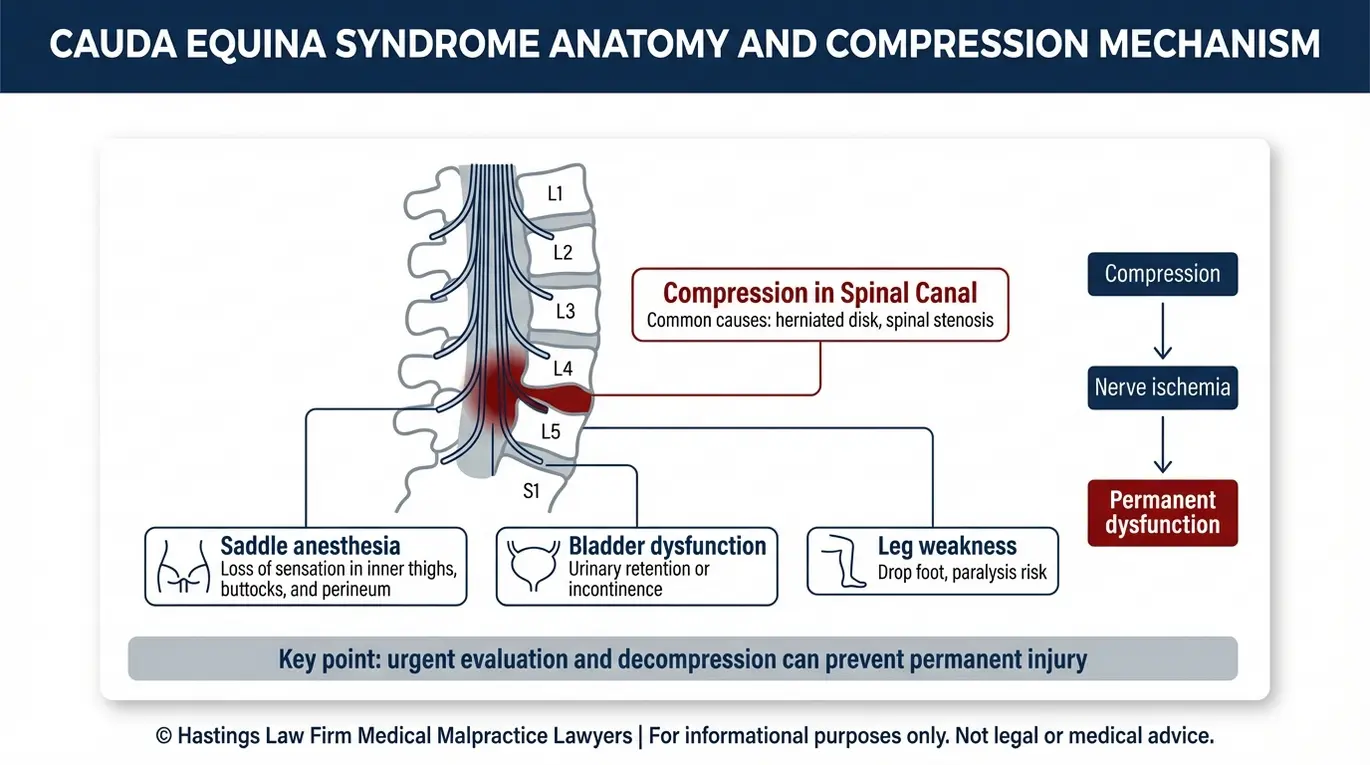
Cauda Equina Syndrome (CES) is a rare but critical surgical emergency caused by compression of the nerve roots at the base of the spinal cord. Without immediate treatment, it can lead to permanent paralysis, loss of bladder and bowel control, and other irreversible damage.
The name “cauda equina” is Latin for “horse’s tail,” which describes the bundle of nerve roots that fan out from the bottom of the spinal cord in the lumbar spine. These nerves are responsible for sending and receiving messages between the brain and the pelvic organs and lower limbs.
Unlike the spinal cord itself, which ends at the upper lumbar level, the cauda equina nerve roots float in cerebrospinal fluid. They control sensation and movement in the lower body, including the legs, bladder, bowels, and pelvic region. When something compresses these nerve roots, it can cut off signals between the brain and the lower body.
The most common cause of CES is a large lumbar disc herniation, where a herniated disk pushes directly against the nerve bundle. Other causes include spinal stenosis, tumors, infections, or trauma. Regardless of the cause, the process is the same: pressure builds on the nerves, and the longer it remains, the greater the risk of permanent damage. According to guidelines published in the Journal of Neurointensive Care, CES requires urgent evaluation and treatment to preserve neurological function.
Emergency room physicians and other providers must recognize the red flag symptoms that point to CES. Severe low back pain is often the earliest symptom, but because back pain is so common, it is the combination with other symptoms that defines the emergency. These include:
- Saddle anesthesia, which is numbness or tingling in the inner thighs, buttocks, and perineal area (the region you would contact if sitting on a saddle)
- Urinary retention or the inability to start or fully empty the bladder
- Bowel incontinence or sudden loss of bowel control
- Severe low back pain, often with radiating leg pain or weakness
- Progressive weakness or numbness in one or both legs
- Sexual dysfunction with sudden onset
Any combination of these symptoms should trigger immediate evaluation. When a provider dismisses them or attributes them to a less serious condition, the window for effective treatment begins to close. If this happens to you, a specialized Texas Cauda Equina Syndrome malpractice lawyer can help evaluate if negligence occurred.
Failure to Diagnose and the Critical Window for Treatment
Medical malpractice often occurs when healthcare providers fail to order an emergency MRI despite the presence of red flag symptoms like urinary retention or saddle anesthesia. Texas Cauda Equina Syndrome malpractice lawyers often see cases where the standard of care, which typically requires surgical decompression within 24 to 48 hours of symptom onset, is ignored, costing the patient their best chance of preserving function.
An emergency MRI, a magnetic resonance imaging scan performed on an urgent basis, is the gold standard for confirming CES. It provides detailed images of the spinal canal and can show exactly where and how severely the nerve roots are compressed. CT scans may be used as an alternative, but they are less detailed for soft tissue evaluation. When a provider suspects CES based on clinical findings, the standard of care calls for immediate imaging, not a wait and see approach.
The concept behind urgent treatment is sometimes described as “time is spine.” Research published on the timing of surgical decompression for Cauda Equina Syndrome (PubMed) supports the principle that earlier treatment leads to significantly better neurological outcomes. Every hour of delay can mean the difference between recovery and permanent disability.
CES-I vs. CES-R: Why the Stage at Treatment Matters
Doctors use the stages of CES to assess the urgency of surgery and the potential for recovery. These stages help medical teams decide how quickly a patient needs an operation to prevent permanent damage.
| Stage | Name | Key Features | Surgical Outlook |
|---|---|---|---|
| CES-I | Incomplete | Reduced urinary sensation, difficulty initiating urination, partial saddle numbness | Better outcomes when decompression occurs at this stage |
| CES-R | Retention | Painless urinary retention, overflow incontinence, significant loss of bladder control | Poorer prognosis; damage is often more advanced |
Operating during the CES-I (Incomplete) stage, before the patient progresses to full urinary retention, generally produces better results. This stage occurs when the patient still has some bladder sensation. Preserving this function is the primary goal of emergency surgery.
Once the patient crosses the threshold into CES-R, the likelihood of a full recovery drops quickly. Documenting exactly when the shift occurred is often a key factor in proving causation. A Texas Cauda Equina Syndrome malpractice lawyer will closely examine the timeline to determine whether earlier treatment could have changed the outcome.
The Role of Bladder Scans and PVR Testing in Diagnosis
A bladder scan is a simple tool used to check for urinary retention at the bedside. One of the simplest diagnostic tools in a suspected CES case is the post-void residual (PVR) test. This is a non-invasive procedure where a bladder scan, a small portable ultrasound device, measures how much urine remains in the bladder after the patient attempts to urinate.
A high PVR reading is a strong clinical indicator of urinary retention and should prompt further workup. Failure to perform this quick test when a patient presents with back pain and urinary symptoms is a common evidence point in CES malpractice claims. When it is skipped, the standard of care may have been breached.

The Hastings Law Firm Difference
Results matter, but what truly sets us apart is how we achieve them. Every verdict, every settlement, and every Texas courtroom victory comes from one guiding promise: To treat each client’s fight for justice as if it were our own.
This balance of skill, experience, and empathy reflects our core philosophy that justice should not only compensate the injured, but also make healthcare safer nationwide.

Proving Liability in Texas Cauda Equina Cases
To win a CES malpractice claim in Texas, the patient must prove that the medical provider breached the accepted standard of care and that this breach directly caused the permanent injury. This requires expert testimony to establish what a reasonably prudent physician would have done under similar circumstances.
Texas medical malpractice claims are governed by Texas Civil Practice and Remedies Code Chapter 74, which sets specific procedural requirements for medical liability cases. At the core of every case are four legal elements that must be established:
- Duty: The healthcare provider owed the patient a duty of care based on the doctor-patient relationship.
- Breach: The provider failed to meet the accepted standard of care. In many cases, the breach is an act of omission, or what the doctor failed to do. For example, failing to perform a perineal sensory exam, not checking anal sphincter tone, or discharging a patient without ordering imaging can deviate from accepted standards.
- Causation: The breach directly caused or contributed to the patient’s permanent injury. We must link the mistake to the paralysis or dysfunction. If the delay allowed the compression to become permanent, causation can be supported.
- Damages: The patient suffered real, measurable harm because of the negligence.
Qualified expert testimony must support each of these elements. A Texas Cauda Equina Syndrome malpractice lawyer on our team works with neurologists, neurosurgeons, and emergency medicine specialists to reconstruct the clinical timeline and identify the points where the standard of care was violated.
Research published in BMC Musculoskeletal Disorders (PubMed Central) highlights the connection between timing of treatment and long-term outcomes, which is central to proving causation in these claims.
Rebutting the “Die Was Already Cast” Defense
The “die was cast” argument is a common legal tactic where hospitals claim the injury was unavoidable regardless of their actions. This defense suggests that the outcome was set before the doctor even arrived, and we work to disprove this with a detailed timeline.
As Texas Cauda Equina Syndrome malpractice lawyers, we know how to challenge this argument. We examine the full medical record, including triage notes, nursing assessments, and any imaging that was or was not performed. We work with our expert network to establish the patient’s neurological status at the time of presentation and track how the condition progressed during periods of inaction. If records show a patient still had partial function (CES-I) upon arrival but deteriorated to full retention (CES-R) by the time surgery was performed, that timeline can demonstrate that earlier treatment would have preserved function.

Calculating Damages for Long-Term Consequences
Patients harmed by CES malpractice may be entitled to substantial compensation for both economic damages, such as lifetime medical care and lost earning capacity, and non-economic damages for pain, suffering, and diminished quality of life. Legal damages represent the financial and personal losses caused by medical negligence.
The physical reality of living with permanent CES damage is something many people do not fully understand until they face it. Depending on the severity, a patient may require permanent catheterization to manage a neurogenic bladder, which is a condition where nerve damage prevents normal bladder function. Structured bowel management programs may become a daily necessity.
Sexual dysfunction is common and can have a profound impact on relationships and mental health. Patients with foot drop, where nerve damage makes it difficult to lift the front of the foot, may need braces or wheelchairs for mobility. These are lifelong conditions that require ongoing medical care and support.
Our team works with life care planners and economists to build projections of what care will cost over several decades. A life care plan is a detailed document. It calculates the costs of replacement catheters, medications for nerve pain, regular urology check-ups, and the architectural changes needed for a home. These projections follow established standards like those outlined by the American Association of Nurse Life Care Planners (Wellspring Case Management) and account for every category of future need.
Recoverable damages in a Texas CES case may include:
- Past and future medical expenses, including surgeries, supplies, and rehabilitation
- Lost wages and diminished future earning capacity
- Pain and suffering
- Physical impairment and disfigurement
- Mental anguish and emotional distress
- Loss of consortium
- Cost of in-home care and medical equipment
A Texas Cauda Equina Syndrome malpractice lawyer will work to ensure that every category of harm is documented with supporting evidence, so the full scope of the injury is reflected in the case.
Why Choose Hastings Law Firm for Your CES Claim
Hastings Law Firm focuses exclusively on medical malpractice. We represent patients who have suffered harm due to medical negligence across Texas. Every attorney, nurse consultant, and staff member on our team is dedicated to holding negligent healthcare providers accountable for the harm they cause.
Our trial-ready approach means we prepare every CES case from day one as if it will go before a jury. This level of preparation signals to insurance carriers that we will not accept less than fair value. Our legal team includes former defense attorneys and hospital nurses who previously worked for the systems they now challenge. Our in-house medical staff, including nurse practitioners and board-certified patient advocates, review records and help translate clinical data into evidence a jury can understand.
We also understand what our clients are going through on a personal level. Many people who call us feel dismissed or ignored by the medical system. We believe in validating that experience and giving our clients a voice. As a Texas Cauda Equina Syndrome malpractice lawyer, Tommy Hastings and his team treat every client as a partner in the process.
We handle CES cases on a contingency fee basis, which means you pay no attorney fees or costs unless we recover compensation for you.
Contact the Texas Healthcare Malpractice Attorneys at Hastings Law Firm Today for Help
Texas law limits the time you have to file a medical malpractice claim, and important evidence can become harder to obtain as time passes. If you or a loved one suffered permanent injury because Cauda Equina Syndrome was not diagnosed in time, we encourage you to reach out.
Hastings Law Firm offers a free, confidential case evaluation led by a patient advocate. We will review your medical records, consult with qualified experts, and give you an honest assessment of whether negligence contributed to your injury.
You do not have to figure this out alone. Call us or fill out our online contact form to schedule your consultation. There is no fee unless we win.
Frequently Asked Questions About Cauda Equina Syndrome Malpractice in Texas


This content was researched and written by the Hastings Law Firm editorial team, which includes attorneys, medical professionals, and experienced researchers. Our writing is informed by internal knowledge and practical experience, and we cross-check critical details against authoritative sources cited throughout. Every piece undergoes human-led fact-checking and legal review. Because legal and medical information can change, if you spot an error, please contact us. Learn more about our content standards and review process on our editorial policy page.

Brady D. Williams is a nationally recognized medical malpractice attorney who has spent his career handling high-stakes litigation for injured patients and families across the country. Licensed in both Texas and California, Brady draws on experience from hundreds of resolved medical cases to break down complex legal and medical topics for the people who need that information most. His writing reflects the same attention to detail and commitment to clarity that he brings to every case he handles.
