


Arizona Cardiac Catheterization Complications Lawyer
Written by: Hastings Law Firm | Reviewed by: Tommy Hastings | Updated: July 27, 2026
Cardiac catheterization is often used to diagnose heart conditions, but preventable mistakes in the cath lab can cause severe complications and long term harm. Problems can arise from improper vascular access, failures to monitor vital signs, contrast dye screening errors, or inadequate post procedure checks, and the most serious outcomes can be life threatening. Arizona law distinguishes between known risks that may be part of informed consent and errors that may constitute malpractice. If you or a loved one were harmed or worse due to cardiac catheterization malpractice in Arizona, contact Hastings Law Firm for a free, confidential case review.

Trusted Arizona Medical Attorneys for Heart Catheterization Malpractice Claims
What You Should Know About Heart Catheterization Malpractice Claims in Arizona:
- Life altering harm can follow when cardiac catheterization complications stem from preventable errors rather than known risks.
- Recovery can turn on whether the injury is tied to improper vascular access that leads to uncontrolled bleeding.
- Severe outcomes can result when contrast dye is given without appropriate screening for allergies or kidney conditions.
- Worsening injury can occur when post procedure monitoring fails to detect bleeding at the access site.
- Liability disputes can focus on whether the chosen entry point was appropriate for the patient, since femoral and radial access carry different risk profiles.
- Options can be lost if the filing deadline under Arizona law is missed.
- Proving a claim can depend on showing a deviation from the accepted medical standard of care and a direct link to the injury.
- Causation can be the most contested issue when the defense argues the complication was a known risk rather than an error.
- Compensation can include corrective surgeries, long term cardiac care, lost income, and pain and suffering.
- Clarity about what happened can depend on access to key records such as angiogram footage and vital signs logs.

A Healthcare Focused Law Firm
While cardiac catheterization is a common procedure used to diagnose heart conditions, mistakes in the cath lab can lead to life-altering injuries. When performed correctly in a specialized facility, the risks are well-documented and manageable. However, errors during these procedures can cause severe complications for patients and their families.
Our firm focuses solely on medical malpractice litigation, ensuring your case receives specialized attention. Our founder, Tommy Hastings, is board-certified in personal injury trial law, a distinction held by fewer than 2% of attorneys in the field.
If you or a loved one suffered a serious complication, an experienced Arizona cardiac catheterization complications lawyer can review your medical records and explain your legal options. Reach out to our team for a free, confidential case evaluation.
Common Preventable Errors in Cardiac Catheterization Procedures
Preventable errors often stem from improper vascular access, failure to monitor vitals, or the negligent use of contrast dyes, leading to hemorrhage, stroke, or kidney failure. In Arizona medical malpractice law, a clear line exists between known risks and preventable errors.
Vascular Access Issues
Vascular access, the point where the catheter enters a blood vessel, is critical. Accessing the femoral or radial artery is the first step in these procedures. Poor technique can cause arterial dissection, a tear in the artery wall leading to uncontrolled bleeding.
Other cardiac catheterization errors include pseudoaneurysms, a contained arterial rupture, and retroperitoneal hemorrhage, bleeding behind the abdominal cavity. The National Center for Biotechnology Information’s review of cardiac catheterization risks and complications notes these vascular injuries are frequent adverse events.
Medication and Dye Errors
Medical teams must screen for allergies and kidney conditions before administering a contrast agent, which is a dye used to improve heart imaging during catheterization. This screening process is a standard safety protocol in the cardiac lab.
Failure to do so may cause anaphylaxis or contrast-induced nephropathy, acute kidney damage. These are preventable with proper screening.
Post-Procedure Negligence
After the cardiologist removes the catheter, the access site requires monitoring for bleeding or a hematoma, which is a localized swelling filled with blood. The access site is the location on the body where the catheter was inserted. Neglecting this check can allow a slow bleed to escalate into a massive hemorrhage.
Femoral vs. Radial Access Risks
The entry point changes the risk profile. Physicians must choose between the groin (femoral) or wrist (radial) to reach the heart. Femoral access carries higher retroperitoneal hemorrhage risks, particularly in obese patients.
Radial access generally has lower bleeding risks but requires specific technical skills. Selecting the wrong approach for a patient’s heart catheterization anatomy can constitute negligence.
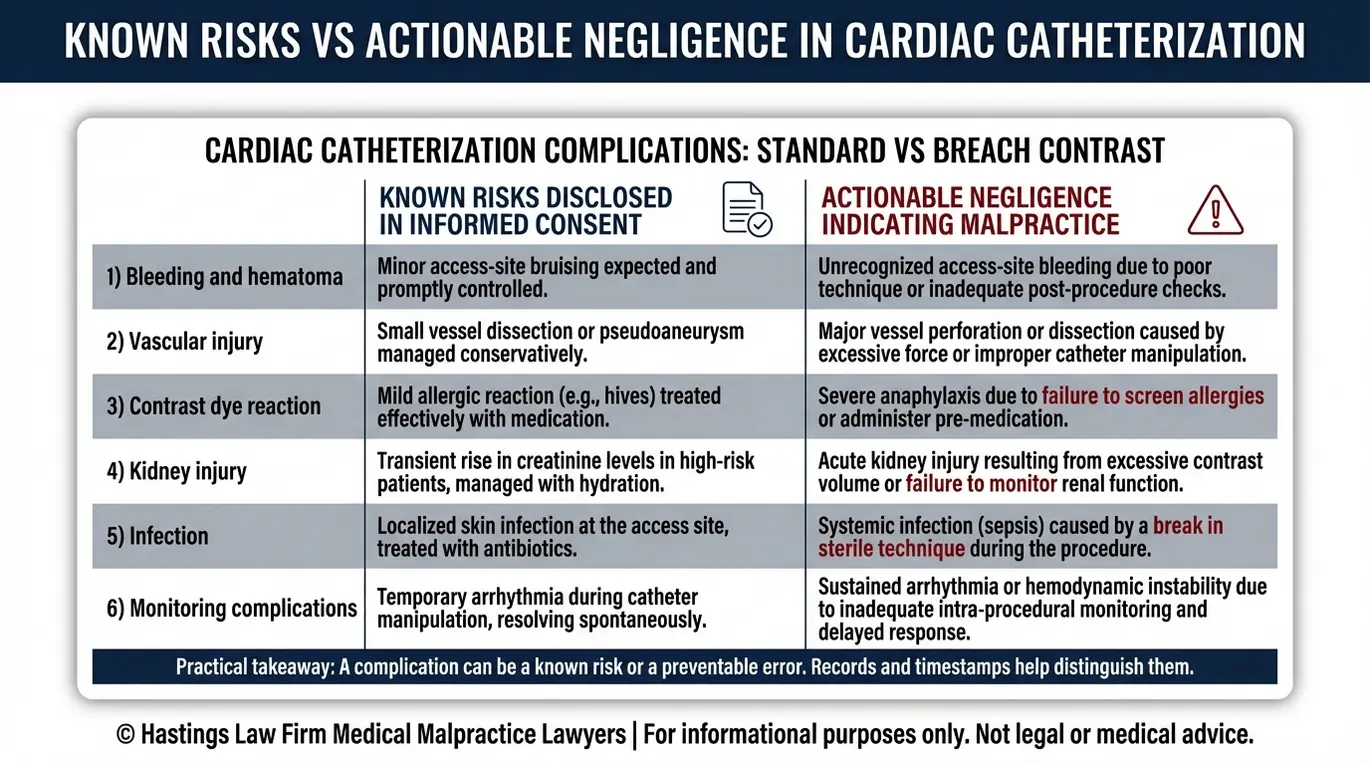
This table illustrates the difference between risks a patient may consent to and errors that may constitute actionable negligence:
| Known Risks (Informed Consent) | Actionable Negligence (Malpractice) |
|---|---|
| Minor bruising or hematoma at the access site | Uncontrolled hemorrhage from improper arterial puncture technique |
| Mild allergic reaction to contrast dye | Anaphylaxis caused by failure to screen patient’s allergy history |
| Temporary soreness or discomfort post-procedure | Retroperitoneal bleed missed due to inadequate post-procedure monitoring |
| Minor arrhythmia during catheter insertion | Stroke or embolism caused by catheter mishandling |
| Slight risk of infection with proper sterile protocol | Infection caused by failure to maintain sterile conditions |
Under Arizona Revised Statutes § 12-542, patients generally have two years from the date of injury to file a claim. An Arizona cardiac catheterization malpractice lawyer can help determine when that deadline applies to your specific situation.
Filing a Lawsuit for Cardiac Catheterization Negligence in Arizona
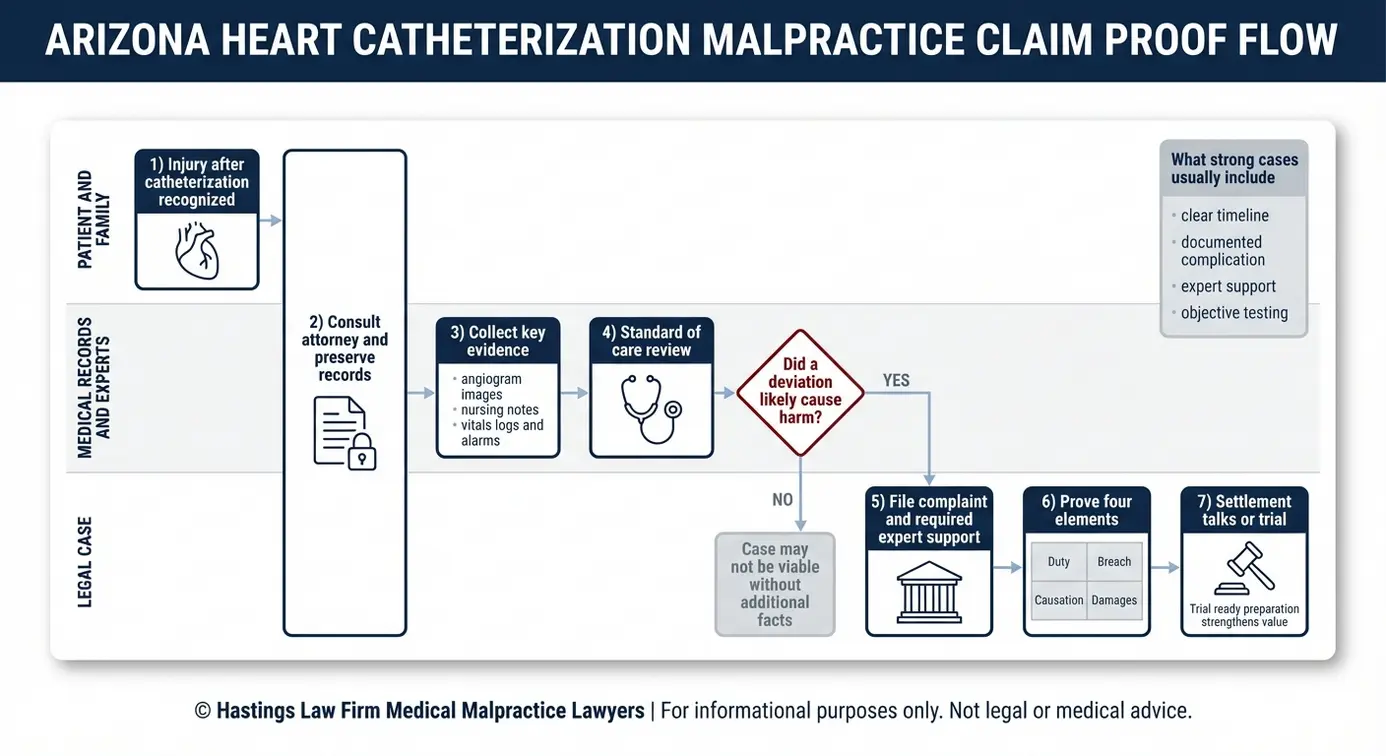
To file a lawsuit in Arizona, a plaintiff must prove that the cardiologist deviated from the accepted medical standard of care and that the deviation directly caused injury or death. A heart injury claim involves establishing three core elements: breach of duty, causation, and damages.
Breach of duty means demonstrating what a reasonably competent cardiologist would have done under similar circumstances, and showing that the treating physician fell short of that standard. This focuses on medical negligence rather than just a bad outcome. It is about whether the care provided met the level of skill and attention the medical community expects.
Causation is often the most contested element. The defense will argue that the complication was a known risk, not the result of error. To counter this, we work with a qualified expert witness who can connect the specific mistake, such as a nicked artery or unscreened allergy, to the resulting harm.
In *Francisco et al. v. Affiliated Urologists et al.*, the Arizona Supreme Court reinforced the importance of expert testimony in establishing that a provider’s conduct fell below accepted standards.
Damages include the full scope of harm caused. Patients may seek compensation for corrective surgeries, long-term cardiac care, lost income, and pain and suffering. In cases involving wrongful death, surviving family members may also pursue claims for loss of companionship and funeral costs.
Certain medical terms often appear in these cases. Contrast-induced nephropathy (CIN) refers to kidney damage triggered by contrast dye. Anaphylaxis is a severe and potentially fatal allergic reaction. Both issues are preventable with proper pre-procedure evaluation.
Here is a summary of the evidence we typically gather when building these cases:
- Angiogram footage and fluoroscopy recordings from the procedure
- Nursing notes and vital signs logs before, during, and after catheterization
- Catheterization lab records, including equipment logs and staffing documentation
- The patient’s full medical history, including allergy records and kidney function tests
- Pre-procedure informed consent documents
- Post-procedure monitoring charts and discharge instructions
- Expert review by a board-certified cardiologist
As an attorney for heart catheterization injuries, our team works alongside in-house medical staff and a national network of cardiology experts to piece together what happened, minute by minute.
The Hastings Law Firm Difference
Results matter, but what truly sets us apart is how we achieve them. Every verdict, every settlement, and every Arizona courtroom victory comes from one guiding promise: To treat each client’s fight for justice as if it were our own.
This balance of skill, experience, and empathy reflects our core philosophy that justice should not only compensate the injured, but also make healthcare safer nationwide.

Recognizing Red Flags and Systemic Failures
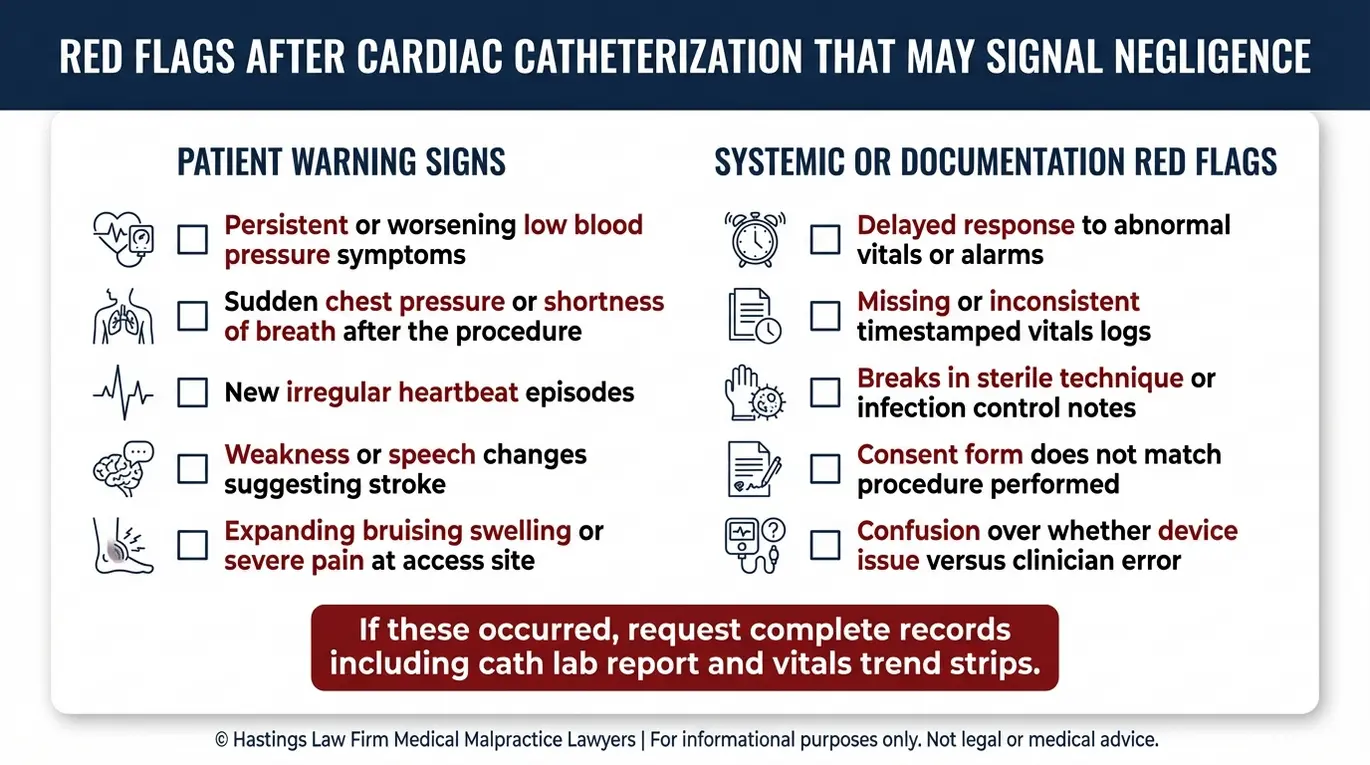
Signs of malpractice may include unaddressed hypotension, delayed reaction to stroke symptoms during the procedure, or failure to sterilize equipment properly. These are not always obvious in the moment, but they often become clear when the medical records are examined closely.
Monitoring failures are among the most common red flags. A sudden drop in blood pressure, known as hypotension, can signal internal bleeding. If the cath lab team fails to track vitals or respond to abnormal readings, a treatable bleed can escalate into cardiac tamponade, a dangerous buildup of fluid around the heart, or cardiac arrest.
Arrhythmias, or irregular heartbeats, may also go unaddressed if monitoring is inadequate. We distinguish between defective devices and physician error. If a catheter malfunctions, the claim may involve product liability; check the U.S. Food and Drug Administration’s Medical Device Recalls and Early Alerts database for flags.
If the equipment functioned correctly but there was a failure to maintain sterile conditions, the claim falls under medical malpractice. Informed consent issues arise if a doctor performs unauthorized procedures. Patients have the right to access their own medical records under the HIPAA right of access rule, a federal law that ensures you can review your health information.
The HIPAA rule, at 45 CFR § 164.524, is the first step in identifying systemic facility failures. Cardiac malpractice lawyers in Phoenix can help you obtain and interpret those records.
Contact the Arizona Healthcare Malpractice Attorneys at Hastings Law Firm Today for Help
If you or a loved one suffered a serious injury during a heart catheterization procedure, you deserve clear answers about what went wrong and whether it could have been prevented. At Hastings Law Firm, our legal team includes former defense attorneys and in-house medical professionals who know exactly how to investigate these cases and hold the responsible parties accountable.
We offer a free, no-obligation case evaluation to help you understand your legal options. Our team will review your medical records, consult with cardiology experts, and give you an honest assessment of your claim.
We handle these cases on a contingency fee basis, which means you pay no attorney fees or costs unless we secure a recovery for you. If something went wrong during your procedure, let us help you find the answers you deserve. Contact Hastings Law Firm today.
Frequently Asked Questions About Cardiac Catheterization Complications in Arizona


This content was researched and written by the Hastings Law Firm editorial team, which includes attorneys, medical professionals, and experienced researchers. Our writing is informed by internal knowledge and practical experience, and we cross-check critical details against authoritative sources cited throughout. Every piece undergoes human-led fact-checking and legal review. Because legal and medical information can change, if you spot an error, please contact us. Learn more about our content standards and review process on our editorial policy page.

Tommy Hastings, founder of Hastings Law Firm, is a board-certified personal injury trial lawyer dedicated exclusively to healthcare injury cases. Since 2001, he has represented injured patients and families in litigation against major hospital systems, pharmaceutical companies, and negligent healthcare providers nationwide. He has handled numerous high-profile cases that have drawn national media attention and resulted in multi-million dollar recoveries. He draws on that experience in his writing, helping readers understand how these cases work and what options may be available to them.
