


Texas Blood Transfusion Error Lawyer
Written by: Hastings Law Firm | Reviewed by: Brady D. Williams | Updated: July 27, 2026
An incompatible blood transfusion can turn a routine hospital procedure into a medical emergency with rapid, life threatening consequences. These events often trace back to preventable breakdowns in patient identification, sample labeling, laboratory testing, and bedside verification. When warning signs are missed and the transfusion is not stopped promptly, the harm can escalate to permanent organ damage or worse. Understanding how these errors happen and how reactions present can help families make sense of what went wrong. If you or a loved one were harmed or worse due to an incompatible blood transfusion in Texas, contact Hastings Law Firm for a free, confidential case review.

Dedicated Texas Medical Attorneys for Incompatible Blood Transfusion Claims
What You Should Know About Wrong Blood Type Transfusion Claims in Texas:
- Harm can be catastrophic when incompatible blood is transfused, including organ failure, cardiac arrest, and death.
- Recovery can hinge on whether hospital staff followed identity verification and bedside labeling safeguards before blood was administered.
- Long term medical needs can be extensive after a severe reaction, including lifelong dialysis or round the clock care when permanent injury occurs.
- Options for compensation can be limited for pain and suffering in Texas because non economic damages are capped.
- Financial recovery for medical costs and lost income can be larger in severe cases because economic damages are not capped in Texas.
- Liability can expand beyond the initial mismatch when staff fail to recognize warning signs and stop the transfusion promptly.
- Disputes often focus on administrative breakdowns such as mislabeled samples or skipped barcode scanning at the bedside.
- Proof can depend on whether hospital records show gaps like missing scans or incomplete verification documentation.
- Access to medical records can be critical when a transfusion error is suspected because transfusion logs and monitoring charts may show what occurred.

A Healthcare Focused Law Firm
A blood transfusion is supposed to be one of the safest, most routine procedures in medicine. When the wrong blood reaches a patient, the consequences can be catastrophic. ABO incompatibility, where a patient receives blood from a mismatched blood type, can trigger organ failure, cardiac arrest, and death within minutes.
If you or a loved one was harmed by a preventable transfusion error, you deserve answers about what went wrong and who is responsible. As a Texas blood transfusion error lawyer team that focuses exclusively on medical malpractice, Hastings Law Firm has the medical and legal resources to investigate these cases thoroughly. Our in-house nurses and former defense attorneys know exactly where to look in hospital records to uncover the breakdown.
We can review what happened and explain your options. Contact us for a free, confidential case evaluation.
Medical Negligence Leading to Wrong Blood Type Transfusions
Negligence in blood transfusions typically occurs when medical staff fail to follow the two-identifier verification protocol, a safety check requiring staff to confirm a patient’s identity using at least two unique identifiers (such as name and date of birth) before administering blood. The standard of care represents the level of care and skill that a competent healthcare professional would provide under similar circumstances. Founded by Tommy Hastings, a board-certified trial lawyer, our firm focuses exclusively on representing patients in medical negligence cases. This breach of the standard of care often traces back to mislabeled samples at the bedside or laboratory errors during the type and screen process, the initial lab test that determines a patient’s blood type and checks for antibodies that could cause a reaction.
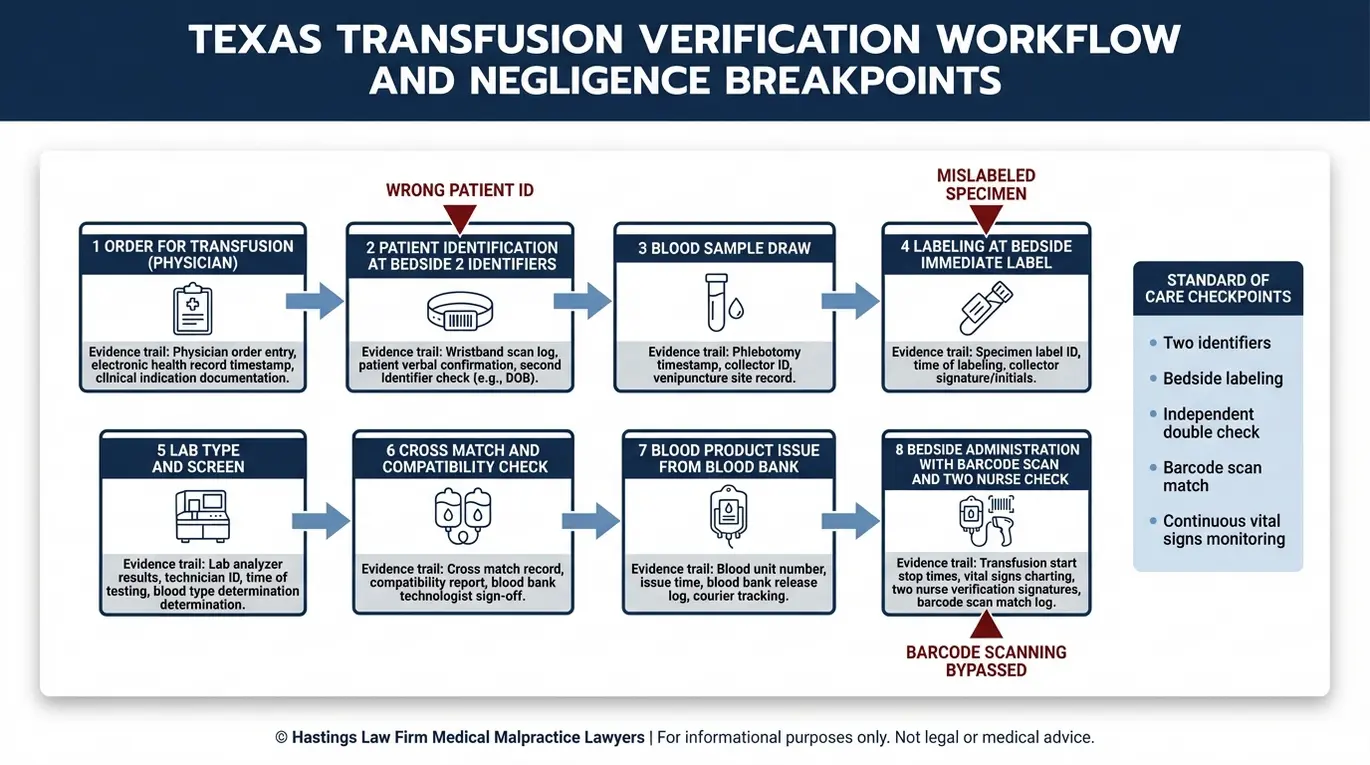
Every blood transfusion follows a specific chain of custody. From the moment a nurse draws blood for typing to the moment a unit is hung at the bedside, there are multiple required checkpoints. When any one of these steps is skipped or performed carelessly, a patient can receive incompatible blood.
The standard of care for patient safety requires a strict verification process involving the following steps:
- Confirming the patient’s identity with two unique identifiers at the time of the blood draw
- Labeling the blood sample at the bedside immediately after collection
- Performing a type and screen and crossmatch in the hospital laboratory
- Scanning the barcode on both the patient’s wristband and the blood unit before infusion
- Having a second nurse independently verify the match before the transfusion begins
Federal regulations reinforce these requirements. Under 42 CFR § 482.23, Condition of Participation: Nursing Services, CMS (Centers for Medicare & Medicaid Services) mandates that hospitals maintain protocols ensuring medications and blood products are administered safely. When a hospital violates these federal standards, that violation is strong evidence of negligence in a malpractice case.
These regulations are designed to prevent the precise administrative failures that lead to incompatibility. Compliance is mandatory, and our legal team uses these federal benchmarks to establish the facility’s liability.
As a blood transfusion error lawyer in Texas, Hastings Law Firm approaches these cases with a level of medical insight most firms cannot match. Our in-house nursing staff reviews the full “audit trail” of the blood bag, tracing it from the blood bank to the bedside. They examine barcode scanning logs, nursing verification records, and lab chain-of-custody documentation to identify exactly where the breakdown occurred. We analyze staffing levels and protocol adherence to prove systemic negligence. This is the kind of detail that a Texas blood transfusion negligence attorney needs to build a strong case, and our team finds it because they know where to look from years of working inside the system.
Identifying Symptoms of an Incompatible Blood Transfusion
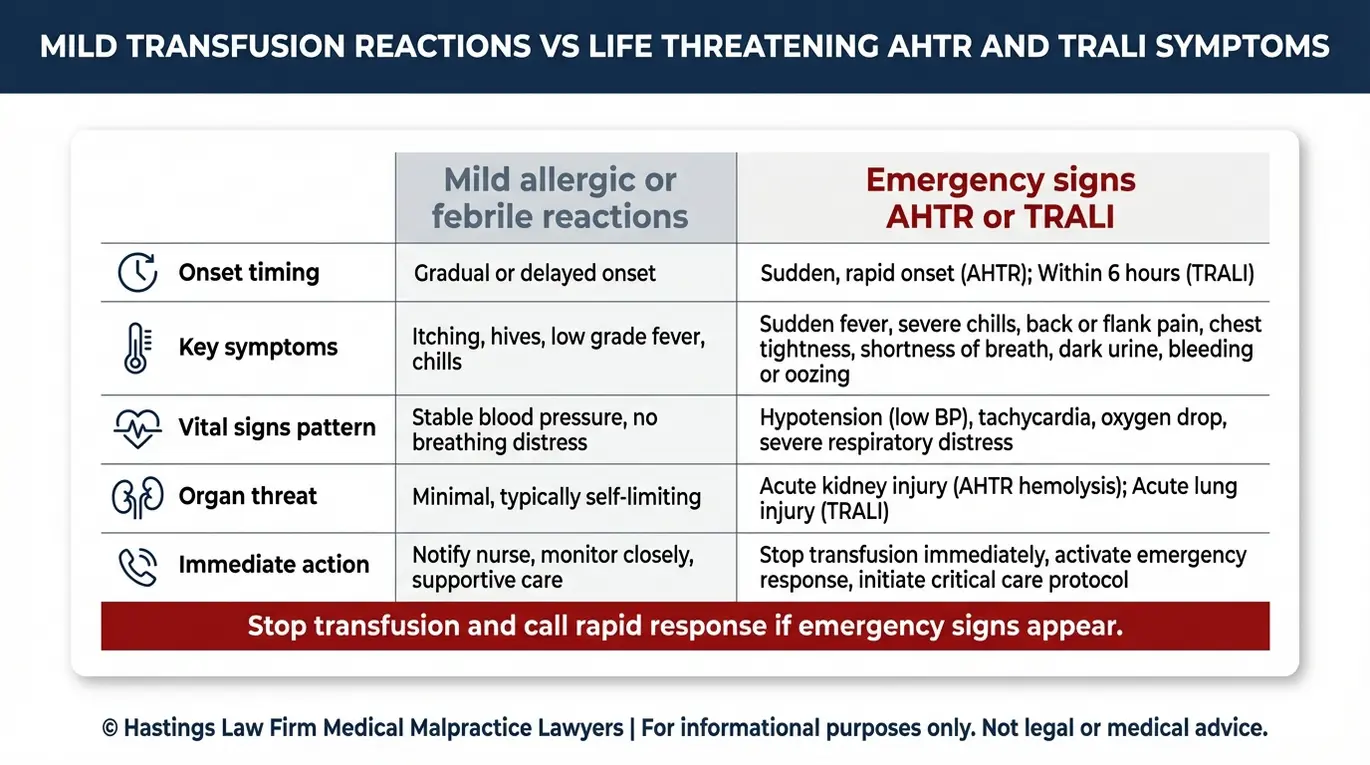
Symptoms of an acute hemolytic transfusion reaction (AHTR), a severe immune response triggered when a patient receives ABO-incompatible blood, often appear within minutes of the infusion beginning. These symptoms include sudden fever, flank pain signaling kidney distress, widespread clotting abnormalities, and a reported sense of impending doom. Failure to recognize these signs immediately and stop the transfusion is a secondary act of medical negligence.
Not all adverse reactions signal a life-threatening emergency. Some reactions are mild and self-limiting. The difference between a minor allergic response and a fatal reaction matters enormously, both medically and legally.
| Mild Allergic Reactions | Life-Threatening AHTR / TRALI Symptoms |
|---|---|
| Hives or skin rash | Sudden high fever and rigors (shaking chills) |
| Mild itching | Severe flank or back pain (kidney distress) |
| Low-grade fever | Dark or bloody urine |
| Minor flushing | Rapid drop in blood pressure / shock |
| Difficulty breathing / acute respiratory failure | |
| Cardiac arrest | |
| Disseminated intravascular coagulation (widespread clotting) |
Transfusion-related acute lung injury (TRALI), a condition where the transfused blood triggers sudden lung inflammation and respiratory failure, remains one of the leading causes of transfusion-related death in the United States. According to the U.S. Food and Drug Administration’s Fatalities Reported Following Blood Collection and Transfusion: Annual Summary for Fiscal Year 2021, TRALI and related pulmonary complications continue to account for a significant portion of reported fatalities.
When bedside nurses and physicians are performing vital signs monitoring during a transfusion, they are trained to watch for these warning signs. Liability can attach not only to administering the wrong blood, but also to a concept known as “failure to rescue,” the failure to stop the transfusion pump and intervene when vital signs begin to crash. Even minutes of delay after symptoms appear can mean the difference between a recoverable reaction and permanent organ damage.
The Physiology of Organ Destruction
Understanding why the wrong blood can be fatal helps explain why these cases carry such severe damages. When ABO-incompatible blood enters the body, the patient’s immune system immediately initiates antibody destruction of the foreign red blood cells. This triggers hemolysis, the rapid destruction and bursting of those cells, which floods the bloodstream with toxic cellular debris.
That debris overwhelms the kidneys as they attempt to filter it out, often leading to acute kidney failure. At the same time, the destroyed red blood cells can no longer carry oxygen, leading to organ oxygen deprivation. The combination of kidney shutdown, oxygen deprivation, shock, and uncontrolled clotting is what makes an incompatible transfusion lethal.
The Hastings Law Firm Difference
Results matter, but what truly sets us apart is how we achieve them. Every verdict, every settlement, and every Texas courtroom victory comes from one guiding promise: To treat each client’s fight for justice as if it were our own.
This balance of skill, experience, and empathy reflects our core philosophy that justice should not only compensate the injured, but also make healthcare safer nationwide.

Common Hospital Failures: Labeling and Monitoring Errors
The majority of transfusion errors are administrative, not clinical. They stem from mislabeled blood samples, which occur when blood drawn from one patient is incorrectly labeled with another patient’s information, or from failure to scan barcodes at the bedside. These are systemic failures of hospital protocol that compromise patient safety before the blood even reaches the room.
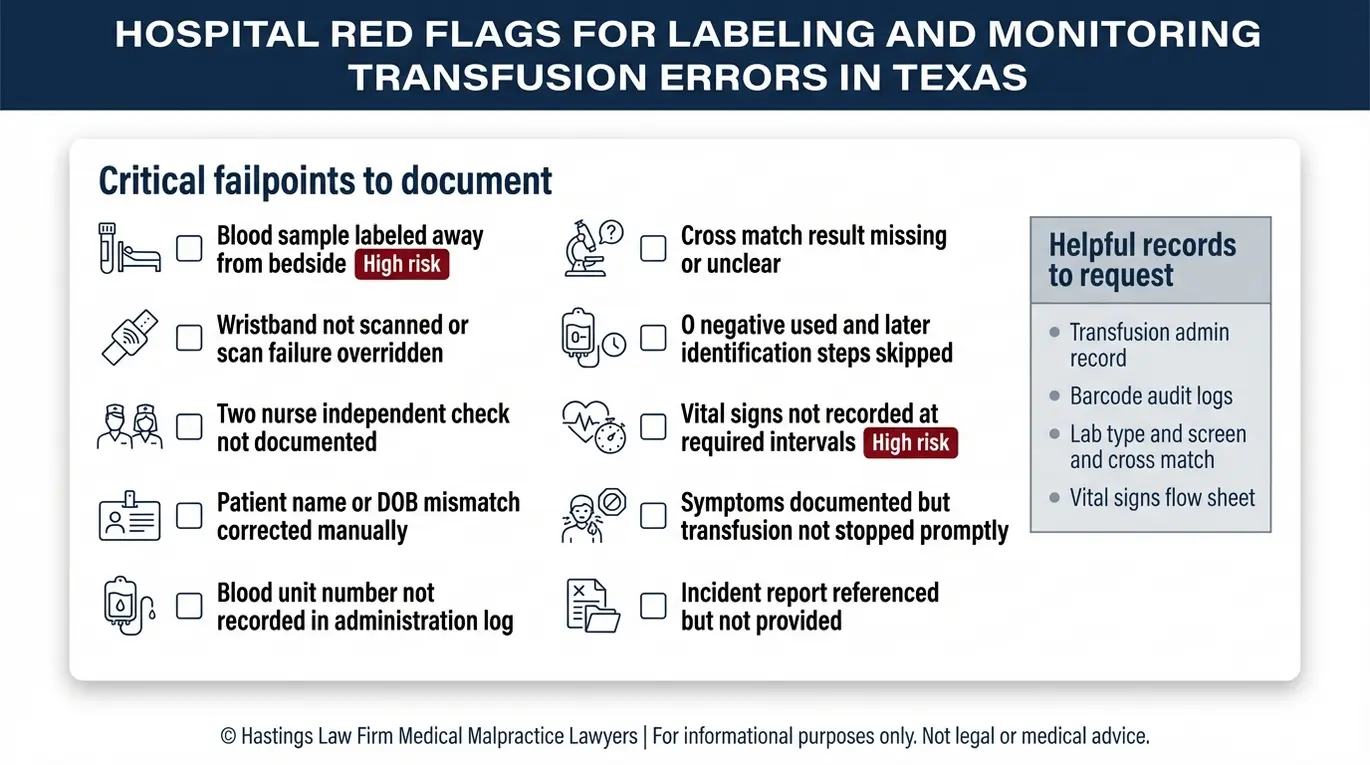
Our investigations as a Texas blood transfusion error lawyer team consistently reveal that errors cluster around a few predictable failure points:
- The bedside draw: A nurse or phlebotomist draws blood from Patient A but labels the tube with Patient B’s information. This is one of the most common blood labeling errors, often because labels were pre-printed or multiple draws were happening simultaneously.
- The lab mix-up: Errors within the hospital laboratory or blood bank during cross-matching, the process of testing a donor unit against the patient’s blood to confirm compatibility, can result in an incompatible unit being cleared for transfusion.
- Missing barcode scans: Staff skip the electronic verification step at the bedside, relying on visual checks alone.
- Incomplete two-identifier checks: Only one identifier is confirmed, or the confirmation is performed by a single nurse instead of two.
- The “O-Negative” masking effect: In emergencies, hospitals often use O-negative blood (the universal donor type) when there is no time for a full type and screen. While this is appropriate in the moment, it can create dangerous complacency. If the emergency unit works and no reaction occurs, staff may become less vigilant about proper verification for later transfusions, assuming the process is “close enough.”
Each of these breakdowns leaves a trail in the medical records. Hospital quality assurance programs regulated under CLIA (Clinical Laboratory Improvement Amendments) require labs to maintain records of every step in the testing and verification process. When those records show gaps, missing scans, or unsigned verification forms, they tell the story of how the system failed.
Compensation for Transfusion Injuries in Texas Courts
Patients harmed by transfusion errors in Texas may recover economic damages for medical bills and lost wages, as well as non-economic damages for pain, suffering, and physical impairment. In Texas, compensation for these injuries is divided into several categories based on whether the loss is financial or personal.
Economic damages, which cover past and future medical expenses, lost earning capacity, rehabilitation costs, and other measurable financial losses, are not capped. This is especially significant in transfusion injury cases. A patient who suffers permanent kidney failure may require dialysis for the rest of their life.
Someone who experiences brain injury from shock or oxygen deprivation during cardiac arrest may need round-the-clock care. The lifetime cost of these injuries can reach into the millions.
Non-economic damages, covering pain and suffering, mental anguish, disfigurement, and physical impairment, are subject to caps under Texas medical malpractice law. The cap is $250,000 against all individual physicians and healthcare providers combined, with a separate cap of $250,000 per healthcare institution (up to $500,000 across multiple institutions), for a total cap of roughly $750,000 when multiple defendants are involved.
Under Texas Civil Practice and Remedies Code § 74.051, medical malpractice claims in Texas also require specific pre-suit notice to the healthcare provider. A lawyer for blood transfusion errors can ensure these procedural requirements are met so your claim is preserved.
For families who lost a loved one, both wrongful death and survival actions may be available. Accurate calculation of lifetime economic losses by a qualified medical malpractice lawyer is critical because those damages have no cap, and they often represent the largest portion of a recovery in catastrophic transfusion cases.
Contact the Texas Healthcare Malpractice Attorneys at Hastings Law Firm Today for Help
If a loved one suffered a serious injury or death because of a preventable transfusion error, you do not have to face the hospital’s legal team alone. Medical malpractice claims involve challenging healthcare providers for failing to meet the accepted standard of care. Our firm, founded by ABOTA inductee Tommy Hastings, is built for exactly these cases. Our team of attorneys, in-house nurses, and medical consultants will investigate what happened, identify where the protocol broke down, and hold the responsible parties accountable.
As a Texas blood transfusion error lawyer team, we handle every case on a contingency fee basis. You pay no attorney fees or costs unless we secure a recovery for you.
Time limits apply to medical malpractice claims in Texas, so reaching out early gives us the best opportunity to preserve evidence and protect your rights. Contact Hastings Law Firm for a free, confidential case evaluation. Let us help you find the answers you deserve.
Frequently Asked Questions About Blood Transfusion Error in Texas


This content was researched and written by the Hastings Law Firm editorial team, which includes attorneys, medical professionals, and experienced researchers. Our writing is informed by internal knowledge and practical experience, and we cross-check critical details against authoritative sources cited throughout. Every piece undergoes human-led fact-checking and legal review. Because legal and medical information can change, if you spot an error, please contact us. Learn more about our content standards and review process on our editorial policy page.

Brady D. Williams is a nationally recognized medical malpractice attorney who has spent his career handling high-stakes litigation for injured patients and families across the country. Licensed in both Texas and California, Brady draws on experience from hundreds of resolved medical cases to break down complex legal and medical topics for the people who need that information most. His writing reflects the same attention to detail and commitment to clarity that he brings to every case he handles.
