


Texas Blood Thinner Drug Injury Lawyer
Written by: Hastings Law Firm | Reviewed by: Gabe Sassin | Updated: July 27, 2026
Prescribed blood thinners are meant to prevent dangerous clots, but some patients experience uncontrolled internal bleeding that can be difficult to stop. The text discusses newer anticoagulants, concerns about reversal agents, and the kinds of harm that can follow a serious bleed event, including lasting disability or worse. It also describes how warning information, marketing claims, and post market safety monitoring can become central issues when a drug causes severe injury. If you or a loved one were harmed or worse due to blood thinner drug injuries in Texas, contact Hastings Law Firm for a free, confidential case review.
Representing Victims of Dangerous Drug Side Effects
What You Should Know About Anticoagulant Medication Claims in Texas:
- Life changing injury or death can follow uncontrolled internal bleeding linked to certain prescribed blood thinners.
- Limited emergency options can worsen outcomes when a bleeding event occurs and a reversal agent is not readily available.
- Accountability can hinge on whether drug warnings and patient information adequately disclosed serious bleeding risks.
- Recovery options can be shaped by whether a claim proceeds as an MDL with individualized damages rather than a class action with shared outcomes.
- Compensation can include both financial losses and personal harms such as pain and suffering and loss of consortium.
- A wrongful death claim may be available when a fatal bleed event is attributed to a blood thinner injury.
- Disputes can focus on whether marketing emphasized convenience while downplaying the severity of bleeding risks.
- Options can be limited if legal time limits are missed, which can permanently bar compensation.
- Medical documentation can be central to causation, including pharmacy records and diagnostic testing such as CT scans or endoscopy reports.

A Healthcare Focused Law Firm
If you or a loved one suffered internal bleeding after taking a prescribed blood thinner, you are not alone. This uncontrolled bleeding can affect the brain, stomach, or intestines, and what happened to you deserves a closer look. Drugs like Xarelto, also known by its generic name rivaroxaban, were prescribed to protect you. When those medications cause serious harm instead, you have the right to ask why and to hold the responsible parties accountable.
Our firm, led by Tommy Hastings, who is board-certified in Personal Injury Trial Law by the Texas Board of Legal Specialization, represents patients across Texas who have been injured by dangerous pharmaceutical drugs. As a dedicated Texas Blood Thinner Drug Injury Lawyer team, we have the medical and legal resources to investigate what went wrong and determine whether a manufacturer failed in its duty to warn. If you are dealing with the aftermath of a serious bleed event, we can review what happened and explain your options in a free, confidential consultation.
Common Dangerous Blood Thinners and the Risk of Uncontrolled Bleeding
Modern blood thinners, particularly a class of drugs known as Novel Oral Anticoagulants (NOACs), also called Direct Oral Anticoagulants (DOACs), carry a severe risk of uncontrolled internal bleeding. The core concern is that some of these newer medications lack an effective reversal agent, a drug or substance that acts as an antidote to stop bleeding in an emergency. This sets them apart from older options in a way that has life-or-death consequences.
How These Drugs Work
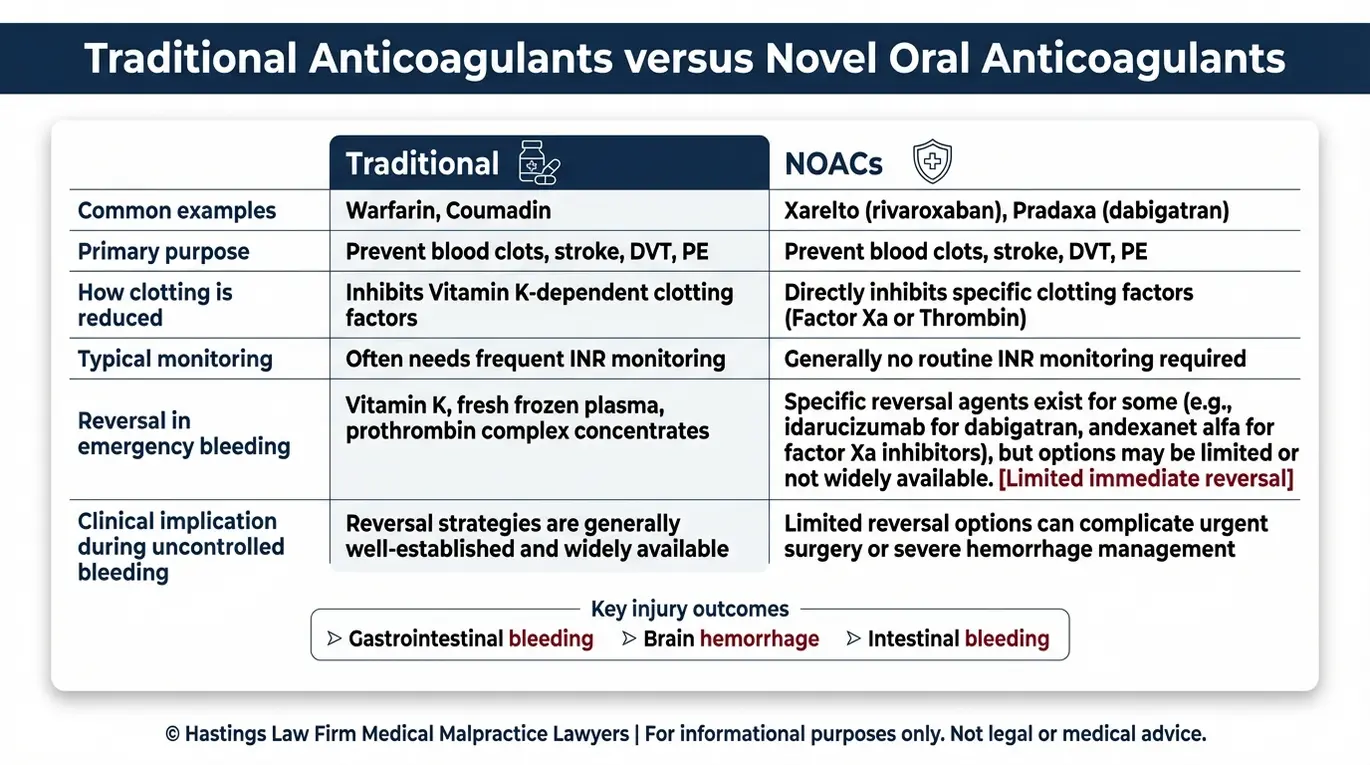
Blood thinners are prescribed to prevent dangerous blood clots that can lead to stroke, deep vein thrombosis (DVT), or pulmonary embolism. Xarelto (rivaroxaban) and Pradaxa (dabigatran) are two of the most widely prescribed anticoagulants for patients with conditions like atrial fibrillation. These drugs work by blocking specific clotting factors in the blood, reducing the risk of clot formation.
The critical problem is what happens when a patient on one of these drugs experiences a bleeding event. With traditional anticoagulants like Warfarin (brand name Coumadin), doctors can administer Vitamin K to reverse the blood-thinning effect and control bleeding relatively quickly. Newer drugs like Xarelto did not have a readily available antidote for years after they reached the market, leaving doctors with limited options during emergency surgery or trauma situations.
| Feature | Warfarin (Coumadin) | Xarelto (rivaroxaban) | Pradaxa (dabigatran) |
|---|---|---|---|
| Drug Class | Traditional anticoagulant | NOAC / DOAC | NOAC / DOAC |
| Reversal Agent | Vitamin K (widely available) | Andexxa (approved 2018; withdrawn from U.S. market in 2025) | Praxbind (approved 2015) |
| Monitoring Required | Yes (regular INR blood tests) | No | No |
| Key Bleeding Risk | Manageable with antidote | Difficult to control if reversal agent unavailable | Difficult to control if reversal agent unavailable |
The types of injuries linked to these drugs are severe. Patients have reported internal bleeding events including gastrointestinal bleeding, intestinal bleeding, and brain hemorrhage. These are not minor side effects. A hemorrhage that cannot be stopped can result in permanent organ damage, disability, or death. When these outcomes occur due to inadequate warnings, families may need the guidance of a blood thinner injury lawyer in Texas to understand their rights.
Adverse Event Data: Xarelto vs. Pradaxa
The scope of these injuries is not anecdotal. A 2015 ISMP report (Institute for Safe Medication Practices), which analyzed data from the FDA Adverse Event Reporting System (FAERS), a database that tracks adverse drug events (ADEs), found that adverse event rates for anticoagulants were consistently among the highest reported. These findings helped contextualize the scale of harm patients were experiencing and underscored the need for an attorney who understands the medical science behind these claims.
Product Liability: Holding Manufacturers Accountable for Failure to Warn
Drug manufacturers have a legal duty to adequately warn both doctors and patients about known risks associated with their products. When a company fails to disclose or downplays those risks, it forms the basis of a product liability lawsuit, and a Texas anticoagulant lawsuit attorney can help you pursue that claim.
The central legal theory in most blood thinner cases is failure to warn. Patients and their families allege that companies like Bayer and Janssen Pharmaceuticals, a subsidiary of Johnson & Johnson, knew about the serious bleeding risks associated with drugs like Xarelto but did not provide adequate warnings. The allegations include claims that marketing materials overstated the safety of these newer anticoagulants compared to Warfarin without clearly disclosing the absence of a readily available reversal agent.
Key legal theories in these cases include:
- Failure to warn: The manufacturer did not include sufficient information about bleeding risks in the drug’s labeling, boxed warning (also called a black box warning, which is the FDA’s strongest safety alert printed on a drug’s packaging), or Medication Guide, the patient-facing document that accompanies a prescription.
- Marketing defect: Promotional materials presented the drug as safer or more convenient than traditional alternatives without balanced disclosure of the risks. For example, advertisements often highlighted the ease of “one pill a day” without monitoring, potentially distracting from the life-threatening bleeding risks. A pharmaceutical injury claim often relies on demonstrating this imbalance.
- Inadequate post-market surveillance: The manufacturer failed to update warnings after adverse event reports revealed a pattern of serious injuries. Pharmaceutical companies are required to monitor safety data even after approval; ignoring rising injury rates can constitute a breach of duty.
One common defense in pharmaceutical cases is the learned intermediary doctrine, where the manufacturer argues it only needed to warn the prescribing doctor, not the patient directly. Our team addresses this by examining whether the warnings provided to physicians were themselves inadequate, incomplete, or misleading. If the information given to the doctor was insufficient, the manufacturer cannot hide behind this defense.
The Hastings Law Firm Difference
Results matter, but what truly sets us apart is how we achieve them. Every verdict, every settlement, and every Texas courtroom victory comes from one guiding promise: To treat each client’s fight for justice as if it were our own.
This balance of skill, experience, and empathy reflects our core philosophy that justice should not only compensate the injured, but also make healthcare safer nationwide.

Mass Tort Litigation: Understanding MDL vs. Class Action
Most drug injury cases involving blood thinners are handled through Multi-District Litigation (MDL), where individual lawsuits are consolidated before a single federal judge for pretrial proceedings but remain separate claims. Understanding the difference matters because it directly affects your rights and the value of your case. A blood thinner drug injury attorney can walk you through which path applies to your situation.
How MDL works: When thousands of patients file similar claims against the same drug manufacturer, federal courts can consolidate those cases under 28 U.S.C. § 1407 to streamline discovery, reduce conflicting rulings, and manage the litigation more efficiently. This approach allows the legal system to handle massive numbers of claims without bogging down local courts, while ensuring consistent rulings on pretrial proceedings. The Xarelto litigation is one well-known example of this process in action, where thousands of claims were centralized in the Eastern District of Louisiana.
Bellwether trials are a key part of the MDL process. These are selected “test cases” that go to trial early to help both sides gauge how juries respond to the evidence. Because these early trials test the strength of the evidence, their results often influence settlement negotiations for the remaining cases in the litigation.
Here are the key differences between MDL and class action:
- In an MDL, you retain your own lawyer and your individual damages (medical bills, lost income, pain and suffering) are evaluated on the specific facts of your case. This ensures that a patient who suffered a life-threatening brain bleed receives significantly more compensation than someone with a minor injury.
- In a class action, one representative plaintiff litigates on behalf of the entire group, and any settlement or judgment is shared among all class members. This often results in smaller individual recoveries, as you have little control over the final settlement terms.
- MDL allows for individualized outcomes, meaning your recovery reflects the severity of your specific injuries, not an average across all claimants.

Proving Causation and Recovering Damages in Texas
Successfully recovering damages requires clear medical evidence linking the drug to your injury and a detailed accounting of both economic and non-economic losses. As a Texas dangerous drug lawyer, our team works with medical experts and uses expert testimony to build that connection.
Evidence collection is the foundation of every case. We gather specific diagnostic records, including hemoglobin (Hgb) levels (a blood test measuring your body’s oxygen-carrying protein that drops during blood loss), CT scans, and endoscopy (EGD) reports, a procedure where a camera examines the digestive tract for sources of bleeding. According to the Texas Medical Board, patients have the right to obtain copies of their own medical records, and we can help you through that process. Data from a CDC analysis of U.S. emergency department visits for outpatient adverse drug events confirms that anticoagulants are among the leading causes of drug-related emergency visits, reinforcing why thorough medical documentation is so important.
The recoverable damages in Texas drug injury cases generally fall into two categories. Economic damages cover medical bills, hospital stays, future treatment costs, and lost wages. Non-economic damages address pain and suffering, physical impairment, and loss of consortium. In cases where a loved one died from a brain hemorrhage or uncontrolled bleed event, surviving family members may pursue a wrongful death claim.

Contact the Texas Dangerous Drug Attorneys at Hastings Law Firm Today for Help
If you or a loved one suffered severe internal bleeding after taking a prescribed blood thinner, you deserve answers and accountability. Hastings Law Firm is dedicated to restoring trust for patients who have been harmed by dangerous drugs, and to securing the compensation necessary for your recovery and future care.
Our legal team includes in-house medical professionals, former defense attorneys, and a national network of experts who understand both the medicine and the law behind these cases. Tommy Hastings, an American Board of Trial Advocates (ABOTA) inductee, oversees our strategic approach to every litigation matter. We prepare every case as if it will go to trial, which puts us in a stronger position whether we are negotiating a settlement or presenting evidence to a jury.
We operate on a contingency fee basis, meaning you pay no attorney fees or costs unless we recover compensation for you. Call us today or reach out online for a free, confidential case evaluation. Let us help you find the answers you deserve.
Frequently Asked Questions About Blood Thinner Drug Injury in Texas


This content was researched and written by the Hastings Law Firm editorial team, which includes attorneys, medical professionals, and experienced researchers. Our writing is informed by internal knowledge and practical experience, and we cross-check critical details against authoritative sources cited throughout. Every piece undergoes human-led fact-checking and legal review. Because legal and medical information can change, if you spot an error, please contact us. Learn more about our content standards and review process on our editorial policy page.

Gabe Sassin has focused exclusively on medical malpractice law since 2007. After spending more than a decade as a malpractice defense attorney, he knows exactly how the other side works. He has seen firsthand how healthcare providers, insurers, corporate defendants, and their legal teams think, prepare, and build their defense against claims. That knowledge works for the people who need it most today, injured patients and their families. His unique experience shapes everything he writes, giving readers a look at how these cases actually work from someone who has handled them from both sides.
