


Texas Blood Clot Misdiagnosis Lawyer
Written by: Hastings Law Firm | Reviewed by: Brady D. Williams | Updated: July 27, 2026
A missed or delayed blood clot diagnosis can escalate quickly from manageable symptoms to life threatening complications, including permanent injury or fatal outcomes. Deep vein thrombosis and pulmonary embolism are often preventable when clinicians assess risk, monitor warning signs, and order appropriate testing. When those safeguards are skipped, patients can lose critical time for treatment and face lasting physical and financial consequences. If you or a loved one were harmed or worse due to failure to diagnose blood clots in Texas, contact Hastings Law Firm for a free, confidential case review.

Trusted Texas Medical Attorneys for Failure to Diagnose Blood Clot Claims
What You Should Know About Deep Vein Thrombosis Malpractice Claims in Texas:
- Outcomes can become life threatening when warning signs of deep vein thrombosis are missed and a clot travels to the lungs.
- Recovery can hinge on whether early symptoms were documented but not acted on by the care team.
- Severe harm can follow when clinicians attribute leg pain and swelling to a less serious cause without ruling out a clot.
- Options for recovery can narrow if required expert support is not provided in the required form.
- Compensation can include both financial losses and personal harms when a preventable clot causes lasting impairment.
- Families may have different categories of claims available when a blood clot results in death.
- Liability can extend beyond a single physician when hospital prevention measures are not ordered, applied, or escalated through nursing supervision.
- Disputes often turn on whether appropriate testing and imaging were ordered promptly when clot risk was present.

A Healthcare Focused Law Firm
A blood clot that goes undiagnosed or untreated can cause permanent damage, or worse. If you or a loved one suffered serious harm because a doctor failed to identify or act on the warning signs of a clot, you may have a valid medical malpractice claim.
At Hastings Law Firm, we focus exclusively on medical malpractice litigation. Our founder, Tommy Hastings, is board-certified in Personal Injury Trial Law by the Texas Board of Legal Specialization, and our legal team includes former defense lawyers. We also maintain an in-house medical staff of nurse practitioners and Board Certified Patient Advocates who analyze complex clinical data. As a trusted Texas blood clot misdiagnosis lawyer team, we know how to investigate what went wrong and hold the responsible parties accountable.
If you believe a healthcare provider missed the signs, we are here to help. Contact us for a free, confidential case evaluation to understand your options.
Understanding Deep Vein Thrombosis and Pulmonary Embolism Risks
Deep vein thrombosis (DVT) occurs when a blood clot forms in a deep vein, usually in the legs, which can travel to the lungs and cause a life-threatening pulmonary embolism (PE) if not treated quickly. Together, these conditions fall under the broader term venous thromboembolism (VTE), one of the most preventable causes of hospital death.
The progression from DVT to PE is what makes this condition so dangerous. A clot that forms in the calf or thigh may initially cause only localized discomfort.
If that clot breaks loose and travels through the bloodstream to the lungs, it can block blood flow and become fatal within minutes. This is why medical teams have a duty to monitor patients for clot risk.
This duty is especially important for those recovering from surgery or on extended bed rest. Without proper monitoring, the window to intervene closes rapidly, turning a manageable condition into a medical emergency.
According to JAMA Network’s overview of pulmonary embolism, PE remains a leading cause of preventable hospital death. Recognizing the difference between DVT and PE symptoms can be lifesaving and is the first line of defense against fatal outcomes.
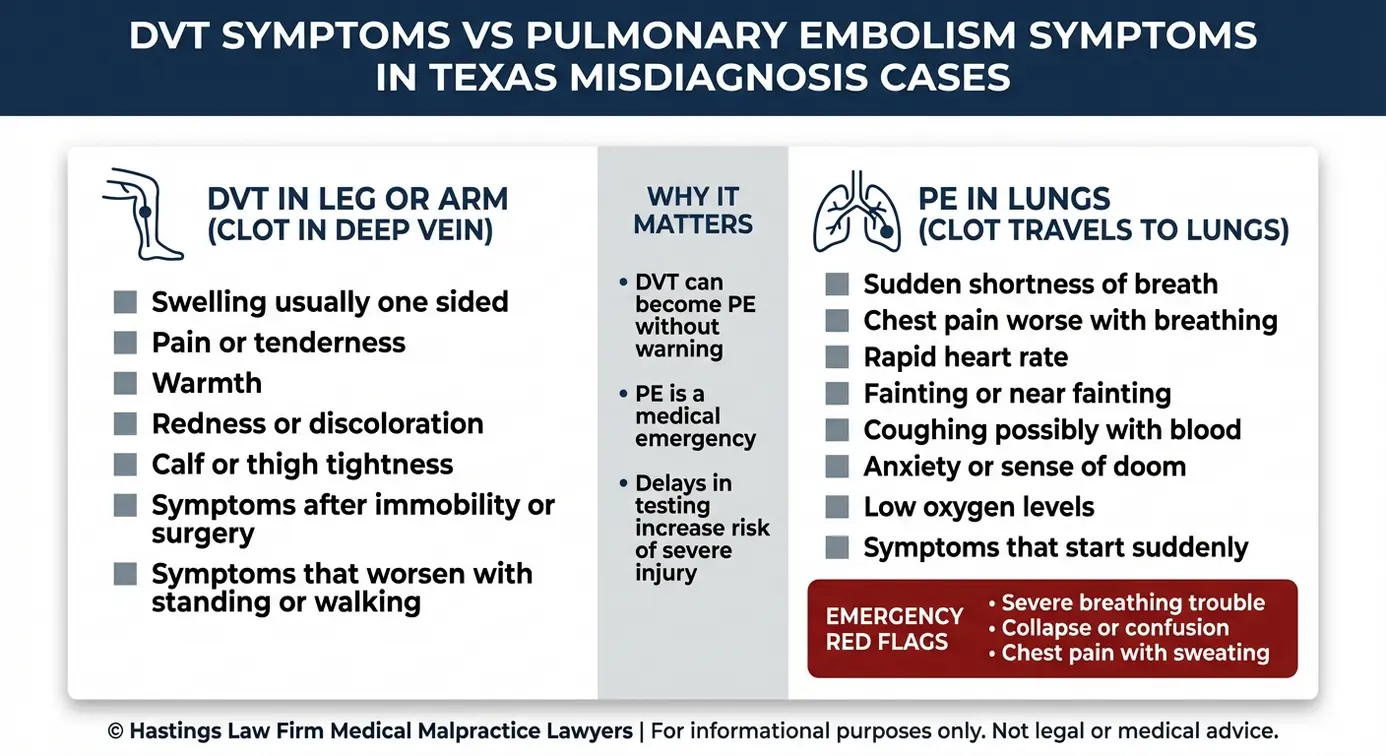
DVT Symptoms (localized, typically in the leg):
- Swelling in one leg
- Pain or tenderness, often starting in the calf
- Redness or warmth over the affected area
- A feeling of heaviness in the limb
PE Symptoms (systemic, affecting the lungs and heart):
- Sudden shortness of breath
- Sharp chest pain that worsens with breathing
- Rapid heart rate
- Coughing up blood
- Lightheadedness or fainting
Because DVT symptoms can seem minor at first, they are sometimes dismissed by patients and doctors alike. That dismissal often marks the start of medical malpractice. Attorneys for blood clot negligence in Texas frequently see cases where early warning signs were documented in the chart but never acted on.
When a Missed Diagnosis Becomes Actionable Medical Malpractice
Medical malpractice occurs when a healthcare provider deviates from the accepted standard of care, the level of treatment a reasonably competent professional would provide under similar circumstances, by failing to recognize classic symptoms, neglecting to order necessary diagnostic tests, or misdiagnosing a clot as a less severe condition.
One of the most common failures we see is a doctor attributing DVT symptoms to something else entirely. Leg pain and swelling may be dismissed as sciatica, a muscle strain, or arthritis. Because these conditions share overlapping features like localized pain and tenderness, physicians must be diligent in ruling out the most dangerous possibility first. While these conditions can share some overlapping features, a careful clinician should consider blood clot risk, especially in patients who are post-operative, immobile, or have other known risk factors.
A delayed diagnosis or misdiagnosis can cost hours or days of critical treatment time. In blood clot cases, those hours matter. A clot that could have been treated with medication may instead travel to the lungs and cause a pulmonary embolism.
The European Journal of Preventive Cardiology’s consensus document on acute DVT diagnosis outlines clear diagnostic pathways that physicians should follow when DVT is suspected. These include ordering a D-dimer test, a blood test that measures clot-related protein fragments, or performing a duplex ultrasound, a non-invasive imaging study that visualizes blood flow in the veins. These diagnostic tools are non-invasive, widely available, and highly effective at confirming the presence of a thrombus. When a doctor skips these steps, it may constitute negligence.
In our experience, preventable errors often stem from a lack of thoroughness during the initial assessment. Common missed opportunities that a DVT malpractice attorney in Texas may identify include:
- Ignoring patient complaints of leg pain, swelling, or shortness of breath
- Failing to order a D-dimer test when symptoms and risk factors are present
- Not performing a duplex ultrasound after an abnormal D-dimer result
- Attributing clot symptoms to sciatica, arthritis, or muscle cramps without further testing
- Discharging a patient without follow-up despite elevated risk factors
- Failing to reassess a patient whose symptoms worsened during hospitalization
Each of these represents a point where the standard of care may have been breached. When we investigate a case, our in-house medical staff reviews the records to determine whether the provider’s actions aligned with accepted diagnostic protocols. If you need a lawyer for a missed blood clot diagnosis, our team has the clinical knowledge to identify where the breakdown occurred.
The Hastings Law Firm Difference
Results matter, but what truly sets us apart is how we achieve them. Every verdict, every settlement, and every Texas courtroom victory comes from one guiding promise: To treat each client’s fight for justice as if it were our own.
This balance of skill, experience, and empathy reflects our core philosophy that justice should not only compensate the injured, but also make healthcare safer nationwide.

Standard of Care and Prevention Protocols in Hospitals
Hospitals are required to assess patients for clot risks upon admission and implement prophylaxis, or preventive measures, such as anticoagulants or mechanical compression, to prevent VTE events during hospitalization or after surgery.
One of the most widely accepted tools for this assessment is the Caprini VTE Risk Assessment, a scoring system that assigns points based on patient-specific risk factors like age, obesity, recent surgery, cancer history, and immobility. By quantifying these risks, the medical team can objectively determine whether aggressive prophylaxis is necessary or if standard measures suffice. The resulting score guides the level of prevention the medical team should provide. When this assessment is skipped or the results are ignored, a Texas DVT malpractice lawyer can use that gap as evidence of a breach in the standard of care.
Prevention strategies generally fall into two categories: mechanical and chemical. A comparison study published in PubMed Central reviewed the effectiveness of both approaches. Mechanical options include sequential compression devices (SCDs), inflatable wraps placed on the legs to promote circulation, and compression stockings (also called TED hose).
Chemical prevention involves anticoagulant medications like Heparin or Lovenox, which thin the blood to reduce clot formation. In many post-operative patients, the standard of care calls for a combination of both. For high-risk patients, relying solely on one method may not be sufficient to meet the standard of care.
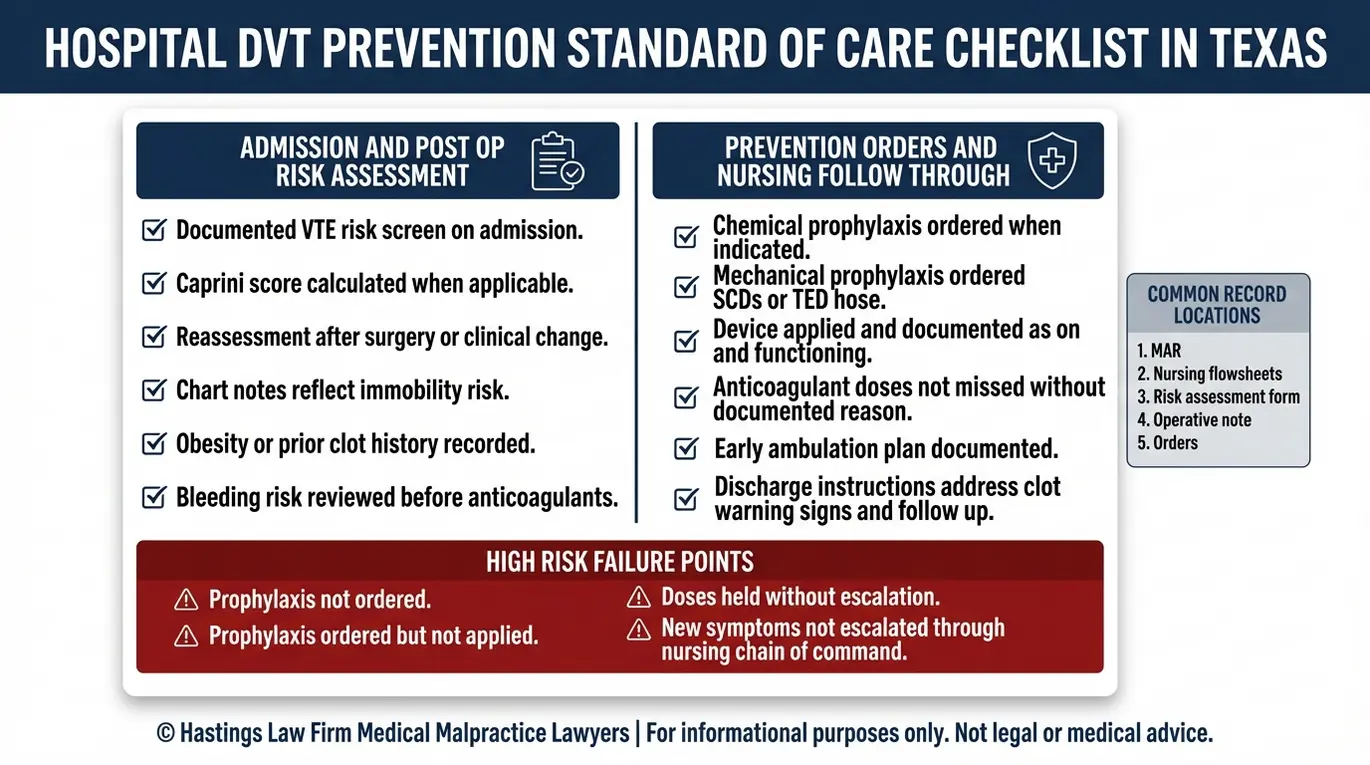
Hospital VTE prevention checklist, what should happen for at-risk patients:
- VTE risk assessment completed at admission using a validated tool (e.g., Caprini Score)
- Prophylaxis ordered based on risk level (mechanical, chemical, or both)
- Compression stockings or SCDs applied and monitored for proper use
- Anticoagulant medications administered on schedule
- Patient reassessed if risk factors change (e.g., prolonged immobility, new surgery)
- Nursing staff documents compliance with prophylaxis orders
- Nursing chain of command activated if a physician fails to order appropriate prophylaxis for a high-risk patient
That last point is one many people overlook. Nurses have an independent obligation to advocate for patient safety.
If a doctor fails to order prophylaxis for a high-risk patient, the nursing chain of command requires nurses to escalate the concern. This usually involves reporting to a supervisor or attending physician.
When that escalation does not happen, both the nurse and the facility may share liability. Nurses act as a safety net; they must intervene when they see a high-risk patient is without protection.
Proving Causation and Negligence in Blood Clot Cases
Proving a claim requires clear evidence that the doctor’s failure to prevent or diagnose the clot directly caused the injury or death, supported by expert testimony and detailed medical records. This is the legal concept of causation, and it is one of the most important elements of any blood clot malpractice case.
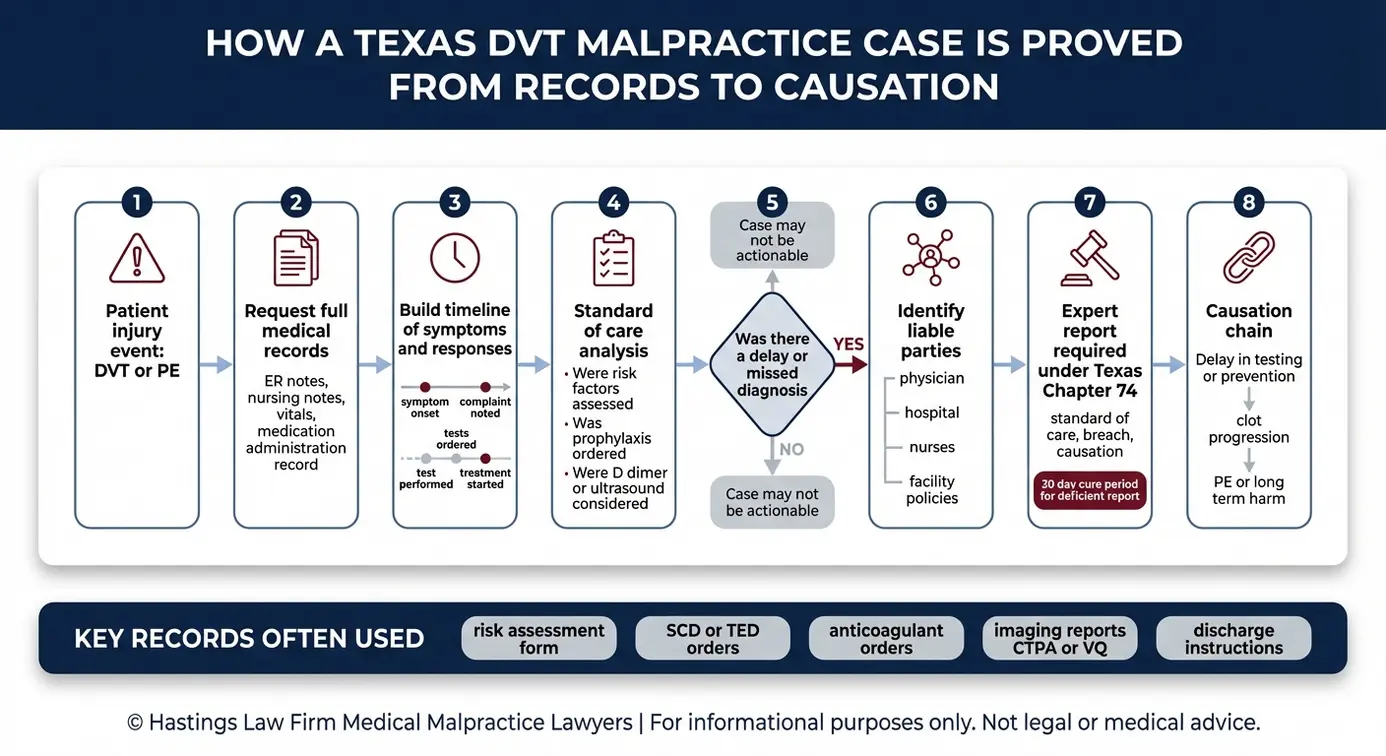
In Texas, medical malpractice claims are governed by Chapter 74 of the Texas Civil Practice and Remedies Code. This requires the patient to serve a qualified expert report within 120 days of the defendant’s original answer.
This report must come from a physician who can speak to the standard of care and explain how it was breached. They must also connect that breach directly to the injury.
If the report is deficient, the court may grant a 30-day extension to cure the deficiency. However, a dismissal is possible if the deficiency remains unaddressed.
The strict hurdles of Chapter 74 mean a simple clerical error or vague opinion can derail a claim. This is why working with an experienced Texas blood clot malpractice lawyer is so important.
Our process for building a blood clot negligence case typically follows these steps:
- Obtain and review all medical records, including admission notes, nursing charts, lab results, and imaging studies.
- Reconstruct the clinical timeline to identify gaps in monitoring, missed test results, or delayed treatment.
- Engage qualified medical experts who can evaluate whether the provider met the standard of care.
- Establish causation by demonstrating that earlier diagnosis or proper prophylaxis would have prevented the clot, PE, or resulting harm. This link must be direct and scientifically supported to withstand scrutiny from defense experts.
- Identify all liable parties, which may include the treating physician, surgeon, hospitalist, nursing staff, or the hospital itself.
Diagnostic evidence we examine includes CT pulmonary angiography (CTPA), an imaging study that uses contrast dye to detect clots in the pulmonary arteries, and V/Q scans (ventilation-perfusion scans), tests that measure airflow and blood flow in the lungs to identify blockages. Whether these tests were ordered, and how quickly, can be central to the case.
Our team of former defense attorneys understands how hospitals and their insurers build their arguments. We anticipate those strategies and prepare the evidence to address them before they are raised.
Compensation for Victims of DVT Negligence
Patients harmed by DVT malpractice may recover economic damages for medical bills and lost wages, as well as non-economic damages for pain, suffering, and physical impairment. The specific amount depends on the severity of the injury and its long-term impact on the patient’s life.
According to the Centers for Disease Control and Prevention, venous thromboembolism (VTE) affects up to 900,000 Americans each year, and complications from these events can result in chronic conditions, long-term disability, or death. The financial toll of a preventable blood clot injury can be enormous.
Economic damages cover the measurable financial losses tied to the injury. These include past and future medical care, rehabilitation costs, prescription medications, and lost earning capacity if the injury prevents the patient from returning to work at full capacity. Future medical expenses are also calculated to account for any long-term complications, such as post-thrombotic syndrome, which requires ongoing management.
Non-economic damages address the personal toll of the injury. These include physical pain, mental anguish, loss of enjoyment of life, and physical impairment. A Texas DVT malpractice attorney can help document these losses with medical evidence and testimony from treating providers. Because these damages are subjective, having compelling testimony that illustrates the daily impact of the injury is crucial for maximizing recovery.
When a blood clot results in death, the family may pursue two distinct types of claims:
| Survival Claim | Wrongful Death Claim | |
|---|---|---|
| Who it compensates | The estate of the deceased patient | The surviving spouse, children, or parents |
| What it covers | Pain and suffering the patient experienced before death; medical expenses incurred | Loss of companionship, loss of financial support, mental anguish of surviving family |
| Who files it | The estate’s representative | Eligible family members |
Both claims can be filed in the same lawsuit. Our team works with families to ensure that every category of loss is accounted for and supported by evidence, helping protect their future financial security.
Contact the Texas Healthcare Malpractice Attorneys at Hastings Law Firm Today for Help
Deep vein thrombosis and pulmonary embolisms are often preventable. When a healthcare provider fails to assess risk, order appropriate tests, or act on warning signs, the consequences can be devastating.
If you or a loved one suffered serious harm because of a missed or delayed blood clot diagnosis, Hastings Law Firm is ready to review your case. Our board-certified attorneys and in-house medical team will examine your records, identify what went wrong, and explain your legal options at no cost to you. As an experienced Texas DVT malpractice lawyer team, we prepare every case as if it is going to trial, because that preparation is what drives fair results.
You pay no fees unless we recover compensation on your behalf. Contact us today for a free, confidential case evaluation.
Frequently Asked Questions About Failure to Diagnose Blood Clots in Texas


This content was researched and written by the Hastings Law Firm editorial team, which includes attorneys, medical professionals, and experienced researchers. Our writing is informed by internal knowledge and practical experience, and we cross-check critical details against authoritative sources cited throughout. Every piece undergoes human-led fact-checking and legal review. Because legal and medical information can change, if you spot an error, please contact us. Learn more about our content standards and review process on our editorial policy page.

Brady D. Williams is a nationally recognized medical malpractice attorney who has spent his career handling high-stakes litigation for injured patients and families across the country. Licensed in both Texas and California, Brady draws on experience from hundreds of resolved medical cases to break down complex legal and medical topics for the people who need that information most. His writing reflects the same attention to detail and commitment to clarity that he brings to every case he handles.
