


Texas Arteriography Malpractice Lawyer
Written by: Hastings Law Firm | Reviewed by: Gabe Sassin | Updated: July 27, 2026
Arteriography procedures such as angiograms can cause serious harm when preventable errors occur during catheter use, contrast dye administration, monitoring, or image interpretation. Patients may be left with sudden complications, lasting impairment, and major financial strain while being told the outcome was only a known risk. Understanding the difference between an inherent complication and a breach of the standard of care can shape what happens next and whether accountability is possible. If you or a loved one were harmed or worse due to arteriography malpractice in Texas, contact Hastings Law Firm for a free, confidential case review.
Trusted Texas Medical Attorneys for Angiogram Complications Claims
What You Should Know About Angiogram Complications Negligence Claims in Texas:
- Accountability can turn on whether an angiogram injury was a preventable error rather than an inherent procedural risk.
- Recovery can be blocked when providers rely on a known complication defense tied to informed consent paperwork.
- Liability can still exist after consent is signed because consent does not cover careless technique or ignored protocols.
- Severe outcomes can follow catheter handling errors that tear an artery or send debris downstream.
- Kidney injury can be linked to contrast dye decisions when screening is skipped or excessive dye is used.
- Life threatening bleeding can result when the catheter puncture site is not closely monitored after the procedure.
- Delayed treatment can follow when angiogram images are misread and a critical finding is missed.
- Compensation can include medical bills and lost wages plus pain suffering and physical impairment.
- Non economic recovery can be limited in Texas because statutory caps apply in medical malpractice cases.
- Options can be lost if legal time limits are missed for bringing a Texas medical malpractice claim.

A Healthcare Focused Law Firm
When an arteriography procedure causes an unexpected injury, the aftermath can feel overwhelming. You may be dealing with new symptoms, mounting medical bills, and the unsettling question of whether something went wrong during the procedure. Complications like an embolism, where a blood clot or debris blocks a blood vessel, or a retroperitoneal hemorrhage, which is serious bleeding into the space behind the abdominal lining near the catheter insertion site, can change your life in an instant.
If you or a loved one was harmed during an angiogram, you deserve honest answers about what happened and why. As a Texas Arteriography Malpractice Lawyer team that focuses exclusively on medical malpractice, Hastings Law Firm has the medical knowledge and litigation experience to investigate these cases thoroughly. We invite you to contact us for a free, confidential case evaluation so we can review your records and explain your options.
Distinguishing Known Risks from Actionable Arteriography Negligence
Medical malpractice occurs during an arteriography, a diagnostic imaging procedure also called an angiogram or angiography, when the physician deviates from the accepted standard of care and causes an injury that was not simply an inherent risk of the procedure. The standard of care represents the clinical guidelines and professional expectations that every doctor must follow. Understanding this distinction is one of the most important parts of any angiography malpractice case.
The “Known Complication” Defense
The known complication defense is a common legal strategy used by medical providers to explain away procedural injuries. Defense attorneys almost always argue that the injury was listed on the informed consent form. They point to the document the patient signed before the procedure and claim the patient accepted the risk. This is one of the most common barriers patients face, and it discourages many people from ever pursuing a legitimate claim.
The Reality of Negligence
Signing a consent form does not grant a doctor permission to be careless. Consent acknowledges that certain risks exist even when the procedure is performed correctly. It does not cover preventable errors caused by poor technique, inattention, or failure to follow established protocols. For example, puncturing a vessel wall because of improper catheter handling is not a “known risk.” It is an error.
Physicians must also strictly adhere to procedural standards that mandate continuous monitoring of the patient’s vital signs and catheter placement. A failure to track these metrics during the imaging can result in unaddressed complications, turning a routine diagnostic test into a medical emergency. When a doctor neglects this duty, the resulting harm is a breach of the standard of care, not an accepted risk.
The same logic applies to contrast-induced nephropathy (CIN), a form of kidney damage caused by the contrast dye used to visualize blood vessels. If a physician administers contrast dye without screening for pre-existing kidney problems or uses an excessive volume, the resulting kidney injury may reflect negligence rather than an unavoidable complication.
An arteriography malpractice attorney in Texas can help you determine whether your injury falls into the category of accepted risk or preventable medical negligence.
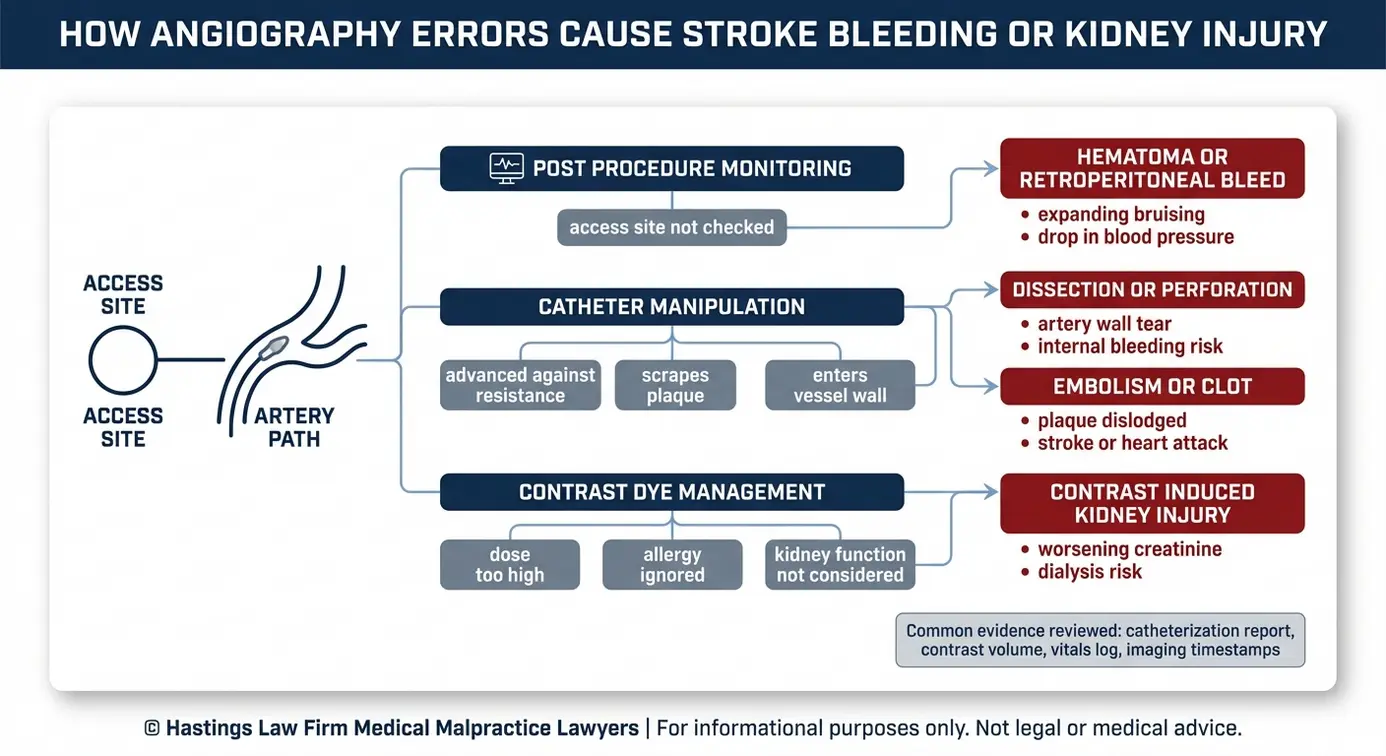
| Known Procedural Risks (Not Negligence) | Potential Negligence (Standard of Care Breach) |
|---|---|
| Minor bruising at the catheter insertion site | Arterial perforation from aggressive catheter manipulation |
| Mild allergic reaction to contrast dye despite proper screening | Administering contrast dye without checking for known allergies |
| Temporary discomfort during catheter insertion | Failure to monitor vitals or catheter position during the procedure |
| Small hematoma that resolves on its own | Uncontrolled bleeding due to failure to monitor the puncture site |
Unnecessary Angioplasty and Over-Treatment
Some cases involve a different kind of harm: procedures that should not have been performed at all. Angioplasty, a procedure where a balloon catheter is used to widen a narrowed artery, and stent placement carry real risks. When these interventions are performed on a patient without significant coronary artery disease, the patient is exposed to danger without any medical benefit. We evaluate whether the original arteriography and any follow-up procedures met the threshold for medical necessity.
Common Errors Committed During Angiography Procedures
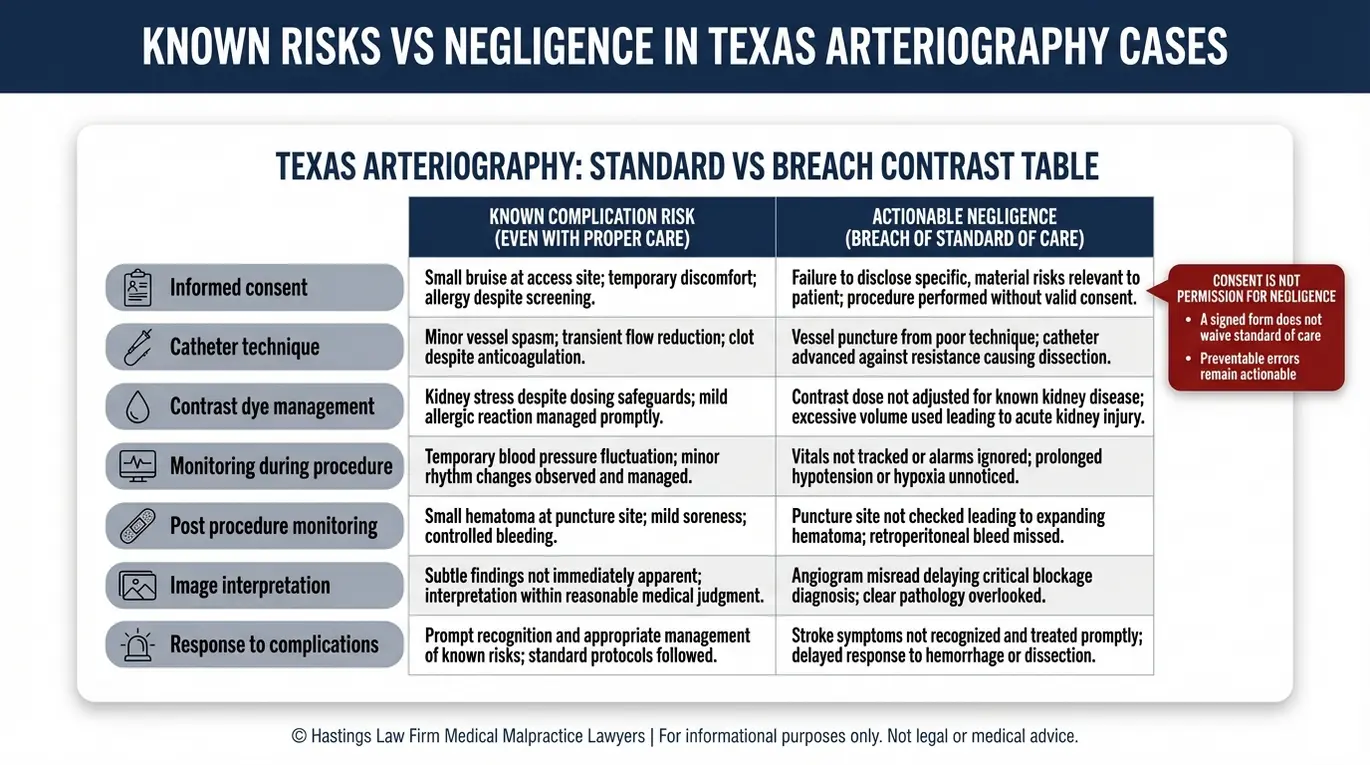
Negligence during angiography often involves improper catheter manipulation, failure to manage contrast dye toxicity, or failure to recognize and treat immediate complications like embolisms. These errors can result in catastrophic injuries, and they tend to follow identifiable patterns.
Catheterization errors are among the most serious. Catheterization, the process of threading a thin, flexible tube through the blood vessels to reach the area being imaged, requires precise handling. Aggressive or imprecise handling of the catheter, or a balloon catheter, can cause severe artery damage, such as tearing the inner lining of an artery, a condition called arterial dissection. It can also dislodge plaque from the vessel walls, creating a blood clot or sending debris downstream where it may trigger a stroke, heart attack, or blockage in another organ. Research published in Cardiovascular Diagnosis and Therapy has examined how procedural volume and technique at medical centers correlate with complication rates during cardiac catheterization.
Contrast dye errors present a separate category of risk. The contrast medium, the special dye injected to make blood vessels visible on X-ray, can cause kidney damage if administered in excessive amounts or given to patients with pre-existing renal conditions. Ignoring a documented allergy to the dye is another preventable failure.
Post-procedural negligence occurs after the arteriography is complete. The puncture site where the catheter was inserted requires close monitoring. Failure to watch for signs of expanding hematoma or internal bleeding can lead to a life-threatening retroperitoneal hemorrhage.
Diagnostic failures round out the common error categories. If a radiologist or cardiologist misreads the angiogram images, a critical blockage or aneurysm may go undetected, delaying treatment that the patient urgently needs.
Common angiography errors include:
- Arterial dissection or perforation from improper catheter technique
- Embolism caused by dislodged plaque during catheterization
- Contrast dye overdose leading to kidney damage
- Administering contrast medium despite a known patient allergy
- Failure to monitor the catheter insertion site after the procedure
- Misinterpretation of imaging results, delaying diagnosis of a blockage or aneurysm
If you suspect that a procedural error caused your injury, a Texas angiogram negligence lawyer can review your medical records and work with qualified experts to determine what went wrong. As an arteriography injury attorney team, we examine operative reports, imaging records, and nursing notes to reconstruct the timeline of your care.
The Hastings Law Firm Difference
Results matter, but what truly sets us apart is how we achieve them. Every verdict, every settlement, and every Texas courtroom victory comes from one guiding promise: To treat each client’s fight for justice as if it were our own.
This balance of skill, experience, and empathy reflects our core philosophy that justice should not only compensate the injured, but also make healthcare safer nationwide.

Types of Angiography Cases We Litigate
We handle malpractice claims arising from all forms of arteriography, including coronary, cerebral, and peripheral vascular imaging. Angiography is a medical imaging technique used to visualize the inside of blood vessels and organs. Each type of angiography targets a different area of the body, and the injuries that result from negligence can vary significantly.
Coronary angiography examines the arteries supplying blood to the heart. Errors during these procedures are often linked to stenting or balloon angioplasty and can result in heart attack, arterial dissection, or the need for emergency cardiac surgery.
Cerebral angiography, which images the blood vessels in the brain, is a high-risk procedure. Because of the delicate anatomy involved, negligence during this procedure can lead to catastrophic outcomes, including stroke, permanent neurological damage, or vision loss. Arterial dissection, a tear in the inner wall of an artery, is a particularly devastating complication when it occurs in cerebral vessels.
Peripheral angiography evaluates the blood vessels in the legs or arms. When errors occur during these procedures, patients may develop limb ischemia, a dangerous reduction in blood flow that can, in severe cases, lead to amputation.
As a Texas medical malpractice lawyer for arteriography cases, Hastings Law Firm brings both legal skill and clinical understanding to each of these case types, including complex claims involving retinal angiography and microangiography.
Securing Compensation for Angiogram Injuries in Texas
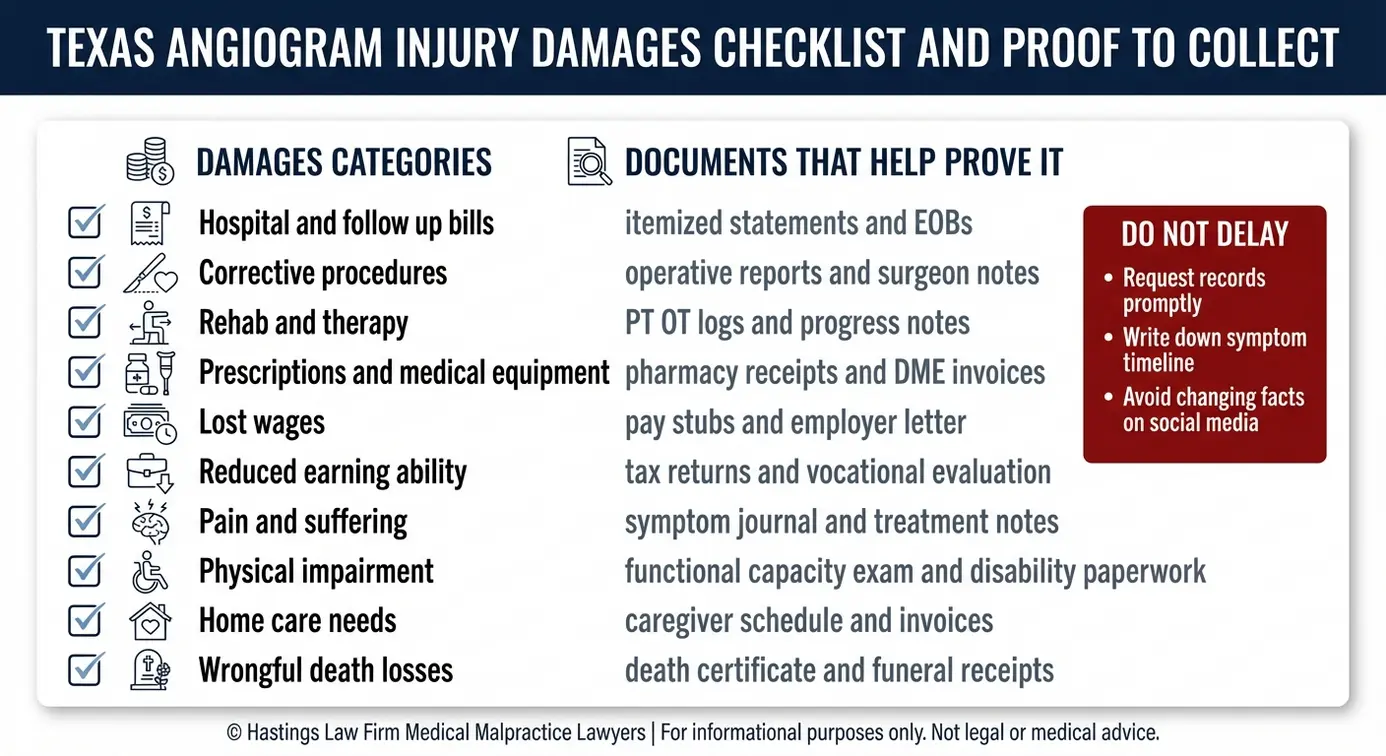
Patients harmed by arteriography malpractice may be entitled to economic damages for medical bills and lost wages, as well as non-economic damages for pain, suffering, and physical impairment. The specific categories of compensation depend on the nature and severity of the injury.
Economic damages cover the measurable financial losses tied to the injury. These can include the cost of corrective surgeries, such as repairing a dissected artery, long-term rehabilitation for stroke-related disabilities, ongoing medical care, and lost income if the injury prevents you from returning to work.
Non-economic damages address the personal toll of the injury. Under Texas Civil Practice and Remedies Code, Chapter 74.301, Texas law addresses compensation for physical pain, mental anguish, disfigurement, and physical impairment, though statutory caps apply to these non-economic damages in medical malpractice cases. These damages reflect the ways an angiography injury reshapes your daily experience, even when the harm is not easily measured in dollars.
Wrongful death claims may be available to surviving family members if a loved one died as a result of negligence during an arteriography procedure. These claims can include compensation for funeral expenses, loss of financial support, and loss of companionship.
Recoverable damages in angiography malpractice cases may include:
- Past and future medical expenses, including corrective procedures and rehabilitation
- Lost wages and diminished earning capacity
- Physical pain and suffering
- Mental anguish and emotional distress
- Physical impairment and disfigurement
- Loss of enjoyment of life
- Wrongful death damages for surviving family members
As an angiography malpractice law firm, we work to document every category of loss so that your claim reflects the full impact of the injury on your life.
Contact the Texas Healthcare Malpractice Attorneys at Hastings Law Firm Today for Help
You do not have to accept a doctor’s claim that your injury was “just a complication.” If something went wrong during your angiogram, you have the right to find out why and to hold the responsible parties accountable.
Hastings Law Firm is led by Tommy Hastings, a board-certified trial attorney who has spent over two decades representing patients harmed by medical negligence. Our team includes in-house medical professionals who can analyze your records and identify where the standard of care may have been breached.
There is no cost to get started. We handle cases on a contingency fee basis, meaning you pay no attorney fees unless we recover compensation for you. If you or a loved one suffered a serious injury during an arteriography procedure, contact our Texas Arteriography Malpractice Lawyer team today for a free, confidential case review. Let us help you find the answers you deserve.
Frequently Asked Questions About Arteriography Malpractice in Texas


This content was researched and written by the Hastings Law Firm editorial team, which includes attorneys, medical professionals, and experienced researchers. Our writing is informed by internal knowledge and practical experience, and we cross-check critical details against authoritative sources cited throughout. Every piece undergoes human-led fact-checking and legal review. Because legal and medical information can change, if you spot an error, please contact us. Learn more about our content standards and review process on our editorial policy page.

Gabe Sassin has focused exclusively on medical malpractice law since 2007. After spending more than a decade as a malpractice defense attorney, he knows exactly how the other side works. He has seen firsthand how healthcare providers, insurers, corporate defendants, and their legal teams think, prepare, and build their defense against claims. That knowledge works for the people who need it most today, injured patients and their families. His unique experience shapes everything he writes, giving readers a look at how these cases actually work from someone who has handled them from both sides.
