


Texas Acupuncturist Malpractice Lawyer
Written by: Hastings Law Firm | Reviewed by: Brady D. Williams | Updated: July 27, 2026
Acupuncture injuries can be especially upsetting because the treatment is meant to relieve pain, not create new harm. When safety protocols are ignored or technique falls below professional standards, the result can be serious injury, infection, lasting nerve problems, or worse, along with medical costs and disruption to daily life. Liability can also depend on the practitioner’s license and which Texas board regulates the care. If you or a loved one were harmed or worse due to acupuncturist malpractice in Texas, contact Hastings Law Firm for a free, confidential case review.

Top Rated Legal Representation for Acupuncture Injuries in Texas
What You Should Know About Acupuncture Injury Claims in Texas:
- Serious acupuncture errors can lead to life threatening complications or permanent harm, especially when needles are placed too deeply or infection control is poor.
- Liability can be harder to assess when different licensing boards and standards apply to different types of practitioners in Texas.
- Options can be lost if required medical malpractice filings are not handled correctly, since Texas imposes strict procedural requirements that can lead to dismissal.
- Recovery can be limited for certain harms, since Texas places caps on non economic damages in medical malpractice cases.
- A signed consent form does not block a claim when the injury stems from negligence rather than an inherent risk of treatment.
- Responsibility may extend beyond the individual practitioner, since a clinic or spa can sometimes face vicarious liability depending on the working relationship.
- Disciplinary action and civil claims can proceed separately, and board investigations may create records that become important later.
- Key evidence can be missing or disputed, since treatment records like intake forms and session notes often determine whether safety protocols were followed.

A Healthcare Focused Law Firm
When a treatment meant to help you heal causes harm instead, the experience can feel deeply unsettling. You trusted a licensed professional, and now you may be dealing with a painful injury, unexpected medical bills, or unanswered questions about what went wrong. These feelings are valid, and you deserve clarity.
Acupuncture is generally considered safe when performed correctly. But when a practitioner fails to follow established safety protocols, the consequences can be severe. If you or a loved one has been injured during an acupuncture session, you may have grounds for a malpractice claim under Texas law.
As a Texas acupuncturist malpractice lawyer, Hastings Law Firm focuses exclusively on medical malpractice. Our team includes in-house medical professionals who can evaluate what happened and help determine whether negligence played a role. If you’d like to understand your options, we offer a free, confidential case evaluation at no cost or obligation to you.
Understanding Acupuncture Malpractice and Liability in Texas
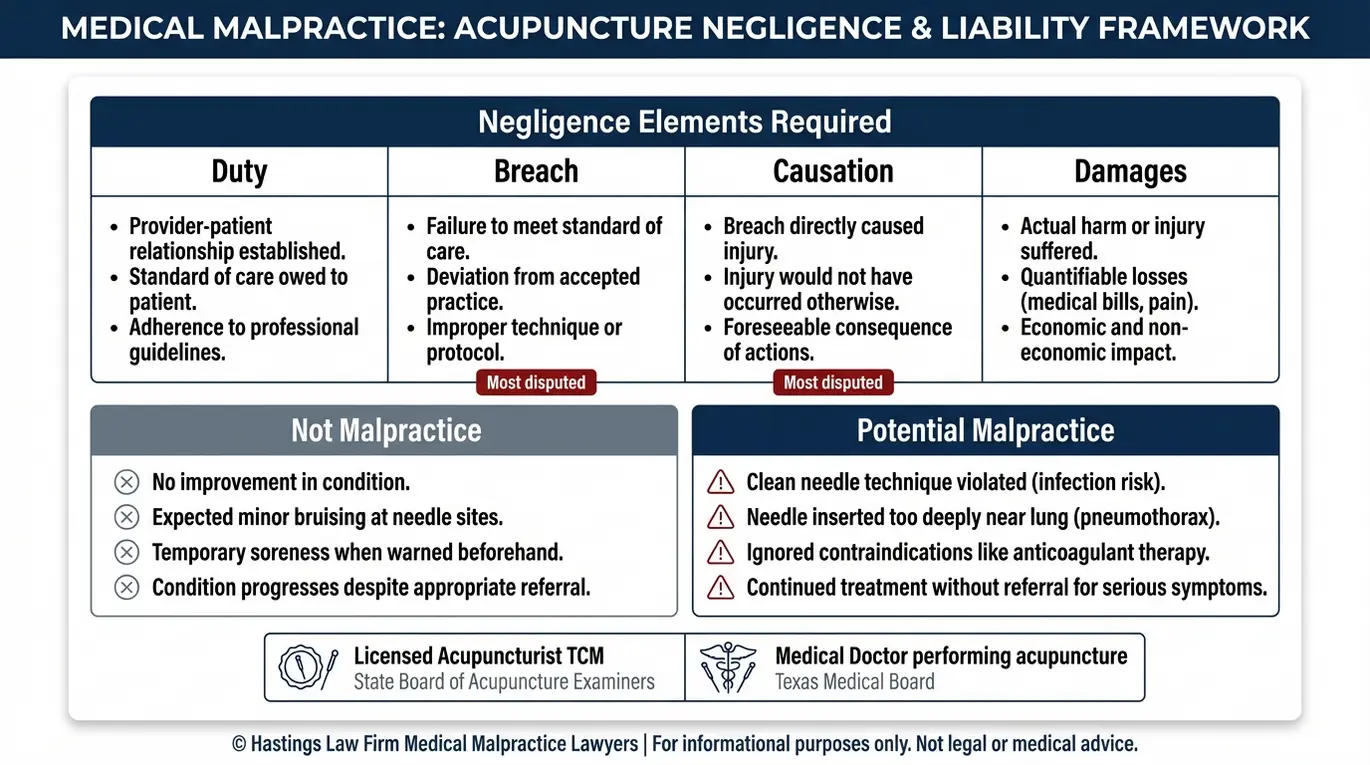
Acupuncture malpractice occurs when a licensed practitioner deviates from the accepted standard of care, such as failing to use the Clean Needle Technique (CNT), a set of sterilization and safety protocols required during needle insertion, or placing needles too deeply, directly causing injury or infection.
Not every bad outcome qualifies as malpractice. Being dissatisfied with treatment results, for instance, is not the same as being harmed by negligence.
To establish a valid malpractice claim, four elements must be present. The practitioner owed you a duty of care. They breached that duty through action or inaction.
That breach directly caused your injury, potentially leading to complications like sepsis, a life-threatening reaction to an infection. And you suffered measurable damages as a result.
The standard of care for acupuncturists is defined by what a reasonably competent practitioner with similar training would do under the same circumstances. National organizations like the NCCAOM help establish these benchmarks, but the legal standard is ultimately measured against the practitioner’s own professional obligations. It is not enough to show that a mistake happened; we must demonstrate that the error was one that a prudent acupuncturist would not have made under the same conditions.
One detail that often matters in these cases is what type of practitioner performed the treatment. Traditional Chinese Medicine (TCM) acupuncturists are regulated by the Texas State Board of Acupuncture Examiners.
Medical doctors who perform acupuncture, however, fall under the jurisdiction of the Texas Medical Board. The licensing body, training requirements, and applicable standards can differ, which affects how liability is assessed.
An experienced acupuncture malpractice attorney in Texas will know how to identify the correct regulatory framework and build your case accordingly. If you believe professional negligence caused your injury, speaking with a Texas acupuncture injury lawyer early can help protect your rights before critical deadlines pass.
Common Breaches of Safety: How Negligence Occurs
Negligence often stems from improper technique, such as failing to sterilize equipment, inserting needles into high-risk anatomical zones without adequate caution, or failing to recognize patient contraindications, which are pre-existing conditions or treatments that make certain procedures unsafe.
These errors are not abstract. They represent specific, identifiable departures from the safety standards every licensed acupuncturist is expected to follow. Below are some of the most common breaches we look for when evaluating a potential case:
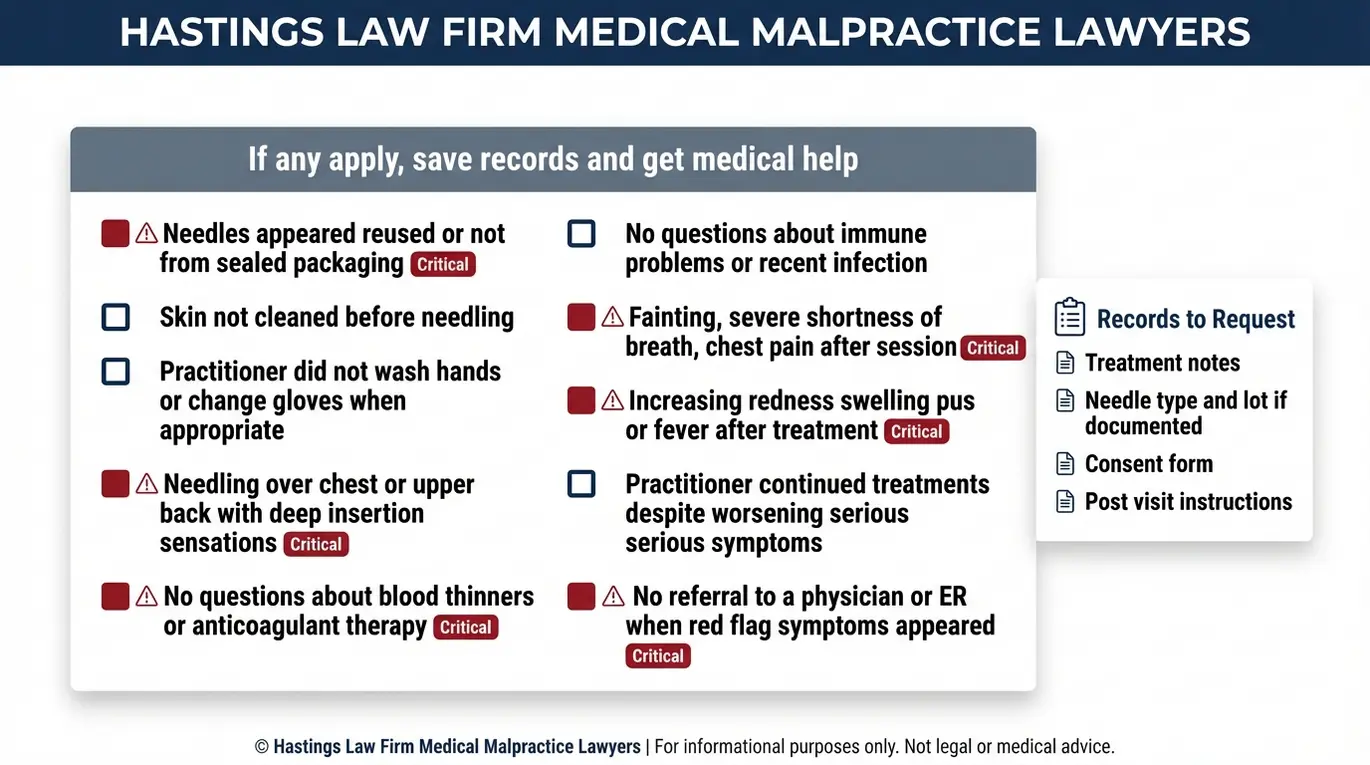
- Violations of Clean Needle Technique: Reusing needles, failing to properly sterilize the insertion site, or not using single-use disposable needles. The Council of Colleges of Acupuncture and Herbal Medicine (CCAHM) publishes detailed standards on clean needle protocols specifically for clinical and hospital settings.
- Improper Needle Depth or Placement: Inserting needles over vital organs like the lungs or kidneys without proper anatomical knowledge. Certain points on the body carry a high risk of organ puncture if the practitioner misjudges depth, and needling the upper back or chest requires precise control to avoid contacting the lungs.
- Failure to Review Medical History: Treating a patient on anticoagulant therapy, a category of blood-thinning medications, without adjusting needle technique or treatment protocols. Patients with compromised immune systems also require modified approaches, as their bodies may not fight off bacteria introduced by a non-sterile needle as effectively as a healthy patient would.
- Failure to Refer: Continuing to treat a serious underlying condition, such as cancer, a fracture, or an infection, with acupuncture instead of referring the patient to the appropriate medical specialist.
Each of these breaches reflects a gap between what the practitioner did and what the accepted standard of care required. Treatment records often hold the key evidence. We examine session notes, intake forms, and medical histories to identify whether the practitioner documented your health conditions, adjusted protocols accordingly, or ignored critical information altogether.
An acupuncture negligence lawyer can determine whether the facts of your case align with a recognized breach. In cases involving malpractice involving acupuncturists, the distinction between an unfortunate outcome and a preventable one often comes down to whether the practitioner followed the protocols designed to keep you safe.
The Hastings Law Firm Difference
Results matter, but what truly sets us apart is how we achieve them. Every verdict, every settlement, and every Texas courtroom victory comes from one guiding promise: To treat each client’s fight for justice as if it were our own.
This balance of skill, experience, and empathy reflects our core philosophy that justice should not only compensate the injured, but also make healthcare safer nationwide.

Serious Injuries Caused by Acupuncture Errors
The most severe injuries include pneumothorax (a collapsed lung caused by air leaking into the chest cavity after deep needle insertion), permanent nerve damage leading to paralysis or chronic pain, and systemic infections like sepsis, a life-threatening condition in which the body’s response to infection begins damaging its own organs, often from unsterile equipment.
These are not minor complications. They can require emergency surgery, long hospital stays, and ongoing rehabilitation. In some cases, the effects are permanent.
Pneumothorax is one of the most well-documented risks of improper acupuncture. It occurs when a needle is inserted too deeply near the chest wall, puncturing the lung lining. A case series published by PubMed Central details multiple instances of acupuncture-related pneumothorax, confirming that this injury is both preventable and potentially fatal without prompt medical intervention.
Infections can range from localized abscesses at the needle site to serious bloodstream infections, including MRSA (methicillin-resistant Staphylococcus aureus) and, in rare cases, hepatitis. These infections often trace back to breaches in sterilization protocols. When infection spreads beyond the initial site, the consequences escalate quickly.
Nerve damage, sometimes called peripheral nerve injury, occurs when a needle directly contacts or damages a nerve. Depending on the location, this can cause numbness, muscle weakness, a condition known as “foot drop” or “wrist drop,” or chronic pain that doesn’t resolve on its own.
Internal organ injury is less common but extremely dangerous. Needles placed near the kidneys or the heart can cause puncture wounds or, in the worst cases, cardiac tamponade, where fluid accumulates around the heart and restricts its ability to pump.
| Injury Type | Potential Long-Term Impact |
|---|---|
| Pneumothorax (Collapsed Lung) | Emergency surgery, respiratory complications, scarring |
| Infections (MRSA, Sepsis) | Extended hospitalization, organ damage, chronic illness |
| Nerve Damage | Chronic pain, loss of motor function, permanent disability |
| Internal Organ Injury | Emergency intervention, organ damage, potential fatality |
If you or a loved one experienced any of these injuries, a Texas acupuncturist malpractice lawyer can help evaluate whether the harm was caused by a departure from accepted safety standards. A lawyer for acupuncture injuries will work with medical experts to connect the practitioner’s actions to the damages you’ve suffered, including pain and suffering, medical costs, and the long-term impact on your quality of life.
Texas Medical Malpractice Laws and Chapter 74
Texas law (Chapter 74 of the Texas Civil Practice and Remedies Code) requires claimants to serve an expert report within 120 days of each defendant’s original answer, detailing the standard of care, how it was breached, and how that breach caused the injury. Missing this deadline can result in dismissal of the entire case.
This statute governs medical liability in Texas. The requirement for an expert report is one of the reasons general personal injury lawyers sometimes struggle with medical malpractice cases. This report is not a formality. It must be authored by a qualified professional with relevant knowledge in the specific field.
A vague or poorly supported report will not survive a challenge from the defense. Identifying the right expert for acupuncture cases can be more challenging than in standard medical malpractice litigation.
Before filing suit, Texas law also requires a pre-suit notice to the healthcare provider. Under Texas Civil Practice and Remedies Code § 74.051, the claimant must give the provider at least 60 days’ written notice of the claim. This step is mandatory, and failure to comply can create procedural problems that jeopardize your case.
The expert must meet the criteria outlined in Chapter 74 of the Texas Civil Practice and Remedies Code, which typically requires active clinical experience in a field relevant to the claim. A medical malpractice attorney for acupuncture cases will already have access to a network of qualified professionals who can provide credible expert testimony.
These procedural requirements make early legal consultation especially important. The timeline is strict, and the preparation involved is substantial.
Does Signing a Consent Form Prevent Me From Suing?
No. A signed informed consent form acknowledges known risks, but it does not grant the practitioner permission to be negligent. You can still pursue a claim if the injury resulted from a deviation from the standard of care.
There’s an important distinction between known risks and preventable injuries. Informed consent form documentation typically covers expected side effects, such as mild bruising or temporary discomfort. You may have signed a form acknowledging those possibilities. But consenting to bruising is not the same as consenting to a collapsed lung from a needle inserted too deeply.
The consent form covers inherent risks of the procedure, not errors caused by carelessness or incompetence. Texas law also recognizes that waivers and consent forms cannot shield a provider from liability for gross negligence or reckless conduct. If a practitioner’s actions fall far below the standard of care, a signed form will not protect them.
If the risks were not adequately explained to you before treatment, the informed consent itself may be legally deficient. Suing an acupuncturist in Texas may be warranted when the practitioner never gave you the information needed to make an informed decision. A valid consent process requires an honest conversation about risks, alternatives, and potential outcomes.
If a practitioner fails to disclose specific dangers, the consent may be deemed invalid. This occurs because you were denied the opportunity to make a fully knowledgeable choice about your own safety.
Why Choose Hastings Law Firm for Your Claim?
We are a medical malpractice-exclusive law firm with the medical resources, legal experience, and trial preparation needed to hold negligent acupuncturists accountable under Texas law.
Unlike general practice firms, we do not divide our attention across unrelated case types. Every attorney, nurse consultant, and advocate at our firm works on medical malpractice cases and nothing else. That focus gives us a significant advantage when handling the specialized demands of acupuncture injury claims.
Here’s what sets us apart:
- Board Certified Trial Attorney: Founder Tommy Hastings is Board Certified in Personal Injury Trial Law by the Texas Board of Legal Specialization, a distinction held by fewer than 2% of Texas attorneys.
- In-House Medical Staff: Our team includes nurse practitioners and Board Certified Patient Advocates who review records, interpret clinical data, and help identify exactly where the standard of care broke down.
- No Fee Unless We Win: We work on a contingency fee basis. You pay no attorney fees or costs unless we secure a recovery for you.
- National Expert Network: We maintain relationships with top-tier medical experts across the country who provide objective case reviews and credible testimony.
Discipline and Licensing in Texas: Filing a malpractice lawsuit and filing a complaint with the Texas State Board of Acupuncture Examiners are two separate processes that can run at the same time. A board complaint may lead to investigation, inquiry letters, or disciplinary action, including license revocation. While a board complaint does not directly result in financial compensation, evidence from a disciplinary proceeding can sometimes support a civil claim. As your Texas acupuncturist malpractice lawyer, we can advise you on both paths.
Contact the Texas Healthcare Malpractice Attorneys at Hastings Law Firm Today for Help
Dealing with a serious injury from a treatment that was supposed to help is an overwhelming experience. You shouldn’t have to sort through complicated legal requirements on your own while trying to recover.
Our team is here to help you understand what happened, whether negligence was involved, and what your options are. We handle the legal process so you can focus on healing. Every consultation begins with a patient advocate who listens to your story, reviews the details, and gives you an honest assessment.
Contact Hastings Law Firm today for a free, confidential case evaluation. There is no cost and no obligation. We don’t collect a fee unless we win your case.
Frequently Asked Questions About Acupuncturist Malpractice in Texas


This content was researched and written by the Hastings Law Firm editorial team, which includes attorneys, medical professionals, and experienced researchers. Our writing is informed by internal knowledge and practical experience, and we cross-check critical details against authoritative sources cited throughout. Every piece undergoes human-led fact-checking and legal review. Because legal and medical information can change, if you spot an error, please contact us. Learn more about our content standards and review process on our editorial policy page.

Brady D. Williams is a nationally recognized medical malpractice attorney who has spent his career handling high-stakes litigation for injured patients and families across the country. Licensed in both Texas and California, Brady draws on experience from hundreds of resolved medical cases to break down complex legal and medical topics for the people who need that information most. His writing reflects the same attention to detail and commitment to clarity that he brings to every case he handles.
