


Arizona Ventilator Mismanagement Lawyer
Written by: Hastings Law Firm | Reviewed by: Tommy Hastings | Updated: July 27, 2026
Ventilator and airway management errors can cause rapid, life changing harm when a patient cannot breathe without mechanical support. These events often involve problems with tube placement, monitoring, alarm response, or emergency airway rescue, and families may be left with lasting medical needs or fatal outcomes. Understanding how ventilator negligence is evaluated can help clarify what went wrong and why it mattered in a critical moment. If you or a loved one were harmed or worse due to ventilator mismanagement in Arizona, contact Hastings Law Firm for a free, confidential case review.
Trusted Arizona Medical Attorneys for Ventilator Malpractice Claims
What You Should Know About Ventilator Malpractice Claims in Arizona:
- Outcomes can be catastrophic when ventilator oversight fails because oxygen deprivation can cause permanent brain damage, cardiac arrest, organ failure, or wrongful death.
- Liability can extend beyond a single clinician because respiratory therapists, ICU nurses, anesthesiologists, and hospitals may share responsibility for airway management breakdowns.
- Recovery options can be limited if a filing deadline is missed because Arizona medical malpractice claims generally must be brought within a set time period.
- Severe injury can occur within minutes when a breathing tube is placed incorrectly because ventilation may deliver no oxygen to the lungs.
- Preventable harm can follow when alarms are ignored because alarm fatigue can lead staff to silence or overlook critical alerts.
- Long term respiratory impairment can result from improper ventilator settings because excessive pressure can cause lung barotrauma.
- Serious infection risk can increase when hygiene lapses occur because ventilator associated pneumonia may develop during prolonged intubation.
- Compensation can include both financial losses and human harms because recoverable damages may cover medical expenses, lost income, pain and suffering, and loss of companionship.
- The amount recoverable is not capped in Arizona because the state constitution prohibits damage caps in personal injury and wrongful death cases.
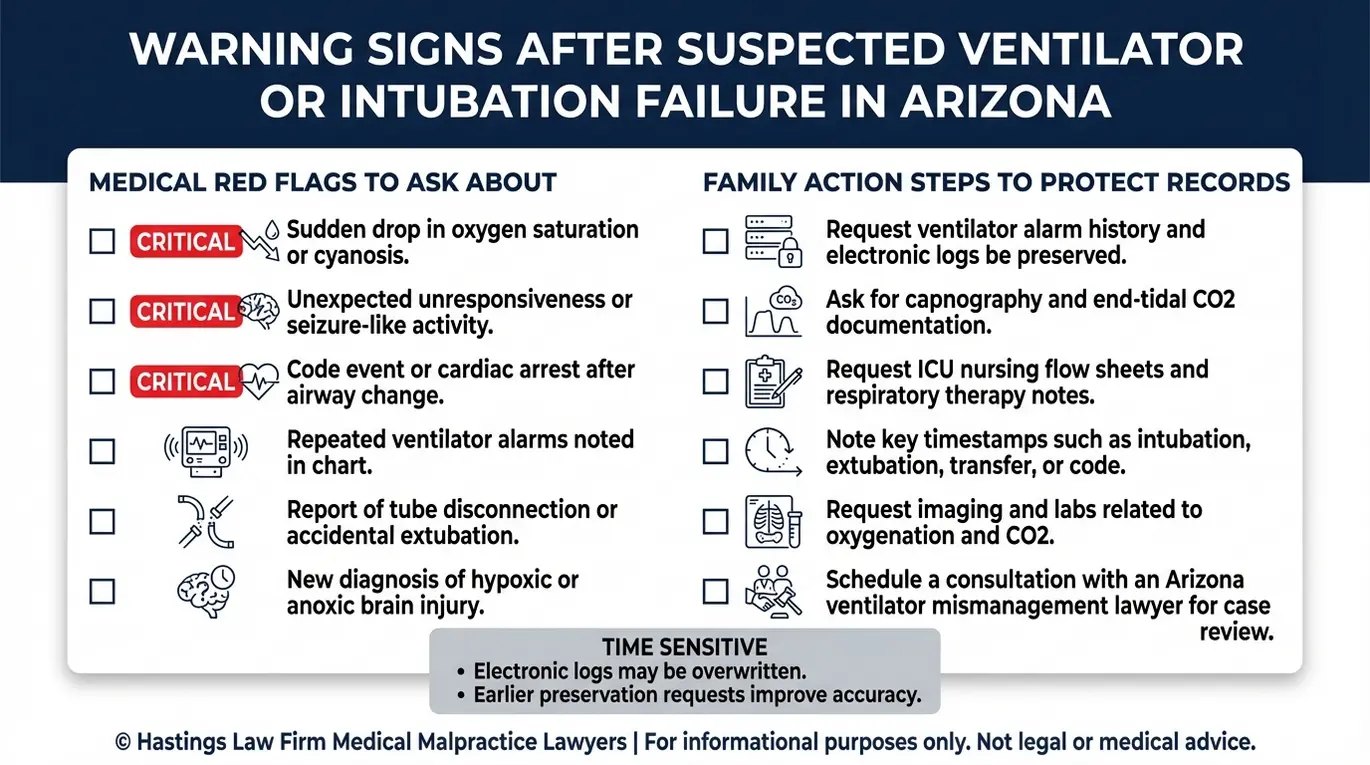
- Key evidence can disappear if not preserved because ventilator electronic logs and alarm history may be overwritten or lost.

A Healthcare Focused Law Firm
When someone you love suffers a preventable injury while on a ventilator, the confusion and grief can be overwhelming. You trusted a medical team to manage a machine that was keeping your family member alive, and something went wrong. You may not have all the answers yet, but the sense that a serious mistake was made is hard to ignore.
At Hastings Law Firm, we focus exclusively on medical malpractice, and we understand how ventilator and airway management errors happen. Since 2005, our firm has focused solely on medical malpractice litigation to help patients recover the compensation they need. Our team includes in-house nurse consultants and former defense attorneys who know how hospitals document these events and where critical evidence is stored. If you believe a ventilator error caused harm to you or someone in your family, an experienced Arizona ventilator mismanagement lawyer can review what happened and explain your options in a free, confidential consultation.
Understanding Ventilator Negligence and the Standard of Care
Ventilator negligence occurs when medical professionals deviate from the accepted standard of care regarding airway management, equipment monitoring, or response times, resulting in preventable patient harm. These are not borderline judgment calls. They are failures in fundamental life-support responsibilities.
The standard of care is the level of treatment a reasonably competent medical professional would provide under similar circumstances. In an ICU or surgical setting, that standard requires constant, skilled oversight of any patient on mechanical ventilation, which is the use of a machine to assist or replace a patient’s breathing through a breathing tube. Patients on ventilators are often sedated and unable to signal for help, making them entirely dependent on the vigilance of the care team. Because the patient cannot breathe effectively on their own, medical providers assume a duty of total awareness that includes verifying tube placement and ensuring settings match lung capacity.
Intubation and ventilation are among the highest-risk interventions in medicine. A breathing tube must be placed correctly, secured properly, and monitored continuously. An experienced Arizona ventilator mismanagement lawyer focuses on what monitoring was in place and whether the medical team responded appropriately.
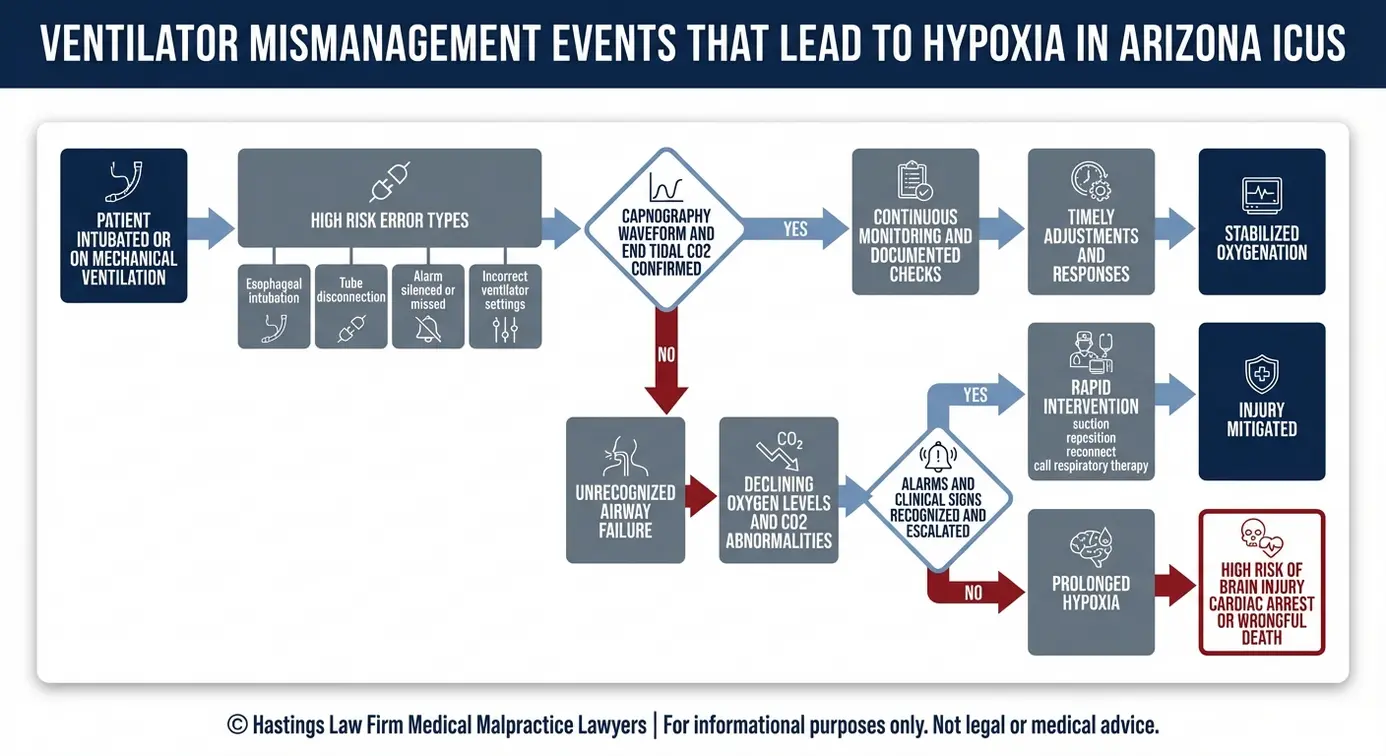
One of the most important safety tools in modern airway management is capnography, a monitoring method that continuously measures the level of carbon dioxide (end-tidal CO2, or EtCO2) in a patient’s exhaled breath. This reading confirms that the breathing tube is in the correct position and that the patient is actually receiving oxygen. According to the American Society of Anesthesiologists (ASA), CO2 monitoring is now mandated for moderate and deep sedation, reflecting its role as a non-negotiable safety standard, not an optional add-on.
When capnography readings are not monitored, or when alarms tied to end-tidal CO2 levels are ignored, the medical team loses its most reliable early warning that a patient is in respiratory failure. Ventilator mismanagement lawyers and an airway negligence attorney look closely at whether these monitoring standards were followed, because gaps in this data often point directly to a breach of duty. Under Arizona Revised Statutes § 12-542, medical malpractice claims must generally be filed within two years, which makes early consultation with a ventilator malpractice attorney important.

Common Types of Ventilator Mismanagement in Arizona Hospitals
Common forms of mismanagement include esophageal intubation, failure to recognize disconnected tubes, ignoring alarms, improper settings causing lung trauma, ventilator-associated pneumonia, and failure to perform a timely cricothyrotomy during “cannot intubate/cannot ventilate” emergencies. Each of these errors is preventable, and each can cause severe injury or death. An Arizona ventilator mismanagement lawyer will investigate which specific failures occurred in a given case.
Placement Errors. One of the most dangerous mistakes is esophageal intubation, where the endotracheal tube is mistakenly placed into the esophagus (the food pipe) instead of the trachea (the windpipe). When this happens, the ventilator pushes air into the stomach rather than the lungs, and the patient receives no oxygen at all. If not caught immediately through capnography, this error can cause brain damage or death in minutes. An intubation malpractice lawyer will review whether proper tube placement verification was performed.
Monitoring Failures and Alarm Fatigue. Ventilator tube disconnection, where the breathing circuit separates from the patient’s endotracheal tube, is another preventable and often fatal error. Ventilators are designed to sound alarms when this occurs. But a well-documented phenomenon known as alarm fatigue can lead ICU staff to ignore, silence, or even disable critical alerts. Research from the UCSF School of Nursing on alarm fatigue confirms this is a recognized and widespread patient safety concern. A ventilator error attorney will examine alarm logs and staffing records to determine whether alarms were properly managed.
Extubation Errors. Premature removal of the breathing tube, or failure to closely monitor a patient after extubation, can lead to aspiration (inhaling stomach contents into the lungs), airway collapse, or respiratory arrest. A hospital negligence lawyer will investigate whether appropriate post-extubation protocols were followed.
| Type of Error | Medical Mechanism | Preventable Outcome |
|---|---|---|
| Esophageal intubation | Tube placed in esophagus instead of trachea | Confirmed by capnography; corrected by immediate repositioning |
| Ventilator tube disconnection | Breathing circuit separates from patient | Detected by continuous alarm monitoring and regular bedside checks |
| Alarm fatigue/ignored alarms | Staff silence or overlook critical alerts | Prevented by proper staffing levels and alarm management protocols |
| Improper ventilator pressure settings | Excessive pressure damages lung tissue (barotrauma) | Avoided through correct settings and ongoing respiratory assessment |
| Premature extubation | Tube removed before patient can breathe independently | Prevented by readiness testing and post-extubation monitoring |
Critical Airway Rescue Failures
When a standard intubation attempt fails and the patient cannot be ventilated by mask, the situation becomes a “cannot intubate, cannot ventilate” (CICV) emergency. In these moments, the standard of care requires the medical team to perform a cricothyrotomy, a surgical procedure where a small incision is made in the neck to create a direct opening into the trachea for airflow.
This is a last-resort emergency airway, which serves as a life-saving backup method when traditional intubation is impossible. Failure to act quickly during a CICV scenario is a specific and often fatal breach of duty. A medical malpractice lawyer for ventilator errors will examine whether the team recognized the emergency in time and whether the cricothyrotomy was performed or delayed. A ventilator lawsuit attorney knows that minutes of hesitation in these situations can mean the difference between recovery and permanent injury.
The Hastings Law Firm Difference
Results matter, but what truly sets us apart is how we achieve them. Every verdict, every settlement, and every Arizona courtroom victory comes from one guiding promise: To treat each client’s fight for justice as if it were our own.
This balance of skill, experience, and empathy reflects our core philosophy that justice should not only compensate the injured, but also make healthcare safer nationwide.

Catastrophic Injuries Caused by Airway Management Failures
Failures in airway management often lead to severe hypoxia, resulting in permanent brain damage, cardiac arrest, organ failure, or wrongful death within minutes of oxygen deprivation. Hypoxia occurs when the body or a region of the body is deprived of oxygen, and this state of severe oxygen deprivation can cause rapid and irreversible tissue damage.
The Timeline of Injury. The brain is uniquely vulnerable to oxygen loss. According to the National Center for Biotechnology Information’s overview of hypoxic brain injury, irreversible brain damage can begin after just four to six minutes without adequate oxygen. After that window, the risk of a permanent hypoxic brain injury, sometimes called anoxic brain injury when oxygen is completely cut off, rises sharply. Our firm reconstructs the brain injury timeline minute-by-minute from the medical records to establish what the team knew and when they acted. Every second matters in these cases.
Physical Trauma. Improper ventilator pressure settings can cause lung barotrauma, which is physical damage to the lungs caused by excessive air pressure. This can result in a collapsed lung, internal bleeding, or long-term respiratory impairment requiring extended care.
Infection. In some cases, poor hygiene practices or prolonged intubation without proper oral care can lead to ventilator-associated pneumonia (VAP). Adhering to strict infection control protocols is necessary to prevent these serious lung infections, which are often preventable through consistent medical standards. While not all VAP cases involve negligence, those caused by documented lapses in hygiene may support a claim.
Families dealing with these outcomes often face a lifetime of medical needs, including long-term care and rehabilitation. A hypoxic brain injury attorney or anoxic brain injury lawyer can help families understand the full scope of what may be recoverable. For patients who do not survive, an Arizona ventilator injury attorney can guide families through the wrongful death claims process.
- Brain damage can begin within 4 to 6 minutes of oxygen deprivation
- Cardiac arrest may follow prolonged hypoxia if not reversed
- Barotrauma from excessive ventilator pressure can collapse a lung
- Ventilator-associated pneumonia may develop from hygiene lapses during intubation
- Survivors often require long-term care, cognitive rehabilitation, and family support services
Liability for Ventilator Errors by Doctors, Nurses, and Facilities
Liability in ventilator mismanagement cases can extend well beyond the attending physician to include respiratory therapists, ICU nurses, anesthesiologists, and the hospital facility itself for inadequate staffing or faulty equipment policies. An Arizona ventilator mismanagement lawyer will identify every provider involved in the patient’s airway management to determine the point of breakdown. This investigation helps establish medical liability for the injury.
This includes examining handoff communications, response times, and whether each team member fulfilled their specific role. Respiratory therapists (RTs), the specialized clinicians responsible for managing ventilator settings and airway equipment, may bear direct responsibility. ICU nurses tasked with continuous bedside monitoring, and anesthesiologists overseeing intubation and sedation, can also be individually liable when their actions fall below the standard of care.
Hospitals themselves can be held liable under a legal principle called vicarious liability, which means the facility is responsible for the negligent acts of its employees performed within the scope of their duties. A hospital may also face direct liability for systemic failures like chronic understaffing, inadequate training, or alarm fatigue, where staff miss critical alerts due to poor protocols. A hospital liability attorney or nurse malpractice lawyer will review staffing schedules and internal protocols to identify these institutional gaps.
Under Arizona Revised Statutes § 12-2506, liability is apportioned based on each party’s degree of fault, which means multiple defendants can share responsibility. Respiratory therapist negligence, nursing lapses, and hospital policy failures may all contribute to a single claim. Families need legal counsel who understands how to build a case against multiple parties.
Hardware Defects and Inspection
In some cases, the ventilator equipment itself may have malfunctioned. Alarm sensors can give false readings or tubing connections can be defective, which can lead to a failure in delivering oxygen. When device malfunction is suspected, engineering inspections are used to determine whether the harm resulted from a device defect rather than user error. This can open a separate product liability claim against the manufacturer, which our team evaluates alongside any negligence claims against the medical staff.
Proving Negligence and Recovering Damages in Arizona
Proving negligence requires obtaining ventilator electronic logs, securing expert testimony to interpret alarm history, and demonstrating that the injury was directly caused by the error rather than the underlying illness. This distinction between the injury caused by the error and the expected course of the disease is often the most contested issue in a ventilator malpractice lawsuit. Establishing these facts requires a deep dive into electronic data logs.
Preserving the Evidence. Ventilator logs and alarm history data are stored digitally, but they can be overwritten or lost if not preserved quickly. These digital ventilator records show exactly when alarms sounded and what settings were in place. These logs act as a black box for the ventilator, recording every setting, and we take immediate steps to secure this data alongside nursing notes and respiratory therapy flow sheets. A Phoenix ventilator lawyer familiar with local hospital systems knows how to request and preserve these records before they disappear.
Causation and Expert Testimony. Proving ventilator negligence also means establishing causation, showing that the specific error led to the specific injury. Defense teams will often argue that the patient’s condition, not the provider’s actions, caused the outcome. To counter this, an Arizona medical malpractice attorney works with qualified medical experts who can review the ventilator data, interpret the clinical timeline, and offer testimony connecting the breach to the harm.
Recoverable Damages. When medical negligence damages are proven, families may recover both economic and non-economic damages:
- Medical expenses, including past treatment and projected future care costs
- Long-term care and rehabilitation
- Lost income and diminished earning capacity
- Pain and suffering experienced by the patient
- Loss of consortium and companionship for family members
- Funeral and burial costs in wrongful death cases
Contact the Arizona Healthcare Malpractice Attorneys at Hastings Law Firm Today for Help
No amount of money can undo the harm caused by a ventilator injury or the loss of someone you love. Our founder, board-certified trial lawyer Tommy Hastings, has dedicated his career to ensuring that hospitals are held accountable for patient safety. Finding out what happened, and holding the responsible parties accountable, can protect your family’s future and help prevent the same mistake from happening to someone else.
At Hastings Law Firm, our team of attorneys, nurse consultants, and medical experts is built specifically for cases like these. We prepare every case as if it is going to trial, and we charge no fees unless we recover compensation for you.
If you believe a ventilator error caused harm to you or a family member, contact us for a free, confidential case evaluation. Let us review the records, explain your legal options, and help you take the first step toward answers.
Frequently Asked Questions About Ventilator Mismanagement in Arizona


This content was researched and written by the Hastings Law Firm editorial team, which includes attorneys, medical professionals, and experienced researchers. Our writing is informed by internal knowledge and practical experience, and we cross-check critical details against authoritative sources cited throughout. Every piece undergoes human-led fact-checking and legal review. Because legal and medical information can change, if you spot an error, please contact us. Learn more about our content standards and review process on our editorial policy page.

Tommy Hastings, founder of Hastings Law Firm, is a board-certified personal injury trial lawyer dedicated exclusively to healthcare injury cases. Since 2001, he has represented injured patients and families in litigation against major hospital systems, pharmaceutical companies, and negligent healthcare providers nationwide. He has handled numerous high-profile cases that have drawn national media attention and resulted in multi-million dollar recoveries. He draws on that experience in his writing, helping readers understand how these cases work and what options may be available to them.
