


Arizona Uterine Rupture Lawyer
Written by: Hastings Law Firm | Reviewed by: Tommy Hastings | Updated: July 27, 2026
A uterine rupture during labor is a catastrophic emergency that can escalate quickly and leave families facing serious physical, emotional, and financial harm. Warning signs may be missed, especially when pain is masked, and delays in recognizing fetal distress or moving to emergency delivery can worsen outcomes. Certain labor situations require heightened monitoring and rapid response, and medical records often show whether care met accepted standards. If you or a loved one were harmed or worse due to uterine rupture during labor in Arizona, contact Hastings Law Firm for a free, confidential case review.

Trusted Legal Representation for Catastrophic Birth Injuries in Arizona
What You Should Know About Hysterorrhexis & Hemorrhage Claims in Arizona:
- Life changing injury can result when uterine rupture is not recognized and treated immediately because oxygen loss and hemorrhage can escalate rapidly.
- Severe outcomes for a baby can follow delayed response to fetal distress because uterine rupture can cut off oxygen and cause permanent brain damage or death.
- Serious maternal harm can follow a complete rupture because it can cause massive hemorrhage, hemorrhagic shock, hysterectomy, and organ damage.
- Disputes often focus on whether fetal heart rate monitoring was treated as an urgent warning because abnormal tracings may be the first sign of rupture.
- Reduced ability to detect rupture can occur when an epidural is used because severe abdominal pain may be masked.
- Higher risk labor situations can change what safe care requires because VBAC and Pitocin use are described as needing closer monitoring and faster intervention.
- The severity of damages can vary widely because dehiscence may cause little or no acute harm while complete rupture is an acute emergency.
- Long term financial impact can be substantial when a child is injured because ongoing treatment, therapy, and specialized care may be needed.
- Options can narrow if key records are not obtained because fetal monitoring strips, nursing notes, orders, and operative reports can be central to evaluating what happened.

A Healthcare Focused Law Firm
When a uterine rupture occurs during labor, the consequences can be sudden and devastating for both mother and baby. If you suspect that medical errors contributed to what happened, it is normal to feel overwhelmed, confused, and unsure of what to do next. You deserve clear answers about your medical care and honest guidance about your legal options.
At Hastings Law Firm, we focus exclusively on medical malpractice cases. Founded by board-certified trial attorney Tommy Hastings, our firm includes in-house nurse consultants and former defense lawyers who understand how hospitals respond to these claims. If you or a loved one experienced a uterine rupture during labor in Arizona, an Arizona uterine rupture lawyer at our firm can review your medical records, explain what should have happened, and help you understand your path forward.
Contact us for a free, confidential case evaluation. You pay nothing unless we recover compensation for you.
Recognizing Critical Warning Signs of Uterine Rupture
Uterine rupture, also known as hysterorrhexis, is a catastrophic medical emergency where the wall of the uterus tears during pregnancy or labor, often indicated by severe abdominal pain and immediate fetal distress. This event can happen rapidly, sometimes in minutes, and it demands an equally rapid medical response.
The tearing can be partial or extend through all layers of the uterine wall. When the rupture is complete, the baby, placenta, or both can be pushed into the mother’s abdominal cavity. This causes massive hemorrhage for the mother and cuts off the baby’s oxygen supply. The speed of recognition and response directly determines the outcome for both patients.
Arizona uterine rupture lawyers who handle these cases look closely at whether the medical team identified the warning signs in time. Common symptoms that should alert providers include:
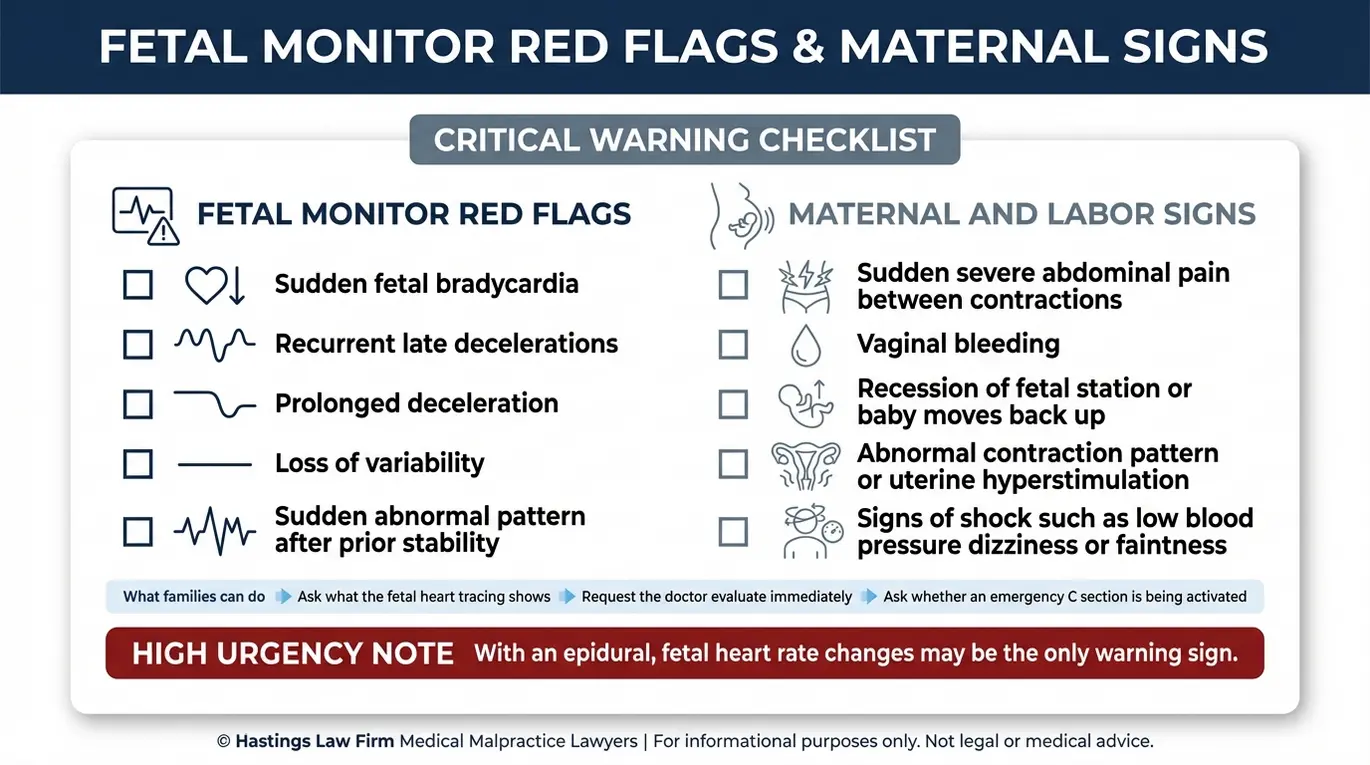
- Sudden, severe abdominal pain, especially pain that occurs between contractions or does not resolve
- Vaginal bleeding that begins abruptly during labor
- Loss of fetal station, which means the baby’s head recedes back into the birth canal after previously descending
- A change in the shape of the mother’s abdomen
- Sudden drop in maternal blood pressure or signs of hemorrhagic shock
- Abrupt cessation of contractions
Some of these signs overlap with other labor complications, which is why continuous monitoring is so important. Research published in PubMed Central on tocogram characteristics of uterine rupture shows that changes in contraction patterns on the monitor can be early indicators of a tear in progress.
For families working with a uterine rupture attorney in Arizona, the medical records from those critical minutes often tell the story of whether the care team acted quickly enough or missed the signs entirely.
Fetal Heart Rate Anomalies as the Primary Indicator
In many cases, the most telling sign of uterine rupture is not something the mother feels. It is what the fetal heart rate monitor shows. A nonreassuring fetal heart rate pattern, meaning abnormalities in the baby’s heart rate that suggest the baby is in distress, may be the first and sometimes the only warning that a rupture has occurred.
This is especially true when the mother has an epidural in place. The epidural can mask the severe abdominal pain that would otherwise signal a tear. Without that pain cue, the electronic fetal monitor becomes the primary safeguard.
When the uterus ruptures, it can compress or sever the blood supply to the baby, causing fetal hypoxia, a dangerous reduction in oxygen reaching the baby’s brain and organs. Prolonged oxygen deprivation can lead to permanent brain damage within minutes.
The ACOG Practice Bulletin No. 205 on Vaginal Birth After Cesarean Delivery emphasizes that continuous fetal heart rate monitoring is essential for any patient attempting a VBAC. A lawyer for uterine rupture cases will examine whether this monitoring was in place and whether the care team responded appropriately when the tracings became abnormal. An Arizona birth injury lawyer evaluates the fetal strip minute by minute to determine whether the standard of care was met.
Risk Factors That Require Heightened Medical Monitoring
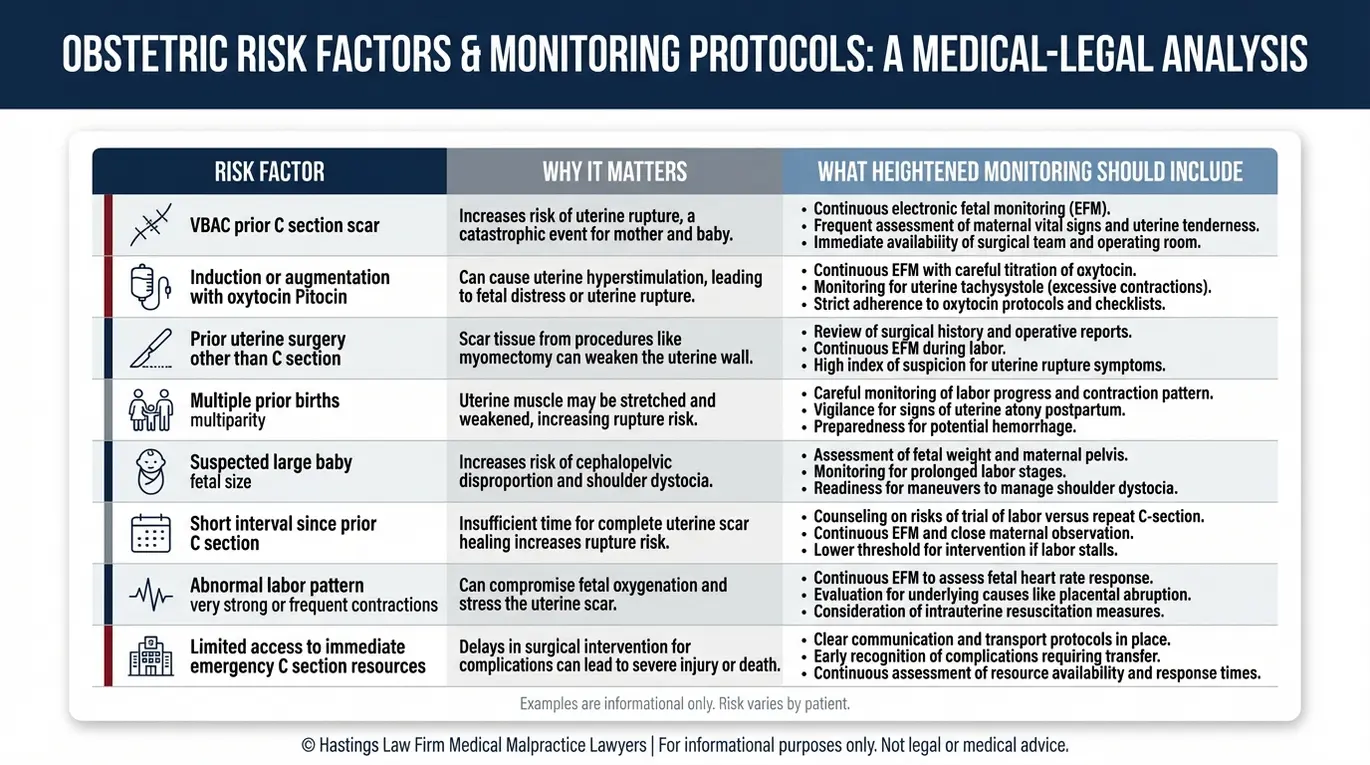
Mothers attempting a vaginal birth after cesarean, commonly called VBAC, or those undergoing induction with Pitocin face a significantly higher risk of uterine scar separation and rupture. When these risk factors are present, the standard of care requires closer monitoring and a lower threshold for emergency intervention.
A VBAC involves delivering vaginally after a previous cesarean section. The scar from the prior C-section creates a structural weak point in the uterine wall. During the strong contractions of active labor, that scar tissue can give way.
The risk increases depending on the type of prior incision, how recently the cesarean was performed, and how many prior uterine surgeries the patient has had. Low-transverse incisions generally carry the lowest risk, while vertical or T-shaped incisions are much more prone to separation.
Oxytocin, sold under the brand name Pitocin, is a medication used for induction or augmentation of labor. It intensifies contractions. When given to a mother with a prior uterine scar, Pitocin can dramatically increase the force placed on the weakened area. The decision to use Pitocin in a VBAC candidate requires careful risk assessment and close surveillance. If something goes wrong, an Arizona uterine rupture lawyer will examine whether that decision followed accepted protocols.
Other risk factors that should trigger heightened medical attention include:
| Risk Factor | Why It Increases Rupture Risk |
|---|---|
| Prior classical (vertical) uterine incision | Higher rupture rate than low-transverse scars |
| Multiple prior cesarean sections | Each surgery adds scar tissue and weakens the uterine wall |
| Short inter-pregnancy interval | Less time for the scar to fully heal |
| Induction or augmentation with Pitocin | Increases contraction intensity against a weakened scar |
| Prior uterine surgery (e.g., myomectomy) | Any surgical scar on the uterus creates a potential rupture point |
| Fetal macrosomia (large baby) | Greater mechanical stress on the uterine wall during delivery |
| Maternal age over 35 or high parity | Associated with increased risk in some studies |
When any of these factors are present, legal help for uterine rupture cases often centers on whether the provider performed an adequate risk assessment before labor began. An attorney for a ruptured uterus will review prenatal records, labor plans, and consent forms to determine whether the mother was properly counseled about these risks.
The presence of one or more risk factors does not automatically mean malpractice occurred. But when providers fail to account for known risks, or proceed with induction without appropriate safeguards, a malpractice lawyer in Phoenix can investigate whether the care fell below the accepted standard. For example, ignoring a patient’s history of classical incision or pushing for a vaginal delivery despite signs of cephalopelvic disproportion can be evidence of negligence. Proper counseling ensures the mother understands the dangers before consenting to a trial of labor.
The Hastings Law Firm Difference
Results matter, but what truly sets us apart is how we achieve them. Every verdict, every settlement, and every Arizona courtroom victory comes from one guiding promise: To treat each client’s fight for justice as if it were our own.
This balance of skill, experience, and empathy reflects our core philosophy that justice should not only compensate the injured, but also make healthcare safer nationwide.

Proving Medical Negligence in Uterine Rupture Lawsuits
Medical negligence is established by proving the obstetrician or care team failed to adhere to the standard of care, such as ignoring signs of fetal distress or delaying a necessary emergency C-section when rupture was suspected or confirmed. This is the core legal question in every uterine rupture case.
An Arizona uterine rupture lawyer works with qualified obstetric experts to define what the standard required in your specific clinical situation. These experts define the baseline expectations, such as the requirement for continuous electronic fetal monitoring (EFM) for any woman attempting a VBAC.
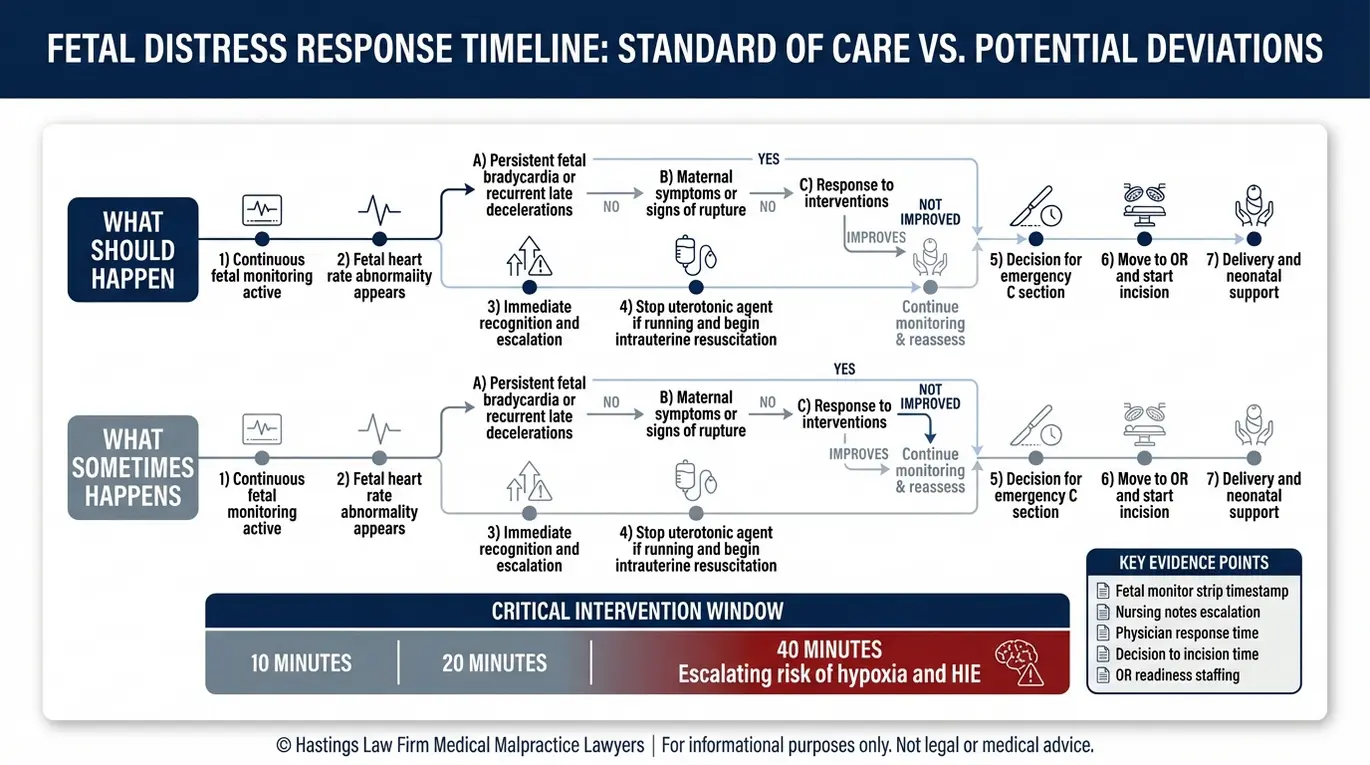
They also clarify that once a nonreassuring pattern is detected, the medical team must implement intrauterine resuscitation measures. These steps include repositioning the mother, administering oxygen, and stopping Pitocin while preparing for an operative delivery. Any departure from these protocols constitutes a breach of the standard of care.
One of the most critical elements in these cases is the time between recognizing the emergency and delivering the baby. This is often referred to as the “decision-to-incision” interval. Research on uterine incision to delivery interval and neonatal outcomes underscores how even short delays can affect outcomes. While the general benchmark suggests an emergency C-section should begin within 30 minutes of the decision to operate, uterine rupture cases often demand a response well within that window.
Because a ruptured uterus cuts off oxygen instantly, the standard often shifts to a “crash” C-section necessity. Research indicates that delivery within 18 minutes of suspected uterine rupture may be necessary to prevent severe oxygen deprivation, and delays beyond 30 minutes are associated with worse long-term outcomes. Hospitals must have anesthesia and surgical teams immediately available for high-risk patients to meet this rapid timeline.
A medical negligence attorney examines the timeline of events carefully:
- When did the fetal heart rate first show signs of distress?
- How quickly was the care team notified?
- When was the decision made to proceed with an emergency cesarean section?
- How long did it take to get the patient into the operating room?
- Were there delays caused by staffing issues, equipment problems, or failure to escalate?
There is an important distinction between a known complication and negligence. Uterine rupture can occur even with excellent care. The legal question is not whether the rupture happened, but whether the medical team’s response to it was timely and appropriate. Suing for uterine rupture is about proving that the delay or failure to act caused harm that could have been prevented. Establishing causation requires showing that this specific delay led to the injury.
A lawyer for birth trauma will work with independent experts to reconstruct the timeline and compare what happened against what should have happened. If the evidence shows a gap between the recognized emergency and the delivery, that gap can form the basis of a medical malpractice claim. Arizona malpractice counsel at our firm builds this evidence from the first day of the investigation, preparing every case as if it will be presented to a jury. We analyze every minute of the strip to prove that earlier intervention would have preserved the baby’s health.
Differentiating Dehiscence from Complete Rupture and Damages
While uterine dehiscence is a partial, often incomplete separation of a prior cesarean scar that may produce few or no symptoms, a complete rupture involves all layers of the uterine wall and poses immediate life-threatening risks to both mother and baby. Understanding this medical distinction matters because the type and severity of the event directly affects both the injuries suffered and the legal claim.
Uterine dehiscence, sometimes called a “window,” occurs when the scar thins and separates but the outermost layer of the uterus, the serosa, remains intact. In a dehiscence, the visceral peritoneum remains intact, acting as a barrier that often prevents the fetus from being expelled into the abdomen.
This containment usually preserves the blood supply, resulting in better outcomes compared to a frank rupture where the fetus is free-floating and placental separation is total. In many cases, dehiscence is found incidentally during a repeat cesarean and causes no acute harm. According to the NCBI Bookshelf resource on Uterine Rupture, complete rupture is a different event entirely. It involves a full-thickness tear that can allow the baby, placenta, or both to pass into the mother’s abdominal cavity.
| Feature | Dehiscence (Partial Separation) | Complete Rupture |
|---|---|---|
| Layers involved | Incomplete; serosa intact | All layers of the uterine wall |
| Symptoms | Often asymptomatic | Severe pain, hemorrhage, fetal distress |
| Fetal risk | Generally low | High risk of hypoxia, brain damage, or death |
| Maternal risk | Usually minimal | Hemorrhagic shock, hysterectomy, organ damage |
| Discovery | Often incidental during surgery | Acute emergency requiring immediate intervention |
The damages from a complete rupture can be severe and lifelong. For the mother, these may include emergency hysterectomy, massive hemorrhage requiring blood transfusion, bladder injuries, and lasting psychological trauma. Beyond the physical injuries, the psychological impact of a traumatic birth and unexpected hysterectomy can be devastating, often requiring years of therapy to process the loss. An Arizona uterine rupture lawyer accounts for every category of harm when building a claim.
For the baby, the primary danger is oxygen deprivation. Hypoxic-ischemic encephalopathy, or HIE, is a form of brain damage caused by a lack of oxygen and blood flow during birth. HIE can lead to cerebral palsy, seizures, developmental delays, and in the most severe cases, wrongful death. A lawyer for hysterorrhexis cases understands that the full scope of damages for an injured child may include decades of medical treatment, therapy, and specialized care. Families must often account for the costs of wheelchairs, home modifications, 24-hour nursing, and special education. Calculating these lifetime damages is essential for a fair settlement.
When pursuing damages for uterine rupture, a Phoenix birth injury attorney works with life care planners and medical experts to document the long-term financial impact on the family.
How Our Arizona Uterine Rupture Lawyers Pursue Justice
We investigate birth injury claims by securing medical records, consulting with independent obstetric experts, and preparing every case for trial to ensure families receive full compensation for lifelong care. Our approach is built on the belief that thorough preparation from day one leads to the strongest possible outcome for our clients. In the most tragic instances, we represent families in wrongful death claims when a mother or child does not survive the rupture.
Securing and Analyzing the Medical Evidence
The first step in a uterine rupture case is obtaining complete medical records, including fetal monitoring strips, nursing notes, physician orders, and operative reports. Under Arizona Revised Statutes § 12-2294, patients and their legal representatives have the right to access these records.
Our in-house nurse consultants review every page, identifying medical monitoring strips and time-stamped entries that reveal how the labor progressed and when critical decisions were made. We look for discrepancies between nursing notes and monitor strips. Often, the electronic record reveals distress long before the physician was called. An Arizona uterine rupture lawyer on our team maps out a minute-by-minute timeline to pinpoint where the standard of care may have been breached.
Independent Expert Consultation
We retain board-certified OB/GYNs and maternal-fetal medicine specialists from our national expert network to provide independent opinions on the care delivered during a uterine rupture event. These experts compare the documented actions against accepted medical standards and help determine whether the response to signs of rupture was adequate. Their analysis forms the medical foundation of the case.
The Trial-Ready Approach
At Hastings Law Firm, we prepare every malpractice lawsuit as though it will go before a jury. This is not a slogan; it is how we operate. Our team includes former hospital nurses and defense attorneys who previously worked for the medical systems they now challenge, giving us direct insight into the defense strategies the other side is likely to use. This level of trial presentation preparation signals to defense counsel and insurance carriers that we will not accept less than fair value.
The birth injury lawsuit process at our firm follows a clear path:
- Record collection and medical review by our in-house clinical team
- Expert evaluation to confirm whether a breach of the standard of care occurred
- Causation analysis linking the breach to the specific injuries suffered
- Damages assessment, including consultation with life care planners to project future medical and support needs
- Litigation and resolution, whether through firm negotiation or jury trial
No Financial Risk to You
Hiring a malpractice lawyer should not add financial stress to an already difficult birth injury lawsuit. We work on a contingency fee basis, which means you pay no attorney fees or costs unless we secure a recovery on your behalf. This model aligns our interests with yours; we invest our own resources into proving your case because we only succeed if you do.
It allows families of all income levels to access top-tier legal representation against well-funded hospital defense teams. Hastings Law Firm’s uterine rupture team is here to carry the legal burden so your family can focus on what matters most: healing and caring for each other.
Contact the Arizona Birth Injury Attorneys at Hastings Law Firm Today for Help
A uterine rupture during labor can change a family’s life in minutes. The physical, emotional, and financial toll can be overwhelming, and you should not have to face it alone. If you believe that medical errors contributed to what happened during your delivery, you have the right to seek answers.
Our Arizona uterine rupture lawyers at Hastings Law Firm are ready to listen, review your medical records, and help you understand your legal options. We serve families in Phoenix and throughout Arizona, and our team of attorneys, nurse consultants, and medical experts is focused entirely on medical malpractice cases.
Call us today for a free, confidential case evaluation. There is no fee unless we win. Let us help you find the answers you deserve.
Frequently Asked Questions About Uterine Rupture in Arizona


This content was researched and written by the Hastings Law Firm editorial team, which includes attorneys, medical professionals, and experienced researchers. Our writing is informed by internal knowledge and practical experience, and we cross-check critical details against authoritative sources cited throughout. Every piece undergoes human-led fact-checking and legal review. Because legal and medical information can change, if you spot an error, please contact us. Learn more about our content standards and review process on our editorial policy page.

Tommy Hastings, founder of Hastings Law Firm, is a board-certified personal injury trial lawyer dedicated exclusively to healthcare injury cases. Since 2001, he has represented injured patients and families in litigation against major hospital systems, pharmaceutical companies, and negligent healthcare providers nationwide. He has handled numerous high-profile cases that have drawn national media attention and resulted in multi-million dollar recoveries. He draws on that experience in his writing, helping readers understand how these cases work and what options may be available to them.
