


Arizona Urogynecologist Malpractice Lawyer
Urogynecologist malpractice can leave patients with lasting pain, additional procedures, and major disruption to daily life after pelvic floor treatment. The topic often involves surgical errors, missed post operative complications, and failures of informed consent, especially when transvaginal mesh is used. Understanding the difference between an expected complication and a preventable error can shape what comes next, including how responsibility is evaluated and what losses may be recoverable. If you or a loved one were harmed or worse due to urogynecologist malpractice in Arizona, contact Hastings Law Firm for a free, confidential case review.

Last Updated: July 27, 2026
Trusted Legal Representation for Medical Specialist Negligence in Arizona
When a urogynecologist causes preventable harm during pelvic floor treatment, the physical and emotional consequences can reshape your daily life. The pelvic floor is the group of muscles and tissues supporting the bladder, uterus, and rectum. It is central to basic bodily functions. Procedures involving transvaginal mesh, a surgical implant used to treat pelvic organ support problems, carry specific risks that demand specialized skill and judgment. If that judgment fell short, you deserve answers.
As an Arizona urogynecologist malpractice lawyer, Hastings Law Firm focuses exclusively on medical malpractice. Our team includes trial attorneys, former defense lawyers, and in-house medical professionals like nurses and patient advocates who understand the medical and legal aspects of these injuries. If you believe your care was substandard, we can review what happened and explain your options during a free, confidential consultation.

Identifying Negligence in Urogynecology and Pelvic Floor Surgery
Urogynecologic malpractice occurs when a specialist deviates from the accepted standard of care during pelvic floor treatments, resulting in preventable harm such as bladder perforation, mesh erosion, or nerve damage. The standard of care is the level of treatment a reasonably competent specialist would provide under similar circumstances. Not every poor outcome qualifies as medical negligence, but when a doctor’s actions fall below what the profession expects, injured patients have valid grounds for suing a urogynecologist.
Understanding the Specialty
A urogynecologist, formally known as a specialist in Female Pelvic Medicine and Reconstructive Surgery (FPMRS), treats conditions where urology and gynecology overlap. This field manages conditions where urology and gynecology overlap, such as pelvic organ prolapse (POP). POP is a condition where pelvic organs shift downward due to weakened support tissues. They also treat urinary incontinence and other pelvic floor disorders.
Because these procedures involve delicate anatomy near the bladder, ureters, and bowel, the margin for error is narrow. If the specialist is employed by a hospital, vicarious liability may apply to the facility, meaning the employer is held responsible for the employee’s actions. An Arizona urogynecologist malpractice lawyer evaluates whether the specialist met or fell below the expected standard by examining surgical records and post-operative notes.
Surgical Errors in Pelvic Procedures
Surgical mistakes during urogynecologic procedures can cause severe, lasting damage. Injuries during these operations often involve damage to the bladder or surrounding tissues. These may include puncturing the organ or improperly placing transvaginal mesh.
Research published through DukeSpace at Duke University documents the incidence of lower urinary tract injuries during laparoscopic hysterectomy. This research underscores how important surgical technique is in this field. Suing a urogynecologist for these errors requires proof of deviation from protocols.
The U.S. Food and Drug Administration has issued specific recommendations about surgical mesh for pelvic organ prolapse. They cite serious risks associated with these products. When a surgeon fails to follow these guidelines or uses a product without proper justification, that decision can form the basis of a claim led by a pelvic mesh injury lawyer.
Failure to Diagnose or Treat Post-Operative Complications
Surgical error is not the only basis for a urogynecologist malpractice attorney to file suit. Doctors must monitor and address complications immediately after surgery to prevent permanent harm. Delayed diagnosis of post-operative infections, failure to recognize mesh erosion symptoms, or improper treatment of complications can also constitute medical malpractice by a urogynecologist.
If a patient reports worsening pain, bleeding, or urinary problems after surgery and the specialist dismisses those concerns, the resulting harm may have been preventable. We look for evidence that medical concerns were ignored or mismanaged.
Informed Consent Failures
Arizona urogynecology malpractice cases often involve a failure to warn. Patients have a legal right to know the risks of mesh and reconstructive procedures before surgery. Informed consent means your doctor explained the risks and you agreed to the treatment.
It requires a meaningful conversation about alternatives, potential complications, and what recovery looks like. When that conversation does not happen, or when known risks are minimized, the patient’s ability to make an informed decision is compromised.
Recognizing the Difference: Errors vs. Complications
One of the first things a urogynecologist malpractice attorney will assess is whether your outcome was a known complication or a preventable error. Determining if an outcome was a common risk or a mistake requires careful medical review.
| Known Complication | Potential Surgical Error |
|---|---|
| Minor post-operative discomfort that resolves with time | Chronic, worsening pain inconsistent with expected recovery |
| Small amount of bleeding managed during surgery | Uncontrolled hemorrhage from a severed blood vessel |
| Temporary urinary retention after prolapse repair | Permanent bladder dysfunction from an unrecognized bladder injury |
| Mild mesh discomfort that responds to conservative treatment | Mesh erosion into the vaginal wall or bladder from improper placement |
| Temporary numbness near the surgical site | Permanent nerve damage causing loss of sensation or chronic pain |
A poor outcome alone does not prove negligence. But when the outcome reflects a departure from accepted surgical practice, an Arizona urogynecologist malpractice lawyer can help determine whether you have a valid claim.
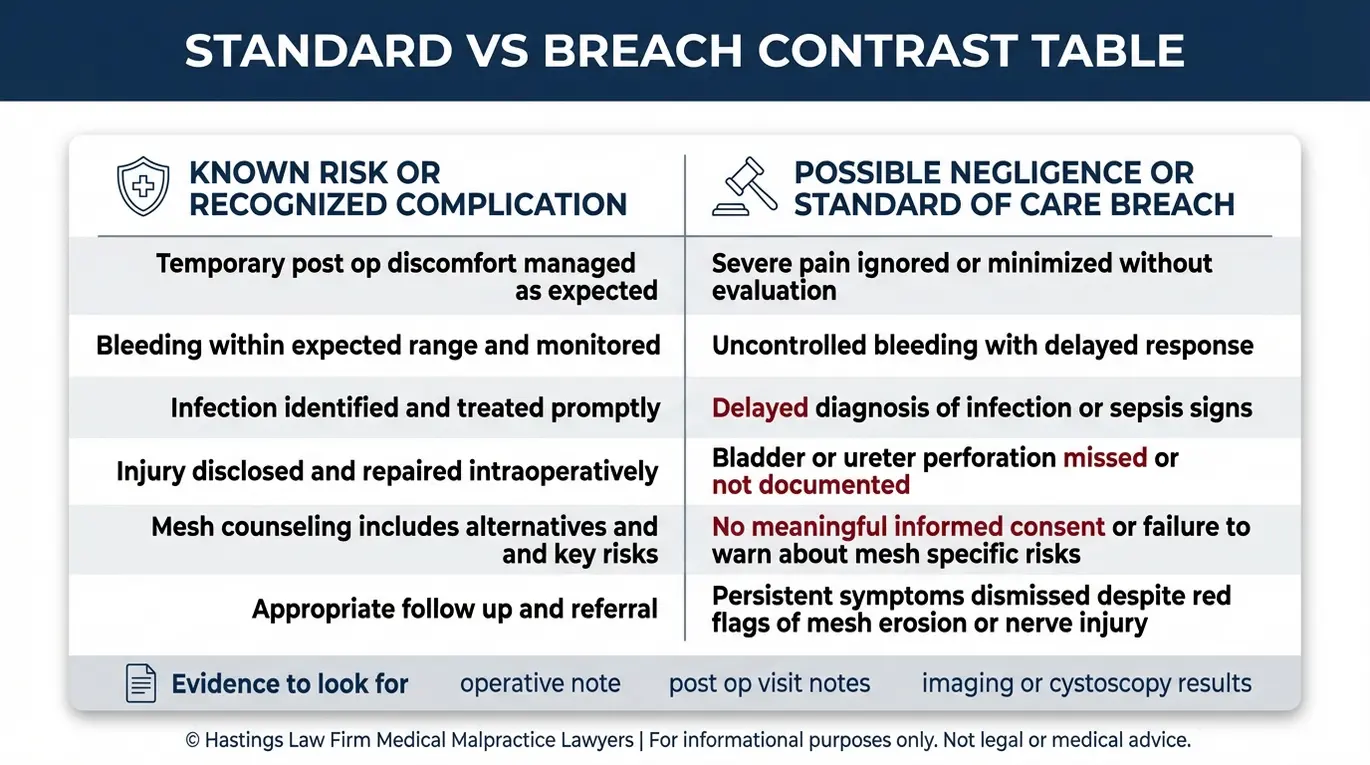
Proving Fault and Navigating Arizona Medical Liability Laws
To win a medical malpractice lawsuit in Arizona, the plaintiff must prove that the doctor owed a duty of care, breached that duty through negligent action, and directly caused specific damages, often requiring an Affidavit of Merit from a qualified medical expert. In urogynecology cases, this process is complex and requires a skilled pelvic floor negligence attorney.
The Four Legal Elements
Every malpractice claim against a pelvic floor specialist rests on four elements. These elements form the legal foundation of every medical liability claim:
- Duty of care: The urogynecologist had a doctor-patient relationship and was obligated to provide competent treatment.
- Breach: The specialist’s actions fell below the accepted standard of care. This may occur through a surgical error, failure to diagnose, or inadequate informed consent. In rare cases, the doctrine of res ipsa loquitur, meaning “the thing speaks for itself,” may apply if an instrument was left inside the body.
- Causation: The breach directly caused the patient’s injury. This is essential for your urogynecologist malpractice attorney to prove because the defense often argues the injury would have occurred regardless.
- Damages: The patient suffered measurable harm, including physical injury, financial loss, or emotional distress, necessitating a medical malpractice attorney for urogynecology.
A malpractice lawyer for urogynecology errors works to connect each element through medical records, expert analysis, and a detailed reconstruction of the care timeline.
Arizona’s Affidavit of Merit Requirement
Under A.R.S. § 12-2602, Arizona law requires patients in medical malpractice cases to file a preliminary expert opinion affidavit. This is a key step for any Arizona urogynecology malpractice lawyer. This document must be signed by a qualified medical expert, typically another urogynecologist or FPMRS specialist.
They must confirm that the defendant breached the standard of care and that the breach caused the injury. Here is how the affidavit process works:
- Identify a qualified expert in the same specialty as the defendant. Arizona law requires that the expert be competent to testify about the specific type of care at issue, a requirement a pelvic floor surgery lawyer handles routinely.
- Provide the expert with complete medical records. This includes operative reports and nursing notes to ensure a complete evaluation.
- The expert reviews the case and determines if the care met professional standards.
- If the expert confirms a breach, they prepare a signed affidavit. This document links the doctor’s actions to your specific injuries.
- The affidavit is filed with the court as required by statute. Missing this deadline can end a case before it begins.
Our firm maintains a national network of medical experts, including board-certified urogynecologists, who can evaluate your case and provide credible testimony.
Altered Medical Records
In some pelvic surgery cases, medical records may contain inconsistencies that raise questions about accuracy. Our medical team reviews every document to ensure the timeline of care is accurate. When a bladder perforation, known medically as a cystotomy, or a ureteral injury occurs, the operative report should reflect that complication.
The operative report is the surgeon’s detailed account of the procedure. If the records do not match the patient’s clinical course, experienced Arizona doctor malpractice attorneys examine whether documentation was altered or incomplete. Our in-house medical staff knows how to identify charting gaps.
Consent-to-Settle Clauses
Arizona urogynecologist malpractice cases can present another hurdle. Insurance policy terms can sometimes impact how a case is resolved. Some physician malpractice insurance policies include a “consent to settle” clause, which allows the doctor to block a settlement offer.
This means even when liability is clear, the case may go to trial if the physician refuses to settle. That reality makes hiring a trial-ready pelvic floor injury lawyer important. At Hastings Law Firm, every case is prepared for the courtroom from day one.

The Hastings Law Firm Difference
Results matter, but what truly sets us apart is how we achieve them. Every verdict, every settlement, and every Arizona courtroom victory comes from one guiding promise: To treat each client’s fight for justice as if it were our own.
This balance of skill, experience, and empathy reflects our core philosophy that justice should not only compensate the injured, but also make health care safer nationwide.

Recoverable Damages for Life-Altering Pelvic Injuries
Patients harmed by urogynecologic errors in Arizona can recover compensation for economic losses like corrective surgeries and lost wages, as well as non-economic damages for pain, suffering, and loss of intimacy, with no state-imposed caps limiting the award secured by an Arizona urogynecologist malpractice lawyer.
Economic Damages
Economic damages represent the measurable financial costs of your injury. In urogynecology cases, these costs can be substantial, which is why retaining a medical malpractice attorney for urogynecology is important:
- Corrective and revision surgeries, including mesh explant to treat mesh erosion, also known as mesh exposure, and repair of damaged organs. These procedures are often more complex than the original surgery.
- Ongoing medical expenses for pelvic floor physical therapy and long-term urological monitoring managed by your pelvic floor injury lawyer.
- Lost wages and reduced earning capacity if the injury prevents you from returning to work. A urogynecologist malpractice attorney can commission a life care plan to project future income losses.
- Costs of assistive care during recovery, including home health aides or household help. If you are unable to perform daily tasks like cleaning or cooking due to chronic pain, these expenses are recoverable.
Non-Economic Damages
Non-economic damages cover the personal impact of the injury on your quality of life. These are a focus for damages in urogynecology cases and often include:
- Pain and suffering, both from the initial injury and from additional corrective procedures. This encompasses the physical agony of nerve entrapment or organ perforation.
- Emotional distress, including anxiety, depression, and the psychological impact of a medical betrayal.
- Loss of consortium, which compensates for the impact on intimate relationships and family life. This is particularly relevant in mesh injury cases where complications alter quality of life.
- Loss of enjoyment of life when chronic pain or dysfunction limits daily activities. An Arizona urogynecology malpractice lawyer fights for this compensation when you can no longer participate in hobbies or social events.
Arizona’s No-Cap Rule
Unlike many states that limit non-economic damage awards, the Arizona Constitution prohibits placing caps on damages for personal injury or wrongful death. This rule ensures that patients can seek recovery based on their actual losses. It means a jury can award full compensation for mesh injuries based on the actual evidence of harm. This allows a urogynecologist malpractice attorney to seek full justice.
Punitive Damages
In rare cases, punitive damages may apply. In Arizona, these awards are meant to address extreme cases of misconduct rather than compensate for losses. If evidence shows that a surgeon acted with an “evil mind” — demonstrated through outrageous, oppressive, or intolerable conduct that goes beyond mere negligence — such as knowingly performing a procedure while impaired, punitive damages can be pursued by your Arizona doctor malpractice attorneys. These claims require a higher burden of proof and our team evaluates whether the facts support this category of recovery.
Why Choose Hastings Law Firm for Your Arizona Claim
Hastings Law Firm offers a specialized team of trial lawyers and medical professionals who focus exclusively on medical malpractice, ensuring your case is prepared for the courtroom to maximize leverage against insurance companies. Every resource in our firm is directed toward holding negligent medical providers accountable for medical negligence.
Our founder, Tommy Hastings, is a board-certified trial lawyer with over two decades of experience. He is board-certified in Personal Injury Trial Law, a distinction held by less than 2% of attorneys in the state. As your Arizona urogynecologist malpractice lawyer, we bring a level of medical understanding that general practice firms simply cannot match.
We also employ former defense attorneys who previously represented hospitals. They know the strategies the other side will use because they used to execute them. This expertise is important for patients or families facing medical error or wrongful death caused by surgical negligence.
We understand that behind every case is a person who trusted their doctor and was let down. We understand the devastation of conditions like dyspareunia (painful intercourse) and pudendal nerve injury (pudendal neuralgia). Our mission is to restore trust by giving you a team that listens, communicates openly, and treats you as a partner. Trust your claim to a specialized urogynecologist malpractice attorney.
Hiring a pelvic floor injury lawyer should not add financial stress. We work on a contingency fee basis, which means you pay no attorney fees or costs unless we recover compensation for you. Contact our Arizona urogynecology malpractice lawyer team today.
Contact the Arizona Doctor Malpractice Attorneys at Hastings Law Firm Today for Help
If you or a loved one suffered a bladder injury, mesh complication, nerve damage, or other harm from a urogynecologic procedure, you need a legal team that understands the medicine as well as the law. We are here to help you understand if you have a claim.
Hastings Law Firm provides free, confidential case evaluations for patients across Arizona. Our Arizona urogynecologist malpractice lawyers will review your medical records, consult with qualified experts, and give you an honest assessment of your legal options.
You do not pay any fees unless we recover compensation for you. Taking the first step costs you nothing, and it may be the most important decision you make for your recovery and your future.
Contact the Arizona doctor malpractice attorneys at Hastings Law Firm today to schedule your consultation.
Frequently Asked Questions About Urogynecologist Malpractice in Arizona


This content was researched and written by the Hastings Law Firm editorial team, which includes attorneys, medical professionals, and experienced researchers. Our writing is informed by internal knowledge and practical experience, and we cross-check critical details against authoritative sources cited throughout. Every piece undergoes human-led fact-checking and legal review. Because legal and medical information can change, if you spot an error, please contact us. Learn more about our content standards and review process on our editorial policy page.

Tommy Hastings, founder of Hastings Law Firm, is a board-certified personal injury trial lawyer dedicated exclusively to healthcare injury cases. Since 2001, he has represented injured patients and families in litigation against major hospital systems, pharmaceutical companies, and negligent healthcare providers nationwide. He has handled numerous high-profile cases that have drawn national media attention and resulted in multi-million dollar recoveries. He draws on that experience in his writing, helping readers understand how these cases work and what options may be available to them.
