


Arizona Umbilical Cord Prolapse Negligence Lawyer
Written by: Hastings Law Firm | Reviewed by: Tommy Hastings | Updated: July 27, 2026
Umbilical cord prolapse is a delivery emergency that can quickly reduce a baby’s oxygen supply and lead to permanent neurological injury. The risk increases when warning signs on fetal monitoring are missed, communication breaks down, or an emergency delivery is delayed. Families may be left coping with long term medical needs, uncertainty about what happened, and concerns about accountability. Clear records and timely action can matter when evaluating what occurred during labor and delivery. If you or a loved one were harmed or worse due to umbilical cord prolapse negligence in Arizona, contact Hastings Law Firm for a free, confidential case review.
Top Rated Umbilical Cord Injury Attorneys in Arizona
What You Should Know About Infant Cord Prolapse Error Claims in Arizona:
- Permanent neurological injury can result when umbilical cord prolapse is not recognized and treated as an urgent emergency.
- Long term family impact can follow when oxygen deprivation during delivery leads to lasting impairment.
- Accountability disputes often focus on whether fetal monitoring warnings were recognized and acted on without delay.
- Options for pursuing a claim can narrow if Arizona filing deadlines are missed.
- Recovery can be shaped by the scope of lifelong care needs and the effect on future earning capacity.
- Liability can extend beyond a single clinician when breakdowns involve nurses, physicians, and the hospital.
- A provider can face lasting professional consequences when a malpractice payment is reported to a federal practitioner database.
- Key records can become harder to obtain over time, including fetal monitoring strips and labor and delivery nursing notes.
- Objective newborn indicators can be central to evaluating oxygen deprivation, including Apgar scores and cord blood gas analysis.

A Healthcare Focused Law Firm
When your child has suffered a birth injury linked to an umbilical cord complication, the weight of that experience can feel impossible to carry alone. You may have questions about what went wrong, whether it could have been prevented, and what options your family has going forward. Our firm focuses exclusively on medical malpractice. Board-certified trial attorney Tommy Hastings leads our team of attorneys, nurse consultants, and in-house medical staff.
As an Arizona umbilical cord prolapse negligence lawyer, our goal is to help families uncover the truth about what happened during delivery and hold the responsible parties accountable. If your child was harmed by a cord-related complication, we invite you to contact our Phoenix office for a free, confidential case evaluation. There are no fees unless we recover compensation for your family.
Understanding Umbilical Cord Prolapse and Why It Is Dangerous
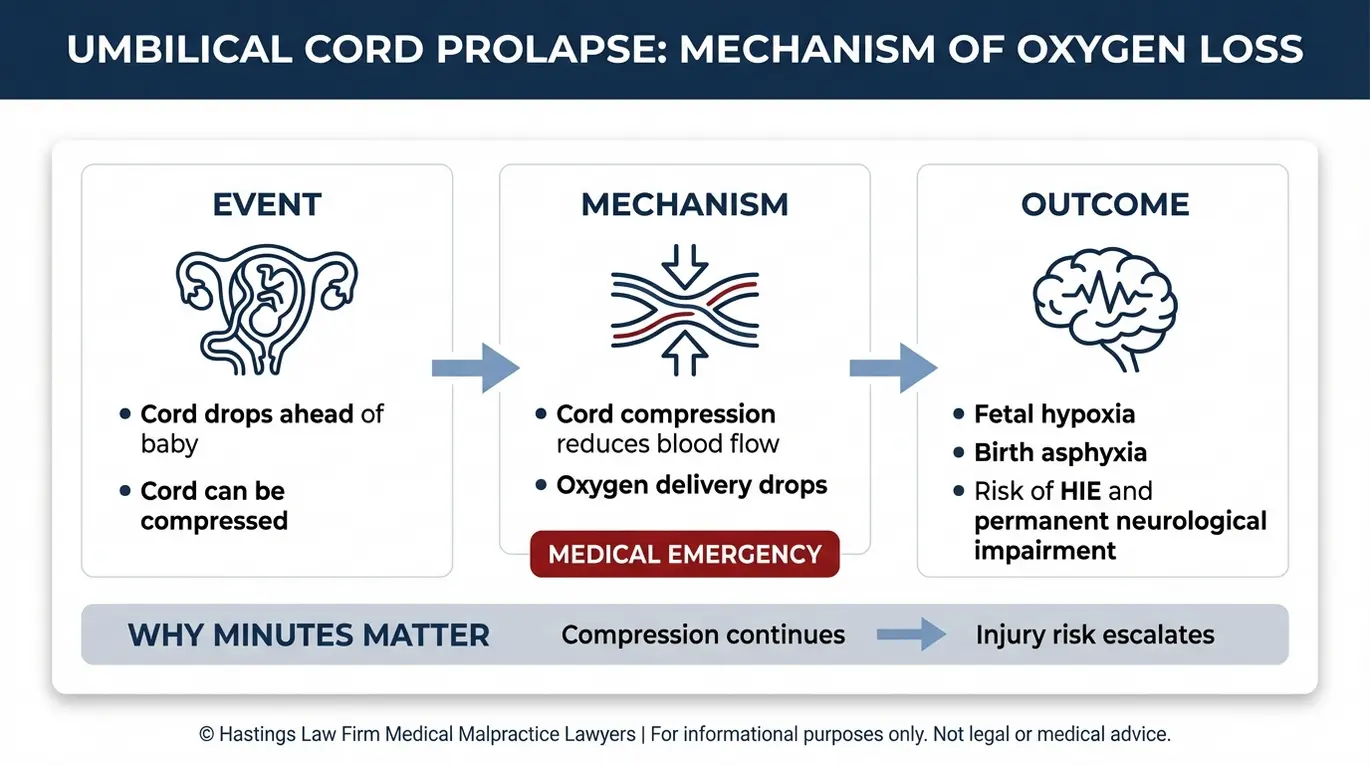
Umbilical cord prolapse occurs when the cord drops through the cervix ahead of the baby, becoming compressed during delivery and reducing or cutting off the baby’s oxygen supply. This is one of the most urgent emergencies in obstetric medicine, requiring rapid assessment and decisive action from the delivery team. When the cord is trapped between the baby and the birth canal, the resulting cord compression, a condition where the umbilical cord is physically squeezed and blood flow is restricted, can starve the baby’s brain of oxygen in a matter of minutes.
The immediate danger is fetal hypoxia, meaning the baby is not receiving enough oxygen. Prolonged hypoxia during delivery can lead to birth asphyxia and a condition called hypoxic-ischemic encephalopathy (HIE), a type of brain damage caused by oxygen deprivation around the time of birth. HIE can result in permanent neurological injury, including cerebral palsy, seizures, and developmental delays. Given these risks, an emergency C-section is frequently the only effective method to prevent catastrophic outcomes.
According to NCBI Bookshelf’s review of Umbilical Cord Prolapse, a prolapsed cord demands immediate clinical intervention. Every second counts. The medical team must recognize the emergency and act without delay. If you believe your child’s injury resulted from a delayed response to cord prolapse, consulting with an umbilical cord prolapse lawyer in Arizona can help you understand whether the standard of care was met. The standard of care is the medical benchmark used to determine if a doctor acted properly under the circumstances.
While the immediate medical focus is on survival, families often face a long road ahead. Understanding your rights under laws such as Arizona Revised Statutes § 12-542, which sets the statute of limitations for medical malpractice claims, becomes relevant as parents seek accountability for preventable birth trauma.
The Critical Time Window for Diagnosis and Treatment
The standard of care in most prolapse situations calls for emergency delivery as quickly as possible once fetal distress is identified and cord prolapse is confirmed. When fetal distress, meaning abnormal signs on monitoring that suggest the baby is losing oxygen, is identified and cord prolapse is confirmed, an emergency cesarean section (C-section), a surgical delivery performed through an incision in the abdomen, is typically the required response. In cases involving fetal bradycardia or sustained distress, the obstetric standard generally requires delivery within 30 minutes of the decision to proceed with emergency cesarean.
When the umbilical cord is compressed and blood flow is restricted, oxygen deprivation can rapidly cause serious harm. That is why obstetric guidelines emphasize rapid decision-to-delivery times. A delay in performing an emergency C-section can mean the difference between a healthy outcome and permanent brain damage. When providers fail to act within the required timeframe, the consequences for the child and family can last a lifetime.
Common Types of Umbilical Cord Injuries Caused by Negligence
Umbilical cord injuries range from overt prolapse to nuchal cords wrapped around the neck, and each type requires specific monitoring and timely intervention to prevent birth asphyxia. Not every cord complication is the same, and the standard of care varies depending on what the medical team is facing. As an Arizona umbilical cord injury attorney, we evaluate the specific type of cord event involved and whether the clinical response matched what the situation demanded.
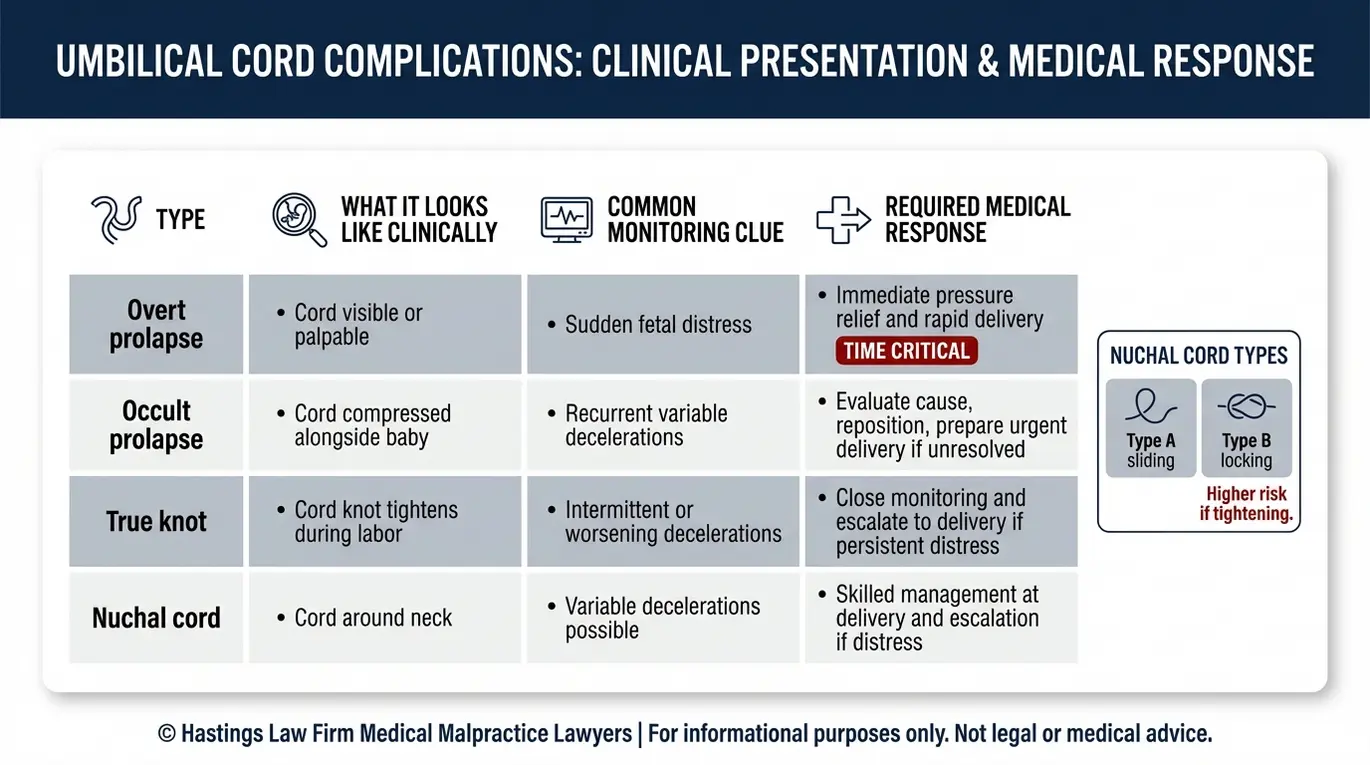
Here is a comparison of the most common umbilical cord complications, how they present, and what the medical team should do:
| Type of Injury | Clinical Presentation | Required Medical Response |
|---|---|---|
| Overt Prolapse | The cord is visible or can be felt in the birth canal ahead of the baby | Immediate emergency C-section; manual elevation of the baby’s presenting part to relieve pressure |
| Occult Prolapse | The cord is compressed alongside the baby but is not visible or palpable | Close fetal monitoring; emergency delivery if heart rate patterns indicate distress |
| True Knot | A knot forms in the umbilical cord that can tighten during labor and restrict blood flow | Continuous fetal heart rate monitoring; urgent delivery if the knot tightens and causes distress |
| Nuchal Cord | The cord is wrapped around the baby’s neck one or more times | Monitoring for signs of umbilical cord strangulation; intervention based on severity and heart rate changes |
Overt prolapse versus occult umbilical cord prolapse is an important distinction. In an overt prolapse, the cord is physically visible or palpable, making diagnosis more immediate. In an occult prolapse, the cord is hidden alongside the baby, which means the medical team must rely on fetal monitoring to detect the problem. Both can cause severe neurological impairment if the response is delayed.
A true knot, a literal knot that forms in the umbilical cord during pregnancy, can tighten as the baby descends through the birth canal, significantly restricting oxygen delivery. According to the Journal of Pharmaceutical Negative Results’ study on nuchal cord incidence, nuchal cords are relatively common, but their management depends heavily on whether they are causing fetal compromise, requiring vigilant assessment by the obstetrics team.
Nuchal Cords: Type A versus Type B and Their Treatability
Nuchal cords occur when the umbilical cord wraps around the baby’s neck during pregnancy or delivery. Not all nuchal cords carry the same level of risk. A Type A nuchal cord slides freely and can often be reduced, or slipped back over the baby’s head, during delivery without significant complication. A Type B nuchal cord, by contrast, is locked in place and cannot be easily unwound.
This locking pattern creates a higher risk of cord tightening during labor, which can lead to changes in fetal heart rate and potential oxygen deprivation. The distinction matters because the standard of care requires the medical team to identify which type is present and respond appropriately. Failing to recognize a Type B nuchal cord or ignoring abnormal heart rate patterns associated with it can constitute medical negligence.
The Hastings Law Firm Difference
Results matter, but what truly sets us apart is how we achieve them. Every verdict, every settlement, and every Arizona courtroom victory comes from one guiding promise: To treat each client’s fight for justice as if it were our own.
This balance of skill, experience, and empathy reflects our core philosophy that justice should not only compensate the injured, but also make healthcare safer nationwide.

How Medical Malpractice Leads to Umbilical Cord Prolapse
Malpractice in cord prolapse cases often occurs when healthcare providers fail to recognize known risk factors, ignore warning signs of fetal distress, or delay the interventions that the situation demands. As a negligence lawyer for umbilical cord prolapse cases, we investigate the sequence of clinical decisions to determine where the medical negligence occurred.
There are several provider actions, or failures to act, that can turn a manageable emergency into a catastrophic outcome. These errors often form the basis of a malpractice claim:
- Failing to perform a timely C-section when fetal monitoring shows distress
- Failing to properly read or respond to fetal heart rate strip abnormalities
- Performing an amniotomy, the artificial rupture of membranes (breaking the water), when the baby is at a high station and the cord is at risk of slipping past
- Failing to place the mother in the Trendelenburg position, a positioning technique where the mother’s hips are elevated above her head to relieve pressure on the prolapsed cord
- Delayed notification to the surgical team after prolapse is identified
According to a review published in PubMed Central on obstetric emergencies involving umbilical cord prolapse, rapid recognition and a coordinated team response are essential to preventing permanent injury. The Agency for Healthcare Research and Quality’s Patient Safety Indicators Benchmark Data Tables also highlight the measurable safety standards hospitals are expected to meet during obstetric emergencies.
As a medical malpractice law firm in Arizona, we work with obstetric experts and our in-house nursing staff to reconstruct the timeline of care and identify whether the clinical team’s response fell below the accepted standard. Our team includes former defense attorneys who understand how hospitals document and defend these cases, giving us a strategic advantage in identifying gaps in the medical record. By rigorously analyzing the evidence, we aim to prove both the breach of duty and the causation required to succeed in a legal claim.
Recognizing Signs of Fetal Distress and Failure to Monitor
Doctors and nurses must continuously monitor fetal heart rate patterns for decelerations or bradycardia, which are the primary indicators that a baby is losing oxygen due to cord compression. Fetal monitoring is not optional during labor; it is a core component of the standard of care, and the clinical team is trained to interpret these tracings in real time.
One of the most telling patterns on a fetal monitor strip is variable decelerations, which are abrupt drops in the baby’s heart rate that often correspond to cord compression events. According to NCBI Bookshelf’s resource on Variable Decelerations, these patterns are among the most common findings on fetal heart rate tracings and should prompt immediate clinical evaluation.
Nurses are typically the first line of defense. They are trained to recognize non-reassuring heart rate patterns and escalate concerns to the attending physician without delay. When nursing staff fail to alert the doctor, or when a doctor dismisses the significance of the tracings, important time can be lost, and the window to prevent injury may close permanently. In many cases, the failure to act on these clear distress signals constitutes the core of the negligence claim.
After delivery, Apgar scores provide a snapshot of the baby’s condition at one and five minutes after birth. Low Apgar scores can indicate that the baby experienced significant oxygen deprivation. As an umbilical cord prolapse negligence lawyer, we examine the fetal monitoring strips, nursing notes, and Apgar scores together to build a minute-by-minute picture of what the medical team knew and when they knew it.
Proving Liability and Establishing Negligence in Arizona Courts
Establishing liability in a birth injury lawsuit requires proving that the doctor breached the accepted standard of care and that this breach directly caused the child’s cerebral palsy, HIE, or other brain injury. Arizona courts apply a structured legal framework that breaks medical negligence into four distinct elements. As an Arizona umbilical cord prolapse lawyer, we build each case around this framework from the very first day of investigation.
The four elements of negligence that must be established are:
- Duty: A doctor-patient relationship existed, creating a legal duty of care to provide competent medical care
- Breach: The healthcare provider committed a breach of duty by deviating from what a reasonably competent Arizona physician would have done under similar circumstances
- Causation: The breach, such as a delay in performing a C-section, directly caused the baby’s oxygen deprivation and resulting injury
- Damages: The child suffered permanent, measurable harm, including conditions like cerebral palsy, HIE, seizures, or other neurological impairment
Proving medical negligence in Arizona requires qualified expert testimony. Under Arizona Revised Statutes § 12-2604, experts in medical malpractice cases must be licensed physicians who are actively practicing or teaching in the same field as the defendant. This stringent requirement ensures that only those with relevant, current experience can critique the actions of another physician. This means we retain qualified expert witnesses, including board-certified obstetricians and maternal-fetal medicine specialists, who can credibly testify about what the standard of care required and how the defendant fell short.
Our firm’s national network of medical experts, combined with our in-house nurse practitioners and patient advocates, allows us to conduct a thorough medical reconstruction before litigation even begins. This trial-ready preparation positions every case for firm negotiation or, when necessary, a jury trial.
Arizona Statute of Limitations for Birth Injury Claims
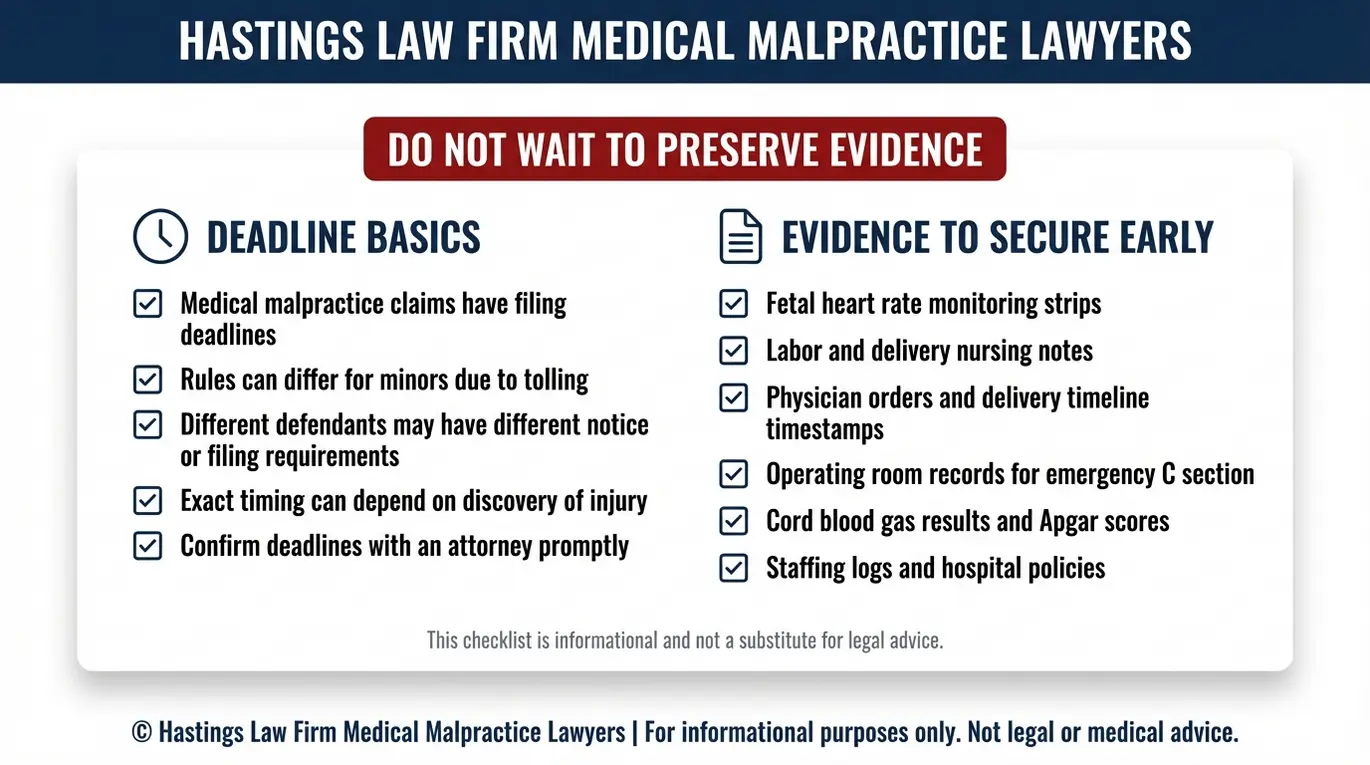
Arizona law sets specific deadlines for filing birth injury lawsuits, and while the law provides certain protections for minors, families should act as early as possible to preserve critical evidence. Under Arizona Revised Statutes § 12-542, the general statute of limitations for medical malpractice claims is two years from the date of the injury. This strict window applies to most adult cases and requires diligent attention to the calendar.
While specific Arizona birth injury statutes govern these timelines, exceptions exist. For minor children, Arizona law includes a tolling provision under A.R.S. § 12-502, which can pause the limitations clock during the child’s minority. This means the filing deadline may be extended in birth injury cases involving minors. However, relying on tolling alone is risky given the complexities of medical malpractice laws.
Why early action matters:
- Evidence deterioration: Fetal heart rate monitoring strips, labor and delivery nursing notes, and staffing logs may be altered, archived, or lost over time.
- Fading memories: Witness recollections become less reliable over time.
- Changing policies: Hospital protocols may shift, obscuring the standards in place at the time of birth.
The sooner an investigation begins, the stronger the foundation for your child’s claim. Our team moves quickly to secure and preserve important evidence the moment we accept a case.
Recovering Damages for a Life-Altering Birth Injury
Compensation in severe birth injury cases covers lifelong medical care, loss of earning capacity, and the pain and suffering endured by the child and family. When a child suffers permanent harm like cerebral palsy or HIE due to medical negligence, the financial impact extends across an entire lifetime. An Arizona Umbilical Cord Prolapse Negligence Lawyer helps families pursue damages in birth injury cases that reflect the true scope of that impact.
Recoverable damages are generally categorized into economic damages and non-economic damages:
- Economic damages: These include past and future medical costs such as surgeries, hospitalizations, medications, physical and occupational therapy, speech therapy, and assistive devices.
- Non-economic damages: These cover the physical pain, emotional distress, and loss of enjoyment of life experienced by the child.
- Loss of earning capacity: Compensation for the income the child will never be able to earn due to their disability.
- Home modifications: Wheelchair accessibility, adaptive technology, and in-home nursing care.
For children with conditions like cerebral palsy, these costs can span 50 years or more. We work with experts to create a comprehensive life care plan to calculate the full cost of care across the child’s expected lifespan. According to the CDC’s Data and Statistics for Cerebral Palsy, cerebral palsy is one of the most common motor disabilities in childhood, and the associated care needs are significant and ongoing.
Reporting Malpractice Settlements to the National Practitioner Data Bank
When a medical malpractice claim results in a settlement or judgment, federal law often requires that the outcome be reported to the National Practitioner Data Bank. This federal database tracks payments made on behalf of doctors and other healthcare providers in malpractice cases. This reporting creates a permanent record tied to the healthcare provider, which can affect their credentialing and licensing.
For many of our clients, this accountability measure is deeply meaningful. It helps ensure that the provider’s conduct is documented and visible to future employers and licensing boards, contributing to patient safety beyond your individual case.
Contact the Arizona Birth Injury Attorneys at Hastings Law Firm Today for Help
If your child suffered a birth injury that you believe was caused by a delayed response to an umbilical cord complication, our team is ready to listen and investigate. Founded in 2005, Hastings Law Firm focuses on restoring trust for families who have been betrayed by the healthcare system. As your Arizona Umbilical Cord Prolapse Negligence Lawyer, we operate on a contingency fee basis.
That means there are no attorney fees or costs unless we recover compensation for you. We understand how isolating and overwhelming this experience can be. We believe you deserve clear answers about what happened to your child.
Contact our Phoenix office today for a free, confidential case evaluation. Let us help you understand your options and take the first step toward accountability.
Frequently Asked Questions About Umbilical Cord Prolapse Negligence in Arizona


This content was researched and written by the Hastings Law Firm editorial team, which includes attorneys, medical professionals, and experienced researchers. Our writing is informed by internal knowledge and practical experience, and we cross-check critical details against authoritative sources cited throughout. Every piece undergoes human-led fact-checking and legal review. Because legal and medical information can change, if you spot an error, please contact us. Learn more about our content standards and review process on our editorial policy page.

Tommy Hastings, founder of Hastings Law Firm, is a board-certified personal injury trial lawyer dedicated exclusively to healthcare injury cases. Since 2001, he has represented injured patients and families in litigation against major hospital systems, pharmaceutical companies, and negligent healthcare providers nationwide. He has handled numerous high-profile cases that have drawn national media attention and resulted in multi-million dollar recoveries. He draws on that experience in his writing, helping readers understand how these cases work and what options may be available to them.
