


Arizona Umbilical Cord Entrapment Lawyer
Written by: Hastings Law Firm | Reviewed by: Tommy Hastings | Updated: July 27, 2026
Umbilical cord compression during labor can interrupt oxygen to a baby and lead to lasting neurological harm when warning signs are missed or responses are delayed. Cord complications such as twisting or prolapse require vigilant monitoring and timely intervention to prevent avoidable injury. Families often face overwhelming uncertainty while trying to understand what went wrong in the delivery room and what the medical team should have done differently. If you or a loved one were harmed or worse due to umbilical cord entrapment in Arizona, contact Hastings Law Firm for a free, confidential case review.

Top Rated Legal Representation for Cord Compression Injuries in Arizona
What You Should Know About Infant Cord Compression Injury Claims in Arizona:
- Lasting neurological injury can result when umbilical cord compression interrupts oxygen and the problem is not addressed promptly.
- Preventable harm may be linked to missed fetal distress signals or delayed escalation to urgent delivery when the baby does not improve.
- Severe outcomes become more likely when time sensitive emergencies like cord prolapse are not recognized and treated with immediate urgency.
- Disputes often focus on whether the medical team met the standard of care in monitoring and responding during labor.
- Recovery options can be limited if Arizona filing deadlines are missed, especially when tolling and discovery issues are disputed.
- Compensation can include long term medical care needs and non economic losses tied to quality of life and physical impairment.
- A life care plan can shape the value of a claim by projecting future medical expenses and related support needs.
- Medical records such as fetal monitoring strips and delivery documentation can be central to evaluating what happened during labor.

A Healthcare Focused Law Firm
When a baby suffers a preventable brain injury during delivery, the emotional weight can feel impossible to carry. If your child was harmed because umbilical cord complications were missed or mismanaged, you deserve honest answers about what happened and whether medical negligence was involved.
At Hastings Law Firm, we focus exclusively on medical malpractice. Our team includes in-house medical professionals, former defense attorneys, and board-certified trial lawyers who understand both the medicine and the law behind birth injury cases. As an experienced Arizona umbilical cord entrapment lawyer, Tommy Hastings and our legal team are prepared to review your child’s medical records, consult with qualified experts, and help you understand your legal options.
If you believe your child’s injury could have been prevented, we welcome the chance to listen. Contact us for a free, confidential case evaluation.
Common Types of Umbilical Cord Entrapment and Complications
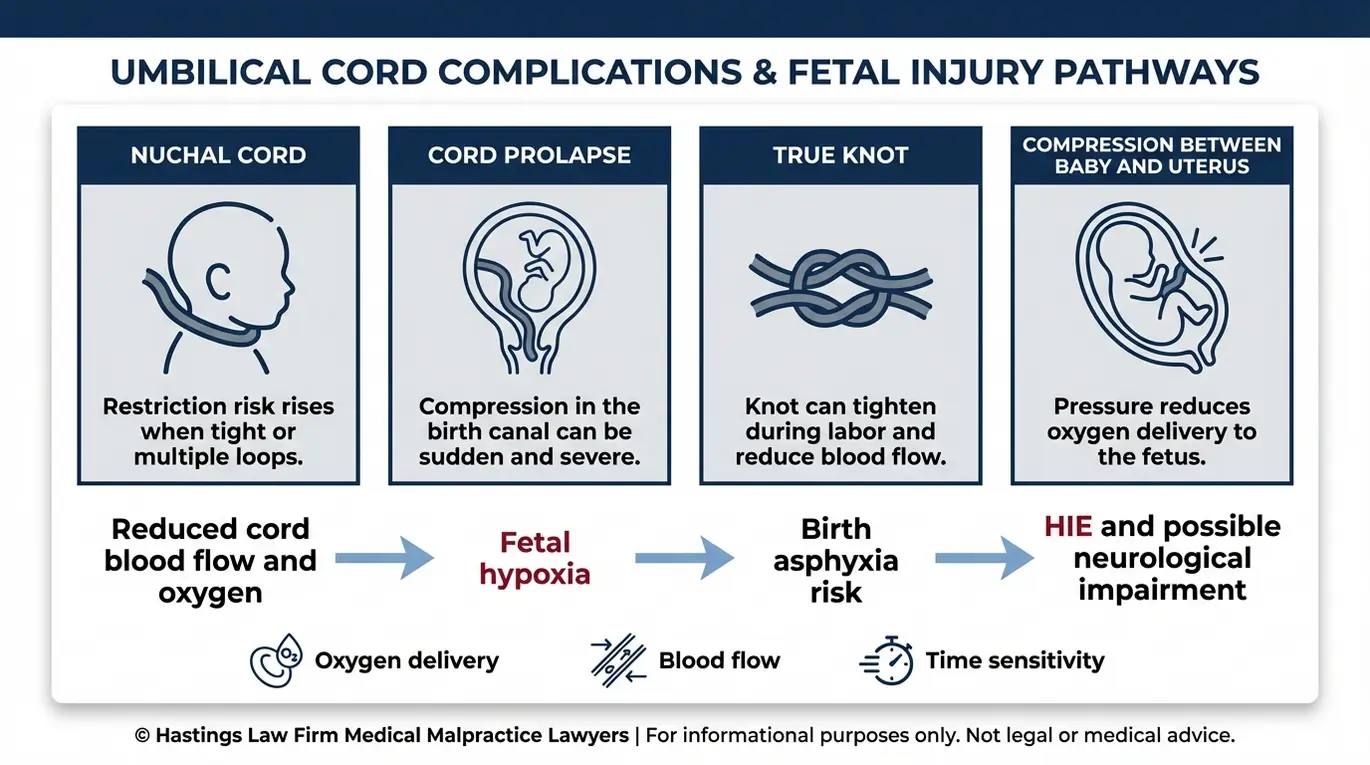
Umbilical cord entrapment occurs when the cord is compressed, twisted, or prolapsed, restricting blood flow and oxygen to the fetus. These complications involve the baby’s lifeline and require careful medical management during birth. The umbilical cord carries oxygenated blood from the placenta to the baby, and when that flow is interrupted, even briefly, the consequences can be severe. This form of umbilical cord entrapment can lead to long-term neurological issues if not addressed.
Several types of cord complications can arise during pregnancy and labor:
- Nuchal cord: The umbilical cord wraps around the baby’s neck one or more times. Nuchal cords are relatively common and often resolve without harm, but they require careful monitoring. If the cord tightens during contractions, it can reduce oxygen flow and lead to distress.
- Cord prolapse: The cord slips into the birth canal ahead of the baby. Once the baby’s body compresses the cord during delivery, blood flow can be cut off rapidly. This is considered an obstetric emergency requiring immediate intervention.
- True knots: A true umbilical cord knot forms when the baby moves through a loop of the cord, creating a knot that can tighten during labor. As documented in a case study published by PubMed Central, true knots can coexist with nuchal cords and still result in a positive outcome when properly managed, but they carry risk when they go undetected.
- Umbilical cord strangulation: In rare and serious cases, a tightly wrapped or knotted cord can significantly restrict or completely block circulation to the baby.
Each of these complications shares a common danger: oxygen deprivation. When the baby’s oxygen supply is interrupted, a condition called hypoxia develops. If hypoxia is prolonged, it can progress to ischemia, where reduced blood flow causes direct damage to brain tissue. This damage is often preventable if caught early.
The standard of care typically requires medical providers to remain vigilant for signs of fetal distress. Timely recognition and response by the medical team are critical to preventing permanent injury. If your child suffered harm from any of these cord complications, an umbilical cord entrapment lawyer in Arizona can help you determine whether the medical team’s response fell below acceptable standards.
Proving Medical Malpractice in Cord Compression Cases
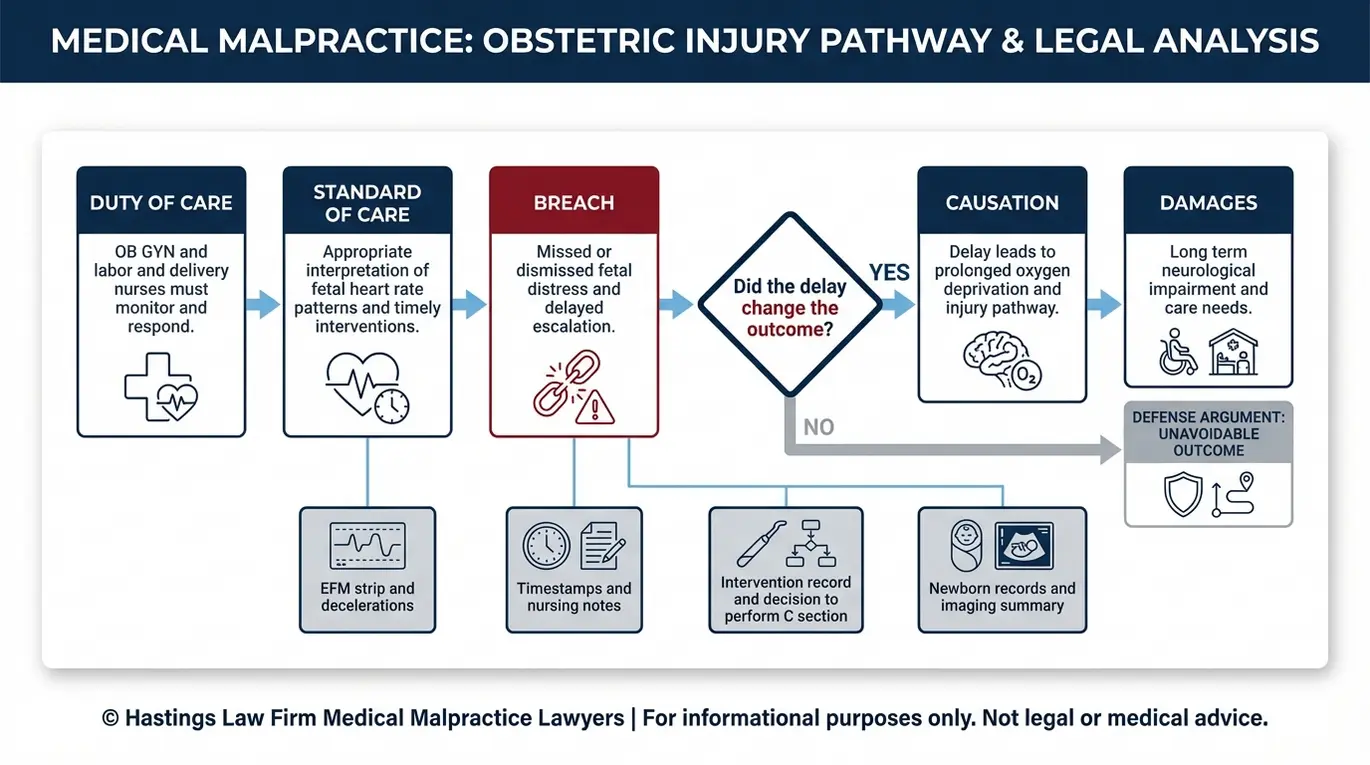
Malpractice in cord compression cases is proven by demonstrating that the medical team failed to meet the standard of care, the accepted level of treatment a reasonably competent professional would have provided under similar circumstances, such as by ignoring fetal distress signals or delaying a necessary intervention. Building a legal claim requires showing how a provider’s actions led to a preventable injury. This could include ignoring signs of fetal distress or delaying a necessary emergency cesarean delivery.
To build a viable malpractice claim, three connected elements must be established:
Duty of care. The obstetrician and labor and delivery nurses have a professional obligation to monitor the baby throughout labor. This includes recognizing warning signs on fetal monitoring strips and responding appropriately when those signs suggest cord compression. When medical professionals accept a patient, they assume legal liability for providing care that meets accepted medical standards.
Breach of duty. A breach occurs when the medical team’s actions fall short of what competent professionals would have done. Examples of potential negligence include:
- Dismissing or failing to recognize variable decelerations on the fetal heart rate monitor
- Delaying an emergency C-section, a surgical delivery necessary to rescue a distressed infant, after clear signs of oxygen deprivation
- Failing to reposition the mother or attempt amnioinfusion, a procedure where fluid is infused into the uterus to relieve pressure on the cord
- Not calling for additional help or escalating care when the baby’s condition worsened
Causation. It is not enough to show a mistake occurred. Arizona umbilical cord entrapment attorneys must also demonstrate a direct link between the provider’s failure and the resulting injury. This often means proving that a timely response would have prevented or significantly reduced the harm, such as hypoxic ischemic encephalopathy (HIE) or permanent brain damage.
Our team works with qualified medical experts to establish each of these elements. As a lawyer for umbilical cord entrapment cases, our job is to reconstruct the timeline of care, identify where protocols broke down, and connect those failures to your child’s diagnosis.
The Hastings Law Firm Difference
Results matter, but what truly sets us apart is how we achieve them. Every verdict, every settlement, and every Arizona courtroom victory comes from one guiding promise: To treat each client’s fight for justice as if it were our own.
This balance of skill, experience, and empathy reflects our core philosophy that justice should not only compensate the injured, but also make healthcare safer nationwide.

Failure to Diagnose and Treat Fetal Distress
Medical professionals rely on electronic fetal monitoring (EFM), a technology that continuously tracks the baby’s heart rate during labor, to detect patterns that signal the baby is in trouble from cord compression or other complications. Effective use of electronic fetal monitoring allows the medical team to intervene before permanent damage occurs.
How EFM works
Monitoring devices help medical staff identify if a baby is receiving enough oxygen during labor. Fetal heart rate monitors produce a continuous readout, often called a “strip,” that records fetal heart rate patterns over time. These patterns provide essential information about how the baby is tolerating labor. The medical team is trained to interpret the strip in real time and respond to concerning changes.
Recognizing dangerous patterns
Two types of heart rate drops are especially important in cord compression cases:
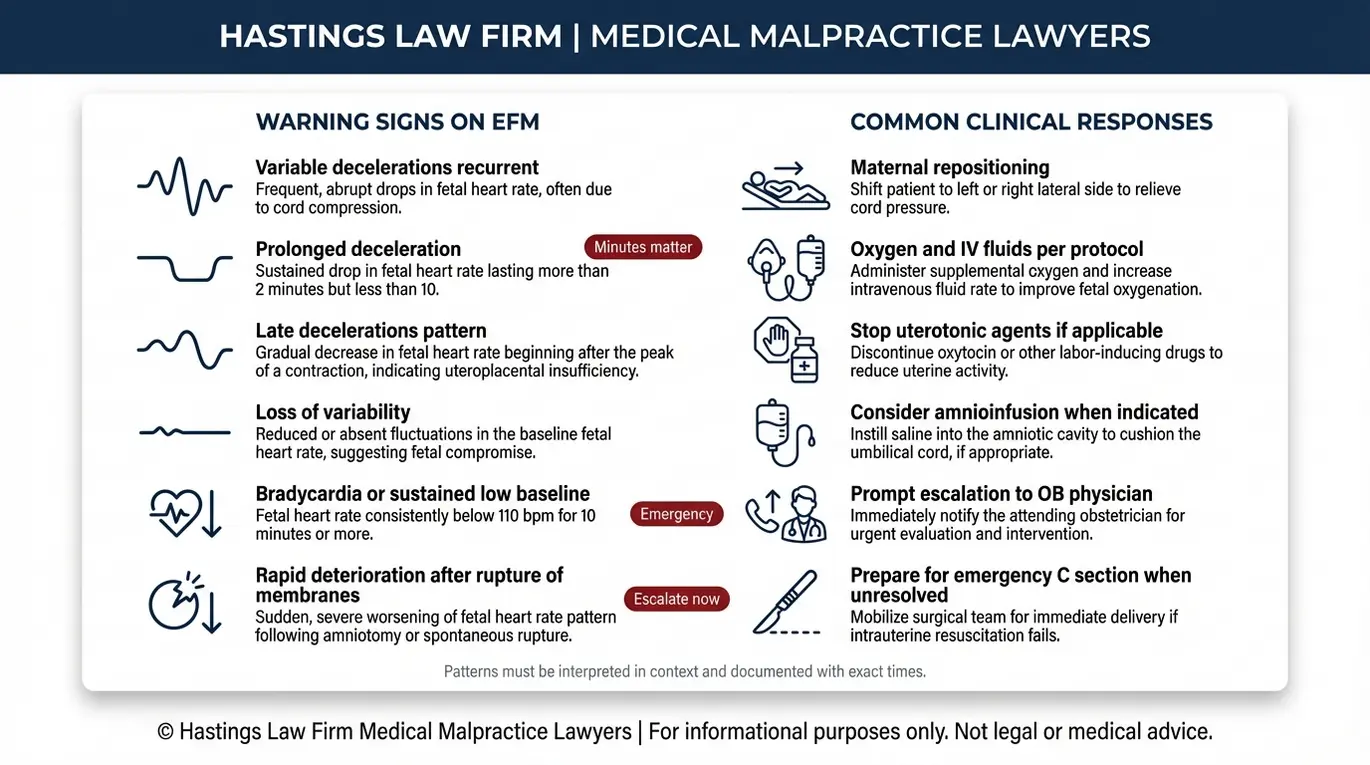
- Variable decelerations: Sudden, sharp drops in heart rate that vary in timing and shape. According to the NCBI Bookshelf entry on Variable Decelerations, these are the hallmark sign of umbilical cord compression and require prompt evaluation.
- Late decelerations: Gradual drops that occur after the peak of a contraction, which can indicate problems with placental blood flow.
- Prolonged decelerations or bradycardia: A sustained drop in heart rate that may signal an acute event like cord prolapse.
- Minimal or absent variability: A flat, unchanging heart rate pattern that can suggest the baby is no longer compensating for oxygen loss.
The medical team must remain alert for any concerning changes that indicate the baby is under stress.
Required responses
Medical teams follow safety protocols to address signs of fetal distress during labor. When these warning signs appear, the standard of care typically requires prompt evaluation and immediate interventions. These may include repositioning the mother, administering oxygen, performing an amnioinfusion (a procedure that relieves pressure by infusing fluid into the uterus), or proceeding with an emergency C-section when the baby’s condition does not improve.
A failure to act on these signals, or a delay in escalating care, can allow birth asphyxia to progress to irreversible brain injury. An Arizona umbilical cord entrapment lawyer examines the fetal monitoring strips alongside the clinical timeline to determine whether the medical team responded appropriately or whether critical time was lost. If valid medical malpractice claims arise from these failures, they are subject to legal timelines defined in Arizona Revised Statutes § 12-542.
Medical Statistics on Cord Prolapse and Nuchal Cord
Understanding how often these events occur helps medical teams prepare for high-risk deliveries. Medical statistics show that nuchal cords occur in roughly 20 to 30 percent of deliveries. In most cases, they are managed without complication. The risk increases when the cord is wrapped tightly or multiple times, particularly if the medical team is not monitoring the fetal response to contractions.
A prolapsed cord is far less common, occurring in approximately 0.1 to 0.6 percent of deliveries. Despite its rarity, cord prolapse is one of the most time-sensitive emergencies in obstetrics. While the prevalence of cord prolapse is lower, the danger is significantly higher.
When it is not identified and addressed within minutes, the risk of severe oxygen deprivation and lasting neurological harm rises sharply. Understanding these risk factors, the specific clinical conditions that increase the chance of injury, is essential for providers. An umbilical cord injury attorney can review the records to assess whether the response met the urgency the situation demanded.
Compensation for Birth Injuries Caused by Oxygen Deprivation
Families may recover economic damages for lifelong medical care and non-economic damages for the child’s loss of quality of life and physical impairment. When oxygen deprivation during delivery causes conditions like cerebral palsy, HIE, or other neurological impairment, the financial and personal costs extend across the child’s entire lifetime.
An umbilical cord entrapment law firm helps families pursue compensation that reflects the full scope of the harm. Damages in these cases generally fall into two categories, often detailed in a full claim for future medical expenses.
| Economic Damages | Non-Economic Damages |
|---|---|
| Future medical expenses and hospitalizations | Pain and suffering |
| Physical, occupational, and speech therapy | Loss of quality of life |
| Assistive equipment (wheelchairs, adaptive devices) | Emotional distress for the child and family |
| Home modifications for accessibility | Loss of enjoyment of childhood milestones |
| In-home nursing or attendant care | Physical impairment and its daily impact |
| Lost future earning capacity | Loss of independence |
The cost of caring for a child with a serious brain injury can reach millions of dollars over their lifetime. A life care plan, developed by medical and economic experts, helps quantify these expenses. This ensures any recovery reflects the child’s actual long-term needs, not just their current medical bills. This plan accounts for inflation, potential medical complications, and the rising cost of healthcare, ensuring that the settlement or verdict is sufficient to support the child for decades. We fight to ensure every predicted cost is covered.
Arizona Statute of Limitations for Birth Injury Lawsuits
In Arizona, the statute of limitations for medical malpractice is generally two years, but specific tolling rules may extend the deadline for children injured at birth.
The standard rule. Under Arizona Revised Statutes § 12-542, a medical malpractice claim must typically be filed within two years of the date the injury occurred.
Exceptions for minors. Arizona law recognizes that children cannot advocate for themselves. Under ARS § 12-502, the statute of limitations may be “tolled,” or paused, for minors. This means the filing deadline can be extended while the child is under 18. However, the specific application of tolling depends on the facts of each case, and parents should not assume they can wait. Courts can interpret these rules strictly, and waiting until the child is older may result in lost evidence or witness testimony, making the claim harder to prove.
The discovery rule. Some birth injuries are not immediately obvious. A baby may appear healthy at first, with signs of brain damage or neurological impairment emerging months or even years later as developmental delays become apparent. In these situations, the statute may begin running from the date the injury was discovered, or should have been discovered, rather than the date of birth.
Because these deadlines directly affect your ability to pursue a claim, speaking with an Arizona umbilical cord entrapment lawyer as early as possible is the safest approach. Waiting too long can mean losing the right to seek answers entirely.
How Our Medical Malpractice Team Investigates Cord Injuries
We conduct a comprehensive forensic investigation, utilizing board-certified experts to review medical records and identify deviations from the standard of care. Umbilical cord compression and the resulting hypoxia often leave a detailed trail in the medical records that our team is trained to follow.
Here is how our investigation typically works:
- Free case evaluation. A Board Certified Patient Advocate reviews your child’s birth records and medical history during a confidential consultation at no cost to your family.
- Medical record analysis. Our in-house medical staff, including experienced nurses who previously worked in hospital settings, examine fetal monitoring strips, nursing notes, physician orders, and operative reports to build a minute-by-minute timeline of the delivery.
- Expert consultation. We consult with OB/GYN specialists, neonatologists, neuroradiologists, and other qualified experts from our national network who can serve as an expert witness to evaluate whether the care your child received met the standard.
- Case development. If the evidence supports a claim, we prepare the case from day one as if it will go to a jury. This trial-ready approach strengthens our negotiating position and signals to the defense that we take your family’s case seriously.
We handle everything on a contingency fee basis. You pay no attorney fees or costs unless we secure a recovery for your family.
Contact the Arizona Birth Injury Attorneys at Hastings Law Firm Today for Help
Losing trust in the people who were supposed to protect your child during delivery is one of the most difficult experiences a family can face. You may still have unanswered questions about what happened in that delivery room, and you have every right to seek those answers.
At Hastings Law Firm, our team of medical malpractice attorneys, in-house nurses, and former defense lawyers is built for exactly these cases. We understand the medicine, we know the defense strategies, and we are committed to helping families find the truth and protect your child’s future.
Time limits do apply to birth injury claims in Arizona. The sooner you reach out, the sooner we can begin reviewing the medical records and advising you on your options.
Call us or contact us online for a free, confidential case evaluation. There is no fee unless we win.
Frequently Asked Questions About Umbilical Cord Entrapment in Arizona


This content was researched and written by the Hastings Law Firm editorial team, which includes attorneys, medical professionals, and experienced researchers. Our writing is informed by internal knowledge and practical experience, and we cross-check critical details against authoritative sources cited throughout. Every piece undergoes human-led fact-checking and legal review. Because legal and medical information can change, if you spot an error, please contact us. Learn more about our content standards and review process on our editorial policy page.

Tommy Hastings, founder of Hastings Law Firm, is a board-certified personal injury trial lawyer dedicated exclusively to healthcare injury cases. Since 2001, he has represented injured patients and families in litigation against major hospital systems, pharmaceutical companies, and negligent healthcare providers nationwide. He has handled numerous high-profile cases that have drawn national media attention and resulted in multi-million dollar recoveries. He draws on that experience in his writing, helping readers understand how these cases work and what options may be available to them.
