


Arizona Umbilical Catheter Birth Injury Lawyer
Written by: Hastings Law Firm | Reviewed by: Tommy Hastings | Updated: July 27, 2026
NICU care often requires umbilical catheters to monitor a newborn and deliver fluids or medications, but errors in placement or monitoring can cause severe harm. Misread imaging, missed warning signs, line migration, and breakdowns in sterile technique can lead to organ damage, infection, or other life threatening emergencies. Understanding how these injuries happen and what records can show helps families make sense of a frightening outcome and seek accountability. If you or a loved one were harmed or worse due to umbilical catheter birth injuries in Arizona, contact Hastings Law Firm for a free, confidential case review.
Fighting for Families Harmed by NICU Negligence in Arizona
What You Should Know About UAC/UVC Line Placement Injury Claims in Arizona:
- Life threatening emergencies can occur when an umbilical catheter tip is misplaced or migrates into a dangerous position.
- Severe long term harm can follow NICU catheter complications when cardiovascular collapse or organ failure occurs.
- Accountability can be disputed when imaging is misread or follow up imaging is not obtained after a line is adjusted.
- Options for recovery can be affected in Arizona because medical malpractice claims have procedural requirements.
- Financial recovery can include economic damages for medical care and non economic damages for pain suffering and diminished quality of life.
- Wrongful death claims may be available when a catheter error results in an infant death.
- Clarity about what happened can depend on NICU records such as placement notes imaging nursing flowsheets and vital sign trends.
- Proof of a catheter related complication can be supported by imaging and lab results when extravasation or thrombosis is documented.
- Responsibility can extend beyond the line placer when radiology errors nursing monitoring failures or hospital protocol breakdowns contribute to harm.

A Healthcare Focused Law Firm
When your newborn is admitted to a neonatal intensive care unit (NICU), the specialized unit designed to care for critically ill or premature infants, you trust that every procedure will be handled with precision. For families of preterm newborns, also called premature infants, that trust extends to the central lines and catheters placed in some of the smallest, most vulnerable patients. If your baby suffered a serious complication linked to an umbilical catheter in the NICU, the confusion and fear you may be feeling right now are completely understandable.
You deserve clear answers about what happened and whether the care your child received met accepted medical standards. As a dedicated Arizona umbilical catheter birth injury lawyer, Hastings Law Firm focuses exclusively on medical malpractice, and our team includes in-house medical staff, including nurse practitioners and Board Certified Patient Advocates, who understand both the clinical details and the legal path forward. If you have concerns about your baby’s NICU care, we welcome the chance to review what happened and explain your options in a free, confidential consultation.
Understanding UVC and UAC Risks in the NICU
Umbilical catheters, both the umbilical artery catheter (UAC) and the umbilical venous catheter (UVC), are central lines inserted through the remnant of a newborn’s umbilical cord. Umbilical catheters are tubes used in the NICU to monitor health and provide medicine to newborns. While these lines can be lifesaving for premature infants, improper placement or inadequate maintenance can lead to life-threatening organ damage or infection.
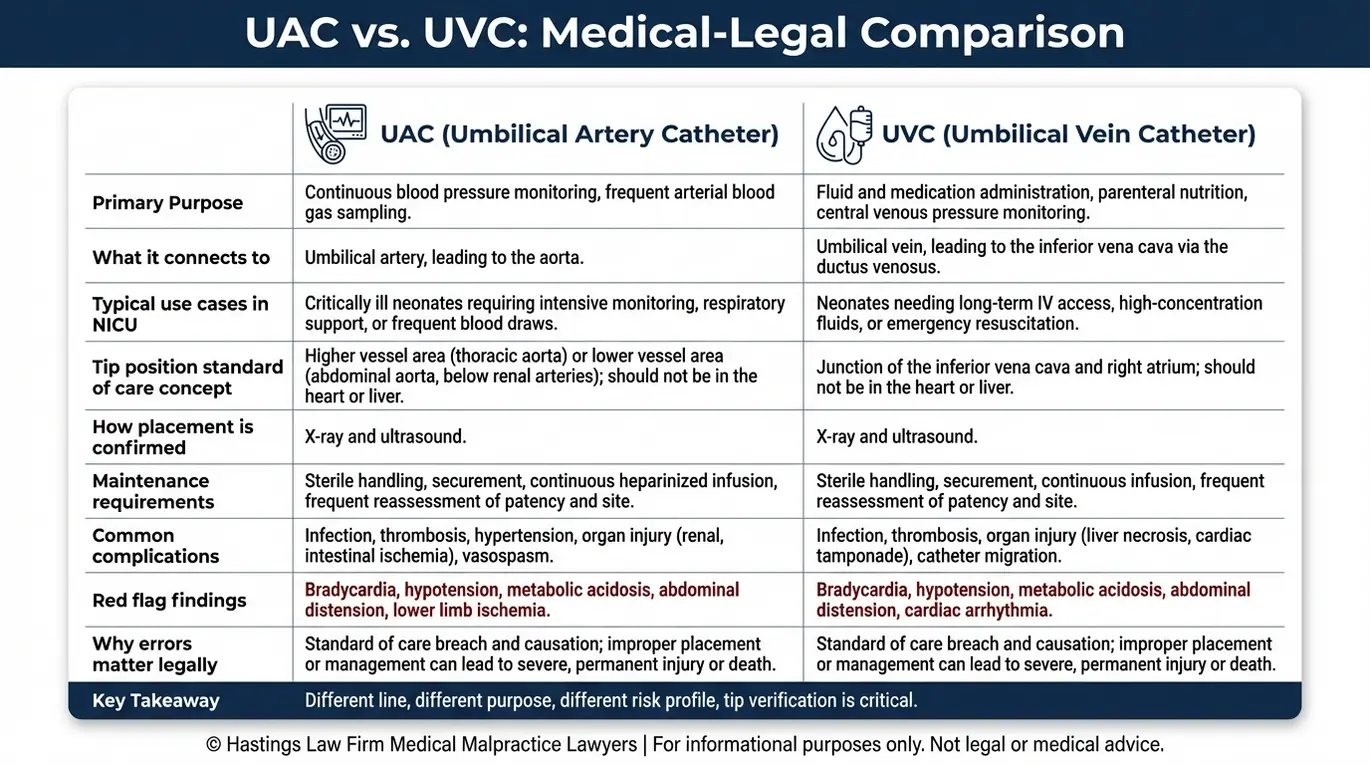
The umbilical artery catheter (UAC), a line threaded into one of the two umbilical arteries, is primarily used for monitoring arterial blood gas levels and blood pressure. The umbilical venous catheter (UVC), which is inserted into the umbilical vein, is used mainly to deliver fluids, medications, and parenteral nutrition, which is nutrition delivered directly into the bloodstream. Each catheter type carries distinct risks tied directly to where the tip of the line sits inside the infant’s body, risks that an umbilical catheter birth injury lawyer understands well.
| Feature | UAC (Umbilical Artery Catheter) | UVC (Umbilical Venous Catheter) |
|---|---|---|
| Primary Purpose | Blood gas monitoring, blood pressure reading | Delivering fluids, medications, nutrition |
| Vessel Used | Umbilical artery | Umbilical vein |
| Correct Tip Position | High position (T6 to T9) or low position (L3 to L4) | Junction of the inferior vena cava and right atrium |
| Confirmation Method | X-ray after placement | X-ray (and/or ultrasound) after placement |
| Key Complication Risks | Thrombosis, limb ischemia, hypertension, acute kidney failure | Pericardial effusion, liver damage, cardiac tamponade |
The standard of care requires that tip position be confirmed by X-ray immediately after insertion. According to guidelines from the University of Wisconsin Pediatrics NICU, proper positioning and sterile technique are essential to preventing serious complications. These are invasive procedures, and even small deviations in line placement can have severe consequences for a fragile newborn, often requiring the oversight of an experienced Arizona birth injury attorney.
Mechanisms of Injury Caused by Misplacement
Umbilical catheters are specialized medical tubes used for infant care in the NICU. When a catheter tip ends up too deep or in the wrong vessel, the results can be catastrophic. A UVC that migrates into the heart can cause pericardial effusion, the dangerous accumulation of fluid in the sac surrounding the heart.
If that fluid compresses the heart and prevents it from filling properly, it becomes cardiac tamponade, a life-threatening emergency that can lead to cardiovascular collapse within minutes. A line positioned over the liver can cause liver injury as concentrated medications or nutrition infuse into a location not intended to receive them. In the intestines, a mispositioned UAC can restrict blood flow and contribute to necrotizing enterocolitis, a devastating condition where bowel tissue begins to die.
Common Errors in Umbilical Catheter Placement
Malpractice in these cases often stems from failures that occur after the catheter is inserted, specifically when medical staff do not verify catheter tip position, the precise location where the line terminates, via X-ray or ultrasound, ignore clinical signs of distress like hypotension, or allow line migration, the unintentional movement of the catheter after placement, to occur without intervention.
Identifying medical errors in catheter management is part of the investigation into NICU negligence. Research published in *Adverse events associated with umbilical vascular catheters in the neonatal intensive care unit* (PubMed) documents several preventable complications, including hypertension and acute kidney failure, tied to these lines. A case study in *Cardiac tamponade in a newborn caused by a peripherally inserted central catheter* (PubMed Central) illustrates how quickly a malpositioned line can become fatal when warning signs go unrecognized.
The specific failure modes our team investigates in umbilical catheter cases include:
- Radiology read failures: A radiologist or neonatologist misreads the post-insertion X-ray and does not recognize that the UVC tip is sitting over the liver or dangerously close to the heart.
- Failure to confirm tip position after repositioning: A line is adjusted but no follow-up imaging is ordered to verify the new location.
- Ignoring signs of cardiac tamponade or extravasation: Clinical indicators such as sudden bradycardia, hypotension, metabolic acidosis, or abdominal distension are dismissed or attributed to other causes.
- Line migration without detection: Catheter tips can shift during routine care. Dangerous migration can lead to bowel perforation or perforation of other internal organs if not detected by periodic imaging.
- Delayed removal: Leaving a UAC or UVC in place longer than clinically necessary increases the risk of catheter-associated thrombosis, blood clots that can obstruct blood flow, as well as serious bloodstream infection.
- Sterile technique breakdowns: Failing to maintain strict aseptic protocols during insertion or line maintenance, which can introduce bacteria directly into the infant’s bloodstream.
If your child experienced unexplained deterioration in the NICU, an umbilical catheter lawyer in Arizona can help determine whether any of these errors occurred. A skilled birth injury lawyer from our team, supported by experienced NICU nurses, knows exactly what to look for in the records.

The Hastings Law Firm Difference
Results matter, but what truly sets us apart is how we achieve them. Every verdict, every settlement, and every Arizona courtroom victory comes from one guiding promise: To treat each client’s fight for justice as if it were our own.
This balance of skill, experience, and empathy reflects our core philosophy that justice should not only compensate the injured, but also make healthcare safer nationwide.

Proving Malpractice in Arizona Catheter Cases
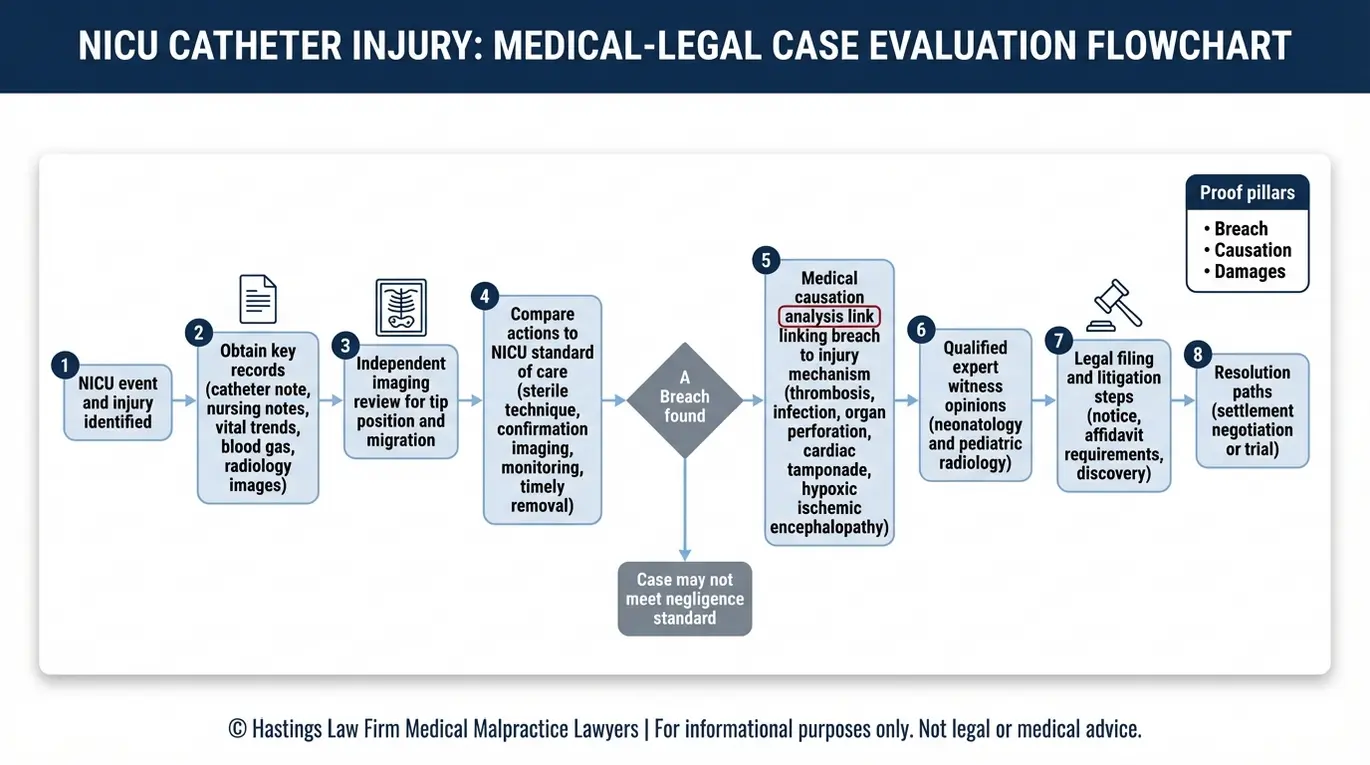
Proving negligence requires demonstrating that the NICU team breached the standard of care during line insertion or monitoring, and that this specific breach directly caused the infant’s injury, whether that means hypoxic ischemic encephalopathy (HIE), a brain injury caused by oxygen deprivation, from cardiovascular collapse, organ failure, or another documented harm. Unlike strict liability cases where a product defect is enough, proving hospital liability requires showing that the provider’s conduct fell below the standard of care.
The process begins with a detailed review of the infant’s medical records, including placement notes, X-ray and ultrasound imaging, nursing flowsheets, and vital sign trends. Extravasation, the leaking of fluid from a catheter into surrounding tissue, and catheter-associated thrombosis, the formation of blood clots around the line, are two complications that often leave clear evidence in imaging and lab results. Your birth injury attorney will reconstruct a minute-by-minute timeline to identify where care fell short.
Under Title 12 of the Arizona Revised Statutes, medical malpractice claims carry specific procedural requirements. These cases typically require testimony from qualified expert witnesses, often neonatologists and pediatric radiologists, who can speak directly to the standard expected in a Level III or Level IV NICU.
Hastings Law Firm was founded in 2005 by Tommy Hastings, who is board-certified in trial law. Our team includes former defense attorneys who use their background to anticipate hospital tactics. That knowledge shapes how we build every case from day one.
Securing Compensation for Long-Term Recovery
Families can recover economic damages for past and future medical care, as well as non-economic damages for pain, suffering, and the diminished quality of life caused by the injury.
Legal claims allow families to seek the financial support needed for a child’s recovery. For children who sustain permanent harm, such as cerebral palsy resulting from prolonged hypoxia, a life care plan is often developed. This document projects future medical costs, the full cost of therapy, adaptive equipment, and educational support the child will need over a lifetime. These plans help establish the true financial impact of the injury.
When a catheter error results in an infant’s death, the family may also have grounds for a wrongful death claim. As Arizona birth injury lawyers, our role is to make sure every category of loss is documented so that your family’s future is protected.
Contact the Arizona Birth Injury Attorneys at Hastings Law Firm Today for Help
Injuries from misplaced or poorly managed umbilical catheters are often preventable. When a NICU team fails to follow established protocols, the smallest patients pay the highest price, and their families deserve honest answers about what went wrong.
Hastings Law Firm was built for cases exactly like these. Our team of attorneys, in-house nurse consultants, and national medical experts focuses exclusively on medical malpractice. Tommy Hastings has over 20 years of experience leading a team that prepares every case for a jury trial. You pay no attorney fees or costs unless we secure a recovery for your family.
If your child was harmed during NICU care in Arizona, request a free, confidential case evaluation with a specialized Arizona umbilical catheter birth injury lawyer. We are here to listen, to investigate, and to help you understand your legal options. Call us today or contact us online to take that first step.
Frequently Asked Questions About Umbilical Catheter Birth Injury in Arizona


This content was researched and written by the Hastings Law Firm editorial team, which includes attorneys, medical professionals, and experienced researchers. Our writing is informed by internal knowledge and practical experience, and we cross-check critical details against authoritative sources cited throughout. Every piece undergoes human-led fact-checking and legal review. Because legal and medical information can change, if you spot an error, please contact us. Learn more about our content standards and review process on our editorial policy page.

Tommy Hastings, founder of Hastings Law Firm, is a board-certified personal injury trial lawyer dedicated exclusively to healthcare injury cases. Since 2001, he has represented injured patients and families in litigation against major hospital systems, pharmaceutical companies, and negligent healthcare providers nationwide. He has handled numerous high-profile cases that have drawn national media attention and resulted in multi-million dollar recoveries. He draws on that experience in his writing, helping readers understand how these cases work and what options may be available to them.
