


Arizona Twin-To-Twin Transfusion Syndrome Lawyer
Written by: Hastings Law Firm | Reviewed by: Tommy Hastings | Updated: July 27, 2026
Twin to Twin Transfusion Syndrome is a serious complication of monochorionic twin pregnancy that can worsen quickly when warning signs are missed or treatment is delayed. Uneven blood flow through shared placental vessels can place both babies at risk and can also create serious maternal complications. Care often depends on close ultrasound surveillance, accurate staging, and timely referral to a Maternal Fetal Medicine specialist for appropriate intervention. If you or a loved one were harmed or worse due to Twin to Twin Transfusion Syndrome malpractice in Arizona, contact Hastings Law Firm for a free, confidential case review.

Specialized Representation for High-Risk Twin Pregnancies in Arizona
What You Should Know About Failure to Treat Twin Transfusion Claims in Arizona:
- The risk of severe harm can rise quickly when Twin to Twin Transfusion Syndrome is not identified and treated promptly.
- The chance to use the most effective intervention can be lost when treatment is delayed after Twin to Twin Transfusion Syndrome is recognized.
- Long term disability costs can be substantial when a surviving twin has lasting impairments linked to oxygen deprivation, blood flow imbalance, or prematurity.
- Wrongful death losses can be part of the damages sought in Arizona when mismanagement results in stillbirth or neonatal death.
- Maternal complications can be part of the harm when severe Twin to Twin Transfusion Syndrome contributes to conditions such as Mirror Syndrome.
- Disputes about whether harm was preventable can turn on whether ultrasound warning signs were recognized and acted on.
- Accountability questions can focus on whether timely referral to a Maternal Fetal Medicine specialist occurred when a monochorionic pregnancy showed concerning changes.
- Recovery options can be limited if Arizona timing requirements are missed, including stricter constraints for claims involving government hospitals.
- Causation can be clearer when placental pathology confirms abnormal placental vessel connections consistent with Twin to Twin Transfusion Syndrome.
- Case clarity can depend on whether qualified medical expert support is available under Arizona requirements for medical malpractice claims.

A Healthcare Focused Law Firm
When a monochorionic twin pregnancy, where twins share a single placenta, develops complications like Twin-to-Twin Transfusion Syndrome, the stakes for both babies can change rapidly. These pregnancies require close surveillance and timely intervention from a Maternal-Fetal Medicine (MFM) specialist, a physician with advanced training in managing high-risk pregnancies. If that standard of monitoring and care was not met, and your babies were harmed as a result, you may have a medical malpractice claim.
An Arizona Twin-To-Twin Transfusion Syndrome Lawyer can help you understand what went wrong and whether the care your family received fell short. At Hastings Law Firm, our team of attorneys, nurse consultants, and medical experts focuses exclusively on medical malpractice. We can review your medical records and explain your legal options at no cost and no obligation.
Understanding the Severity of Twin-to-Twin Transfusion Syndrome
Twin-to-Twin Transfusion Syndrome (TTTS) is a serious condition in monochorionic pregnancies where abnormal blood vessel connections in the shared placenta cause uneven blood flow between twins. Instead of each baby receiving a balanced supply, one twin donates blood to the other through these vascular connections. This imbalance can progress quickly and threaten the life of both babies if it is not identified and treated promptly.
The twin losing blood is called the donor twin. This baby can develop anemia and oligohydramnios, a dangerous decrease in amniotic fluid that restricts growth and movement. Without enough fluid, the donor twin acts as a “stuck twin” pressed against the uterine wall, which can severely hinder lung development and overall maturation.
The twin receiving excess blood is called the recipient twin. That baby faces its own risks, including fluid overload, heart strain, and polyhydramnios, an excess of amniotic fluid that can trigger preterm labor.
TTTS can develop as a chronic condition that worsens gradually over weeks or as an acute event that escalates within days. Frequent ultrasound monitoring of monochorionic pregnancies is necessary to detect fluid discrepancies and other warning signs early. When providers miss these signs or fail to act on them, a TTTS malpractice attorney can investigate whether that delay caused preventable harm.
Physicians classify the severity of TTTS using the Quintero staging system, a five-stage framework that guides treatment decisions based on ultrasound and Doppler findings. According to the National Center for Biotechnology Information (NCBI Bookshelf), accurate staging is essential to determining the appropriate intervention. The table below outlines each stage:
| Quintero Stage | Key Findings |
|---|---|
| Stage I | Amniotic fluid imbalance is present (polyhydramnios in the recipient, oligohydramnios in the donor), but blood flow on Doppler ultrasound appears normal. |
| Stage II | The donor twin’s bladder is no longer visible on ultrasound, indicating severely reduced urine output due to low blood volume. |
| Stage III | Doppler ultrasound shows abnormal blood flow in the umbilical cord or heart vessels of one or both twins, signaling cardiovascular compromise. |
| Stage IV | One or both twins develop hydrops fetalis, a condition involving fluid accumulation in body tissues and cavities that indicates heart failure. |
| Stage V | One or both twins have died. |
Each stage represents an escalation in risk. The speed at which TTTS progresses from Stage I to Stage IV or V is why early detection and immediate referral to a qualified specialist are so important.
Establishing Medical Negligence in TTTS Diagnosis and Treatment
Medical malpractice occurs when a healthcare provider fails to meet the standard of care by missing diagnostic signs of TTTS or delaying necessary intervention like laser surgery. The standard of care is the level of treatment that any skilled medical provider is expected to provide. Proving negligence in these cases involves showing that a reasonably competent provider would have recognized the warning signs and acted sooner.
As an attorney for twin transfusion syndrome cases, we examine every step of the care timeline to identify where breakdowns occurred. This investigation helps determine whether the patient’s injuries were preventable.
Failure to Diagnose
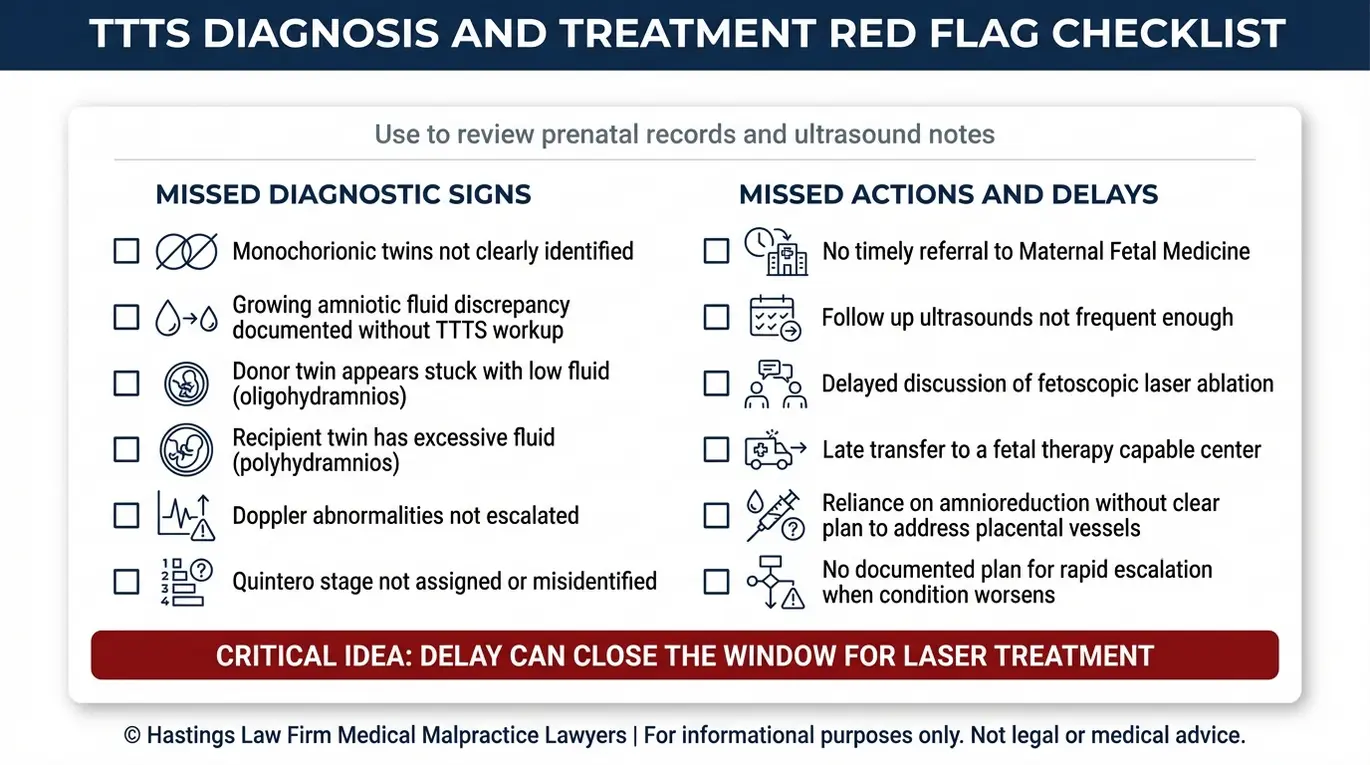
TTTS produces identifiable warning signs on routine ultrasound. Fluid discrepancies between the twins, significant size differences, and abnormal bladder visibility are all red flags that should prompt immediate follow-up. When an OB-GYN identifies a monochorionic pregnancy, the standard of care calls for regular monitoring, typically every two weeks, starting early in the second trimester. A general obstetrician might not have the equipment or expertise to accurately stage TTTS.
We look for patterns like these when reviewing medical records for medical negligence:
- Ultrasound showing amniotic fluid differences between twins that was not flagged or investigated. Checking these differences helps doctors see if blood is flowing unevenly between the babies.
- Failure to perform Doppler ultrasound, a specialized imaging technique that measures blood flow velocity through the umbilical cord and fetal vessels, when standard screening indicated a need. This imaging is necessary to track the health of fetal cardiovascular systems.
- Delayed or absent referral to a Maternal-Fetal Medicine specialist for evaluation and management. Specialists have the specific training needed to manage the high risks associated with a shared placenta.
- Failure to recognize or document growth discordance between twins. Growth differences are a major warning sign that the syndrome is progressing.
- Missed or skipped monitoring appointments without clinical justification. Regular checks are necessary to catch sudden changes in amniotic fluid levels before they cause permanent harm.
If a provider fails to involve a specialist when they suspect complications, it can be viewed as a lapse in the standard of care. The UC Davis Health Fetal Care and Treatment Center identifies TTTS as a condition that should be referred to a specialized fetal care center as soon as it is suspected. This reinforces that delayed referral can itself represent a breach of the standard of care.
Failure to Treat
Even when TTTS is correctly identified, delays in treatment can result in a missed window of intervention, which eliminates the chance for the most effective outcome. Laser surgery is often the preferred treatment for severe TTTS cases. Fetoscopic laser ablation, a minimally invasive procedure where a surgeon uses a thin scope to seal the abnormal blood vessel connections in the placenta, is the standard of care for TTTS at Stage II and above. This procedure directly addresses the cause of the syndrome rather than simply managing symptoms.
When laser surgery was available and appropriate but was not offered or was delayed, we investigate whether the patient lost a viable treatment option. In some cases, providers may have relied on amnioreduction, a procedure that drains excess amniotic fluid, as an alternative. While amnioreduction can temporarily relieve pressure, it does not correct the underlying vascular problem and is generally considered inferior to laser ablation for severe stages. If laser ablation was accessible and the pregnancy met the criteria for the procedure, choosing a less effective method may constitute a failure to meet the standard of care.
The Role of Placental Pathology in Proving Causation
After a delivery involving Twin-to-Twin Transfusion Syndrome, examination of the placenta can provide critical physical evidence. Placental pathology, the laboratory analysis of placental tissue, can confirm the presence of placental vascular anastomoses, the abnormal blood vessel connections between twins that define TTTS. This analysis can directly counter defense arguments that attribute the injury to infection, genetic abnormalities, or other unrelated causes.
Our team works with an expert network, including pathologists and MFM specialists, to ensure this evidence is preserved and properly analyzed. In TTTS cases, the placenta is often the most important piece of physical evidence available, and securing its examination early can be the difference between a provable claim and a case that is difficult to support.
The Hastings Law Firm Difference
Results matter, but what truly sets us apart is how we achieve them. Every verdict, every settlement, and every Arizona courtroom victory comes from one guiding promise: To treat each client’s fight for justice as if it were our own.
This balance of skill, experience, and empathy reflects our core philosophy that justice should not only compensate the injured, but also make healthcare safer nationwide.

Calculating Damages for Birth Injuries and Wrongful Death
Compensation in Arizona TTTS cases covers past and future medical expenses, life care planning for surviving twins with disabilities, and non-economic damages for pain and suffering or wrongful death. Damages are the legal term for the financial compensation a family seeks for their losses. The specific damages depend on the outcome for each twin and the impact on the family as a whole.
The extent of injury often correlates with the duration the twins were exposed to the poly-oligo sequence, where polyhydramnios and oligohydramnios (excess and low fluid levels) create a hostile intrauterine environment. If untreated, this imbalance can escalate to hydrops fetalis, a condition of severe edema and heart failure. Legal claims also often account for complications from preterm labor, which is frequently triggered by the uterine distension of polyhydramnios.
Surviving Twins with Long-Term Needs
When a twin survives TTTS but suffers neurological damage from oxygen deprivation, blood flow imbalances, or extreme prematurity, the consequences can last a lifetime. Conditions like cerebral palsy, developmental delays, and heart failure may require ongoing medical care, therapy, adaptive equipment, and assisted living support. A study published by PubMed Central on the prevalence and cost of care for children with cerebral palsy documents the significant and sustained financial burden these conditions place on families.
An Arizona medical malpractice attorney experienced in birth injury cases works with life care planners and medical economists to calculate the true cost of a child’s future needs. This includes not just immediate medical bills, but projected expenses for rehabilitation, education, home modifications, and full-time care extending into adulthood. For children with severe impairments, we calculate the cost of round-the-clock nursing and the specialized therapies required to maximize their quality of life.
Wrongful Death of One or Both Twins
When TTTS mismanagement results in the stillbirth or neonatal death of one or both babies, Arizona law provides a path for families to seek accountability. A wrongful death claim is a legal path filed by surviving family members after a death caused by someone else’s negligence. Under A.R.S. § 12-542, wrongful death claims generally must be filed within two years. These claims can address the profound emotional loss parents experience, as well as funeral expenses and other related costs.
Maternal Harm
Twin-to-Twin Transfusion Syndrome can also pose direct risks to the mother. Maternal harm refers to injuries or health conditions suffered by the mother during or after pregnancy.
In severe cases, a condition known as Mirror Syndrome can develop, where the mother develops edema and symptoms similar to preeclampsia in response to fetal hydrops, a complication that can occur in the recipient twin. This can lead to dangerously high blood pressure, organ stress, and emergency delivery. Damages related to maternal health complications are a separate but important part of the overall claim.

Why Choose Hastings Law Firm for Your Arizona Medical Liability Case
Choosing a board-certified trial firm ensures that your case is prepared for court from day one, giving you maximum leverage against hospital insurance carriers and their legal teams. At Hastings Law Firm, we do not practice general personal injury law. Every case we accept involves medical malpractice, and our entire team is built around that focus.
Founder Tommy Hastings is Board Certified in Personal Injury Trial Law by the Texas Board of Legal Specialization, a distinction held by fewer than two percent of Texas attorneys. In 2025, he was inducted into ABOTA (American Board of Trial Advocates), an invitation-only organization recognizing elite trial lawyers. These credentials reflect a career built on courtroom results. Insurance companies know which firms are willing to go to trial and which are looking for a quick exit; our reputation ensures they take your claim seriously.
We are selective about the cases we take. Rather than accepting hundreds of cases and pushing for quick settlements, we dedicate significant resources to each claim. For families dealing with TTTS injuries, this means your Twin-To-Twin Transfusion Syndrome Lawyer is supported by in-house nurse consultants, board-certified patient advocates, and a national network of medical experts who specialize in maternal-fetal medicine and neonatology. This focused approach allows us to outwork defense teams and uncover critical evidence that high-volume firms might miss.
Our team also includes former defense attorneys who previously represented hospitals and insurance carriers. That experience gives us direct insight into how the other side builds its case and allows us to anticipate their strategies before they are deployed. We handle all TTTS cases on a contingency fee basis. You pay no attorney fees or costs unless we recover compensation for your family. The initial free confidential evaluation is the first step toward understanding your rights and securing your family’s future.
Contact the Arizona Birth Injury Attorneys at Hastings Law Firm Today for Help
If your family experienced a pregnancy complicated by Twin-to-Twin Transfusion Syndrome and you believe the care you received fell short, we want to hear from you. Legal advice is essential for understanding your rights in complex medical cases. Our team understands the grief, confusion, and frustration that follow a preventable birth injury or loss, and we are here to help you find answers.
When you contact our Phoenix office, a board-certified patient advocate will review your medical records and help determine whether your case meets the threshold for a medical negligence claim. There is no fee for this evaluation, and everything you share with us is confidential.
You do not have to carry this burden alone. Call Hastings Law Firm or complete our online form to schedule your free case review today.
Frequently Asked Questions About Twin-to-Twin Transfusion Syndrome in Arizona


This content was researched and written by the Hastings Law Firm editorial team, which includes attorneys, medical professionals, and experienced researchers. Our writing is informed by internal knowledge and practical experience, and we cross-check critical details against authoritative sources cited throughout. Every piece undergoes human-led fact-checking and legal review. Because legal and medical information can change, if you spot an error, please contact us. Learn more about our content standards and review process on our editorial policy page.

Tommy Hastings, founder of Hastings Law Firm, is a board-certified personal injury trial lawyer dedicated exclusively to healthcare injury cases. Since 2001, he has represented injured patients and families in litigation against major hospital systems, pharmaceutical companies, and negligent healthcare providers nationwide. He has handled numerous high-profile cases that have drawn national media attention and resulted in multi-million dollar recoveries. He draws on that experience in his writing, helping readers understand how these cases work and what options may be available to them.
