


Arizona Toxicologist Malpractice Lawyer
Written by: Hastings Law Firm | Reviewed by: Tommy Hastings | Updated: July 27, 2026
Toxicology malpractice can happen when healthcare providers miss signs of poisoning, mismanage an overdose, or prescribe or dispense medications in a way that leads to toxic harm. These errors can leave patients with lasting injuries, major financial strain, and profound changes to daily life. Arizona claims often involve medication dosing problems, missed drug interactions, delayed testing, and failures to monitor patients after high risk drugs are given. If you or a loved one were harmed or worse due to toxicologist malpractice in Arizona, contact Hastings Law Firm for a free, confidential case review.
Trusted Legal Representation for Healthcare Negligence in Arizona
What You Should Know About Overdose or Toxic Exposure Negligence Claims in Arizona:
- Life changing injury or loss can follow when poisoning or overdose signs are missed or treatment is delayed.
- Preventable brain injury can result when high risk medications are not monitored closely and breathing problems are not addressed.
- A missed toxic exposure can worsen long term outcomes when symptoms are dismissed and testing is delayed.
- Disputes over what caused the harm can control the outcome because toxicology cases often require expert testimony to link the substance, dosage, and injury.
- More than one party may face liability, including a physician, a hospital, a pharmacist, or a drug manufacturer.
- Recovery options in Arizona can include economic damages and non economic damages when negligence causes medical bills, lost wages, and reduced quality of life.
- Additional damages may be available when conduct is grossly reckless or intentional.
- Family compensation may be available in fatal cases through wrongful death claims and survival actions.
- Options can be lost if filing deadlines are missed, and toxic exposure cases may raise disputes about when the harm and its cause were discoverable.
- Medical records and testing documentation can be central because gaps in charting and lab interpretation issues may indicate missed opportunities to diagnose or treat toxicity.

A Healthcare Focused Law Firm
When a doctor, pharmacist, or hospital fails to properly identify or treat poisoning, an overdose, or toxic exposure, the consequences can be devastating. If you or a loved one has suffered because a medical professional missed the signs of toxicity or prescribed a dangerous dosage, you deserve answers about what went wrong.
At Hastings Law Firm, we focus exclusively on medical malpractice. Our team of attorneys, in-house nurse consultants, and former defense lawyers investigates these cases with the medical depth they require. Led by board-certified trial attorney Tommy Hastings, our firm provides the specialized representation needed for these high-stakes claims. As an Arizona toxicologist malpractice lawyer, we are prepared to help you understand what happened and hold the responsible parties accountable.
Contact us for a free, confidential case evaluation. We can review your situation and explain your legal options.
Common Substances and Medications Involved in Arizona Toxicology Claims
Toxicology malpractice claims in Arizona frequently involve opioid overdoses, medication errors with dangerous drug interactions, and failure to diagnose poisoning from environmental toxins like lead or pesticides. The range of substances at the center of these cases is broad, and the type of exposure often determines both the medical harm and the legal strategy your Arizona toxicologist malpractice lawyer will pursue.
Prescription medication errors remain one of the most common sources of toxicology claims. These can include prescribing the wrong dosage, failing to account for a patient’s existing medications, or missing a drug-drug interaction, which occurs when one medication changes how another works in the body, sometimes amplifying it to toxic levels.
According to the National Center for Biotechnology Information (NCBI), medication dispensing errors are a persistent problem across healthcare settings and a recognized source of patient harm. Even common pharmaceuticals can become hazardous substances when mismanaged. An overdose negligence attorney can help determine whether a prescribing or dispensing mistake fell below the accepted standard of care.
Illicit drug overdose mismanagement in emergency room settings raises a separate set of concerns. When a patient arrives at the ER showing signs of overdose, the medical team is expected to act quickly to stabilize them. Failure to monitor vital signs, delays in administering reversal agents like naloxone, or misinterpreting a toxicology screen can all result in preventable death or brain injury. An overdose negligence attorney can investigate whether the ER staff failed to intervene in time.
Environmental toxins also generate serious claims. Lead poisoning, pesticide exposure, asbestos, and per- and polyfluoroalkyl substances (PFAS), a group of synthetic chemicals found in drinking water and industrial products, can cause chronic illness when a physician fails to recognize and treat the symptoms. A toxic exposure lawyer knows that these cases often involve latent injuries that go undiagnosed for months or even years.
When a doctor dismisses the signs of chemical poisoning as a common viral illness, the continued exposure can cause irreversible damage. A qualified toxic exposure lawyer can help families connect the medical condition to the environmental cause. This legal process helps ensure that those responsible for hazardous exposure are held responsible.
| Category | Common Substances | Typical Negligence |
|---|---|---|
| Pharmaceutical / Overdose | Opioids, benzodiazepines, blood thinners, chemotherapy agents | Wrong dosage, missed drug interactions, failure to monitor toxic levels |
| Environmental Toxins | Lead, PFAS, asbestos, pesticides, mercury | Failure to diagnose poisoning symptoms, delayed testing |
| Hospital Administration Errors | Anesthesia, IV medications, compounded drugs | Incorrect preparation, mislabeling, wrong patient administration |
If you suspect that a medical professional failed to properly identify or manage a toxic substance, an Arizona toxicologist malpractice lawyer can evaluate your case and determine whether negligence occurred.

How Medical Negligence Leads to Fatal Overdoses and Toxic Injuries
Medical negligence occurs when a physician, clinical toxicologist (a specialist trained in managing poisoning and chemical exposures), or pharmacist breaches the standard of care by failing to recognize signs of toxicity, administering incorrect dosages, or ignoring a patient’s history of chemical exposure. Medical malpractice involving toxicology occurs when healthcare providers fail to properly manage drugs or chemical exposure. Understanding how these errors happen is the first step toward building a claim for medical malpractice for overdose.
In many medical malpractice for overdose situations, the breakdown starts with a failure to diagnose. A patient may present to an emergency room with altered mental status, respiratory distress, or unusual lab results that suggest toxic exposure. If the treating provider overlooks these signs or attributes them to another condition, the window for effective treatment can close rapidly. A medication error attorney often looks for these missed opportunities in the medical chart, specifically identifying where the doctor committed a breach of duty by ignoring clinical guidelines.
Improper monitoring after administering high-risk drugs is another common failure. Opioids, sedatives, and anesthesia all carry a known risk of respiratory depression and cardiac complications. The standard of care typically requires close monitoring of vital signs, oxygen saturation, and consciousness levels during and after administration. When that monitoring does not happen, the results can be fatal. A medication error attorney can scrutinize the nursing flowsheets to see if vital sign checks were skipped during critical windows.
Laboratory errors add another layer of risk. A toxicology screen, sometimes called a urine drug screen, is a test used to detect the presence of drugs or chemicals in a patient’s system. Misinterpreting these results, or failing to order the right tests when hazardous substance exposure is suspected, can lead to a missed diagnosis entirely.
Here are some of the red-flag errors we examine when evaluating a potential case:
- Failing to order a toxicology screen when overdose or poisoning symptoms are present
- Prescribing medications without reviewing the patient’s current drug list for interactions
- Discharging a patient too early after a known toxic ingestion
- Ignoring abnormal lab values that suggest organ distress from chemical exposure
- Delaying the administration of antidotes or reversal agents
As an Arizona toxicologist malpractice lawyer, we review medical records line by line to identify where the standard of care was breached and whether that breach caused the injury. Our team includes in-house nurses who understand clinical documentation and can spot charting gaps that might otherwise go unnoticed.
The Hastings Law Firm Difference
Results matter, but what truly sets us apart is how we achieve them. Every verdict, every settlement, and every Arizona courtroom victory comes from one guiding promise: To treat each client’s fight for justice as if it were our own.
This balance of skill, experience, and empathy reflects our core philosophy that justice should not only compensate the injured, but also make healthcare safer nationwide.

Long-Term Consequences of Untreated Poisoning and Medication Errors
Survivors of untreated poisoning or medication errors often suffer from permanent organ damage, hypoxic brain injuries caused by respiratory depression, and chronic neurological impairments that require lifetime care. These are not temporary setbacks. They reshape a person’s entire future, and a severe overdose injury lawyer is essential for quantifying these lifetime costs.
One of the most serious consequences is hypoxia, a condition where the brain or other organs are deprived of adequate oxygen. During an overdose, respiratory depression, the dangerous slowing or stopping of breathing, can cut off the brain’s oxygen supply within minutes. Even if the patient survives, the resulting hypoxic brain injury can cause memory loss, cognitive decline, seizures, and the inability to perform basic daily tasks.
A severe overdose injury lawyer understands that these injuries demand lifelong compensation for medical care and lost independence. The adverse effects of hypoxic injury often require 24-hour skilled nursing care. Providing evidence of these long-term medical needs is a key part of building a case.
Organ failure is another devastating outcome. The liver and kidneys are responsible for filtering toxins from the body. When a patient is exposed to toxic levels of drugs or chemicals that go untreated, these organs can sustain irreversible damage. Liver failure from acetaminophen toxicity and kidney damage from prolonged exposure to certain medications are well-documented consequences that a toxic injury attorney frequently encounters in these cases.
Some injuries do not appear right away. Latent conditions like cancer can develop years after prolonged exposure to environmental toxins that were never properly diagnosed or treated. A patient exposed to hazardous substances such as asbestos or PFAS may not develop symptoms for a decade or more. When a medical provider fails to connect early warning signs to the underlying exposure, the delay in treatment can significantly worsen the prognosis. A toxic injury attorney can help demonstrate that earlier intervention would have changed the outcome.
An Arizona toxicologist malpractice lawyer evaluates not only the immediate harm but also the long-term medical needs that stem from these injuries. We work with medical experts and life care planners to document the full scope of damages, including future treatment costs, lost earning capacity, and diminished quality of life.
Proving Toxicologist Malpractice with Expert Testimony and Evidence
Proving a toxicology malpractice case requires a detailed analysis of medical records and expert testimony from board-certified toxicologists to establish that the provider’s actions directly caused the injury or death. These cases are medically complex, and the burden of proof falls on the patient.
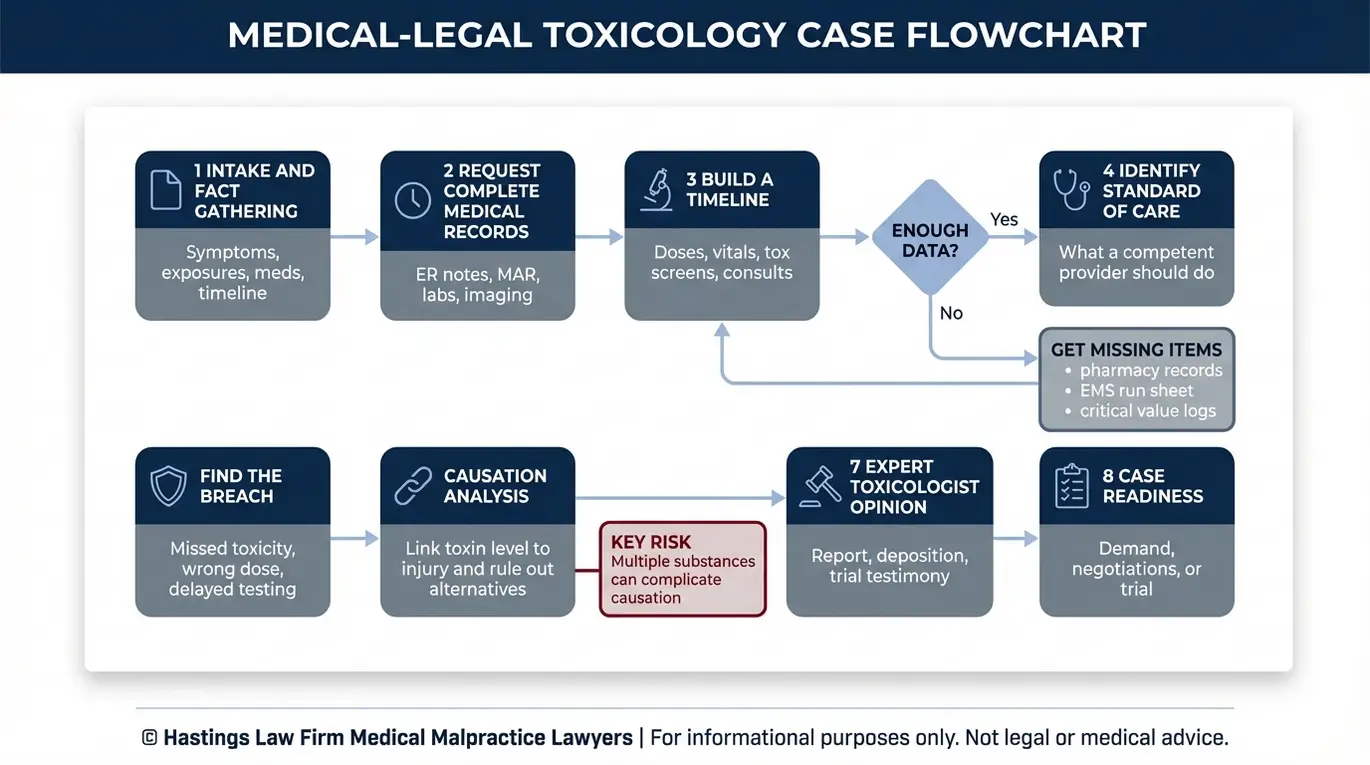
Here is how an Arizona toxicologist malpractice lawyer approaches building a toxicology malpractice case:
Step 1: Obtain and review all medical records. The medical chart is the foundation of every case. We look at admission notes, lab results, medication orders, nursing assessments, and discharge summaries to build a minute-by-minute timeline of the care that was provided. Our in-house medical staff identifies gaps in documentation and inconsistencies that may reveal where the standard of care was breached.
Step 2: Retain qualified expert witnesses. Arizona law requires expert testimony to establish that a medical provider deviated from accepted practice. A toxicology expert witness attorney knows that the right expert is often the difference between a case that moves forward and one that does not. We work with board-certified toxicologists from our national expert network who can evaluate the clinical decisions made and testify about what a competent provider should have done. A toxicology expert witness attorney also ensures that a preliminary expert opinion affidavit is prepared as required to support the validity of the claim.
Proving overdose negligence often hinges on two specialized concepts. Therapeutic drug monitoring (TDM) is the practice of measuring drug concentrations in a patient’s blood to keep them within a safe and effective range. The therapeutic index, sometimes called the therapeutic window, refers to the narrow margin between a drug’s effective dose and its toxic dose. When a provider fails to monitor levels for a drug with a narrow therapeutic index, the risk of toxicity rises significantly. A toxicology expert witness attorney uses these concepts to show the jury exactly where the provider failed.
Step 3: Establish causation. It is not enough to show that an error occurred. We must also prove that the specific error caused the injury. Proving overdose negligence requires ruling out other potential causes and demonstrating a direct link between the substance, the dosage, and the harm. Expert testimony is critical here, and courts evaluate its reliability under standards like those discussed in the Mississippi College Law Review’s analysis of *Daubert v. Merrell Dow Pharmaceuticals, Inc.*, which governs how scientific evidence is admitted at trial. To show the jury exactly how the negligence caused the harm, we use scientific data and expert analysis.
Step 4: Present the evidence. Once the records, expert opinions, and causation analysis are assembled, an Arizona toxicologist malpractice lawyer builds a case narrative that translates the medical evidence into clear, persuasive arguments for a jury or settlement negotiation.
Liable Parties in Overdose and Toxic Exposure Lawsuits
Liability in toxicology cases can extend beyond the treating physician to include hospitals for inadequate protocols, pharmacists for dispensing errors, and manufacturers for defective pharmaceutical products. Identifying every responsible party is essential to securing full compensation, and an Arizona toxicologist malpractice lawyer can help uncover all liable entities.
Physicians and clinical toxicologists may be directly liable when their treatment decisions fall below the standard of care. This includes prescribing errors, failure to diagnose poisoning, and inadequate monitoring of patients on high-risk medications. A pharmacy negligence lawyer also examines whether the pharmacist filled a prescription incorrectly, dispensed the wrong drug, or failed to flag a dangerous drug interaction before releasing the medication.
Hospitals and healthcare facilities can bear liability for systemic failures that contribute to patient harm. Understaffing, lack of toxicology protocols in the emergency department, and poor communication between care teams are all institutional issues that may support a hospital liability attorney’s claim of negligence. In some cases, a hospital may be vicariously liable for the actions of its employed physicians and staff. A hospital liability attorney investigates whether the facility enforced proper safety policies.
Pharmaceutical companies may also be held responsible when a defective or contaminated drug causes toxic injury. For example, the case involving Pharmatech Laboratories highlights how manufacturing defects can harm patients. Reports filed through the FDA’s Adverse Event Reporting System (FAERS) can provide evidence about known adverse effects. A pharmacy negligence lawyer will verify if the drugs involved were part of a known recall or contamination event.
Drug compounding also introduces additional risk when contamination or incorrect formulations reach patients. This practice of custom-mixing medications by a pharmacy or compounding facility requires strict quality control to ensure safety.
The Role of Product Liability in Toxicology Cases
Product liability involves legal responsibility for injuries caused by items that are defective or unsafe for consumers. Not every toxicology case is medical malpractice. When the harm results from a defective product rather than a doctor’s error, the claim may fall under product liability law. A defective drug with inadequate labeling and warnings, for example, may expose the manufacturer to liability even if the prescribing physician followed standard protocols.
Some cases involve both theories, and an Arizona toxicologist malpractice lawyer can help determine which legal pathway, or combination of pathways, applies to your situation. In mass tort litigation, multiple patients harmed by the same product may pursue claims against the manufacturer simultaneously.

Damages Recoverable for Toxicology Negligence in Arizona
Patients harmed by toxicology negligence in Arizona may recover economic damages for medical bills and lost wages, as well as non-economic damages for pain, suffering, and loss of quality of life. The specific damages depend on the severity of the injury and its long-term impact.
Economic damages cover the financial losses that can be calculated with documentation. These include past and future medical expenses, rehabilitation costs, prescription medications, lost income, and diminished earning capacity. In cases involving severe overdose injuries or chronic toxic exposure, a life care plan prepared by a qualified expert can project the total cost of future medical needs.
Compensation for overdose death cases may also include the financial support the deceased would have provided to their family. An Arizona toxicologist malpractice lawyer ensures that compensation for overdose death claims accounts for the full value of the lost wages and benefits.
Non-economic damages address the losses that do not come with a receipt. Pain and suffering, emotional distress, loss of enjoyment of life, and loss of consortium (the impact on a spouse or family relationship) are all recoverable in Arizona. These damages recognize that the harm extends far beyond hospital bills. Toxic exposure damages also cover the immense psychological toll of living with a chronic illness caused by negligence.
Punitive damages may be available in cases involving egregious conduct. Arizona courts may award punitive damages when the negligence was grossly reckless or intentional. Our legal team, led by board-certified Tommy Hastings, handles complex claims involving reckless overprescribing and hazardous exposure. An Arizona toxicologist malpractice lawyer evaluates whether punitive damages are warranted based on the specific facts. Toxic exposure damages can be substantial when the injury requires ongoing treatment or results in permanent disability.
| Damage Type | What It Covers | Examples |
|---|---|---|
| Economic Damages | Measurable financial losses | Medical bills, lost wages, future care costs, rehabilitation |
| Non-Economic Damages | Quality of life and personal impact | Pain and suffering, emotional distress, loss of consortium |
| Punitive Damages | Punishment for egregious conduct | Gross negligence, reckless overprescribing, intentional concealment |
Compensation for overdose death is important for families left behind, providing the resources needed to manage life without their loved one. We work with medical experts and economists to document the full value of your claim.
Wrongful Death Claims for Fatal Overdoses and Poisonings
If a toxic exposure or medication error leads to death, surviving family members can file a wrongful death lawsuit to recover compensation for funeral costs, lost financial support, and emotional anguish. These cases carry both legal and emotional weight, and understanding the process is an important first step. A wrongful death attorney Arizona families trust can guide you through this difficult time.
Under Arizona Revised Statutes § 12-612, wrongful death claims may be filed by the surviving spouse, children, parents, or guardian of the deceased, as well as the personal representative of the deceased on behalf of statutory beneficiaries. These individuals each have the right to seek damages for the losses they have personally suffered as a result of the death. An Arizona toxicologist malpractice lawyer helps these beneficiaries organize their claims effectively.
Arizona law recognizes two distinct types of claims in fatal cases. A wrongful death claim compensates the family for their own losses, including funeral expenses, loss of companionship, lost financial support, and emotional suffering. A survival action, by contrast, allows the estate to recover damages such as the deceased’s medical bills, lost income from the time of injury until death, and funeral expenses. Both claims can be pursued in the same lawsuit, and a fatal overdose lawyer can help families understand how these legal theories apply to their situation. A fatal overdose lawyer is particularly important when the cause of death is disputed by the defense.
Time is a critical factor. Arizona’s statute of limitations generally requires that a wrongful death lawsuit be filed within two years. In cases involving toxic exposure where the cause of death was not immediately apparent, the discovery rule may affect when the deadline begins to run. A wrongful death attorney Arizona residents rely on can assess your timeline and help ensure your claim is preserved.
Losing a family member to a preventable overdose or poisoning is one of the most painful experiences imaginable. An Arizona toxicologist malpractice lawyer can help you seek both accountability and the financial security your family needs to move forward.
Contact the Arizona Healthcare Malpractice Attorneys at Hastings Law Firm Today for Help
At Hastings Law Firm, we represent patients and families harmed by medical negligence, including medication errors, undiagnosed poisoning, and mismanaged overdoses. Our team of trial attorneys, in-house nurses, and former defense lawyers brings the medical knowledge and courtroom preparation these cases demand.
We handle every case on a contingency fee basis, which means you pay no attorney fees or costs unless we secure a recovery for you. If you believe a healthcare provider’s negligence caused a toxic injury or the death of someone you love, we are here to listen.
Contact Hastings Law Firm for a free, confidential case evaluation. Let us review what happened and help you understand your options.
Frequently Asked Questions About Toxicologist Malpractice in Arizona


This content was researched and written by the Hastings Law Firm editorial team, which includes attorneys, medical professionals, and experienced researchers. Our writing is informed by internal knowledge and practical experience, and we cross-check critical details against authoritative sources cited throughout. Every piece undergoes human-led fact-checking and legal review. Because legal and medical information can change, if you spot an error, please contact us. Learn more about our content standards and review process on our editorial policy page.

Tommy Hastings, founder of Hastings Law Firm, is a board-certified personal injury trial lawyer dedicated exclusively to healthcare injury cases. Since 2001, he has represented injured patients and families in litigation against major hospital systems, pharmaceutical companies, and negligent healthcare providers nationwide. He has handled numerous high-profile cases that have drawn national media attention and resulted in multi-million dollar recoveries. He draws on that experience in his writing, helping readers understand how these cases work and what options may be available to them.
