


Arizona Sports Medicine Physician Malpractice Lawyer
Written by: Hastings Law Firm | Reviewed by: Tommy Hastings | Updated: July 27, 2026
Sports medicine care is meant to help athletes heal and return safely, but mistakes can leave lasting harm. When treatment falls below the accepted standard of care, the result can be a longer recovery, additional procedures, lost earning potential, and the loss of the ability to compete at the same level. These situations often involve disputes about whether an outcome was an unavoidable risk or preventable negligence, including decisions about diagnosis, surgery, rehabilitation, and return to play. If you or a loved one were harmed or worse due to sports medicine physician malpractice in Arizona, contact Hastings Law Firm for a free, confidential case review.

Top-Rated Legal Representation for Sports Injury Specialist Negligence in Arizona
What You Should Know About Sports Rehab Doctor Negligence Claims in Arizona:
- Lasting harm and career disruption can follow when sports medicine care falls below the accepted standard of care.
- Options can narrow quickly in public university related cases because special requirements can permanently bar a claim if missed.
- Settlement may be delayed or blocked when an insurance policy gives the physician the right to refuse a proposed settlement.
- Recovery can be reduced when comparative negligence is alleged, even when physician negligence also contributed to the harm.
- Liability may extend beyond the treating physician to organizations such as sports teams or hospitals depending on the working relationship.
- Severe outcomes can occur when return to play clearance is given too early after a concussion.
- Compensation can include both financial losses and personal losses tied to pain, suffering, and loss of enjoyment of life.
- Medical records and related documentation can be central to evaluating what happened, including imaging, surgical notes, and rehabilitation logs.

A Healthcare Focused Law Firm
When a sports medicine doctor’s care makes your condition worse instead of better, it can feel like the people you trusted most let you down. You may be dealing with a longer recovery, a second surgery, or the possibility that you’ll never compete at the same level again. Those concerns are valid, and you deserve clear answers about what went wrong and what your options are.
As an Arizona sports medicine physician malpractice lawyer, Hastings Law Firm focuses exclusively on medical malpractice. Our team of attorneys, former defense lawyers, and in-house medical professionals understands how to evaluate sports injury cases from both a clinical and legal perspective. If you believe a physician’s error changed the course of your recovery or your career, we can review what happened and explain your options in a free, confidential consultation.
Defining Sports Medicine Malpractice in Arizona
Sports medicine malpractice occurs when a physician, orthopedic surgeon, or rehabilitation specialist deviates from the accepted standard of care, causing preventable harm or worsening an athlete’s condition. The standard of care is the level of treatment a reasonably competent sports medicine professional would provide under similar circumstances. It applies across the full scope of care: initial injury treatment, surgical intervention, and rehabilitation management.
A bad outcome does not always mean malpractice occurred. Surgery carries inherent risks, and some injuries do not heal as expected despite proper treatment. The legal question is whether the physician’s decisions fell below what other qualified specialists would have done in the same situation.
If a doctor clears an athlete for return-to-play (RTP), the process of medically approving a patient to resume physical activity, too early and a re-injury occurs, that may cross the line into negligence. Evaluating whether an unfortunate result is actually medical negligence requires a deep clinical and legal review. A sports medicine malpractice attorney can review the specific facts of your clearance to determine if this threshold was crossed.
Sports medicine malpractice claims also cover failures in diagnosing and managing sport-related concussion (SRC), a brain injury caused by a blow or jolt during athletic activity. When an Arizona sports medicine physician malpractice lawyer evaluates these cases, the focus is on whether the doctor’s treatment mistakes fell outside the boundaries that a competent specialist would have followed. At Hastings Law Firm, our in-house medical staff reviews these clinical decisions in detail to determine whether a duty of care was violated.
Proving Negligence Against a Sports Physician
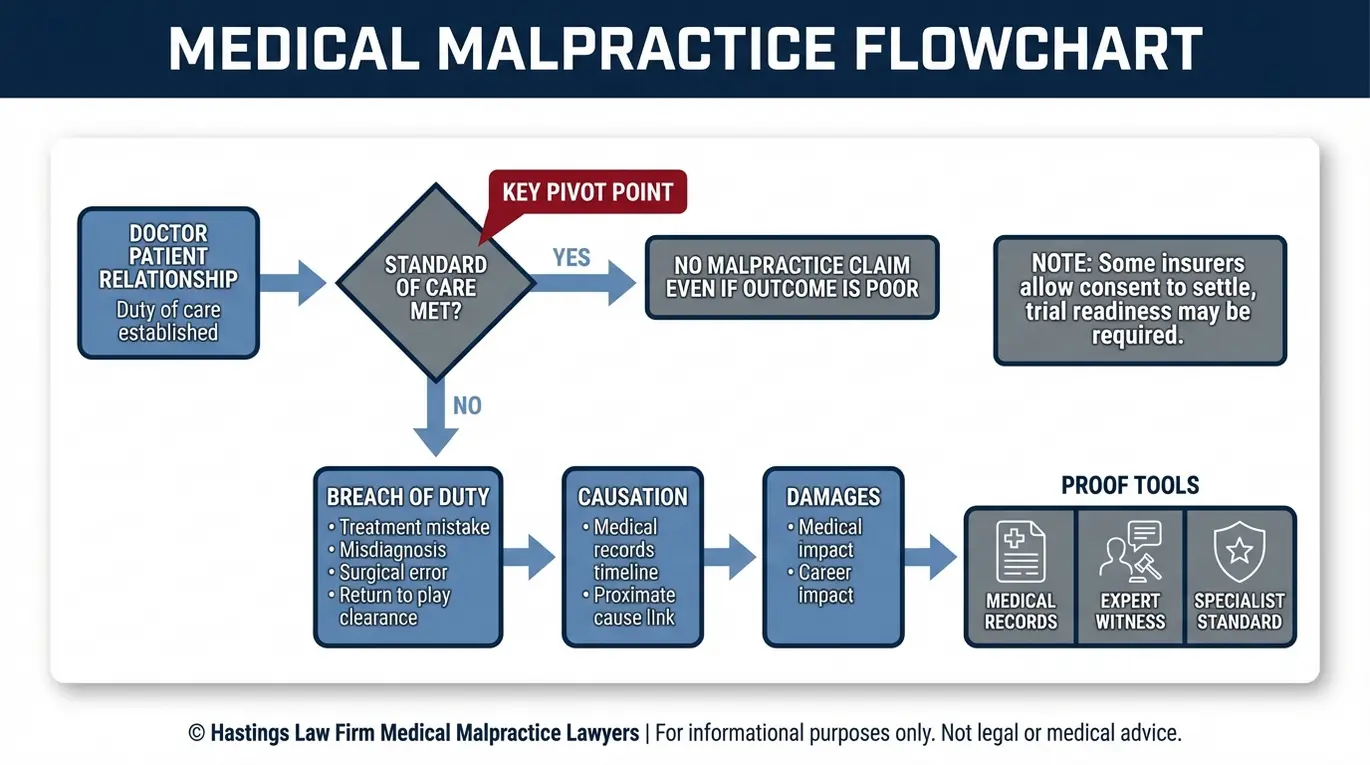
To prove a claim, you must demonstrate that a doctor-patient relationship existed, the physician breached the standard of care, and that breach directly caused specific damages or injury. These four elements form the foundation of every malpractice case, and each one must be supported by evidence.
Here is what a malpractice lawyer for sports injuries must establish:
- Duty: The doctor agreed to treat the athlete, which creates a formal doctor-patient relationship and a legal obligation to provide competent care.
- Breach: The doctor failed to act as a competent specialist would. This breach of duty occurs when a physician ignores MRI results or misinterprets imaging that showed clear structural damage.
- Causation: The error directly caused new injury or eliminated the patient’s chance of recovery. Causation, often referred to as proximate cause, requires showing a direct link between what the doctor did (or failed to do) and the harm that followed.
- Damages: The athlete suffered measurable financial or physical loss as a result. These losses include economic damages like medical bills and non-economic damages like physical pain.
Research published by the National Academies of Sciences, Engineering, and Medicine has documented how diagnostic errors contribute to patient harm. This reinforces why expert witness testimony is essential to proving what a physician should have identified and when.
When an Arizona sports medicine physician malpractice lawyer assists in suing a sports medicine doctor, we examine medical records, imaging studies, surgical notes, and rehabilitation logs. Procedures like arthroscopy, a minimally invasive surgical technique using a small camera to diagnose and treat joint problems, often generate detailed operative reports that our team reviews closely with qualified experts to pinpoint exactly where the negligence occurred.
Unique Challenge: The “Consent to Settle” Clause
Many Arizona physicians carry insurance policies that include a “consent to settle” clause, which gives the doctor the right to refuse a proposed settlement. Physicians may decline settlement offers to protect their professional reputation, even when the evidence strongly supports liability. This clause allows a doctor to block a settlement, potentially forcing a trial even when negligence is clear.
Understanding insurance defense strategies is important in these scenarios. This clause means a case might proceed to litigation even if the insurance company wants to resolve it. As an Arizona sports medicine physician malpractice lawyer, we prepare every case as if it will go to trial. This ensures this tactic does not weaken our clients’ position.
The Hastings Law Firm Difference
Results matter, but what truly sets us apart is how we achieve them. Every verdict, every settlement, and every Arizona courtroom victory comes from one guiding promise: To treat each client’s fight for justice as if it were our own.
This balance of skill, experience, and empathy reflects our core philosophy that justice should not only compensate the injured, but also make healthcare safer nationwide.

Common Errors by Sports Medicine Doctors & Orthopedists
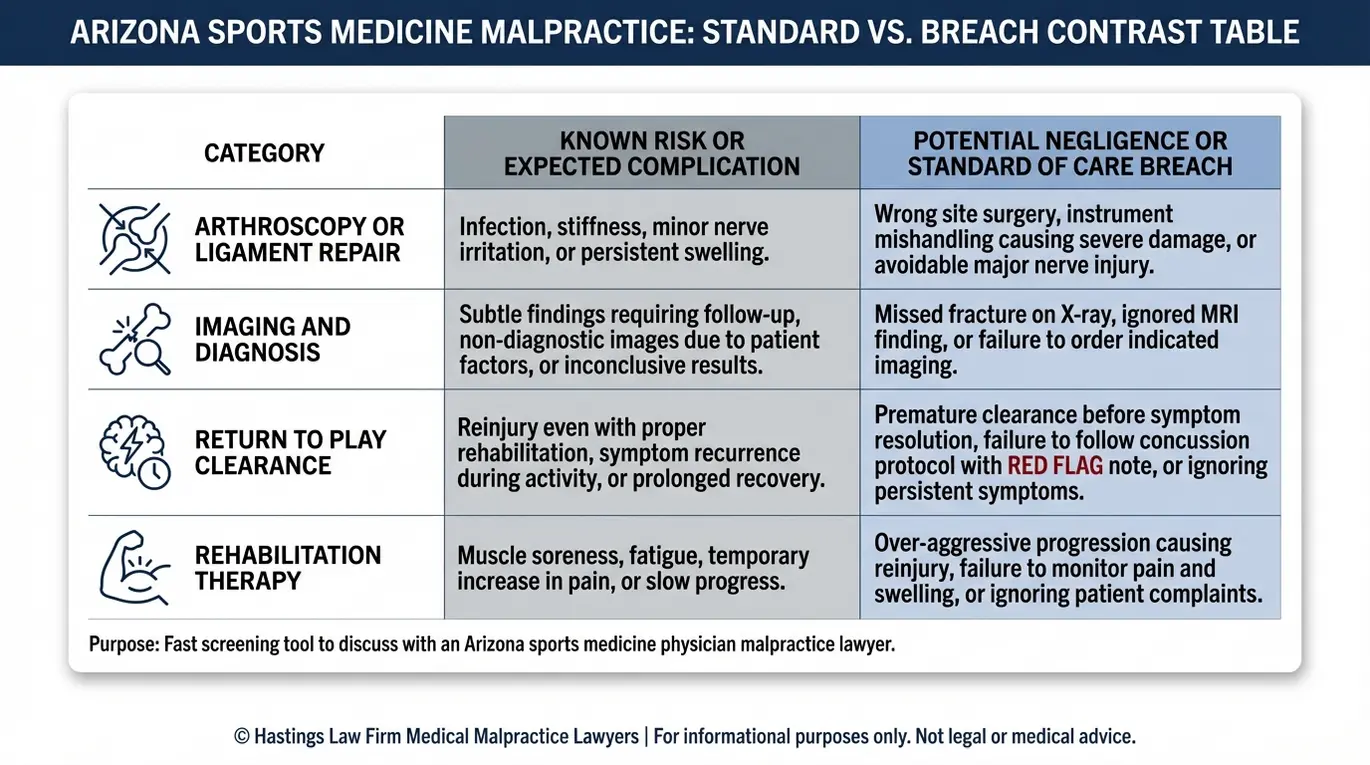
Frequent errors include surgical mistakes during ligament repair, failure to diagnose fractures, improper clearance for return to play, and mismanagement of concussions. These errors can turn a treatable injury into a permanent one. Understanding the difference between a known risk and negligence is central to any Arizona sports medicine physician malpractice lawyer‘s evaluation of a case.
Surgical Errors. ACL reconstruction, a procedure that replaces a torn anterior cruciate ligament with a tissue graft, is one of the most common sports surgeries. Negligence by a sports doctor during this procedure can include drilling bone tunnels in the wrong position, improper graft fixation, or nerve damage during arthroscopic surgery. They are deviations from what a skilled orthopedic malpractice attorney would identify as below-standard surgical technique.
Diagnostic Failures. A stress fracture, a small crack in a bone caused by repetitive force, can be missed on initial imaging if a physician fails to order appropriate follow-up tests. Missing a hairline fracture or a partial ligament tear on MRI may delay treatment, leading to a misdiagnosis or worsening of the condition that causes further structural damage and prolonged recovery time.
Clearance Negligence. One of the most dangerous errors a sports medicine malpractice lawyer encounters is premature return-to-play clearance. The 6th International Conference on Concussion in Sport established consensus protocols requiring a graduated, stepwise return to activity following a concussion. Clearing an athlete too soon can lead to Second Impact Syndrome, a potentially fatal condition where a second concussion occurs before the brain has healed from the first.
| Actionable Error (Potential Malpractice) | Known Risk (Not Necessarily Malpractice) |
|---|---|
| Drilling ACL bone tunnel in wrong location | ACL graft failure due to poor tissue quality |
| Missing a fracture visible on imaging | Delayed bone healing despite proper treatment |
| Clearing a concussed athlete without completing protocol | Persistent post-concussion symptoms after proper management |
| Nerve damage from improper arthroscopic technique | Temporary numbness near surgical incision site |
Liability: Team Doctors, Orthopedic Surgeons, and Rehab Clinics
Liability can extend beyond the individual physician to include professional sports teams, university athletic departments, hospitals, and physical therapy clinics, depending on employment status and the nature of the relationship. This means multiple organizations might be responsible for the injuries you suffered.
Independent Contractors vs. Employees. A team doctor who treats athletes at a university or professional organization may be an independent contractor rather than an employee. This distinction affects who can be held responsible. If the doctor is an employee, the team or organization may share liability under the doctrine of vicarious liability.
If the doctor operates independently, the claim may be directed at the physician’s own practice. However, hospital negligence may also play a role if the surgery occurred at a facility where nursing staff contributed to the error. When suing a team doctor, we investigate employment agreements and contracts to identify every responsible party.
Rehab Clinic Negligence. Physical therapy (PT), a structured rehabilitation protocol designed to restore function after injury or surgery, is another area where sports rehab negligence occurs. Over-aggressive rehabilitation programs or failure to follow post-surgical weight-bearing restrictions can cause re-injury or graft failure. A certified athletic trainer (ATC), a licensed healthcare professional specializing in prevention and treatment of sports injuries, may also be liable if their decisions fall outside accepted clinical guidelines.
Public Entity Claims. If the treating physician works for a state university like ASU or the University of Arizona, special rules apply. Under A.R.S. § 12-821.01, claims against public entities require filing a Notice of Claim within 180 days.
This is a much shorter window than the standard statute of limitations, and missing it can permanently bar your case. Strict adherence to these procedural rules is mandatory, as courts rarely grant exceptions for missed deadlines in public entity claims. An Arizona sports medicine physician malpractice lawyer experienced with these deadlines can help protect your right to file.
Compensation for Career-Ending Sports Injuries
Patients can recover economic damages for medical bills and lost future earnings, as well as non-economic damages for pain, suffering, and loss of enjoyment of life. For athletes, the financial impact of malpractice often extends far beyond the cost of corrective surgery and can include lost career potential.
Lost Career Potential. When a physician’s error ends an athletic career, the calculation of damages in sports malpractice cases may include the value of a lost college scholarship, a professional contract, or years of earning potential. Our team works with economic experts to build a detailed projection of lost earning capacity, analyzing draft projections and contract statistics to determine what you would have earned had the injury been properly treated. This is one of the most significant categories of compensation for athlete injury cases.
Medical Costs. Corrective surgeries, long-term rehabilitation, prescription medications, and adaptive equipment all factor into economic damages. If the original error requires additional procedures or extended recovery, those costs are part of the claim.
Compensatory damages in these cases typically fall into two categories:
- Economic damages: Medical expenses (past and future), lost wages, lost earning capacity, rehabilitation costs, and any out-of-pocket expenses directly tied to the injury.
- Non-economic damages: Physical pain and suffering, emotional distress, loss of enjoyment of life, and the psychological toll of losing the ability to compete.
In rare cases involving egregious conduct, punitive damages may also be available. These are awarded not to compensate the patient but to penalize particularly reckless behavior. An Arizona sports medicine physician malpractice lawyer can evaluate which categories of damages apply to your specific situation.
Arizona Statutes of Limitations for Sports Injury Claims
In Arizona, medical malpractice claims typically must be filed within two years from the date the injury occurred or was discovered, though exceptions exist for minors. Under A.R.S. § 12-542, this two-year deadline applies to most claims involving physician negligence.
The discovery rule may extend this deadline in certain situations. If a surgical error was not immediately apparent, such as a mispositioned graft that only becomes evident months later during follow-up imaging, the statute of limitations for sports injury claims may begin when the patient knew or should have known about the injury rather than the date of the procedure itself.
Special rules apply to minors. Athletes under 18 may have additional time to file, as Arizona law generally allows for tolling of the statute of limitations until the minor reaches the age of majority. However, waiting is risky. Evidence can be lost, and memories fade. If you suspect malpractice, consulting an Arizona sports medicine physician malpractice lawyer early protects both your rights and your evidence.
Steps to Take After a Failed Sports Procedure
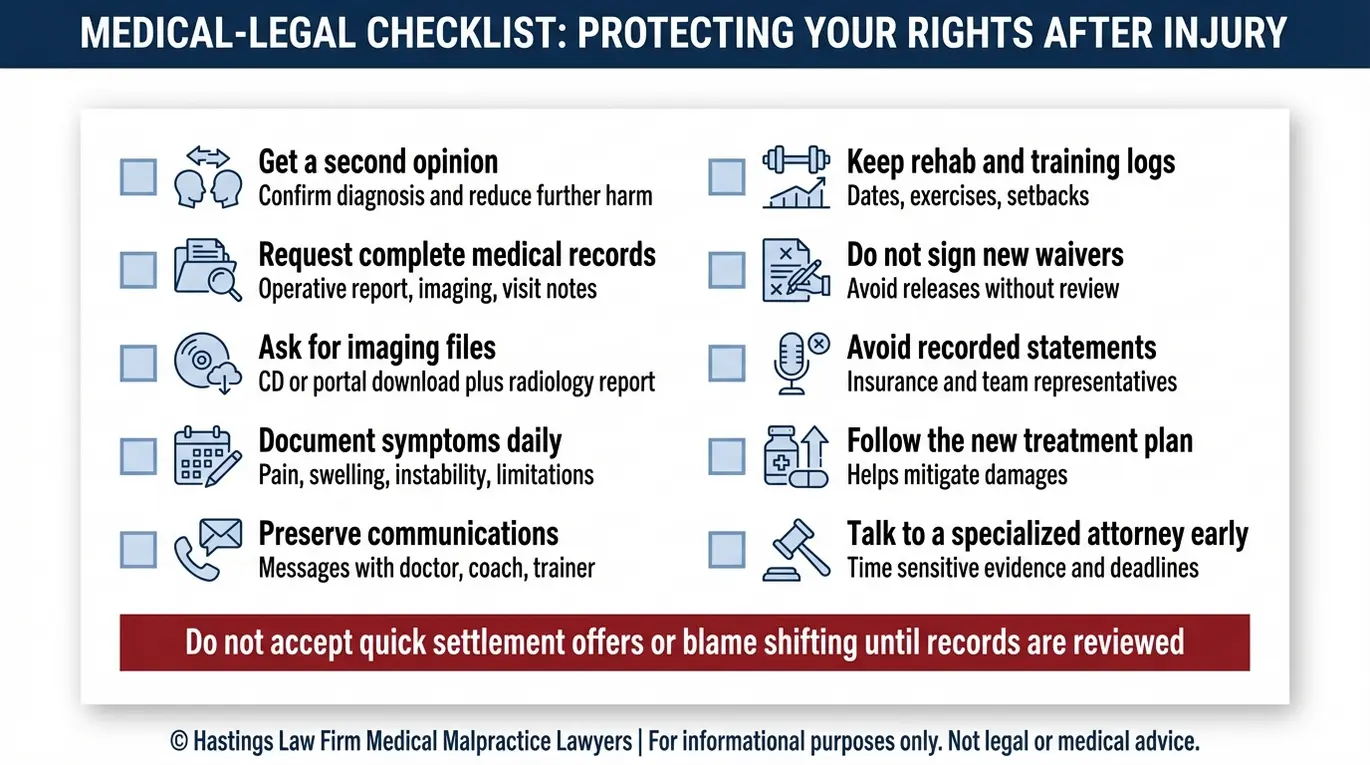
Patients should immediately seek a second opinion to correct the medical issue, request a complete copy of their medical records, and contact a specialized attorney before speaking to insurance adjusters. Seeking a second opinion creates a new medical record that documents the current state of your condition and helps you prevent further injury.
Here is what we recommend:
- Get a second opinion immediately. Seeing a new doctor is both medically necessary and legally important. Arizona law requires injured patients to mitigate their damages, meaning you must take reasonable steps to prevent your condition from getting worse.
- Preserve all evidence. Request your complete medical records, including surgical notes, diagnostic tests, imaging, and post-operative reports. Keep training logs, communications with coaches or athletic trainers, and any written instructions from your doctor.
- Do not sign anything or accept quick offers. Teams, clinics, or insurance companies may offer a fast settlement or ask you to sign a waiver. Before agreeing to anything, speak with a qualified attorney. Hiring a sports malpractice lawyer before making any statements protects you from unintentionally weakening your claim.
- Understand concussion-specific concerns. Concussion protocols are the graded return-to-play steps a physician must follow before clearing an athlete. If these steps were skipped and a second injury occurred, the risk of Second Impact Syndrome, a severe brain swelling, becomes a central legal issue.
Contact the Arizona Healthcare Malpractice Attorneys at Hastings Law Firm Today for Help
A physician’s error should not define your future. If a sports medicine doctor’s negligence caused you lasting harm, whether through a failed surgery, a missed diagnosis, or a premature return-to-play clearance, you have the right to seek answers and hold them accountable.
Hastings Law Firm brings together trial attorneys, former defense counsel, and in-house medical professionals who understand the clinical details that make or break these cases. Our firm’s founder, Tommy Hastings, is a board-certified trial lawyer who has dedicated his career to helping patients understand their rights when medical care fails. As an Arizona sports medicine physician malpractice lawyer, we prepare every case for trial from day one, which puts us in a strong position whether your case resolves through settlement or before a jury.
We work on a contingency fee basis, so you pay no attorney fees or costs unless we secure a recovery for you. Contact us today for a free consultation. We can review your medical records, explain what we see, and help you understand your path forward.
Frequently Asked Questions About Sports Medicine Physician Malpractice in Arizona


This content was researched and written by the Hastings Law Firm editorial team, which includes attorneys, medical professionals, and experienced researchers. Our writing is informed by internal knowledge and practical experience, and we cross-check critical details against authoritative sources cited throughout. Every piece undergoes human-led fact-checking and legal review. Because legal and medical information can change, if you spot an error, please contact us. Learn more about our content standards and review process on our editorial policy page.

Tommy Hastings, founder of Hastings Law Firm, is a board-certified personal injury trial lawyer dedicated exclusively to healthcare injury cases. Since 2001, he has represented injured patients and families in litigation against major hospital systems, pharmaceutical companies, and negligent healthcare providers nationwide. He has handled numerous high-profile cases that have drawn national media attention and resulted in multi-million dollar recoveries. He draws on that experience in his writing, helping readers understand how these cases work and what options may be available to them.
