


Arizona Shoulder Dystocia Birth Injury Lawyer
Shoulder dystocia is a delivery emergency that can quickly become a medical crisis when a baby shoulder becomes trapped and oxygen flow is reduced. When the response is delayed or excessive force is used, a child can suffer lasting nerve damage and long term physical and emotional challenges for the whole family. Understanding how shoulder dystocia is managed and what records may show about the care provided can help families make informed decisions. If you or a loved one were harmed or worse due to shoulder dystocia birth injury in Arizona, contact Hastings Law Firm for a free, confidential case review.

Last Updated: July 27, 2026
Trial-Ready Shoulder Dystocia Birth Injury Lawyers in Arizona
When your child is hurt during delivery, the confusion and grief can feel overwhelming. You may sense that something went wrong in the delivery room, but you’re unsure how to confirm it or what to do next. That instinct deserves to be taken seriously.
As an Arizona Shoulder Dystocia Birth Injury Lawyer, Hastings Law Firm focuses exclusively on medical malpractice litigation rather than general personal injury. Board-certified trial lawyer Tommy Hastings founded our firm to provide trial-ready advocacy for families affected by medical negligence. Our team includes former defense attorneys and former hospital nurses who understand how medical systems operate from the inside. We prepare every birth injury case as if it will go before a jury because that level of preparation is what families deserve.
If your child was injured during a difficult delivery, we can review the medical records and explain your options. Consultations are free, and you pay no fees unless we recover compensation for your family.

Understanding Shoulder Dystocia and Preventable Birth Injuries
Shoulder dystocia is an obstetric emergency where the baby’s head delivers but one or both shoulders become trapped behind the mother’s pelvic bone, requiring immediate intervention to complete the birth safely. It can happen quickly and without warning, turning what seemed like a routine delivery into a high-stakes medical crisis.
When the shoulders are stuck, the baby’s body is partially outside the birth canal while the umbilical cord may be compressed between the baby and the pelvic wall. This compression can reduce or cut off the baby’s oxygen supply, a condition known as hypoxia. The longer the delay, the greater the risk of fetal distress, oxygen deprivation, and lasting harm.
Here is what happens physiologically during shoulder dystocia:
- The baby’s head delivers normally, but the anterior shoulder catches on the mother’s pubic bone
- The umbilical cord can become compressed, restricting blood flow and oxygen to the baby
- The delivery team has a limited window to free the shoulder before oxygen deprivation causes injury
- Excessive force applied to the baby’s head or neck during this window can damage the nerves controlling the arm and hand
Not every shoulder dystocia results in injury. Some deliveries involve a brief, well-managed delay that resolves without harm. The difference between a complication and a preventable injury often comes down to how the medical team responds. A trained provider who recognizes the emergency and performs the correct maneuvers can resolve it safely.
A provider who fails to follow established protocols or applies excessive traction may cause permanent damage. A failure to follow standard procedures can turn a manageable situation into a traumatic event. An experienced Arizona birth injury attorney can help determine whether your child’s injury resulted from a medical team’s failure or an unavoidable complication.
Standard of Care and Proper Management of Shoulder Dystocia
The standard of care dictates that doctors must immediately stop pushing and utilize established techniques like the McRoberts maneuver or suprapubic pressure to release the shoulder without harming the infant. Pulling harder on the baby’s head is not one of those techniques.
The medical community has developed a well-known protocol called HELPERR, a mnemonic that guides obstetric teams through a structured sequence of maneuvers. According to a review published in PubMed Central on the management of shoulder dystocia, these maneuvers are taught in residency programs and practiced through drills because a coordinated response can mean the difference between a safe delivery and a permanent injury.
The HELPERR protocol includes the following steps:
| Step | Maneuver | What It Involves |
|---|---|---|
| H | Call for Help | Alert additional staff, including anesthesia and neonatal teams |
| E | Evaluate for Episiotomy | Assess whether a surgical cut will create more room for maneuvers |
| L | Legs (McRoberts Maneuver) | Flex the mother’s legs sharply toward her abdomen to widen the pelvic opening |
| P | Suprapubic Pressure | Apply firm pressure just above the mother’s pubic bone to push the baby’s shoulder free |
| E | Enter (Internal Rotation) | Reach inside and rotate the baby’s shoulders to a wider diameter |
| R | Remove Posterior Arm | Deliver the baby’s back arm first to reduce shoulder width |
| R | Roll the Patient (Gaskin Maneuver) | Reposition the mother onto hands and knees to change pelvic geometry |
The McRoberts maneuver, where the mother’s thighs are flexed tightly against her abdomen, is typically the first physical intervention. It flattens the lower spine and rotates the pelvis, creating more space without touching the baby at all. Suprapubic pressure, a steady downward push applied by a nurse above the pubic bone, works alongside this maneuver to dislodge the trapped shoulder.
A shoulder dystocia lawyer in Arizona will examine whether the delivery team followed this protocol, in what order, and how quickly.
The Geometry of Delivery and Reducing Shoulder Diameter
Birth canal geometry dictates how a medical team must respond to a trapped shoulder. The reason these maneuvers work to resolve shoulder dystocia comes down to basic geometry. The baby’s shoulders are widest from front to back. When one shoulder is wedged behind the pubic bone, the goal is to reduce that width or change the angle so the shoulders can pass through.
Internal rotation techniques, like the Woods screw maneuver, change the orientation of the shoulders from a wider diameter to a narrower one. During this maneuver, the physician reaches inside and applies pressure to the baby’s posterior shoulder to rotate the body like turning a screw. Delivering the posterior arm first achieves a similar result by physically removing one shoulder from the equation, which significantly reduces the overall width that must fit through the pelvis.
A provider who skips these steps and instead relies on force is not following the accepted standard. That failure is something we examine closely in every case, identifying exactly where the geometric principles of safe delivery and physics were ignored.

The Hastings Law Firm Difference
Results matter, but what truly sets us apart is how we achieve them. Every verdict, every settlement, and every Arizona courtroom victory comes from one guiding promise: To treat each client’s fight for justice as if it were our own.
This balance of skill, experience, and empathy reflects our core philosophy that justice should not only compensate the injured, but also make health care safer nationwide.

How Medical Negligence Causes Permanent Nerve Damage
Negligence occurs when a doctor applies excessive traction or pulls too hard on the baby’s head, stretching or tearing the nerves of the brachial plexus instead of performing the correct release maneuvers.
The brachial plexus is a network of nerves that runs from the spinal cord through the neck and into the arm. A brachial plexus injury occurs when these nerves are stretched, compressed, or torn during delivery. In the context of shoulder dystocia, this damage typically happens when force is applied to the baby’s head in a downward or lateral direction while the shoulder remains lodged against the pelvic bone. The head moves, but the shoulder does not, and the nerves between them bear the strain.
Research published in Acta Obstetricia et Gynecologica Scandinavica identifies risk factors for brachial plexus injuries specifically related to shoulder dystocia, reinforcing that the mechanism of injury is closely tied to how the delivery is managed.
Instrument misuse can compound the problem. In some cases, a physician may attempt to use a vacuum extractor or forceps to pull the baby free when the shoulders are stuck. These tools are not designed to resolve shoulder dystocia, and applying additional traction through them can dramatically increase the force on the brachial plexus. Using such instruments during a dystocia event contravenes safe practice guidelines and often serves as strong evidence of negligence.
Documentation gaps also matter. In our experience, delivery records in these cases sometimes lack critical details: how long the dystocia lasted, what maneuvers were attempted, and in what order. When a birth injury malpractice lawyer reviews the chart, missing or inconsistent entries can indicate that the team did not follow protocol or failed to document key decisions in real time.
Legal help for shoulder dystocia focuses on this gap between the standard of care and the actual care delivered. Establishing causation is central to a medical malpractice claim; we must prove that the nerve damage was directly caused by the physician’s failure to act appropriately.

Identifying Missed Risk Factors Before Delivery
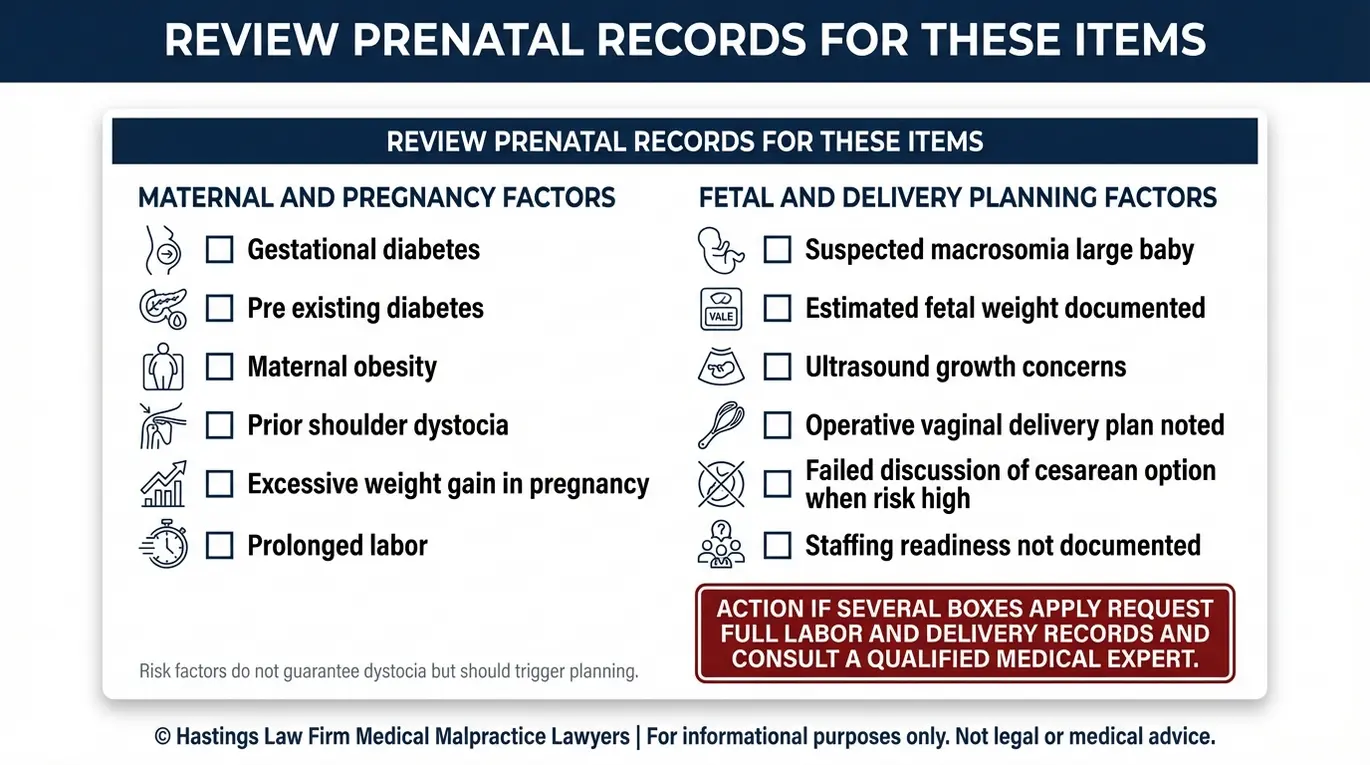
Doctors are expected to screen for known risk factors that increase the likelihood of shoulder dystocia and plan accordingly, including discussing the option of a Cesarean delivery (C-section) when the risk of vaginal birth is elevated.
Macrosomia, a term meaning the baby is significantly larger than average (generally over 4,000 grams, or about 8 pounds 13 ounces), is one of the most well-documented risk factors. According to the NCBI Bookshelf resource on macrosomia, fetal size estimation through ultrasound and clinical assessment is a standard part of prenatal care. When a baby is estimated to be large, the care team should be planning for the possibility of a difficult delivery.
Gestational diabetes, a form of diabetes that develops during pregnancy, also increases the risk of both macrosomia and shoulder dystocia. Maternal diabetes that existed before pregnancy carries similar concerns. Both conditions can cause the baby to accumulate excess fat around the shoulders and trunk, which is precisely the body type most likely to encounter problems during vaginal delivery.
Risk factors that an Arizona medical negligence attorney may investigate include:
- Estimated fetal weight above 4,000 to 4,500 grams on prenatal imaging
- Gestational diabetes or pre-existing maternal diabetes
- Maternal obesity
- History of shoulder dystocia in a prior delivery
- Prolonged labor or failure to progress
- Post-term pregnancy (beyond 40 weeks)
- Need for operative vaginal delivery (vacuum or forceps)
When multiple risk factors are present and documented in the prenatal record, the question becomes whether the care team developed an appropriate delivery plan. If a provider identified a large baby in a mother with gestational diabetes and still proceeded with vaginal delivery without discussing the option of a C-section, that decision-making process is something we examine carefully. Identifying these missed red flags is often the key to proving that the injury was preventable. If the medical team had heeded the warning signs of macrosomia or diabetes, a safer surgical delivery could have been chosen.
Long Term Consequences Including Erb’s Palsy
Severe shoulder dystocia cases often result in Erb’s Palsy or Klumpke’s Palsy, causing permanent arm weakness, paralysis, or disfigurement that requires years of surgery and therapy.
Erb’s palsy is a condition caused by damage to the upper nerves of the brachial plexus, typically the C5 and C6 nerve roots. Children with Erb’s palsy may have weakness or complete paralysis of the affected arm. The arm may hang limp at the side, rotated inward, with limited ability to lift, bend, or grip. Some children recover partial function over time with therapy, while others face permanent limitations that require surgical intervention such as nerve grafts or tendon transfers.
Klumpke’s palsy affects the lower brachial plexus nerves and primarily impacts the hand and wrist. Children with this condition may lose fine motor control, making everyday tasks like writing, buttoning clothes, or holding objects difficult or impossible. In some cases, Klumpke’s palsy occurs alongside Horner syndrome, which affects the nerves to the face and eye on the injured side, causing a drooping eyelid and constricted pupil.
Other injuries that can result from shoulder dystocia include:
- Fractured clavicle or humerus from excessive delivery force
- Torticollis (abnormal head positioning due to muscle or nerve damage)
- Hypoxic-ischemic encephalopathy (HIE), a form of brain damage caused when oxygen deprivation during the delivery is prolonged enough to injure brain tissue
- Developmental delays related to nerve damage or oxygen loss
HIE is the most severe potential outcome. When the baby remains stuck long enough for oxygen flow to be critically reduced, the resulting brain injury can affect cognition, motor function, and development across the child’s entire lifespan.
Psychological Impact of Permanent Disfigurement
Physical limitations from birth trauma often lead to significant psychological challenges. The physical injuries from a shoulder dystocia birth injury are only part of the picture. As children with brachial plexus injuries grow, they often develop visible differences in arm size, strength, and range of motion. One arm may be noticeably smaller or positioned differently than the other.
These differences can affect a child’s self-image, social interactions, and ability to participate in activities their peers enjoy. Parents frequently describe the emotional toll of watching their child adapt to limitations that could have been prevented. The psychological impact of living with a permanent disfigurement, including anxiety, social withdrawal, and reduced quality of life, is real and documented. These non-physical consequences matter in a legal claim, and an Erb’s palsy lawyer in Arizona will account for them when building a case for full compensation.
Recovering Damages for a Shoulder Dystocia Injury in Arizona
Families affected by a preventable shoulder dystocia injury can pursue compensation for both the financial costs and the personal toll of their child’s condition. Arizona law allows recovery of economic and non-economic damages, and there is no statutory cap limiting what a jury can award.
Economic damages cover the measurable financial losses tied to the injury. These may include:
| Damage Category | Examples |
|---|---|
| Past medical expenses | Emergency care, NICU stays, surgeries already performed |
| Future medical costs | Nerve repair surgery, tendon transfers, ongoing specialist visits |
| Physical and occupational therapy | Rehabilitation to restore or maintain arm function |
| Adaptive equipment | Braces, prosthetics, modified tools for daily tasks |
| Lost earning capacity | Reduced ability to work in the future due to permanent physical limitations |
Non-economic damages address the harm that cannot be measured with a receipt. These include the child’s physical pain, emotional suffering, loss of enjoyment of life, and the impact of living with a permanent disability. Parents may also recover for their own mental anguish and loss of companionship with their child.
One of the most important tools in birth injury compensation in Arizona is the Life Care Plan. This is a detailed projection created by medical and economic experts that maps out every anticipated expense over the child’s lifetime. For a child with Erb’s palsy or a related condition, that plan may span 70 or more years and include repeated surgeries, decades of therapy, vocational assistance, and psychological support.
Life Care Plans are essential because insurance companies and defense teams often try to minimize future costs. A well-supported plan backed by qualified experts gives a jury a clear, evidence-based picture of what the child will actually need. At Hastings Law Firm, we work with medical and financial professionals to build these plans early, so every demand we make reflects the true scope of the injury. This comprehensive approach ensures that the settlement or verdict accounts for inflation in medical costs and the increasing needs of the child as they age.
Arizona Statutes of Limitations and Legal Requirements for Birth Injury Claims
In Arizona, birth injury claims involving minors have specific tolling provisions that can extend the filing deadline beyond the standard statute of limitations, but families must still act promptly to preserve evidence and meet the state’s procedural requirements.
The general rule under Arizona Revised Statutes § 12-542 is that medical malpractice claims must be filed within two years of the date the injury occurred or was discovered. For birth injuries, the discovery rule can apply if the full extent of the harm was not immediately apparent. Arizona also tolls (pauses) the statute of limitations for minors, which may give families additional time. However, relying on these extensions without consulting a Phoenix medical malpractice lawyer is risky because evidence deteriorates and memories fade with every passing month.
Arizona also imposes a strict procedural requirement before a medical malpractice lawsuit can move forward. Under Arizona Revised Statutes § 12-2603, the plaintiff must obtain a Preliminary Expert Opinion Affidavit from a qualified medical expert. This affidavit must certify that the defendant healthcare provider failed to meet the standard of care and that the failure caused the injury. Our founder, Tommy Hastings, is board-certified in Personal Injury Trial Law, a distinction held by fewer than 2% of practitioners, ensuring your case meets these high standards.
This requirement exists to screen out claims that lack medical support, but it also means families need an attorney who can quickly identify the right expert, obtain the records, and secure the affidavit before deadlines pass. Our team handles this entire process, from locating qualified OB-GYN experts to coordinating the record review and affidavit preparation.
One important distinction about Arizona law: the Arizona Constitution prohibits caps on damages for personal injury and wrongful death claims. Unlike some states that limit non-economic awards, Arizona allows juries to determine the full value of a family’s losses without an artificial ceiling. This protection prevents the legislature from capping damages, ensuring that the most severely injured children have access to the full justice they require.
Contact the Arizona Birth Injury Attorneys at Hastings Law Firm Today for Help
Shoulder dystocia injuries are often preventable. When the medical team fails to follow established protocols, your child bears the consequences, and your family deserves honest answers about what happened.
Hastings Law Firm represents families across Arizona in birth injury cases involving shoulder dystocia, Erb’s palsy, and related conditions. Our team of attorneys, nurse consultants, and in-house medical staff will review your child’s delivery records, identify where the standard of care may have been violated, and explain your legal options clearly.
We operate on a contingency fee basis, which means you pay no attorney fees or costs unless we recover compensation for your family. Every case begins with a free, confidential evaluation led by a patient advocate.
If your child was injured during delivery, contact Hastings Law Firm to schedule your consultation. We are here to help you understand what happened and protect your child’s future.
Frequently Asked Questions About Shoulder Dystocia Birth Injury in Arizona


This content was researched and written by the Hastings Law Firm editorial team, which includes attorneys, medical professionals, and experienced researchers. Our writing is informed by internal knowledge and practical experience, and we cross-check critical details against authoritative sources cited throughout. Every piece undergoes human-led fact-checking and legal review. Because legal and medical information can change, if you spot an error, please contact us. Learn more about our content standards and review process on our editorial policy page.

Tommy Hastings, founder of Hastings Law Firm, is a board-certified personal injury trial lawyer dedicated exclusively to healthcare injury cases. Since 2001, he has represented injured patients and families in litigation against major hospital systems, pharmaceutical companies, and negligent healthcare providers nationwide. He has handled numerous high-profile cases that have drawn national media attention and resulted in multi-million dollar recoveries. He draws on that experience in his writing, helping readers understand how these cases work and what options may be available to them.
