


Arizona Radiation Oncologist Malpractice Lawyer
Radiation therapy demands precision, and errors can leave patients facing serious injuries, lasting pain, and the return or progression of cancer. Problems such as incorrect dosing, targeting mistakes, and failures in verification systems can cause harm that is difficult to separate from expected treatment effects. Arizona cases often turn on whether a specialist met the accepted standard of care and whether the error directly caused measurable damage. Compensation may address financial losses and the personal toll of a preventable outcome. If you or a loved one were harmed or worse due to radiation oncologist malpractice in Arizona, contact Hastings Law Firm for a free, confidential case review.
Last Updated: July 27, 2026
Trusted Legal Representation for Medical Specialist Negligence in Arizona
When radiation therapy goes wrong, the consequences can be devastating. You may be dealing with painful burns, organ damage, or the return of a cancer you believed was being treated. These injuries shake your confidence in the medical professionals you trusted with your life. Medical negligence cases are complex, especially when they involve specialized treatments like radiation therapy and the severe, long-term harm they can cause.
If you or a loved one has been harmed by a radiation treatment error, you deserve to know what happened and whether negligence was involved. As experienced Arizona radiation oncologist malpractice lawyers, our firm focuses exclusively on medical malpractice and is recognized nationally as a trial-ready firm. Our team, founded by Tommy Hastings, a board-certified trial lawyer with over two decades of experience, includes in-house medical professionals and former defense attorneys who understand both the medicine and the legal strategy these cases demand.
We offer a free, confidential case evaluation at no cost to you. Contact us to review your situation and learn what options may be available.

Common Radiation Oncology Errors and Treatment Injuries
Malpractice by a radiation oncologist occurs when a specialist deviates from the standard of care during radiation therapy, resulting in overdosing, underdosing, shielding errors, or failure to target the tumor accurately. Radiation oncology is a medical field that uses high-energy beams to destroy cancer cells and shrink tumors.
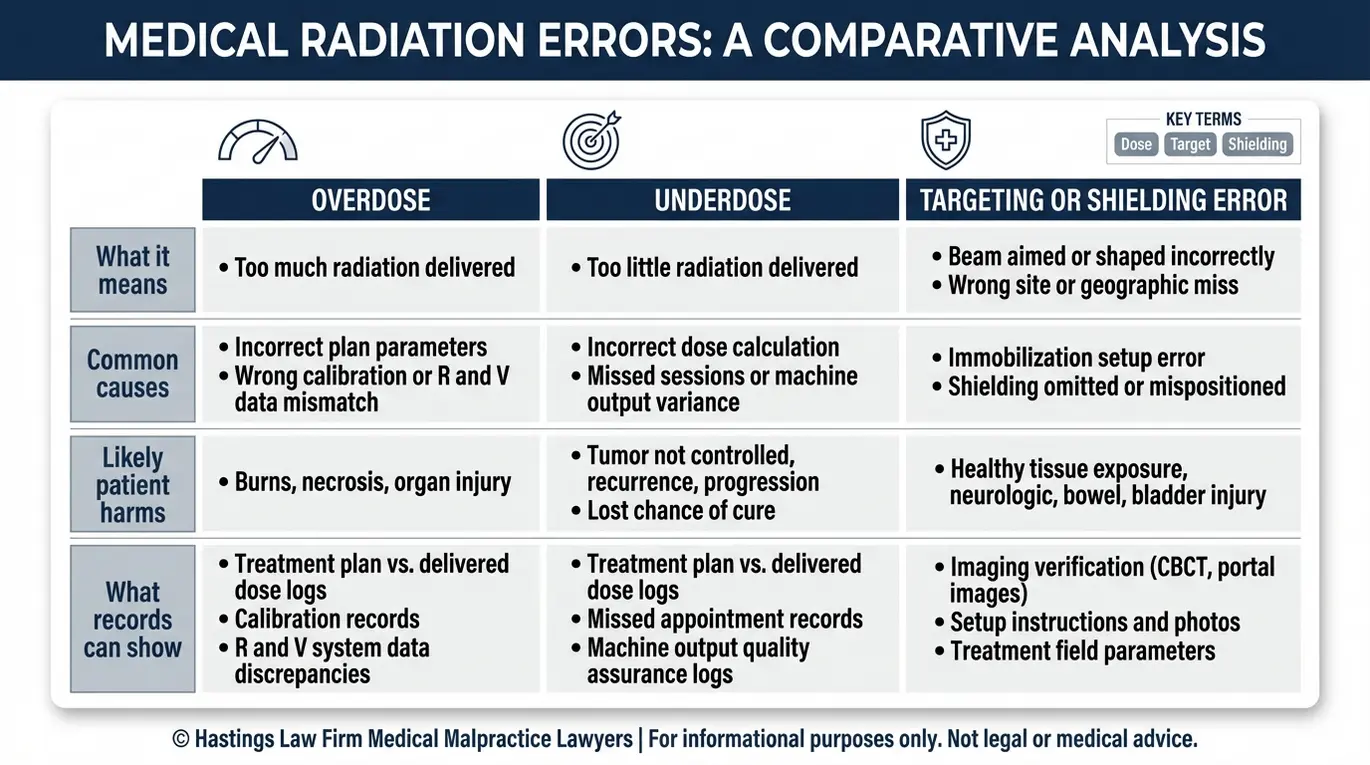
Radiation therapy requires extreme precision. Even small miscalculations in dose or targeting can cause significant harm. Modern clinical standards require rigorous planning to ensure radiation only hits intended targets. Common errors in radiation oncology include:
- Overdose of radiation: Delivering too much radiation, a higher dose than the treatment plan specifies. This can cause radiation burns, tissue death (necrosis), and permanent damage to healthy organs.
- Inadequate dose (underdosing): Delivering too little radiation to effectively destroy the cancer cells. This can allow the tumor to survive and grow, leading to cancer recurrence.
- Shielding errors: Radiation shielding, the protective measures used to block radiation from reaching healthy tissue, must be properly positioned. When shielding is omitted, surrounding organs absorb harmful doses.
- Wrong-site radiation: Directing the beam at the incorrect location. Unlike a diagnostic radiology error, this active treatment mistake destroys healthy tissue while leaving the actual tumor untreated.
- Treatment plan programming errors: Mistakes in how the dose, angle, or number of sessions is entered into the delivery system.
The Radiotherapy Risk Profile published by the WHO in collaboration with the IAEA documents how these types of errors occur in clinical settings around the world.
Failures in Record Verification and System Errors
Modern radiation therapy relies heavily on computerized Record & Verify (R&V) systems, automated platforms designed to confirm that the correct radiation treatment plan is delivered during each session. These systems act as a software-based safety check to ensure the radiation machine follows the specific medical instructions for each patient.
When a software error or data entry mistake exists within the R&V system, it can repeat the same incorrect dose across multiple treatment sessions without detection. According to the Agency for Healthcare Research and Quality’s Radiation Safety primer, human oversight remains essential at every stage of the treatment process.
A radiation treatment plan, the detailed blueprint specifying exact doses and angles, must be independently verified by qualified professionals. When staff rely solely on automated systems without proper manual checks, negligence may be present. A radiation injury lawyer on our team examines treatment logs, physics records, and system data to determine whether verification protocols were followed.
Proving Negligence in Arizona Radiation Therapy Cases
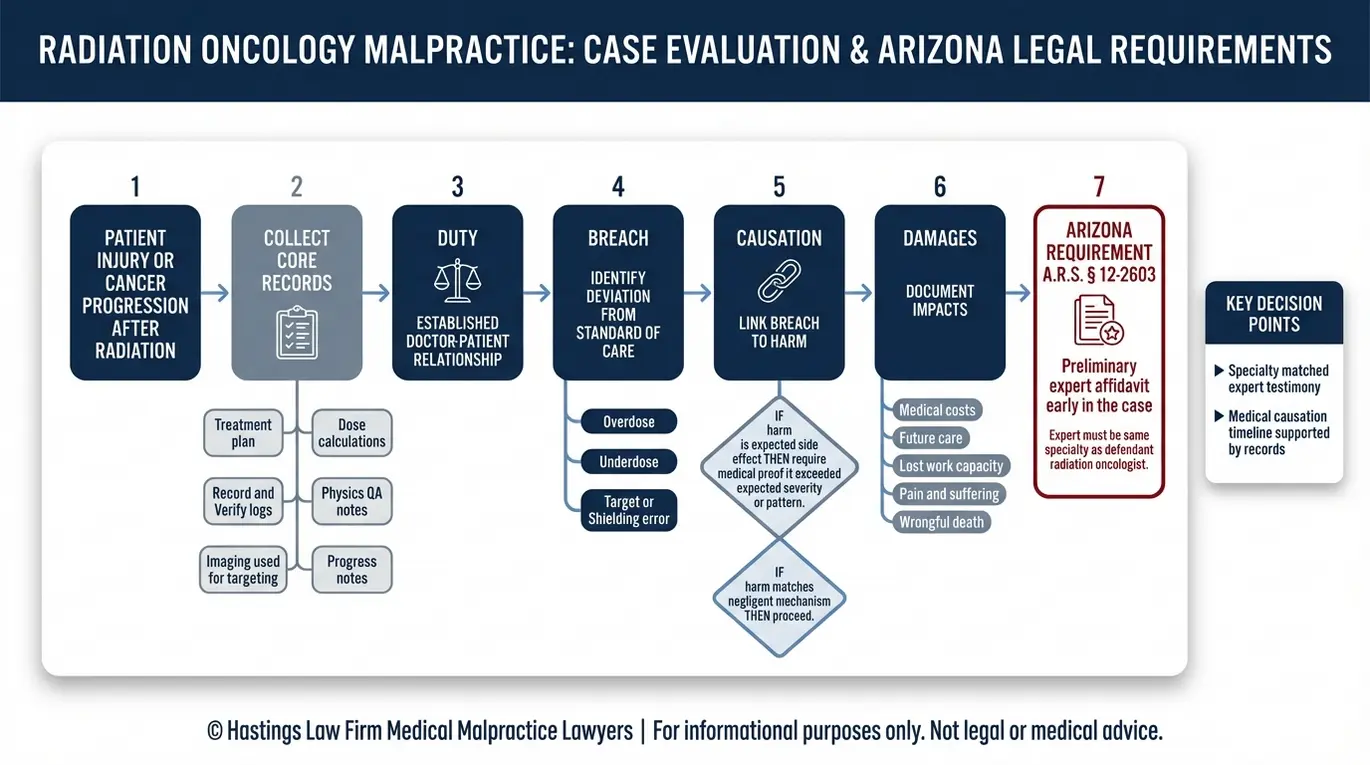
To prove negligence in Arizona, a plaintiff must demonstrate that the radiation oncologist violated the accepted standard of care and that this violation directly caused significant injury or the progression of cancer. The standard of care is the specific legal benchmark used to determine if a specialist’s actions were appropriate under the circumstances. This is the foundation of every radiation malpractice claim.
Arizona medical malpractice cases require proof of four elements:
- Duty: The radiation oncologist had a professional obligation to provide competent care to their patient
- Breach: The oncologist failed to meet the accepted standard of care for radiation treatment
- Causation: The breach directly caused the patient’s injury or delayed treatment consequences
- Damages: The patient suffered measurable harm as a result
One of the greatest challenges in radiation therapy cases is separating expected side effects from injuries caused by negligence. Injuries like severe radiation burns or a geographic miss, where radiation misses the tumor entirely, may point to a breach in the standard of care.
An Arizona radiation malpractice attorney must also satisfy specific expert witness requirements. Under A.R.S. § 12-2603, a plaintiff must serve a preliminary expert opinion affidavit supporting the claim. Additionally, under A.R.S. § 12-2604, the expert who provides standard of care testimony must practice in the same specialty as the defendant. This Arizona requirement mandates that expert testimony in a lawsuit against a radiation oncologist must come from a peer, not simply a general radiologist. These rules, found within Title 12 of the Arizona Revised Statutes, exist to ensure that claims are evaluated by someone with direct, relevant expertise.
At Hastings Law Firm, we work with a national network of qualified medical experts to meet this requirement and build a clear, evidence-based case.
The Hastings Law Firm Difference
Results matter, but what truly sets us apart is how we achieve them. Every verdict, every settlement, and every Arizona courtroom victory comes from one guiding promise: To treat each client’s fight for justice as if it were our own.
This balance of skill, experience, and empathy reflects our core philosophy that justice should not only compensate the injured, but also make health care safer nationwide.

Compensation for Radiation Injuries and Cancer Mismanagement
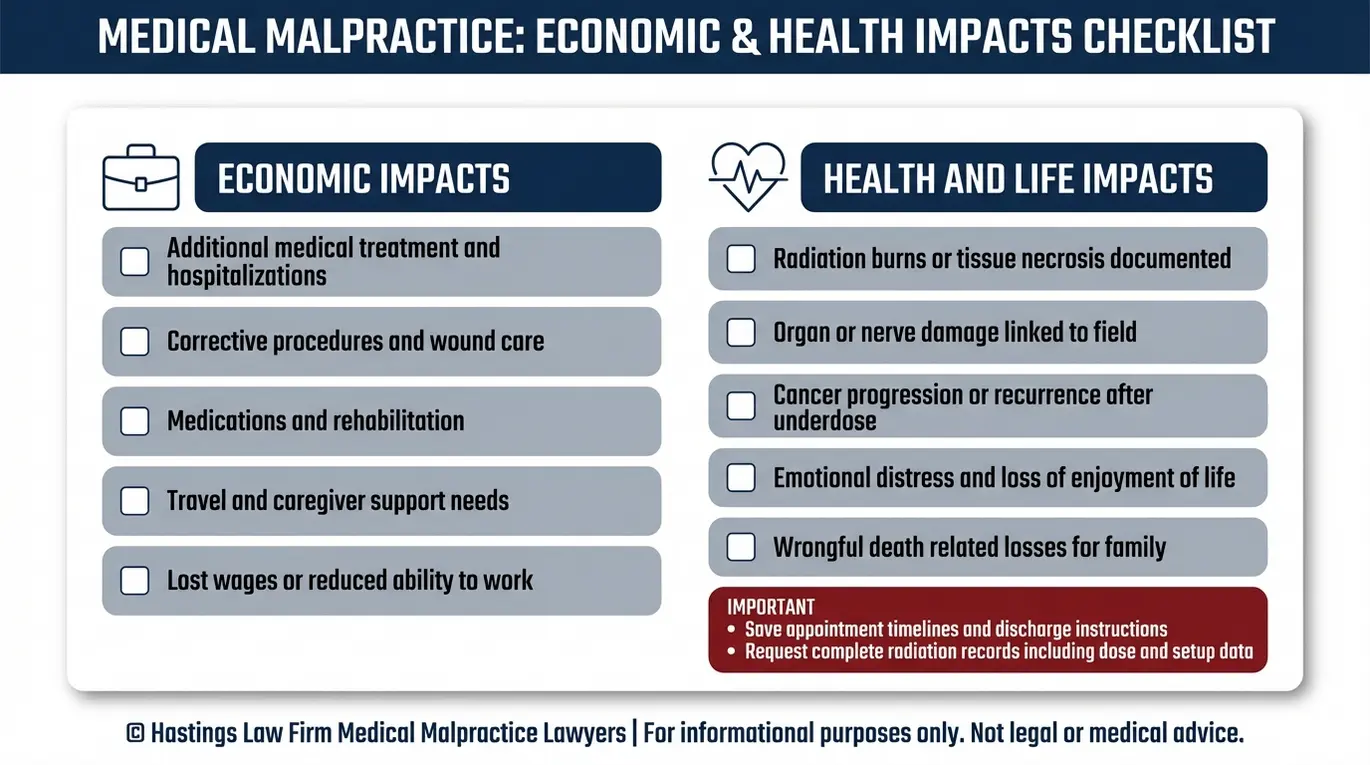
Patients harmed by radiation malpractice can recover economic damages for medical bills and lost wages, as well as non-economic damages for pain, suffering, and the lost chance of survival. Economic damages cover verifiable financial losses, while non-economic damages address the human impact of the injury.
Economic damages often include the cost of corrective procedures like skin grafts for burns or treatment for radiation necrosis. They also cover the management of radiation fibrosis, which causes permanent scarring and stiffening of treated tissue. Lost wages and lost earning potential are also recoverable when the injury affects a patient’s ability to work.
Non-economic damages address the emotional and physical toll. This includes pain, suffering, and the psychological trauma of a delayed diagnosis or learning that a cancer recurrence could have been prevented if the radiation dose had been administered correctly.
When a radiation error leads to a fatal outcome, families may pursue a wrongful death claim to recover funeral costs and loss of companionship. A radiation malpractice lawyer in Phoenix can evaluate which categories of compensation apply to your specific situation.
Contact the Arizona Doctor Malpractice Attorneys at Hastings Law Firm Today for Help
Radiation injuries involve complex medical evidence that most law firms are not equipped to handle. Hastings Law Firm brings together medical professionals, former defense attorneys, and board-certified trial lawyers who focus entirely on medical malpractice. We understand the technology, the treatment protocols, and the Arizona laws that apply to these claims.
If you or a loved one suffered harm from a radiation therapy error, we are here to help you find answers. Our team will review your medical records, consult with qualified radiation oncology experts, and determine whether negligence contributed to your injury.
There is no cost to get started. We work on a contingency fee basis, which means you pay no attorney fees unless we recover compensation on your behalf.
Call our Arizona radiation oncologist malpractice lawyer today for a free, confidential case evaluation.
Frequently Asked Questions About Radiation Oncologist Malpractice in Arizona


This content was researched and written by the Hastings Law Firm editorial team, which includes attorneys, medical professionals, and experienced researchers. Our writing is informed by internal knowledge and practical experience, and we cross-check critical details against authoritative sources cited throughout. Every piece undergoes human-led fact-checking and legal review. Because legal and medical information can change, if you spot an error, please contact us. Learn more about our content standards and review process on our editorial policy page.

Tommy Hastings, founder of Hastings Law Firm, is a board-certified personal injury trial lawyer dedicated exclusively to healthcare injury cases. Since 2001, he has represented injured patients and families in litigation against major hospital systems, pharmaceutical companies, and negligent healthcare providers nationwide. He has handled numerous high-profile cases that have drawn national media attention and resulted in multi-million dollar recoveries. He draws on that experience in his writing, helping readers understand how these cases work and what options may be available to them.
