


Arizona Pulmonary Embolism Malpractice Lawyer
Written by: Hastings Law Firm | Reviewed by: Tommy Hastings | Updated: July 27, 2026
A missed pulmonary embolism can escalate quickly and lead to life threatening complications, permanent injury, or worse. These cases often involve warning signs that were documented but not acted on, risk factors that were not weighed appropriately, or diagnostic testing that was delayed or omitted. Understanding how pulmonary embolism is evaluated in emergency and hospital settings can clarify when a breakdown in care may have occurred and why timely treatment matters. If you or a loved one were harmed or worse due to a failure to diagnose pulmonary embolism in Arizona, contact Hastings Law Firm for a free, confidential case review.

Experienced Arizona Medical Attorneys for Failure to Diagnose Pulmonary Embolism Claims
What You Should Know About Failure to Diagnose Pulmonary Embolism Claims in Arizona:
- Outcomes can be catastrophic when pulmonary embolism warning signs are missed because delays can lead to hypoxia, cardiac arrest, or death.
- Accountability can depend on whether symptoms and risk factors were documented but not acted on in emergency or hospital records.
- Recovery options can be affected when a pulmonary embolism is misdiagnosed as another condition because treatment may be delayed.
- Liability can change based on whether the clinician was a hospital employee or an independent contractor.
- A claim can turn on whether appropriate diagnostic testing was ordered when pulmonary embolism was suspected, such as D dimer testing or CT pulmonary angiography.
- Long term financial impact can be substantial when a missed pulmonary embolism causes lasting impairment because damages may include medical expenses and lost earning capacity.
- Family losses can be recognized in wrongful death situations because Arizona allows additional categories of compensation.
- Evidence can hinge on early access to medical records because documentation of symptoms, testing decisions, and discharge choices may be central.

A Healthcare Focused Law Firm
A missed pulmonary embolism can change everything in a matter of hours. If you or someone you love suffered serious harm, or worse, because a doctor failed to recognize the warning signs of a blood clot, you are not alone in wondering whether something should have been done differently.
That instinct deserves to be taken seriously. Pulmonary embolism is one of the most commonly missed diagnoses in emergency medicine, and the consequences of that delay can be devastating. At Hastings Law Firm, our team of attorneys, nurse consultants, and medical experts focuses exclusively on medical malpractice claims. We understand both the medicine and the law behind these cases.
If you need an Arizona pulmonary embolism malpractice lawyer, we are here to listen. Contact us for a free, confidential case evaluation so we can review what happened and explain your options.
What is a Pulmonary Embolism and How Does it Occur?
A pulmonary embolism, a life-threatening blockage in a lung artery, is usually caused by a blood clot—specifically deep vein thrombosis (DVT)—traveling from the leg to the lungs. Medical negligence often occurs when providers ignore the physiological process that leads to a lung blockage. In the majority of cases, this clot starts in the deep veins of the legs or pelvis before migrating through the venous system.
According to the Centers for Disease Control and Prevention (CDC), venous thromboembolism, which includes both DVT and pulmonary embolism, affects hundreds of thousands of Americans each year. The mechanism follows a specific and dangerous path:
- A blood clot forms in a deep vein, often in the leg
- The clot breaks free and travels through the bloodstream toward the lungs
- It lodges in a pulmonary artery, partially or completely blocking blood flow
- The blockage prevents proper oxygen exchange, leading to hypoxia, a dangerous drop in blood oxygen levels
When blood flow to the lungs is cut off, the heart is forced to work harder against the obstruction. Depending on the size and location of the clot, the result can range from lung tissue damage to complete cardiovascular collapse. A large or “saddle” PE that blocks both main pulmonary arteries can cause sudden cardiac arrest and death within minutes, highlighting the urgent need for rapid diagnosis and intervention.

Recognizing the Signs and Symptoms of Pulmonary Embolism
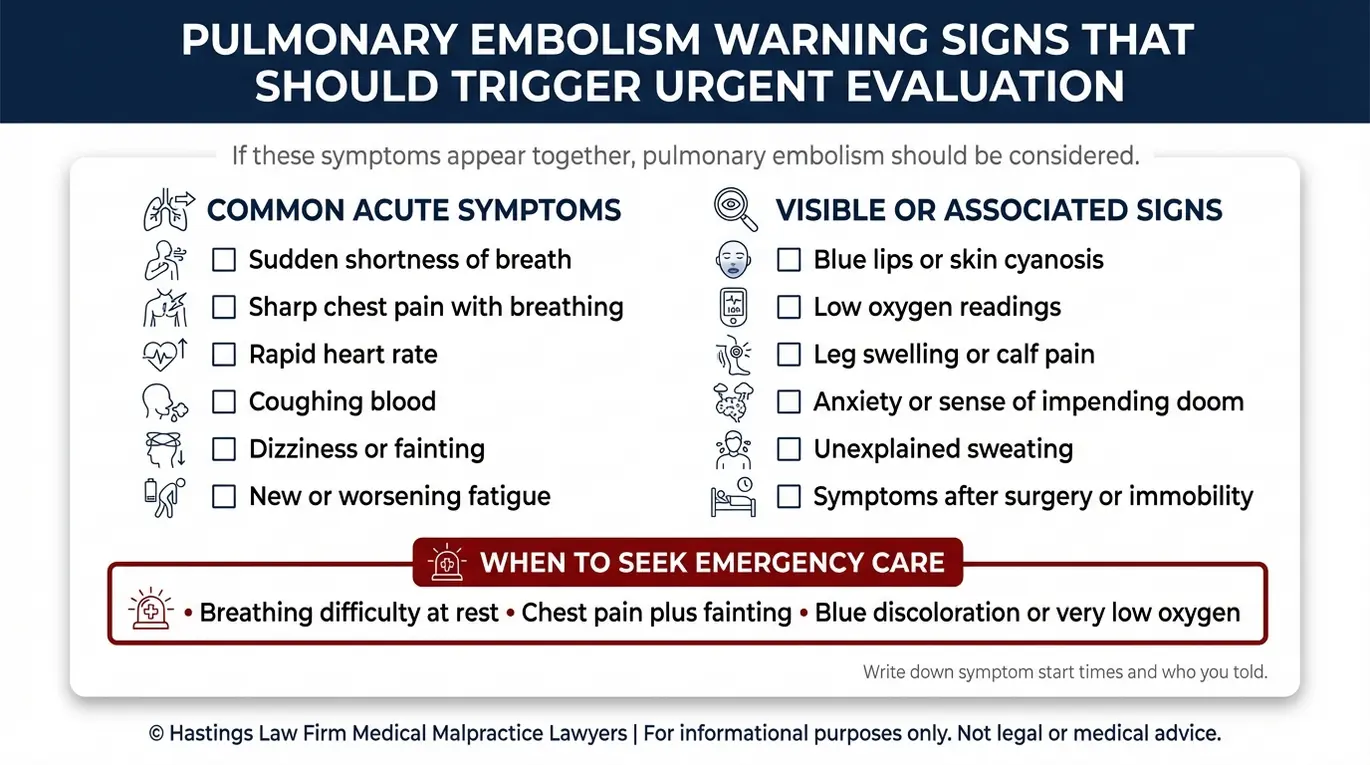
Common symptoms include sudden shortness of breath, sharp chest pain that worsens with breathing, rapid heart rate, and coughing up blood; however, subtle signs like anxiety or a sense of dread are often overlooked by clinicians. Proper clinical evaluation requires physicians to interpret symptoms as indicators of a potential cardiovascular emergency. According to UC San Diego Health, the symptoms of DVT and pulmonary embolism can develop quickly and require immediate medical attention to prevent fatal complications.
A pulmonary embolism malpractice lawyer often sees cases where the following signs were documented but not acted upon:
- Sudden shortness of breath (dyspnea), even at rest
- Sharp, stabbing chest pain that gets worse when breathing deeply or coughing
- Rapid or irregular heartbeat (palpitations)
- Hemoptysis, coughing up blood or blood-tinged mucus
- Cyanosis, a bluish discoloration of the lips, fingertips, or skin caused by low oxygen
- Leg swelling, warmth, or tenderness, which can indicate an underlying DVT
- Lightheadedness, dizziness, or fainting
- Unexplained anxiety or a feeling of impending doom
These physical manifestations provide the roadmap for diagnosis, yet they are frequently missed in busy emergency departments. Under Article 2, Section 31 of the Arizona Constitution, individuals who suffer personal injuries due to the actions or omissions of others retain the right to pursue a claim for damages. This ensures that patients harmed by medical negligence have a legal pathway to accountability. When a physician fails to connect these symptoms, particularly visible cues like cyanosis or reported chest pain, to a potential pulmonary embolism, the consequences can be severe.
Psychological Indicators as a Warning Sign
One symptom that deserves special attention is an intense, unexplained feeling of dread or severe anxiety. This is a clinically recognized symptom of pulmonary embolism, not a psychological condition. It occurs because the body is sensing a sudden drop in oxygen and mounting cardiovascular stress.
Clinicians who are not considering a pulmonary embolism in their differential diagnosis may attribute these psychological symptoms to a panic attack or generalized anxiety. That misdiagnosis can cost the patient critical time. When the medical record shows a patient reported feeling that “something is terribly wrong” and the physician documented it as anxiety without ordering further testing, that gap can become important evidence.
The Hastings Law Firm Difference
Results matter, but what truly sets us apart is how we achieve them. Every verdict, every settlement, and every Arizona courtroom victory comes from one guiding promise: To treat each client’s fight for justice as if it were our own.
This balance of skill, experience, and empathy reflects our core philosophy that justice should not only compensate the injured, but also make healthcare safer nationwide.

Risk Factors for Pulmonary Embolism and DVT
High-risk patients include those with recent surgeries, prolonged immobility, cancer history, or those on hormone replacement therapy; failure to monitor these patients for clots constitutes a breach of the standard of care. Clinicians must assess patient history to prevent life-threatening clotting events. Research published in PubMed Central on venous thromboembolism rates after total hip and knee arthroplasty confirms that orthopedic surgical patients face a significantly elevated risk of developing DVT and PE. Hospitals and physicians are expected to identify at-risk patients and take immediate post-operative prevention measures.
The following table outlines common risk factors and the prevention measures that may be required:
| Risk Category | Examples | Typical Prevention Measures |
|---|---|---|
| Surgical | Hip replacement, knee replacement, abdominal surgery | Anticoagulants (blood thinners) before and after surgery; early mobilization |
| Immobility | Extended hospital stays, bed rest, paralysis | Sequential compression devices (SCDs) placed on the legs to promote circulation |
| Medical History | Prior DVT/PE, cancer, heart failure, clotting disorders | Ongoing anticoagulant therapy; regular monitoring |
| Hormonal | Oral contraceptives, hormone replacement therapy, pregnancy | Risk assessment before prescribing; heightened clinical awareness |
| Other | Obesity, smoking, advanced age, long-distance travel | Patient education; clinical screening protocols |
The medical standard calls for both pharmacological prevention, primarily anticoagulants, or blood thinners that reduce the blood’s ability to form clots, and mechanical prevention. This often involves sequential compression devices (SCDs), which are inflatable cuffs worn on the lower legs to keep blood circulating.
When a hospital or physician fails to order these preventive measures for a known high-risk patient, and a pulmonary embolism results, we examine the medical records to determine whether that failure fell below the accepted standard of care.
Failure to Diagnose and Misdiagnosis of Pulmonary Embolism
Medical malpractice occurs when a physician fails to include PE in the differential diagnosis despite clear risk factors and symptoms, often misdiagnosing the condition as a heart attack, pneumonia, or anxiety. The condition is commonly mislabeled, and each misdiagnosis delays treatment that may have prevented serious harm or death.
The concept of differential diagnosis is central to these claims. When a patient presents with symptoms that could indicate several conditions, the accepted medical practice requires the physician to consider and systematically rule out the most dangerous possibilities first. A pulmonary embolism, which can be rapidly fatal, should be among the first conditions evaluated. A failure to diagnose this condition typically stems from bypassing this critical safety step.
A study published in PubMed Central on delayed venous thromboembolism diagnosis and mortality risk found that diagnostic delays are associated with significantly higher rates of death. This research reinforces what our medical team sees repeatedly. When the window to administer anticoagulants or clot-dissolving medications closes, the patient may suffer permanent lung damage, brain injury from hypoxia, which involves dangerously low oxygen levels to the brain, or even death.
One of the screening tools physicians can use early is the D-dimer, a blood test that measures a protein fragment produced when a blood clot dissolves. An elevated D-dimer does not confirm a pulmonary embolism on its own, but it can prompt further imaging. When a physician does not even order this basic test in a symptomatic patient, we examine whether that omission constituted a breach of duty.
As an Arizona pulmonary embolism malpractice lawyer, our team also investigates the common misdiagnoses that lead to delayed treatment. Labeling chest pain as musculoskeletal, attributing shortness of breath to anxiety, or treating a patient for pneumonia without ruling out a clot first are patterns we look for when establishing negligence. We analyze whether the medical provider adhered to protocols or dismissed signs that demanded investigation.
Liability Distinctions in Arizona Hospitals
Determining who is legally responsible for a missed pulmonary embolism depends on the employment relationship between the provider and the hospital. If the physician who failed to diagnose the condition is a hospital employee, the hospital itself may be held liable for that doctor’s negligence. This is known as vicarious liability.
However, many emergency room physicians and specialists work as independent contractors with hospital privileges rather than as direct employees. In these situations, the hospital may argue it is not responsible for the doctor’s actions. We examine employment agreements, contracts, and how the physician was presented to the patient to determine the full scope of liability and identify instances of hospital negligence.
Standard of Care and Diagnostic Testing for Pulmonary Embolism
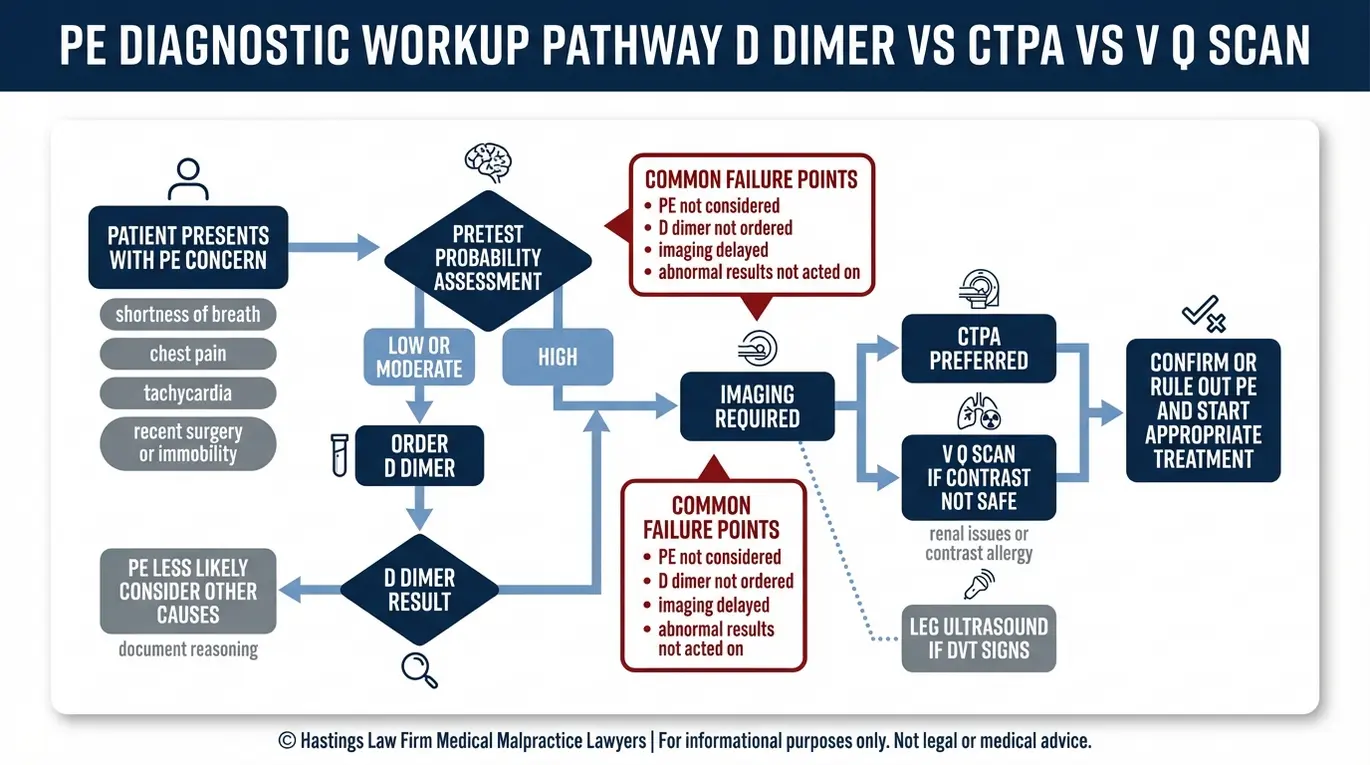
The standard of care requires physicians to order specific diagnostic tests when PE is suspected, including D-dimer blood tests and CT Pulmonary Angiograms (CTPA), to confirm or rule out the presence of a clot. Following the proper diagnostic steps is essential for patient safety. Failing to order these tests in a symptomatic patient with known risk factors can form the basis of a malpractice claim.
The diagnostic process typically follows a structured pathway. The table below outlines the primary tests used and their role in diagnosing PE:
| Test | What It Does | When It Is Used |
|---|---|---|
| D-dimer blood test | Detects a protein released when blood clots break down; a negative result can help rule out PE | Initial screening in low-to-moderate risk patients |
| CT Pulmonary Angiogram (CTPA) | Uses contrast dye and CT imaging to directly visualize clots in the pulmonary arteries; considered the gold standard for diagnosing PE | When D-dimer is elevated or clinical suspicion is moderate to high |
| Ventilation-Perfusion (V/Q) scan | Compares airflow and blood flow in the lungs to detect blockages | Used when patients cannot receive contrast dye, such as those with kidney problems or dye allergies |
| Doppler ultrasound | Uses sound waves to detect blood clots in the deep veins of the legs | To confirm DVT as the likely source of a pulmonary embolism |
A CT pulmonary angiogram (CTPA), a specialized imaging scan that injects contrast dye into the bloodstream, takes rapid cross-sectional images of the lung arteries to reveal the exact location and size of a clot. For patients unable to tolerate contrast dye, physicians may use a ventilation-perfusion (V/Q) scan. This is an alternative that uses small amounts of radioactive material to compare how air and blood are moving through the lungs.
When we review a pulmonary embolism case, we look at whether the physician followed this diagnostic pathway or deviated from it. If a symptomatic, high-risk patient was sent home without pulmonary angiography or if an elevated D-dimer was ignored, those gaps in the medical record become central to establishing negligence. Today, the failure to use available advanced imaging to rule out a potential killer is often indefensible.
Recoverable Damages in Arizona Pulmonary Embolism Cases
Victims of PE malpractice in Arizona may recover economic damages for medical bills and lost wages, as well as non-economic damages for pain, suffering, and loss of consortium in wrongful death claims. Seeking compensation is an important step in securing the long-term medical care a patient may need. When a family has lost someone, wrongful death claims allow for additional categories of compensation. A pulmonary embolism malpractice lawyer in Arizona can help you understand the full scope of what you may recover.
Economic damages cover the measurable financial losses caused by the malpractice:
- Past and future medical expenses, including hospitalizations, surgeries, medications, and rehabilitation
- Lost wages and lost earning capacity, which is especially significant for survivors living with permanent lung damage or reduced cardiovascular function
- Cost of ongoing care, such as oxygen therapy, cardiac monitoring, or home health assistance
To accurately calculate these future costs, we often consult with a life care planner who maps out the long-term medical and daily living needs of the patient. Calculating the lifetime cost of an injury like severe hypoxia-induced brain damage requires detailed analysis. A life care planner helps us project expenses decades into the future, ensuring settlements account for inflation and rising healthcare costs.
Non-economic damages address the personal toll of the injury:
- Physical pain and suffering
- Mental anguish and emotional distress
- Loss of enjoyment of life
- Loss of consortium, which compensates a spouse or family for the loss of companionship and support
In wrongful death cases, surviving family members may recover compensation for funeral and burial costs, loss of the deceased’s financial support, and the loss of love, guidance, and companionship. Arizona law protects the right of families to seek these damages when a death results from medical negligence.
How Our Medical Malpractice Lawyers Can Help
We investigate claims by securing medical records, consulting with independent experts, and building a trial-ready case to prove that the failure to treat the embolism was a direct result of medical negligence. Establishing negligence in a pulmonary embolism case requires a combination of legal skill and clinical expertise. Our team includes in-house nurse consultants and board-certified patient advocates who review charts, lab results, imaging records, and nursing notes to identify where the standard of care was breached.
We also work with former defense attorneys who understand how hospitals and their insurers respond to these claims. That perspective helps us anticipate the arguments on the other side and prepare our evidence accordingly. Founded by Tommy Hastings, a board-certified trial lawyer and member of the American Board of Trial Advocates, our firm handles every case with a trial-ready strategy.
As an Arizona pulmonary embolism malpractice lawyer, our firm also carries the full burden of proof. We retain qualified expert witnesses who can testify about the specific medical failures in your case and establish causation, which is the link between the missed diagnosis and the resulting harm. Managing the legal system while recovering from a tragedy is overwhelming. We handle every legal detail so you can focus on healing.
You pay nothing unless we recover compensation for you. Our firm works on a contingency fee basis, which means there are no upfront costs and no attorney fees unless your case is successful.
Contact the Arizona Healthcare Malpractice Attorneys at Hastings Law Firm Today for Help
Time matters in Arizona medical malpractice cases. Strict filing deadlines apply, and medical records are easier to secure and analyze when the process begins early. Our team handles every aspect of the investigation so you can focus on your recovery. If you believe a doctor or hospital failed to diagnose a pulmonary embolism that caused serious injury or death, we encourage you to reach out now.
Hastings Law Firm focuses exclusively on medical malpractice. Our attorneys, medical staff, and consulting experts have the experience and resources to take on complex pulmonary embolism cases against hospitals and healthcare systems of any size.
Your consultation is free, and everything you share with us is confidential. As your Arizona pulmonary embolism malpractice lawyer, we will review your records, explain whether you have a viable claim, and walk you through every step of the process. There is no fee unless we win. Contact us today to get the answers you deserve.
Frequently Asked Questions About Pulmonary Embolism Malpractice in Arizona


This content was researched and written by the Hastings Law Firm editorial team, which includes attorneys, medical professionals, and experienced researchers. Our writing is informed by internal knowledge and practical experience, and we cross-check critical details against authoritative sources cited throughout. Every piece undergoes human-led fact-checking and legal review. Because legal and medical information can change, if you spot an error, please contact us. Learn more about our content standards and review process on our editorial policy page.

Tommy Hastings, founder of Hastings Law Firm, is a board-certified personal injury trial lawyer dedicated exclusively to healthcare injury cases. Since 2001, he has represented injured patients and families in litigation against major hospital systems, pharmaceutical companies, and negligent healthcare providers nationwide. He has handled numerous high-profile cases that have drawn national media attention and resulted in multi-million dollar recoveries. He draws on that experience in his writing, helping readers understand how these cases work and what options may be available to them.
