


Arizona Psychologist & Psychiatrist Malpractice Lawyer
Written by: Hastings Law Firm | Reviewed by: Tommy Hastings | Updated: May 6, 2026
Mental health care should provide safety, trust, and competent treatment, but negligence by a psychiatrist, psychologist, or therapist can leave lasting harm. The topic includes medication mismanagement, missed suicide risk, boundary violations, and confidentiality breaches, along with the challenge of proving psychological injuries that are not visible on imaging. Arizona law also recognizes that not every poor outcome is malpractice, and liability often turns on whether accepted standards were followed and whether the harm was foreseeable. If you or a loved one were harmed or worse due to psychologist and psychiatrist malpractice in Arizona, contact Hastings Law Firm for a free, confidential case review.

Trusted Legal Advocacy for Victims of Mental Health Negligence
What You Should Know About Mental Health Provider Negligence Claims in Arizona:
- Lasting psychological harm can follow when a mental health professional violates trust through negligence or exploitation.
- Accountability can be disputed when a provider argues a poor outcome was unavoidable rather than the result of substandard decision making.
- Severe outcomes can occur when suicide risk is not properly assessed or clear warning signs are ignored.
- Serious injury can result from medication errors when prescribing and monitoring are not handled carefully.
- Ongoing symptoms can worsen when psychiatric diagnoses are made without ruling out underlying physiological causes.
- Future care can be affected when stigmatizing labels are applied without a proper evaluation.
- Options for recovery can be lost if Arizona time limits and special public entity requirements are missed.
- Claims against state run mental health facilities can be more complex due to sovereign immunity rules.
- Proving a claim can depend on qualified expert support to connect a breach of the standard of care to the harm.
- Medical records can be central to showing what was assessed, what warnings were present, and what actions were taken.

A Healthcare Focused Law Firm
When a mental health professional causes harm instead of healing, the betrayal can feel deeply personal. You sought help during one of the most vulnerable times in your life, and the care you received made things worse. That experience can leave you questioning everything, including whether you have the right to hold your provider accountable.
You do.
Founded in 2005 by board-certified trial attorney Tommy Hastings, our firm represents patients and families across Arizona harmed by medical negligence. As an Arizona psychologist and psychiatrist malpractice lawyer, our team includes former defense attorneys and nurses who previously worked for hospital systems to investigate what happened and build a trial-ready case.
If you believe a mental health provider’s negligence caused harm to you or someone you love, we can review your situation and explain your options in a free, confidential consultation.
Defining Psychiatric and Psychological Malpractice in Arizona
Psychiatric malpractice occurs when a mental health professional deviates from the accepted standard of care, resulting in harm, injury, or death to a patient. This standard refers to the level of treatment that a reasonably competent mental health provider, with similar training and in similar circumstances, would deliver. When that standard is breached and a patient suffers because of it, the provider may be legally liable. The link between the breach and the injury is proximate cause.
Not every bad outcome qualifies as negligence. Mental health treatment involves uncertainty, and not every medication works for every patient. The distinction lies in how the provider made their decisions.
If a psychiatrist prescribed a drug without reviewing your medical history, that is a breach of duty. This differs from a medication simply not producing the desired result. Negligence focuses on whether the provider ignored accepted protocols or failed to act as a competent peer would have.
This distinction matters even more in psychiatric care because of the unique vulnerability of patients. People seeking mental health treatment often depend heavily on their provider’s judgment. They may not be in a position to question recommendations or recognize when boundaries are being crossed.
Therapeutic boundary violations are actions by a provider that exploit the trust inherent in the treatment relationship. These acts, along with the unauthorized sharing of protected health information, are serious failures that a qualified mental health malpractice attorney can investigate. Because of this power dynamic, mental health providers carry a heightened responsibility. Arizona law recognizes that duty, and a psychiatric malpractice lawyer at our firm holds providers to it.
Common Errors Committed by Mental Health Professionals
Common forms of mental health negligence include failure to diagnose suicidal intent, improper medication management, sexual misconduct, and breaches of doctor-patient confidentiality. These failures often stem from systemic problems in how psychiatric care is delivered today.
Rushed Medication Management
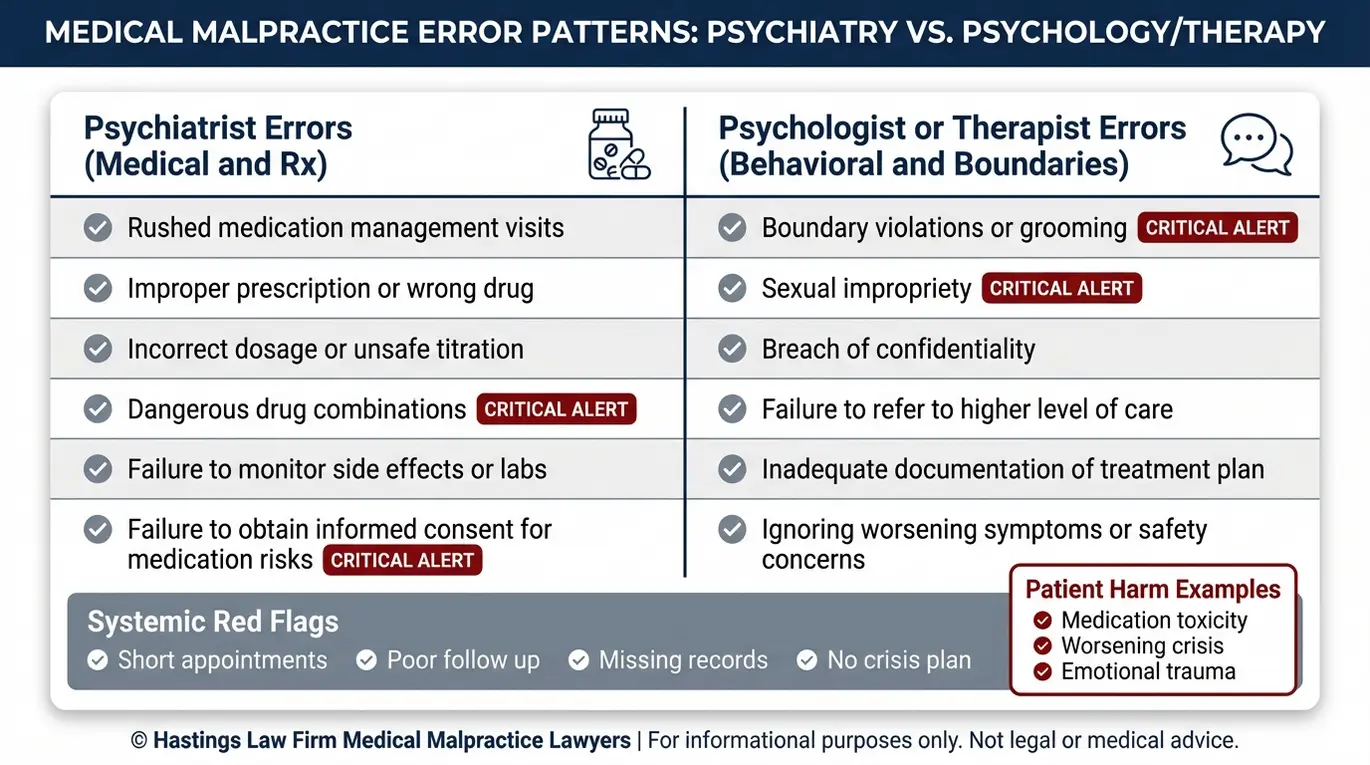
One of the most widespread issues in modern psychiatry is the rise of rushed brief medication-management visits. Commonly called a “med check,” this brief appointment (often 15 minutes or less) is focused solely on adjusting prescriptions. When a psychiatrist relies on these short visits as the primary point of contact, critical changes in a patient’s condition can go unnoticed. A patient presenting with new symptoms may be given a dosage adjustment without a thorough diagnostic reassessment, leading to misdiagnosis.
Medication Errors
Psychotropic medications require careful prescribing and ongoing monitoring. Errors include prescribing the wrong dosage, failing to screen for dangerous drug interactions, or neglecting to monitor for toxicity. Lithium, for example, is a commonly prescribed mood stabilizer that requires strict oversight. Lithium toxicity, a dangerous buildup of the drug in the bloodstream, can cause kidney damage, seizures, and death if levels are not regularly checked. The University of Washington’s Lithium Monitoring Guidelines outline the blood work required to prescribe this drug safely.
Therapist Abuse and Boundary Violations
Some of the most harmful forms of malpractice by a psychologist or therapist involve sexual impropriety and grooming disguised as treatment. These providers exploit the trust and emotional dependence that naturally develops in the therapeutic relationship. Arizona law treats these acts as a profound breach of duty, and suing a psychiatrist or therapist in Arizona for this conduct is both a legal right and a path toward accountability.
The types of errors differ depending on the provider’s role and training:
| Category | Psychiatrist Errors (Medical/Rx Focus) | Psychologist/Therapist Errors (Behavioral/Boundary Focus) |
|---|---|---|
| Prescribing | Wrong medication, dangerous combinations, failure to monitor drug levels | N/A (psychologists cannot prescribe in Arizona) |
| Diagnosis | Misdiagnosis due to rushed med checks, failure to rule out medical causes | Misapplication of diagnostic labels, failure to use validated assessment tools |
| Patient Safety | Failure to assess suicide risk, premature discharge | Failure to refer a high-risk patient for psychiatric evaluation or hospitalization |
| Boundary Violations | Dual relationships, exploitation of vulnerable patients | Sexual misconduct, grooming, inappropriate self-disclosure |
| Confidentiality | Unauthorized disclosure of records | Sharing session content without consent |
An experienced Arizona mental health lawyer can identify which standards were violated and by whom, whether liability falls on an individual provider, a supervising physician, or the facility itself.
The Hastings Law Firm Difference
Results matter, but what truly sets us apart is how we achieve them. Every verdict, every settlement, and every Arizona courtroom victory comes from one guiding promise: To treat each client’s fight for justice as if it were our own.
This balance of skill, experience, and empathy reflects our core philosophy that justice should not only compensate the injured, but also make healthcare safer nationwide.

Liability for Preventable Suicide and Self-Harm
Mental health providers may be liable for a patient’s suicide if they failed to perform a proper suicide risk assessment or ignored clear warning signs that required intervention, including hospitalization. A suicide risk assessment is a structured clinical evaluation used to determine whether a patient is experiencing suicidal thoughts. This assessment examines whether the patient has a plan and how likely they are to act on it.
Validated tools like the Columbia-Suicide Severity Rating Scale (C-SSRS), endorsed by the Centers for Medicare & Medicaid Services, provide a standardized framework for this screening. When providers skip or superficially complete these assessments, they may miss the very signals designed to trigger action. A provider’s failure to protect a patient from foreseeable harm is a critical failure.
Liability in these cases often centers on specific, identifiable failures. Red flags that providers are trained to recognize and act on include:
- A patient expressing suicidal ideation, a specific plan, or access to means
- A recent suicide attempt or history of self-harm
- Sudden withdrawal from treatment or abrupt behavioral changes
- A worsening condition following a change in medication
- Family members or third parties communicating concern directly to the provider
- Premature discharge resulting in inpatient suicide or harm shortly after release
An Arizona psychologist and psychiatrist malpractice lawyer examines the clinical record to determine whether the provider assessed these risk factors and what action they took.
In wrongful death psychiatrist claims, defense attorneys frequently attempt to shift blame to the patient or their family. They may argue the death was unforeseeable. Our team at Hastings Law Firm counters these strategies by building a detailed timeline from the medical records. When the evidence shows a provider failed to follow accepted standards, we present a strong suicide malpractice claim with the clarity and force a jury needs to see the truth.
The Impact of Psychiatric Misdiagnosis and Failure to Treat
Misdiagnosis in mental health can lead to worsening conditions, unnecessary exposure to harmful psychotropic drugs, or the failure to treat an underlying physiological cause of symptoms. This involves assigning an incorrect clinical label to a patient’s symptoms or failing to identify a hidden medical cause.
One of the most dangerous diagnostic errors occurs when a medical condition mimics psychiatric symptoms. Thyroid disorders, brain tumors, autoimmune diseases, and infections can all produce anxiety, depression, psychosis, or mood instability. These are sometimes called medical mimics of psychiatric symptoms.
When a provider assigns a psychiatric diagnosis without first ruling out physiological causes, the real condition goes untreated. Meanwhile, the patient may suffer mistreatment through the improper prescription of medications that offer no benefit and carry significant risk. This type of iatrogenic harm, meaning injury caused by the treatment itself, is a recognized basis for a psychiatric misdiagnosis lawyer to build a claim.
Misdiagnosis also causes harm when providers apply stigmatizing labels without proper evaluation. Stigmatizing labels refer to clinical diagnoses that can negatively impact how a patient is treated by future healthcare providers. Research published by PubMed Central on diagnosing borderline personality disorder highlights how this diagnosis is frequently assigned based on incomplete assessments.
A patient incorrectly labeled may be denied appropriate care, dismissed as “difficult,” or suffer deep psychological damage. A psychiatrist malpractice attorney investigates whether the diagnostic process met accepted clinical standards. There is also a broader dimension to mental health negligence in Arizona. When a misdiagnosed or untreated patient poses a danger to others, the question of third-party liability can arise.
The Arizona Supreme Court addressed the scope of a provider’s duty to third parties in CV-22-0288-PR, examining the circumstances under which a mental health professional’s failure to warn or protect may create legal liability.
Proving Negligence with Our Trial-Ready Approach
Proving a mental health malpractice claim requires expert testimony to establish that the provider’s actions fell below the standard of care and directly caused the patient’s injury or financial loss. This process involves comparing the professional care you received to the protocols followed by other competent doctors. At Hastings Law Firm, we prepare every case from day one as though it will go before a jury.
Every psychiatric negligence case rests on four legal elements:
- Duty: The provider had a professional obligation to deliver care meeting accepted standards.
- Breach: The provider’s conduct fell below that standard.
- Causation: The breach directly caused or contributed to the patient’s harm.
- Damages: The patient suffered measurable harm. This includes economic damages like lost wages and noneconomic damages for suffering.
The challenge unique to mental health cases is proving what are often called “invisible” injuries. Unlike a surgical error that shows up on imaging, psychological damage from malpractice, such as worsened depression or trauma, does not leave visible scars.
Presenting these injuries persuasively to a jury requires a deliberate strategy from a mental health injury attorney. Our team works with qualified psychiatric and psychological experts who can document the progression of harm and explain exactly how the negligence changed the trajectory of someone’s life.
Our in-house nurses and board-certified patient advocates review every record before an outside expert is ever retained. This internal screening process allows us to succeed in proving psychiatric negligence by identifying breaches early. As an Arizona psychologist and psychiatrist malpractice lawyer, we understand that credible expert testimony is the foundation of these cases.
Contact the Arizona Doctor Malpractice Attorneys at Hastings Law Firm Today for Help
Every patient who seeks mental health care deserves a safe environment built on trust, competence, and professional integrity. When a provider violates that trust through negligence, you have the right to seek answers and accountability.
Hastings Law Firm is here to help you take that step. Our team of attorneys, medical professionals, and psychiatric experts will review your records, identify what went wrong, and build a case designed to hold the responsible parties accountable. As an Arizona psychologist and psychiatrist malpractice lawyer, we handle these cases exclusively on a contingency fee basis, meaning you pay no attorney fees or costs unless we recover compensation for you.
Contact our firm today for a free, confidential case evaluation. Let us help you find the answers you deserve.
Frequently Asked Questions About Psychologist & Psychiatrist Malpractice in Arizona

Key Psychologist & Psychiatrist Malpractice Terms:
- Therapeutic boundary violations
- Actions by a mental health provider that cross professional limits and exploit the trust inherent in the therapist-patient relationship. These can include inappropriate personal disclosures, dual relationships (such as becoming friends or business partners with a patient), or sexual contact. In a malpractice case, boundary violations demonstrate a breach of the standard of care because they prioritize the provider’s needs over the patient’s welfare and can cause significant psychological harm.
- Breach of confidentiality
- The unauthorized disclosure of private information shared during therapy or psychiatric treatment. Mental health providers are legally and ethically required to keep patient communications confidential except in specific circumstances, such as imminent danger to self or others. In malpractice claims, a breach of confidentiality can result in damages for emotional distress, loss of privacy, and harm to the patient’s reputation or relationships.
- Medication management visit (“med check”)
- A brief appointment, often lasting only 15 minutes, where a psychiatrist reviews a patient’s medications and symptoms. These short visits have become common in mental health care but can lead to malpractice when providers rush through evaluations, miss critical changes in symptoms, fail to assess side effects, or prescribe medications without adequate diagnostic workup. In malpractice cases, rushed med checks are often shown to fall below the standard of care.
- Lithium toxicity
- A dangerous condition that occurs when lithium, a medication commonly prescribed for bipolar disorder, builds up to harmful levels in the bloodstream. Symptoms can include tremors, confusion, seizures, kidney damage, and even death. Psychiatrists have a duty to regularly monitor lithium levels through blood tests and watch for signs of toxicity. In malpractice claims, failure to monitor or respond to early warning signs of lithium toxicity can establish negligence.
- Suicide risk assessment
- A clinical evaluation performed by a mental health provider to determine whether a patient is at risk of attempting suicide. The assessment should include questions about suicidal thoughts, specific plans, access to means, prior attempts, and protective factors. In malpractice cases involving suicide or self-harm, failure to conduct a thorough risk assessment or to act on warning signs can demonstrate a breach of the standard of care and establish that the death was foreseeable and preventable.
- Columbia-Suicide Severity Rating Scale (C-SSRS)
- A widely used, evidence-based tool that helps clinicians assess the severity and immediacy of suicide risk by asking specific questions about suicidal ideation, intent, and behavior. Many mental health facilities and providers use the C-SSRS as part of their screening protocol. In a malpractice case, failure to use this or a similar validated tool, or failure to act on a high-risk score, can support claims that the provider fell below the standard of care.
- Medical mimics of psychiatric symptoms
- Physical medical conditions that produce symptoms resembling mental illness, such as brain tumors, thyroid disorders, vitamin deficiencies, infections, or neurological diseases. When a psychiatrist or psychologist fails to consider or rule out these underlying medical causes and instead treats the patient for a psychiatric disorder, it can lead to misdiagnosis, delayed treatment of the true condition, and serious harm. In malpractice cases, this type of diagnostic error demonstrates a failure to meet the standard of care.
- Iatrogenic harm (medication-induced worsening)
- Injury or worsening of a patient’s condition caused by medical treatment itself, rather than by the underlying illness. In psychiatric care, this often occurs when a provider prescribes the wrong medication, uses an incorrect dosage, or fails to monitor side effects, leading to increased depression, suicidal thoughts, agitation, or new medical problems. In a malpractice claim, iatrogenic harm establishes that the provider’s negligence directly caused additional suffering beyond the original condition.
- 12-561 Definitions | Arizona State Legislature
- 12-821.01 Authorization of claim against public entity public school or public employee | Arizona Legislature
- Lithium Monitoring Guidelines | University of Washington
- C SSRS Screen Version | Centers for Medicare Medicaid Services
- Diagnosing borderline personality disorder | PubMed Central
- CV-22-0288-PR | Arizona Courts
Get Answers Today
If you think that medical negligence, a dangerous drug, or a failed medical product caused harm to you or someone you love, our team is standing by to offer guidance. We’ll explain your options under current laws and help you move forward with clarity and understanding. Case reviews are free and 100% confidential.